
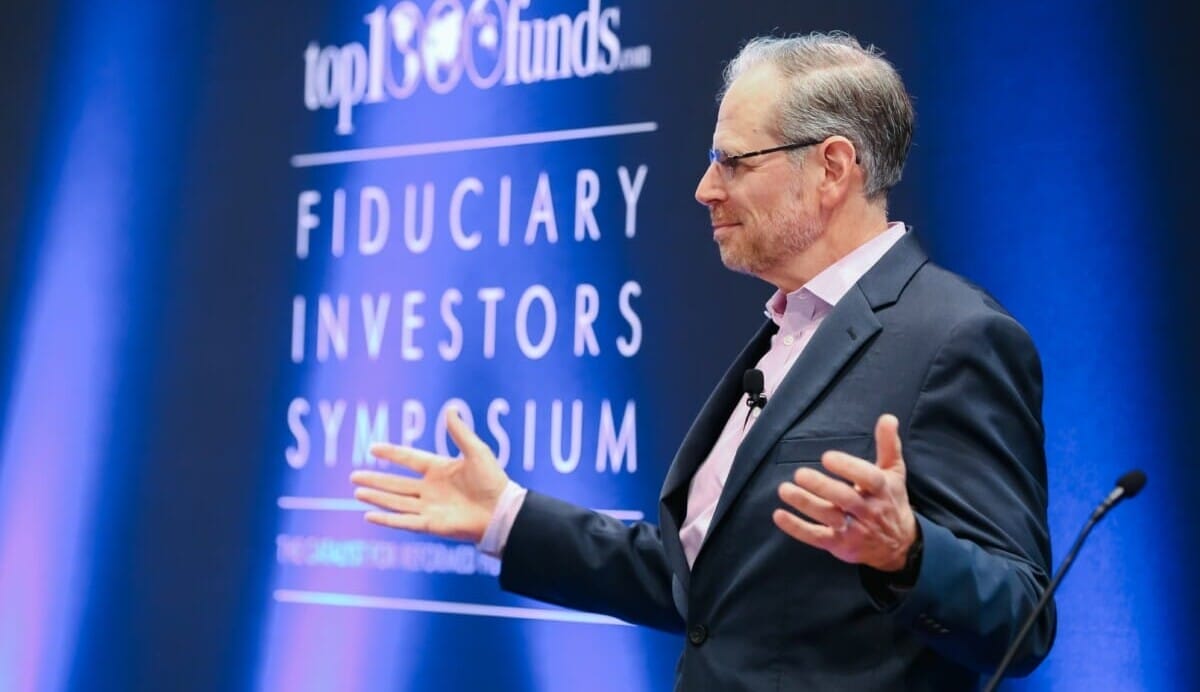

The global economy is running in a “paradigm vacuum” as the classical theories of marginal change, equilibrium and rational markets are breaking down. Amid the void, University of Oxford professor Eric Beinhocker said investors must seek new economic tools that reflect how the world actually works.
Beinhocker, who is professor of public policy practice at Blavatnik School of Government, told the Fiduciary Investors Symposium Oxford that the vacuum occurred when the four notable historical frameworks no longer provided useful directions to solve the current socio-economic challenges.
“We’ve got a little problem that the four main economic paradigms of the last century have all failed,” he said. These were the Laissez-faire capitalism which carried through the Great Depression and the two World Wars; Marxist socialism which dominated a third of the global population until the fall of Berlin Wall; Keynesianism that collapsed with the Bretton Woods system and the 1970s stagflation crisis; and, most recently, neoliberalism, which lost its credibility during the GFC.
“Both nature and politics abhor a vacuum, so into that vacuum of how to think about things and organise our economy and policy has stepped populism and the policy chaos that we’re experiencing today,” he said.
Beinhocker argued that the world is shifting from a “neoliberal consensus” to what he called “market humanism”. The latter put focus on the idea that the current economy focuses on “markets serving people, not people serving markets”.
“The neoliberal consensus was really built on ethical foundations that pleasure through consumption is kind of the purpose of the economy… that selfish individualism is actually a good thing and by pursuing our self-interest and our pleasure, through Adam Smith’s invisible hand, we’re making things better in the world,” he explained.
But a more recent understanding of the way humans acquire satisfaction and happiness demonstrates that these things cannot be achieved through consumption alone.
“We’re now starting to re-found economics on a broader notion of wellbeing, that things like social connections and relationships and mutuality in the system actually matter to people,” Beinhocker said.
“So there’s this shift from a narrow, pleasure-seeking or hedonic view of the economy to a broader, eudaimonic view of what the economy should do for us.”
Central to the idea of market humanism is cooperation – between companies and countries. “What markets do is they create these competitions to push for evolution, for better solutions to human problems, better forms of cooperating, better technologies that also drive progress,” he said.
While the US markets, which have been the prime embodiment of the neoliberal model, outperformed regions such as the UK and Europe that seemingly subscribed more to the market humanist ideology in the past decades, Beinhocker said allocators should focus on what ultimately “creates prosperity and opportunity” in the long run.
“Investors can do well for short periods of time on a very narrow basis – we can make a lot of money on the AI boom right now and the seven stocks,” he said, but adding the fact that 10 per cent of earners are now responsible for 50 per cent of consumer spending in the US “has to set off alarm bells”.
“The headline from this is it’s not greed that is good – cooperation is good. Now, if you buy that [market humanism] story, there’s an important corollary to this, which is what underpins cooperation are fairness, trust and inclusion.
“The scarce resource in the world today isn’t labour, capital or knowledge, it’s trust. I hope you all will invest in trust.”








Leave a Comment
You must be logged in to post a comment.
Login