

Decades of US economic and financial supremacy have made diversification away from it a drag on returns for many investors, but the forces that have underpinned that supremacy may now be coming to an end, according to Maria Vassalou, head of the Pictet Research Institute.
“What we have had, since the end of the Second World War and particularly since the end of the Cold War, is a global financial architecture by which you had the rest of the world producing surpluses that they would ship over to the US, and in exchange the US would provide the rest of the world US dollars to be used as a reference currency and US safe assets in the form of US Treasuries,” Vassalou told the Top1000funds.com Fiduciary Investors Symposium at Harvard.
“A lot of people overlook the importance of safe assets, but they’re a really fundamental cornerstone of the functioning of the global financial system, and in their absence a lot of things collapse.”
The system Vassalou described worked well for the benefit of everyone while the US remained the “undisputable leader in technology and innovation globally”, a position that has provided growth that effectively acts as collateral or a guarantee on the persistent fiscal deficits it has run up.
But now the rise of China as a technology superpower threatens the primacy of the US – and so the growth rates that have been “steady and robust” by Western standards are at risk, along with the sustainability of its debt and the supremacy of its dollar.
“The competition of the US with China is not just an ego-driven competition of who is the best, but is, to a large extent, existential for the US,” Vassalou said.
Over the last three decades, investors haven’t had to diversify very much, according to Nick Chamie, chief strategist at Investment Management Corporation of Ontario. In fact, diversification often hurt when it took them away from the US. But now that US Treasuries might become less effective as diversifiers, investors will have to look further afield.
“We’ve lowered our duration, we’ve started increasing our currency diversification, we’ve started to tinker with our equity benchmarks and think about how we’re going to reduce the very high concentration in the US stock market, because the market cap weights keep driving us more and more into one specific market,” Chamie said.
But there are also a lot more opportunities that look interesting on a risk-adjusted basis than there have been “in the previous 20 or 30 years in the rest of the world”.
“There’s much more fiscal activism going on, all of a sudden there’s more sectors firing up in other countries – there’s a lot more drive to get tech innovation going in [Canada], in Europe, in Asia,” Chamie said.
“The rest of the world had abdicated its technology innovation to the US and allowed Silicon Valley to be the purveyor of technology to the world, and now everybody is asking whether that’s going to be the right security formula for them; people are seeking out technology security, resource security, and that’s causing a lot of countries to focus on increasing investment.”
Todd Mattina, asset and risk allocation chief investment officer and head economist at the State of Wisconsin Investment Board, “completely agrees” with the idea of long-term geopolitical fragmentation and likened the US balance sheet to that of a “hedge fund”.
“Foreign investors would typically buy Treasuries to park their savings and have the safety of US dollar-denominated assets, and American investors would invest internationally in equities, and that helped make the current account deficit and the net negative international investment position sustainable.”
But if Treasuries or the fixed income bucket generally become less effective at diversifying equity risk, that means any asset allocation is “going to be higher risk” at the total fund level, Mattina said.
“All of the options that we’ve been talking about are generally higher-risk assets than the Treasuries we’re trying to replace. That’s a really important consideration. In terms of your asset-liability problem, are you comfortable getting more of that inflation sensitivity, but taking on higher total plan risk, which will increase your volatility from an asset-liability perspective?”
FIS 2026 at Harvard University
China tech rivalry is ‘existential’ for the US – and diversification
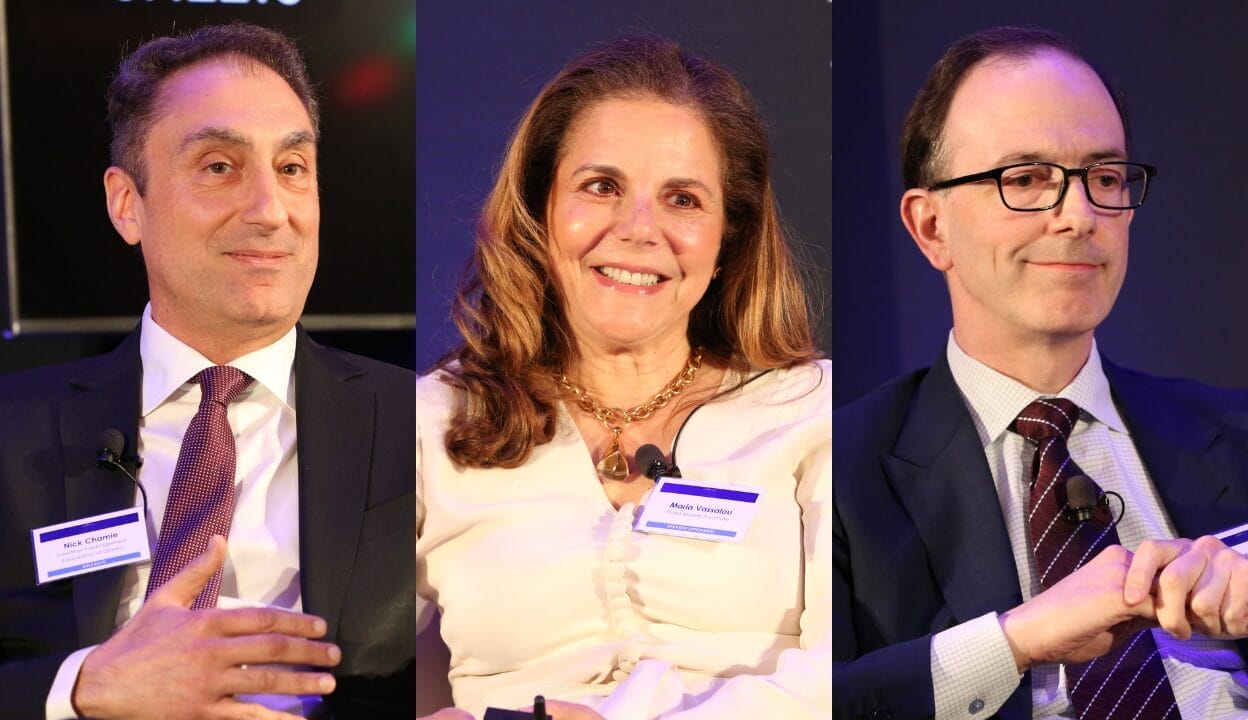
L-R: Nick Chamie, Maria Vassalou and Todd Mattina. Photo: Jack Smith
IMCO, Nick Chamie, SWIB, Todd Mattina
FIS 2026 at Harvard University

Impact investing’s case for scale
Impact investing has come a long way in the past two decades, going from a niche strategy to a $1.5 trillion industry, but there are still challenges for it to reach institutional scale due to the lack of products and insufficient evidence of outperformance in some parts of the market.
Sort content by
Macquarie: Deglobalisation the next inflection point in real assets
Global governments are partnering with private investors to boost their domestic infrastructure and become more self-sufficient in a geopolitically fragmented world, according to Ben Way, global head of Macquarie Asset Management, who said that constrained public balance sheets are increasingly reliant on private capital to meet their infrastructure needs.
Investors put private equity performance under the microscope
Investors are seeking better performance attribution in private markets to better understand underlying return drivers – especially in private equity, where metrics such as IRR or multiples are increasingly criticised for being opaque. HarbourVest made the case for an alternative attribution method at FIS Harvard.
The ‘space economy’ is a legal and literal vacuum for investors
The looming SpaceX IPO has put the spotlight firmly on the so-called ‘space economy’, but asset owners have been urged to exercise caution about investing in a sector that still resembles the wild west, with no legal or governance framework to protect capital. That’s not to say money will not be made, but it might not be in the areas investors first expect.
Photo gallery: Fiduciary Investors Symposium 2026 at Harvard University
mrec4inarticleinline Sponsored Content scnative1 scnative2 scnative3
The twin forces rewriting the rules of investing
Portfolios built for the old world will be severely tested as emerging forces rewrite the rules of investing. The Fiduciary Investors Symposium heard that geopolitical and macroeconomic upheaval, together with the disruption wrought by AI, should force asset owners to rethink the structure and composition of portfolios.
CPP outlines risk playbook for a new world order
The $570 billion CPP Investments is strengthening efforts around scenario analysis as volatile fiscal, geopolitical and economic risk factors plunge the macro environment into a state of flux, with the fund naming four scenarios for the future world order within its risk management framework.







Leave a Comment
You must be logged in to post a comment.
Login