
Post-Liberation Day regime will attack portfolio weaknesses: Bridgewater

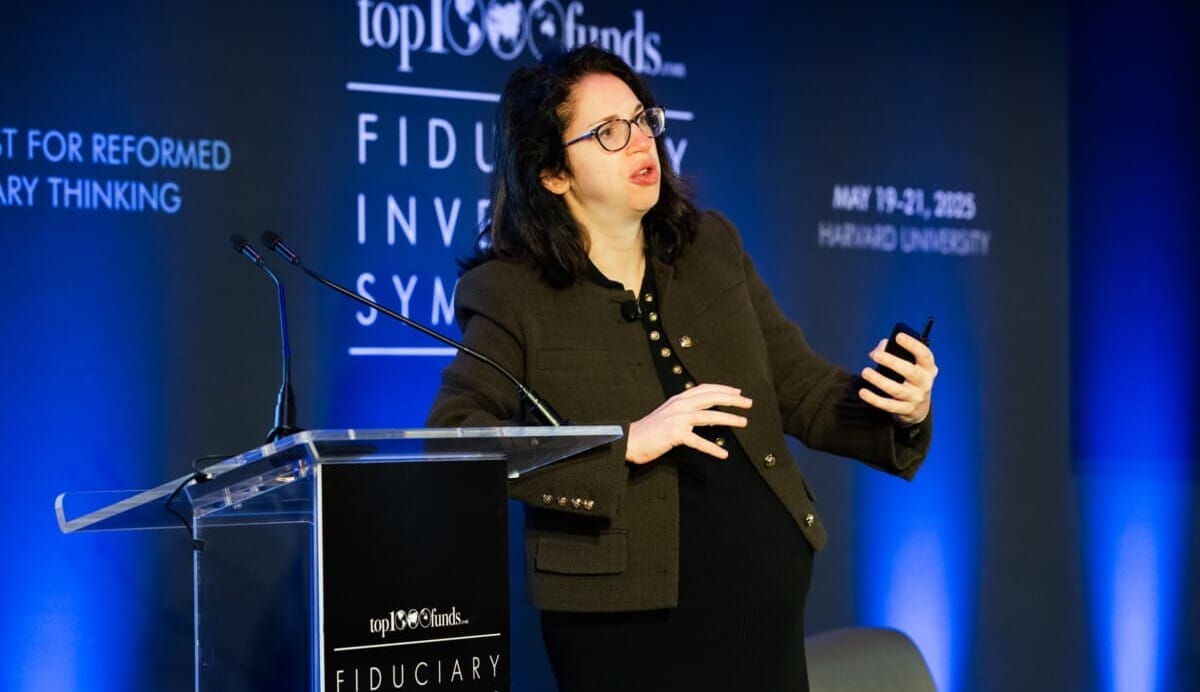
Karen Karniol-Tambour. Photo: Jack Smith

Bridgewater Associates co-chief investment officer Karen Karniol-Tambour warned that many investors have built up significant vulnerabilities in their portfolios over the past 15 years, which is a period defined by steady growth and US market exceptionalism.

However, the Liberation Day tariffs and resulting market action exemplified how the world is shifting to a new economic paradigm that is much less favourable for traditional portfolios, and investors who fail to address these vulnerabilities face significant risks.

The shift is caused by what Bridgewater calls a pivot to “modern mercantilism” where countries treat the accumulation of national wealth, pursuit of geopolitical strength and economic self-sufficiency as priorities.

“This shift is a very direct threat to what a lot of people hold,” Karniol-Tambour told the Top1000funds.com Fiduciary Investors Symposium at Harvard University.

Specifically, a lot of portfolios aren’t well-equipped to handle weak growth, tightening liquidity from the Federal Reserve, an equity bear market or US stocks underperforming the rest of the world.

While these vulnerabilities existed 15 years ago, investors are a lot more sensitive to them now, with huge US concentration in their portfolios and coming out of a strong equities bull market run. “Naturally, people invest with market cap and so whatever the winners are, you end up holding more and more of them,” Karniol-Tambour said.

Sponsored Content

“But the environment we’re in today very directly goes at these vulnerabilities and puts them in the limelight for us to stare at and think, how resilient am I to these vulnerabilities going forward?”

US companies are more exposed to risks created by the Trump administration’s volatile trade policies than the direct impact of tariffs would suggest, and the fact that a lot of US corporates are global companies makes them “uniquely vulnerable” in many ways, she said.

“We’re seeing countries get very sophisticated about how to target US companies specifically; how to specifically deal with their market access; how to specifically reduce buying US goods; and how to go after antitrust against these companies.”

This is combined with the fact that negative impacts tend to be more outsized on US equity market earnings compared to positive impacts. According to Bridgewater’s modelling, US-imposed tariffs and retaliation from other countries are likely to be a downward pressure on US earnings that won’t be offset by reshoring and a lower corporate tax.

The beginning of the second Trump administration has also caused the unravelling of the US’ relationships with allies and prompted them to quickly reassess their reliance and investment exposure to the world’s largest economy.

“I think it is somewhat underappreciated by policymakers, at least, how much the flip side of the trade deficit is – of course, the fact that so much capital is coming into the United States,” Karniol-Tambour said.

With the dependence of US dollar and assets on foreign inflows, even just a slowdown in foreign purchases could turn into huge risks to US market performance and currency.

“We’re starting at a point where 80 cents, 90 cents on the dollar that cross any border around the world are coming into the United States, just because of the high market cap and liquidity,” she said.

“All it takes is some reassessment [of US allocation]… to get US underperformance, to get a dollar issue.

“I think we’re in the early stages of that, given how long it takes for governments to shift, for places to reassess and for that money to actually move.”

For asset owners who are looking to address their portfolio vulnerabilities, now is the time to consider the toolkit available. For one, Karniol-Tambour said investors need to “treat the geographical diversification question as urgent”, looking at places like Asia.

“You could take out China with all of its own geopolitical and governance issues, and still say that there’s a lot of places around the world that look a lot less like the United States, and have a lot more of their own drum beating to determine what will happen there, where investors are radically under allocated,” she said.

Other measures worth considering include revisiting the currency hedging position, focusing on maintaining liquidity, and building a portfolio resilient to different economic scenarios.

“The biggest takeaway I have from just the broad shift we’re in in the world, is that when things change, almost inevitably everyone is set up to the world that used to be,” she said.

“And people set up more nimbly, able to take advantage of the world as it is and the changes in it, end up doing better when the world looks different than it used to.”

Leave a Comment

Behind Norges’ search for pure alpha

Behind Norges’ search for pure alpha

Despite uncertainties, Norges Bank is tipping that the US stock market will continue to outperform Europe in the next two decades. The mammoth fund also explained how it carved out a $90 billion pure alpha portfolio from passive investments, overseen only by 8 portfolio managers.

Sort content by

Investors reflect on whether active managers can escape the Magnificent 7

Active managers has been under stress for several years due to lukewarm performance commonly attributed to the rise and rise of large cap technology stocks and passive investing. However, investors at the Top1000funds.com Fiduciary Investors Symposium concluded that the root cause of that stress might be more complicated.

Path to net zero requires honest dialogue about sustainable investing

Leading institutional investors at the Fiduciary Investors Symposium at Harvard said the industry could benefit from having a franker conversation about sustainable investments, both in terms of what climate goals are achievable on the path to net zero and what is behind the pushback on ESG funds.  

CPPIB spots accelerating change, alpha opportunities in healthcare

Technology is reshaping the healthcare sector, creating opportunities that investors “never imagined” as companies apply robotics and AI to new and established treatments.

TPA: Unlocking alpha through enhanced liquidity management

Stronger liquidity management through a total portfolio approach (TPA) can do more than manage real-time risk exposures – it can also help generate alpha, according to panellists at the Fiduciary Investors Symposium at Harvard University. 

AI the ‘most consequential’ trend for infra investors despite scepticism

AI is “the most consequential megatrend” for infrastructure investors with opportunities not only around data centres, but also energy and fibre networks by extension. But despite the bullishness, some asset owners are wondering when – or if – AI will deliver a miraculous productivity gain and benefit the underlying infrastructure.

European capital markets reform could unlock trillions in investment

Co-president of Apollo's asset management arm, John Zito, said reforms to European capital markets could unlock trillions of dollars worth of investment opportunities as investors seek alternatives to the US market, and Germany and France are key to leading the region's growth narrative.