
Emerging economies: Rich opportunities

Investment opportunities in emerging markets include high yields on local government debt and cheap currencies, while China’s Renminbi has proven its resilience and is now considered a safe asset currency according to chief economist at Pictet Asset Management, Patrick Zweifel.

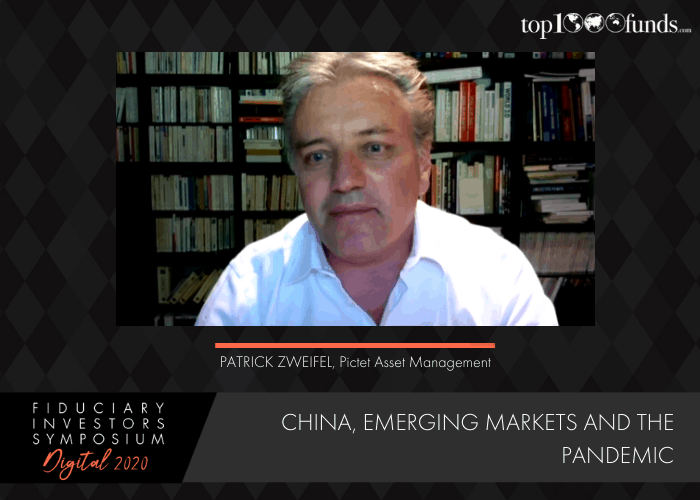
Contrary to the idea that COVID-19 will hit emerging economies most, many developing countries particularly in Asia and eastern Europe have successfully managed the crisis, said Patrick Zweifel, chief economist at Pictet Asset Management.

Speaking at FIS2020 Digital, Zweifel said that some emerging economies managed to source healthcare equipment and instil societal discipline around lockdowns better than the US and Europe. However, reminding investors to not view emerging markets as a single asset class, he said India and countries in Latin American are struggling with the outbreak.

Zweifel said that GDP levels in some emerging markets look more favourable than growth levels in developed countries. This is partly attributable to larger service sectors in developed countries, particularly hard hit by COVID-19. In what he called an “attractive story” for investors, emerging markets are also improving on key indicators around governance, economic diversity and improved debt levels, he said.

Other factors are also at play regarding emerging markets’ ability to outperform: a weaker US dollar, Chinese growth and a spike in commodity prices.

“Commodity prices will rise if the first two conditions are met,” he said.

Sponsored Content

As for growth in global trade which particularly impacts emerging markets, he said “the worst is behind us.” Trade data shows flows reached a low in April, but May figures show stabilisation. For example, Brazil’s exports recently got a boost from Chinese demand.

Zweifel said that emerging economies have struck an appropriate fiscal response between necessity and affordability. Highly indebted countries have mostly refrained from over-spending, he said. He noted how for the first time in history nine emerging countries have adopted quantitative easing. Meanwhile, many emerging economies will continue to attract inflows as investors search for yield. Apart from risky Italian debt, it is hard to find positive real yields in developed markets, he said.


Currency opportunity

Along with high yields, cheap currencies will also draw investors to emerging markets where he believes many currencies are undervalued.

Regarding the Renminbi, he said the currency has “been through the crisis and shown resilience” making it “a safe asset currency.” Moreover, he said the Renminbi has become more influential in Asia, supporting other Asian currencies and commodity exporting countries.

This gives China the “elasticity” to build monetary zones or a currency bloc, he said, predicting the Chinese currency will position “more internationally.”

One factor that could influence the Renminbi’s rise is other emerging countries’ perception of China. Here he believes that in contrast to developed markets, most emerging markets have a positive view of China.

“Ultimately the economic fundamentals will prevail, and it is a hard trend to stop,” he said.

Negative sentiment towards China is particularly fuelled by China’s human rights record and transparency. However, countries that benefit from an economic relationship with China are less mindful of these issues.

In contrast, countries which compete with Chinese products like South Korea have a negative view, he concluded.

Leave a Comment

Florida: Opportunities in a crisis

Florida: Opportunities in a crisis

The Florida State Board of Administration has made some strategic moves to take advantage of opportunities in the dislocation, including in private equity, distressed debt and active listed equities.. But CIO, Ash Williams, is concerned about the underlying real economy.

Sort content by

America, China and Donald Trump

As trade wars between the US and China dominate financial markets, Princeton historian Stephen Kotkin has assured pension funds that the world order that has been in place since World War II remains intact.

Understanding US/China relations

Understanding the fractious relationship between US and China is more important– and simultaneously more confronting – than it has been in the past, according to Stephen Kotkin, professor of history and international affairs at Princeton University. While the China investment challenge has always been to capture the aspirational middleclass, the high-profile historian says “the big money that’s going to be made in China is going to be made from the dislocation”.

What can the past teach us?

Institutional investors' investment strategy should be serving the China middle class and the dislocation from within Asia, according to Stephen Kotkin,Professor of History and International Affairs at Princeton University speaking at the Fiduciary Investors Symposium at Cambridge University. He explored what the geopolitical conflicts of the past can teach us about the future. He looked at some of the key points in history, how China, the European Union and the US have survived, and what it means for the future.

A ‘Sputnik Moment’ with China?

Whither United States-China? Stephen Kotkin, Professor in History and International Affairs at Princeton University and adviser to conexust1f.flywheelstaging.com, discusses the changing nature of the complex relationship between the US and China and the struggle underway as these two large economies find their positions in the economic and technological hierarchy. So what should investors watch for?

Taiwan epicentre of geopolitical risk

The China-US trade war is the latest development in a tense relationship that threatens to bubble over into war over Taiwan, “incinerating” portfolios, Stephen Kotkin said.

Kotkin weighs in on geopolitical risks

Global tensions are an important consideration in decision-making. At a recent roundtable, geopolitical expert professor Stephen Kotkin discussed the risks related to China and the US.

Previous