
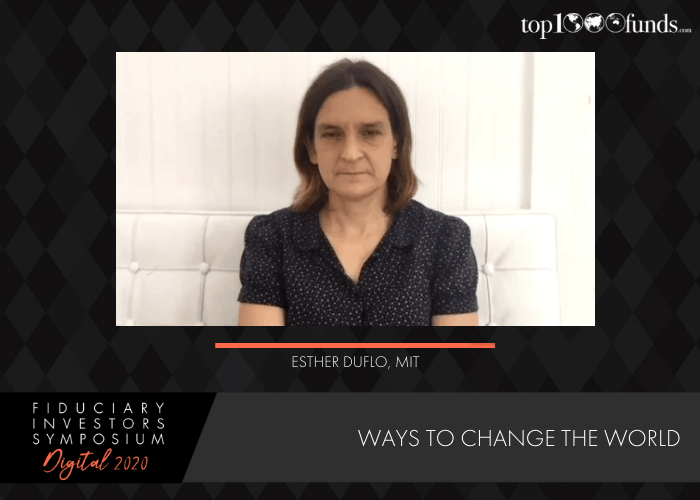

Nobel prize winner Esther Duflo suggests institutional investors can help alleviate poverty by fostering new supply chains and looking beyond a country’s credit rating.
For institutional investors that are unsure how to play a direct role in helping alleviate poverty exacerbated by COVID-19, Esther Duflo, Professor of Poverty Alleviation and Development Economics at the Massachusetts Institute of Technology (MIT) and current winner of the Nobel Prize in Economics, has a few ideas.
Speaking at FIS 2020 Digital, Duflo urged investors to think “carefully” about country credit risk, “reading” and “processing” credit ratings to ensure that countries trying to help their populations during the pandemic are not “punished” by high external borrowing costs. India’s pledge to spend 10 per cent of its GDP on a pandemic recovery plan has been mired by credit agencies cutting its country rating to a notch above junk in early June, increasing borrowing costs and making lenders wary.
Duflo said that although poverty reduction has progressed in recent decades, the pandemic means fewer people will now escape poverty. The poor are particularly vulnerable because poor countries can’t protect their citizens to the same degree; have no social protection systems and will suffer from the slow-down in production.
“They have much less scope to weather uncertainty,” she said.
COVID-19 hasn’t just increased poverty in poor countries. Inequality has been growing in the US for decades with the top 1 per cent of the population owning a larger and larger share of the national income while wages of the bottom 50 per cent remain stable.
“The pandemic has put the spotlight on the consequences of this,” she said, adding that some racial groups are much more likely to get sick – and die if they are sick – because of deep inequalities in treatment. There is an “unacceptable” level of poverty amongst Africa Americans and Latinos who are keeping the US economy going but dying for it, she said.
Globalisation
Institutional investors can also play a role in helping poor countries by encouraging a shift in supply chains. The idea that poor countries benefit from globalisation because they have an abundance of labour is pervasive, yet a closer look at the data questions the assumption that globalisation has been good for the poor. Although poverty has fallen in China and India as a result of integration with the global economy, inequality in these countries has also risen.
Moreover, many countries struggle to benefit from globalisation. For example, countries producing labour intensive goods are squeezed out by the dominance of China. It will take countries like Ethiopia or Kenya a long time to build new production hubs, not because they don’t have the ability, but because they don’t have the reputation, she said.
But the pandemic could trigger a positive shift. Companies are realising that it is risky to source all their production from one country, more so a particular town.
“What we realise is that we need to spread the global supply chain across more countries, and this could be an opportunity for developing countries,” she said.
However, it won’t happen without a collective effort by governments and trade associations.
“It is not in the interest of firms to do it – they want to work with their trusted provider. But it is in the interests of the entire sector.”
The costs, and a steep learning curve, make companies reluctant to move their supply chains. Every new country and relationship with a producer is a risk because “there is a chance it won’t work out,” more so if there is no track record of production in that country.
Duflo told investor delegates that they had an incentive to encourage diversification. They could either look for potential investee companies in new producing countries, or support efforts by large firms in importing countries to look for new partners. Currently, much of this type of matchmaking is done by not-for-profits supported by governments. Building new relationships and financing new production hubs needs to be long-term and patient. Here she suggested collective groups, acting on behalf of an industry, could raise bonds to finance new supply chains for the whole membership.
Duflo said that the reduction of poverty is a success story and that amidst today’s challenges progress on poverty is a “bright spot.” She also said that much of the alleviation has been achieved by developing countries own economic management.
Finally, she advised institutional investors to consider social impact in their investments, urging them to “exercise scrutiny” and “follow the evidence” to assess the social value of an investment.
To listen to the Fiduciary Investors Series podcast interview with Esther Duflo, click here.









Leave a Comment
You must be logged in to post a comment.
Login