
Asset management’s new purpose

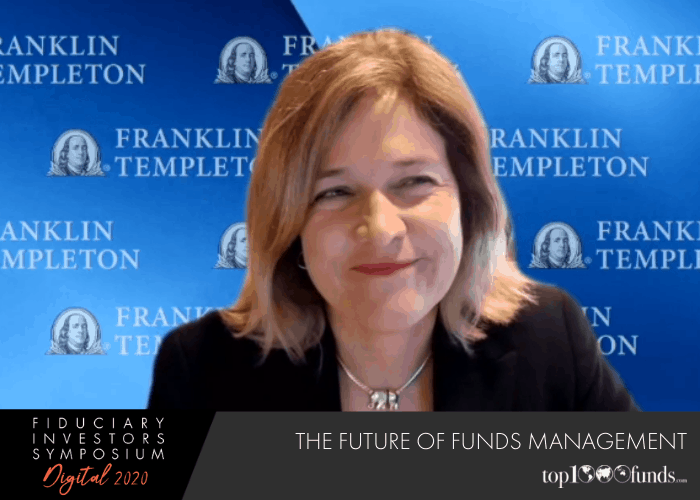
“We didn’t have any sleepless nights,” Jenny Johnson, president and chief executive of Franklin Templeton told FIS 2020 Digital delegates, reflecting on one of the largest purchases in asset management history on the eve of the pandemic in February.

“We are long-term, and the reasons we did the acquisition still remain today.”

Franklin Templeton’s cash purchase of rival Legg Mason was driven by the need to fill product gaps and move more into the alternatives space, as well as diversify the active manager’s client base, she said. Now the focus will be on investing in AI, data and fintech across asset classes which account for a combined $1.5 trillion.

“We still have lots of cash to invest in the business,” she said.

The merger will help the two firms navigate trends in the asset management industry including downward pressure on fees and more customisation, said Johnson.

Sponsored Content

She said institutional partners increasingly seek thought leadership, and that active managers like Franklin Templeton are increasingly responding to institutional client demand for data analytics.

For example, the firm’s global macro team has built an ESG data platform bringing together ESG data feeds from 17 different sources to support investment research, she said. Active managers will be able to take advantage of the market dislocation caused by COVID-19, Johnson continued, although she flagged that government intervention has reduced the level of dislocation, making it “more difficult” in the short-run.

She also said that the asset management industry will have to adapt to employees working from home. A new flexibility will see firms support employees who want to work from home and that employees may only come together “some days of the week”.

Elsewhere, she noted how distribution and sales teams will travel less because of digital communication. Active managers have always worried how often their portfolio managers visit clients because it takes away from research, she said. Now, COVID-19 will result in less travel and more efficiency. She also said that ESG investment would see more of a focus on the integrations of social factors.

Reflecting on growing racial tension in the US and the recent high profile firing of a senior Franklin Templeton employee for racism, Johnson said “she’d learnt a lot in the last couple of weeks”. She said that equality is not only the right approach but diversity is proven to produce better outcomes. She also said that it was “a good thing” firms and individuals are increasingly accountable for their behaviour.

However, asset managers need to do more, particularly in boosting diversity and inclusion in the underlying companies they own. She said most black-run businesses and female entrepreneurs struggle to attract venture capital, and that the industry needed to do more to ensure capital is available to these groups. Everyone has a fiduciary responsibility to make sure they are getting returns, but she urged investors to “change the lens” on how they view investments to enable capital to flow to these groups.

Johnson also reflected on a new purpose in asset management.

“What we do every day really matters,” she said, referencing the in-depth research carried out by Franklin Templeton’s biotech team into companies developing a COVID-19 vaccine. She said although Wall Street is viewed as “greedy,” people working in asset management do care. She also urged a keen focus on helping pension funds that are underfunded.

“For us it is just staying focused on what is important,” she concluded.

Leave a Comment

Florida: Opportunities in a crisis

Florida: Opportunities in a crisis

The Florida State Board of Administration has made some strategic moves to take advantage of opportunities in the dislocation, including in private equity, distressed debt and active listed equities.. But CIO, Ash Williams, is concerned about the underlying real economy.

Sort content by

Asset owners adapt and respond to COVID

The Responsible Asset Allocator Initiative finds that 25 leading public pension and sovereign wealth funds, with assets of $6 trillion, are investing tens of billions of dollars in COVID-19 solutions and in funds to support stricken companies. Here they look at what the leading asset allocators around the world are doing to respond to the pandemic.

Investors outline actions for resilience

Global economic activities will not be back to pre-COVID levels until 2022 according to CPP Investments’ outlook, with the giant Canadian investor expecting the situation to get worse before it gets better.

Five lessons from the COVID-19 crisis

The coronavirus pandemic sparked a surge of volatility across global financial markets. In this paper, MSCI looks at five key lessons for investors from the crisis, including that managing factors was more critical than picking stocks.

COVID-19 impact far from over

New research looking at the impact of COVID-19 under different scenarios – from opening of economies to no vaccine – suggests the economic consequences of COVID-19 under all scenarios is substantial and the ongoing economic adjustment is far from over.

IMCO uses nimbleness to advantage

Meticulous planning for the next market crash, and an eye on liquidity, meant IMCO was well positioned to invest, particularly in credit, when the opportunity arose. The fund continues to use its agility to its advantage and is now looking for opportunities in private markets.

Alternative data as a market predictor

It is critical to analyse how much COVID-19 could impact the US economy and stock markets but most of the traditional factors or economic indicators will lag the market movement. Therefore, alternative datasets other than the financial data show their explanation power to provide insights into the pandemic. This article, by academics at Tsinghua University, University of Illinois and Carnegie Mellon University, looks at the pattern of the market fluctuation from the perspective of alternative data.