
The ingredients for success in private credit

Investing in private credit brings income and supports capital preservation, but as more investors enter the asset class, competition for assets is set to heat up.Investors from South Carolina Retirement Systems Investment Commission, Investment Management Corporation of Ontario and Ohio School Employees Retirement System explain their approaches.

In recent years, the private credit allocation at South Carolina’s SC Retirement Systems Investment Commission has pivoted from targeting absolute returns to mid-market direct lending. The allocation was initially set up to invest in distressed opportunities coming out of the GFC, said Michael Hitchcock, executive director at the pension fund who told FIS Chicago attendees the allocation brings income and capital preservation in opportunities primarily accessed via SMAs with investment managers.

Hitchcock also explained how the allocation sits within South Carolina’s recently streamlined portfolio. Two years ago, South Carolina reduced its level of diversification when analysis questioned the efficacy of 21 different benchmarks and 18 different asset classes – now reduced to five. These five asset classes are categorized based on either ‘persistent of outperformance’ (private credit sits here) or ‘magnitude of return.’

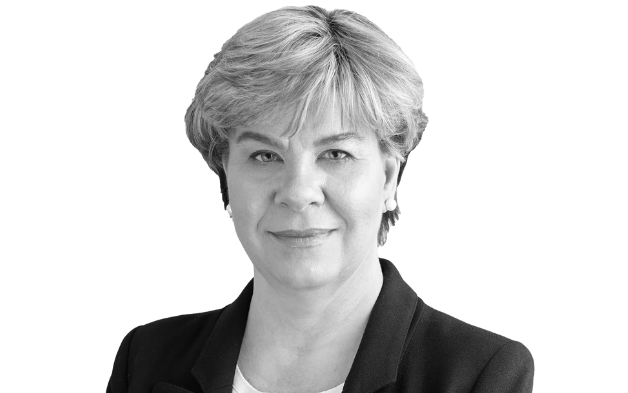
At IMCO, the asset manager for public sector pensions in Ontario, private credit tends to deliver alpha while public credit typically provides liquidity and a useful signal on the private market, said Jennifer Hartviksen, managing director, global credit at IMCO. Hartviksen (pictured) who joined IMCO in 2020 to build out the global credit allocation, said her remit spans public and private credit markets, emerging market credit, levered loans, CLOs, and allocations to tactical solutions. IMCO allocates to external managers but is also building its internal capabilities.

Farouki Majeed, chief investment officer of the Ohio School Employees Retirement System, explained how he looks at investment through different prisms – one of which is shaped around the returns the fund needs to help close its deficit. Private credit yields around 7 per cent, a crucial solution to part of the problem, he explained.

The quest to invest in line with the fund’s objectives led Majeed to drop hedge funds from the portfolio when he first took the CIO helm. “Hedge funds didn’t help solve the problem of managing the fund to our objectives,” he said. A gap filled by the private credit allocation, grown from 0-5 per cent over the last eight years. The allocation begun life as an exploratory, opportunistic investment outside SAA targets.

Sponsored Content

Majeed said that one of Ohio’s advantages is that the private credit allocation is not too big, adding that size may impede big entrants now coming into the market seeking to deploy large amounts. “We can be nimble and target certain areas,” he said.

Defaults

For now, Ohio’s focus is on mid-market lending targeting direct corporate solutions and capital restructuring. The fund doesn’t invest in sponsor-backed private credit but does invest in a few distressed opportunities mostly via direct, controlled leverage with tight covenants. Ohio doesn’t get into leverage at fund level but controls it at an individual portfolio company level.  He noted how the history of defaults in private credit is very low, and many investments restructure and recover.

Hartviksen advised investors to conduct due diligence on managers’ historical track record regarding losses and recovery.

“Recoveries from private credit are high,” she said.

She added that resilient portfolios are diversified within corporate segments to avoid challenges in one sector. For example  direct lending to restaurants during the pandemic proved fraught with risk. Due diligence should include what managers own and how diversified they are, she said.

Hitchcock said SMAs allow investors to look through into the portfolio, contributing to due diligence. He added that floating rate financing acts as an inflation hedge, but warned that the cost of leverage is also going up, offsetting that protection. Elsewhere panellists explained that the macro environment is pushing some investors to diversify their allocation into private infrastructure and real estate credit which has a lower correlation and different cycle.

Ohio targets managers with deep lending, restructuring and recovery experience over cycles. He noted that middle market opportunities are not typically large transactions that could blow up a portfolio and explained how private credit can offer an alternative to private equity. For example, the asking price is often too high for equity – investors don’t want to pay that much to get into private equity. By offering debt, companies can tap liquidity and investors a healthy return. Elsewhere, he noted the importance of quarterly dispersions. “A 7 per cent yield is a pretty decent steady stream of quarterly cash flows.”

Ahead

Panellists reiterated that the primary purpose of the allocation is yield and that all private credit investors’ primary concern should be getting paid back over time and guarding against the risk of a default. Reflecting on the next cycle, panellists warned that the market hasn’t gone through a credit cycle without central bank support. They flagged opportunities most likely would be accessed through smaller, more focused groups with strategic partners with look throughs in tightly held solutions.

Hitchcock advised on the importance of keeping investment as simple as possible despite the complexity of the asset class. He concluded that investment relied on great teams with credit experience, good processes, and procedures.


Leave a Comment

Long term lens shields Colorado from private credit jitters

Long term lens shields Colorado from private credit jitters

As concerns in private credit mount, Colorado PERA CIO and COO Amy McGarrity says the pension fund isn’t seeing any strains in its growing allocation to the asset class, arguing that long-term investors are shielded from the risks because they can lock up their capital to weather market cycles.

Sort content by

GPIF feels equity’s wrath; active equity reboot

Japan's GPIF feels the heat of see-sawing global equity markets in its latest quarterly results while the latest annual review reveals a shakeup in global active equity allocations in search of more manager diversification.

San Bernardino tilts to US equity; informed rebalancing reaps rewards

San Bernardino County Employees’ Retirement Association, SBCERA, plans to increase its exposure to US equity in preparation for de-globalization trends. Sarah Rundell talks to CIO, Donald Pierce about asset allocation and the fund’s ‘informed rebalancing’ program.

Beyond traditional asset allocation

Today’s challenging climate has led diversified investors like GIC, Singapore's sovereign wealth fund, to explore different approaches to portfolio construction to build resilience. Grace Qiu and Ding Li, both senior vice presidents in total portfolio policy and allocation at GIC discuss their new research.

Investors prioritise governance, tilts and liquidity

In a wide-ranging session at the Fiduciary Investors Symposium at Chicago Booth School of Business investment executives from HOOPP, CalSTRS, USS and Cbus reflect on the need for strong governance in the current climate, diversification and liquidity.

Bridgewater advises downside protection as turning point appears

Investors should shape strategies that protect against the downside, said Jeff Gardner, senior portfolio strategist, Bridgewater Associates.  Speaking at the Fiduciary Investors Symposium at the Chicago Booth School of Business, he said that investors should prioritise protecting against losses in the current environment: increasing returns can be additive to long-term wealth, but missing the big

The sudden death and strange afterlife of globalisation

Daniel Celeghin, managing partner at INEFI, argues globalisation is not dead but has morphed so that post-2022 globalisation is a series of deeply rooted local investments that together result in a global portfolio.

Previous



