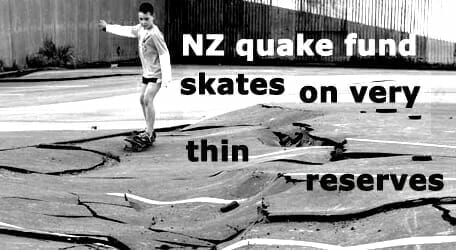

NZ quake fund skates on very thin reserves

New Zealand’s earthquake disaster relief fund could be completely drained following the fatal 6.3 quake that flattened large swathes of central Christchurch on February 22.

The Earthquake Commission (EQC) was already releasing about NZ$1.5 billion ($1.1 billion) of the $4.4 billion disaster fund to pay for claims generated by the 7.1 quake that caused widespread destruction in Christchurch last September.

The latest New Zealand government accounts to the end of January this year show the EQC had budgeted for insurance claims amounting to just over $1.78 billion from the September event.

While the fund itself must meet the first $1.1 billion in claims it had reinsurance in place up to a further $1.85 billion.

The EQC covers residential homeowners up to a value of $74,000 per claim. Owners who had been paid out after the September quake would be able to claim again if their homes sustained fresh damage following the latest catastrophe.

According to latest government estimates, about 10,000 Christchurch homes would have to be demolished while a further 100,000 required some level of repair as a result of the February earthquake.

Sponsored Content

If the latest round of claims exceeded $2.95 billion ($1.1 billion from the fund plus $1.85 billion from reinsurers), the EQC would have to dip into its remaining capital, which would amount to about $2.22 billion of New Zealand fixed-interest investments.

Last year Phil Jacques, EQC chief financial officer, told Top1000Funds’ sister publication, I&T News, the fund would first sell-down its $1.26 billion global equities portfolio to meet claims.

While EQC would not comment, it is understood the global equities sell-down had almost been completed. AXA’s annual accounts to the end of December last year, for example, reveal the EQC redeemed its $237.3 million global equities mandate with AllianceBernstein to cover costs incurred by the September earthquake.

The EQC also had global equity mandates with State Street Global Advisors, Tweedy Browne, T. Rowe Price and Capital International.

The remaining 70 per cent of the EQC portfolio was chiefly invested in a range of New Zealand government securities, including about 20 per cent in inflation-linked bonds.

Russell acts as investment adviser to the EQC fund.

EQC collects about $66.6 million in levies each year but New Zealand Prime Minister, John Key, said that figure could triple next year to replenish the disaster fund.

One response to “NZ quake fund skates on very thin reserves”

  1. Investor need to understand the risk of investing in infrastructure fund.

Leave a Comment

Sort content by

Complexity: thinking ahead

Complexity is, well complex. And as trite as that sounds, it’s something investors, even professional investors, don’t understand well enough, according to Tim Hodgson, head of the Thinking Ahead Group at Towers Watson. The Thinking Ahead Group (TAG), as has been reported here before, gets paid to think – a gig conexust1f.flywheelstaging.com is envious of.

Study finds greenness equals performance

There is a positive correlation between the investment performance of REITs and the “greenness” of their portfolio holdings, according to a new paper by Maastricht University’s Piet Eichholtz, Nils Kok and Erkan Yonder. The paper – Portfolio greenness and the financial performance of REITs – finds that investment performance of REITs is positively related to

Benchmarking ESG changes behaviour

The power of benchmarking funds on sustainability is demonstrated by the fact 171 property companies and funds surveyed in the 2012 GRESB benchmarking report reduced GHG emissions by 6 per cent – this is a reduction of 432,000 metric tons of CO2, the equivalent of removing 85,000 cars from the road. The Global Real Estate

Taking RI from in-house to front of mind

The industry needs to be better at thinking how responsible investing can be accessed by smaller funds or those lacking sufficient internal resources, David Russell, co-head of responsible investment at the UK’s Universities Superannuation Scheme, says. Russell, who will join a panel at the Fiduciary Investors Symposium in Santa Monica produced by Conexus Financial, publisher

In-house not for
every house: WSIB

While the trend for most large institutional investors is to insource asset management, the $85-billion Washington State Investment Board (WSIB) has decided to take a different path. Much-cited CEM Benchmarking research shows that funds with internal-management platforms are better performers after cost, and this is largely driven by the lower costs of internal management. Many

Three-way shift in investor behaviour

There are three major behavioural shifts occurring among investors that will have significant impact on asset allocation in the next 10 years, according to a year-long study by global head of research at State Street’s Center for Applied Research, Suzanne Duncan. An increase in investor sophistication, re-evaluation of the risk/return trade-off and more discernment over

Previous




