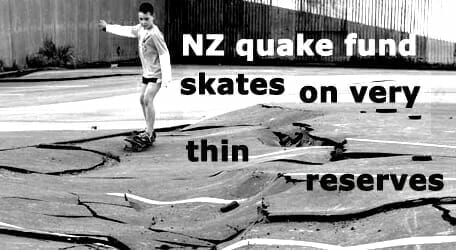

NZ quake fund skates on very thin reserves

New Zealand’s earthquake disaster relief fund could be completely drained following the fatal 6.3 quake that flattened large swathes of central Christchurch on February 22.

The Earthquake Commission (EQC) was already releasing about NZ$1.5 billion ($1.1 billion) of the $4.4 billion disaster fund to pay for claims generated by the 7.1 quake that caused widespread destruction in Christchurch last September.

The latest New Zealand government accounts to the end of January this year show the EQC had budgeted for insurance claims amounting to just over $1.78 billion from the September event.

While the fund itself must meet the first $1.1 billion in claims it had reinsurance in place up to a further $1.85 billion.

The EQC covers residential homeowners up to a value of $74,000 per claim. Owners who had been paid out after the September quake would be able to claim again if their homes sustained fresh damage following the latest catastrophe.

According to latest government estimates, about 10,000 Christchurch homes would have to be demolished while a further 100,000 required some level of repair as a result of the February earthquake.

Sponsored Content

If the latest round of claims exceeded $2.95 billion ($1.1 billion from the fund plus $1.85 billion from reinsurers), the EQC would have to dip into its remaining capital, which would amount to about $2.22 billion of New Zealand fixed-interest investments.

Last year Phil Jacques, EQC chief financial officer, told Top1000Funds’ sister publication, I&T News, the fund would first sell-down its $1.26 billion global equities portfolio to meet claims.

While EQC would not comment, it is understood the global equities sell-down had almost been completed. AXA’s annual accounts to the end of December last year, for example, reveal the EQC redeemed its $237.3 million global equities mandate with AllianceBernstein to cover costs incurred by the September earthquake.

The EQC also had global equity mandates with State Street Global Advisors, Tweedy Browne, T. Rowe Price and Capital International.

The remaining 70 per cent of the EQC portfolio was chiefly invested in a range of New Zealand government securities, including about 20 per cent in inflation-linked bonds.

Russell acts as investment adviser to the EQC fund.

EQC collects about $66.6 million in levies each year but New Zealand Prime Minister, John Key, said that figure could triple next year to replenish the disaster fund.

One response to “NZ quake fund skates on very thin reserves”

  1. Investor need to understand the risk of investing in infrastructure fund.

Leave a Comment

Sort content by

Why integrated reporting makes sense: Robert Eccles

Robert Eccles has been trying to change the nature of corporate reporting for more than 20 years. He has been an advocate for supplementing financials with information on non-financial factors that are leading indicators of financial results – such as product development, customer satisfaction and the development of intangible assets. The premise is those companies

Opportunities in Europe

Investors and academics agree that political developments in Greece are important because they may shape how financial markets will respond to future political situations in the Eurozone. But according to Olivier Rousseau, the executive director of the FFR, the French pension reserve fund, there is more hype outside of the Eurozone on the implications of

More evidence big is better in pension funds

A pension fund that has 10 times more assets under management has on average 7.67 basis points lower annual investment costs according to a working paper from authors at De Nederlansche Bank, that explores the relationship between pension fund size and investment costs. Written by Dirk Broeders, Arco van Oord and David Rijsbergen the paper

European investment plan requires public private collaboration

The two largest institutional investors in the Netherlands, PGGM and APG, have responded to the European Commission’s investment plan, urging the commission to call on institutional investors to collaborate on the investment proposal. However they also warn that institutional investors are not just a “subsidising entity” and the Juncker Plan is best executed as a

Why Andrew Ang joined Blackrock

Andrew Ang believes factor investing is a more efficient way to organise a portfolio as it allows liquid and illiquid strategies to be managed across the portfolio. It also has the added benefit of honing managers on value creation. He’s been working with a handful of investors while Professor of Finance at Columbia University on

The power of engagement

It is called the “CalPERS’ Effect” but it could easily be called the asset owner effect, or the institutional investor effect, or the power of engagement effect. Wilshire, which is a consultant to the $300 billion Californian fund CalPERS, has provided an update on its study measuring the effect of engagement on a targeted list of companies called the Focus List.

Previous




