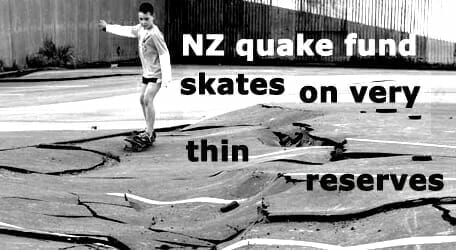

NZ quake fund skates on very thin reserves

New Zealand’s earthquake disaster relief fund could be completely drained following the fatal 6.3 quake that flattened large swathes of central Christchurch on February 22.

The Earthquake Commission (EQC) was already releasing about NZ$1.5 billion ($1.1 billion) of the $4.4 billion disaster fund to pay for claims generated by the 7.1 quake that caused widespread destruction in Christchurch last September.

The latest New Zealand government accounts to the end of January this year show the EQC had budgeted for insurance claims amounting to just over $1.78 billion from the September event.

While the fund itself must meet the first $1.1 billion in claims it had reinsurance in place up to a further $1.85 billion.

The EQC covers residential homeowners up to a value of $74,000 per claim. Owners who had been paid out after the September quake would be able to claim again if their homes sustained fresh damage following the latest catastrophe.

According to latest government estimates, about 10,000 Christchurch homes would have to be demolished while a further 100,000 required some level of repair as a result of the February earthquake.

Sponsored Content

If the latest round of claims exceeded $2.95 billion ($1.1 billion from the fund plus $1.85 billion from reinsurers), the EQC would have to dip into its remaining capital, which would amount to about $2.22 billion of New Zealand fixed-interest investments.

Last year Phil Jacques, EQC chief financial officer, told Top1000Funds’ sister publication, I&T News, the fund would first sell-down its $1.26 billion global equities portfolio to meet claims.

While EQC would not comment, it is understood the global equities sell-down had almost been completed. AXA’s annual accounts to the end of December last year, for example, reveal the EQC redeemed its $237.3 million global equities mandate with AllianceBernstein to cover costs incurred by the September earthquake.

The EQC also had global equity mandates with State Street Global Advisors, Tweedy Browne, T. Rowe Price and Capital International.

The remaining 70 per cent of the EQC portfolio was chiefly invested in a range of New Zealand government securities, including about 20 per cent in inflation-linked bonds.

Russell acts as investment adviser to the EQC fund.

EQC collects about $66.6 million in levies each year but New Zealand Prime Minister, John Key, said that figure could triple next year to replenish the disaster fund.

One response to “NZ quake fund skates on very thin reserves”

  1. Investor need to understand the risk of investing in infrastructure fund.

Leave a Comment

Sort content by

Agent provocateur

Paul Smith, the Hong Kong based chief executive of the Global CFA Society is on an evangelical mission to change the culture within the investment industry. Not only is he looking to curb the frequency of excess behaviour that leaves the public cynical of high paid finance professionals, but he is a persuasive advocate for

Do long-term mandates produce better results?

About 11 years ago, the Towers Watson’s Thinking Ahead Group came up with the concept of investors appointing managers for 10-year mandates. The consulting arm then started talking to clients about it in 2004/05 and the early mandates have now matured. So did it work? Do longer-term mandates produce outperformance, better behaviour and more security?

GRESB infrastructure launch

A new infrastructure sustainability benchmark has been developed by a group of eight institutional investors, alongside GRESB, to enable systematic evaluation and industry benchmarking of the sustainability performance of their infrastructure assets.   Despite large and widespread allocations by Canadian and Australian pension funds to infrastructure, institutional investors globally do not have large allocations to

Frozen by the entanglement of risk

Equity prices in continental Europe and emerging markets, including China, are below fair value, and present an opportunity for investors, but the ‘entanglement of risk’ in current markets is making Brian Singer, partner and head of dynamical allocation strategies team, William Blair cautious. William Blair typically targets around 10 per cent volatility in its portfolios,

Exchanges need to adapt to institutional demands: Norges

Institutional investors now dominate the free float holdings of listed companies and exchanges need to adapt to this enduring change in market structure and investor needs, according to Norges Bank Investment Management, manager of the $818 billion Norwegian sovereign wealth fund. Norges Bank, which itself owns around 1 per cent of the world’s listed stock,

Dalio says Fed should focus on secular forces

The US Federal Reserve is not paying enough attention to secular forces affecting the market, according to chairman and founder of Bridgewater, Ray Dalio, who says the “risks of the world being at or near the end of its long-term debt cycle are significant”. In an opinion piece posted on LinkedIn, The Dangerous Long Bias

Previous




