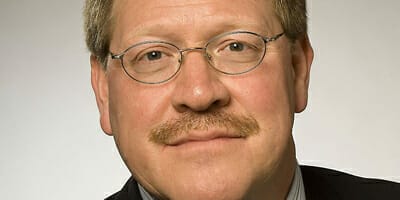

Eijffinger’s decade of financial repression

Financial repression will define the economic landscape for at least another decade, according to professor of financial economics at Tilburg University, Sylvester Eijffinger, which has serious implications for institutional investors.

Eijffinger, who also is also a visiting professor at Harvard, sits on the monetary experts panel of the European Union and is an adviser to the International Monetary Fund, says negative interest rates are the major issue of our time.

Negative real interest rates are here to stay, a realisation that has huge implications for investors.

“Governments have to de-leverage risk in times of low growth and they are not prepared to increase taxes; they have to do it with financial repression,” he says. “As an investor, be prepared. You have to realise that low interest rates are here to stay at the short-end and possibly at the long-end of the yield curve. This has huge implications for investments.”

By way of example, he says the European Central Bank’s policy rate stands at 0.5 per cent, while the eurozone’s annual inflation rate is 2.5 per cent. The Bank of England keeps its policy rate at only 0.5 per cent, despite an inflation rate that hovers above 2 per cent. And, in the United States, where inflation exceeds 2 per cent, the Federal Reserve’s benchmark federal funds rate remains at an historic low of 0 to 0.25 per cent.

This will be the financial and economic environment of the immediate future.

Sponsored Content

He says negative interest rates, which he describes as a kind of wealth tax, are necessary for governments to de-risk, but they come at the expense of savers.

“People who save should be aware that governments need to do this for at least a decade,” he says.

Eijffinger will give a keynote address at the Fiduciary Investors Symposium, an event that brings together institutional investors to examine the power and responsibility of fiduciary investment.

The event, which is convened by Conexus Financial, the publisher of conexust1f.flywheelstaging.com, will be held in Amsterdam from October 20 to 22, 2013. www.fiduciaryinvestor.com

Read an article by Eijffinger on the subject here.


Leave a Comment

Sort content by

Why integrated reporting makes sense: Robert Eccles

Robert Eccles has been trying to change the nature of corporate reporting for more than 20 years. He has been an advocate for supplementing financials with information on non-financial factors that are leading indicators of financial results – such as product development, customer satisfaction and the development of intangible assets. The premise is those companies

Opportunities in Europe

Investors and academics agree that political developments in Greece are important because they may shape how financial markets will respond to future political situations in the Eurozone. But according to Olivier Rousseau, the executive director of the FFR, the French pension reserve fund, there is more hype outside of the Eurozone on the implications of

More evidence big is better in pension funds

A pension fund that has 10 times more assets under management has on average 7.67 basis points lower annual investment costs according to a working paper from authors at De Nederlansche Bank, that explores the relationship between pension fund size and investment costs. Written by Dirk Broeders, Arco van Oord and David Rijsbergen the paper

European investment plan requires public private collaboration

The two largest institutional investors in the Netherlands, PGGM and APG, have responded to the European Commission’s investment plan, urging the commission to call on institutional investors to collaborate on the investment proposal. However they also warn that institutional investors are not just a “subsidising entity” and the Juncker Plan is best executed as a

Why Andrew Ang joined Blackrock

Andrew Ang believes factor investing is a more efficient way to organise a portfolio as it allows liquid and illiquid strategies to be managed across the portfolio. It also has the added benefit of honing managers on value creation. He’s been working with a handful of investors while Professor of Finance at Columbia University on

The power of engagement

It is called the “CalPERS’ Effect” but it could easily be called the asset owner effect, or the institutional investor effect, or the power of engagement effect. Wilshire, which is a consultant to the $300 billion Californian fund CalPERS, has provided an update on its study measuring the effect of engagement on a targeted list of companies called the Focus List.

Previous




