
Emerging market funds need to diversify

Rush hour people movement during Lathmaar Holi Barsana

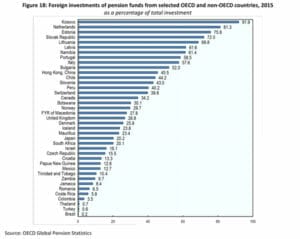
The extremely low levels of foreign investments in pension funds in emerging countries is cause for concern, according to the World Bank, which is calling for more diversification of portfolios.

A new paper by the World Bank, Pension funds capital markets and the power of diversification, outlines the need for pension funds, in emerging markets in particular, to invest more of their assets internationally in order to achieve higher returns with potentially lower volatility.

The paper calls for a deliberate creation of innovative domestic investment vehicles combined with more reasonable overseas investment limits, based on the size of the pension fund assets relative to macroeconomic and market factors.

Some countries, including Brazil, Turkey, Thailand, Colombia, Costa Rica and Romania, have less than 7 per cent of their pension assets in foreign investments.

Brazil has less than 0.2 per cent investing offshore, according to the OECD global pension statistics. This compares to the Netherlands, which has 81 per cent of its pension assets invested outside the country.

Some emerging market countries have restrictions on the amount of foreign investments, notably some African countries and India which have a limit of zero.

Sponsored Content

“There is often much resistance to allowing pension fund assets to invest overseas as governments and authorities wish to see domestic savings used for domestic purposes,” the paper says. “Macroeconomic factors clearly play an important role – including foreign exchange regime, capital flows and policy and availability of foreign currency held by a country’s central bank … however, deciding on the amount and allocation of these international investments should be done in a systematic fashion.”

In particular it says that the amount of foreign investment allowed should be linked to the size of a pension fund’s assets compared to the size and turnover of domestic capital markets or flows, and currency movements.

The paper looks at Chile as an example of a country that has more systematically increased its overseas investment limits, raising them as the pension fund assets have grown and become too large for the domestic market.

The regulatory authorities in Peru have also gradually increased their limits on several asset classes.

The paper also points out that improving governance and management is an important precondition for diversifying these portfolios.



Asset Owner:World Bank

Leave a Comment

GIC, Temasek eye trillions of growth in climate adaptation market

GIC, Temasek eye trillions of growth in climate adaptation market

Singapore’s two largest asset owners, GIC and Temasek, see attractive opportunities in climate adaptation solutions – a relatively underfunded area compared to decarbonisation. The former has already made selective adaptation investments and said the opportunity set across public and private debt and equity could increase to $9 trillion by 2050.

Sort content by

Sovereign Development Funds: designing strategic investment institutions

The hunt for alpha is leading traditional investors toward more innovative strategies and operating models. And, significantly, one potential source of inspiration for long-term investors has come from an unconventional place: the community of sovereign development funds (SDFs). In this paper academics from Stanford University provide readers with analytical frameworks that can assist in the

Capitalising on institutional co-investment platforms

Co-investment is often perceived as referring to institutional investors investing alongside their external asset managers in companies, but increasingly it refers to investment responsibilities being shared among peer investors, as long-term institutional investors are forming co-investment partnerships with the specific objective of deploying capital collaboratively into attractive investment opportunities. These collaborative partnerships seem to be an

State pension funds tilt towards politically-connected stocks

It is well documented that local bias exists in US state pension fund holdings, but now an article in the Journal of Financial Economics (forthcoming) finds evidence not only of local bias, but bias towards politically-connected stocks.  Not only that, but the article finds that political bias is detrimental to fund performance. “Political bias is

The power of knowledge management

Funds management is often discussed in the context of it being part art and part science, however most of the literature centres around the science, the finance, of funds management. The premise of active management is that skills and knowledge are paramount to capturing excess returns above the benchmark. But despite this premise, little is

Worldwide diversity in funded pension plans

There is a huge diversity in pension system design across the globe, reflecting historical, cultural and institutional diversity. There is much to be learned by each of the different systems, so in order to compare the benefits of various systems, two authors from APG in the Netherlands postulate a new classification of four role models

Re-intermediating investment management

In this paper, Ashby Monk and Rajiv Sharma from the Global Projects Center at Stanford University, examine the balance of power among the various parties in the private assets investment food chain. They argue that fund managers have too much power, as do the consultants that act as gatekeepers to those managers. While the authors

Previous




