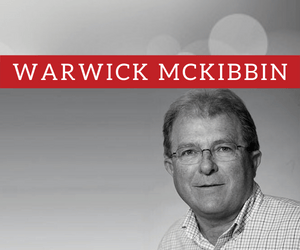

Climate policy key to balancing incoming economic shocks

With US inflation hitting its fastest annual pace in 40 years, the “output gap” method central banks use to forecast inflation, using the difference between potential output and actual output over the projection period, appears to have broken down, says Warwick McKibbin, Professor of Public Policy and Director of the Centre for Applied Macroeconomic Analysis in the Crawford School of Public Policy at the Australian National University.

Dealing with inflation while balancing fragile economies will require careful use of monetary policy, balanced with green infrastructure spending and investment in ongoing pandemic prevention measures, McKibbin said.

 Speaking with Top1000funds.com editor Amanda White on the Fiduciary Investors Series podcast, McKibbin said more inflation is likely due to the war in Ukraine, not just from surging gas prices but also in agriculture and food, with Russia and Ukraine making up around 40 per cent of global wheat production. This would be a “very, very significant impulse to inflation,” he said.

“That itself is very bad news for the emerging world, because food is a much larger part of the budget of the poorest people on the planet,” McKibbin, who was a former decade-long board member of the Reserve Bank of Australia.

 Higher inflation expectations in the US could cause a wage price spiral similar to what was seen in the 1970s, leading to ongoing interest rate hikes by the US Fed. But the Fed will “have to be very clear in how they communicate the reason for the increasing interest rate,” he said, with a lot of sensitivity in demand conditions in the US economy due to higher oil prices squeezing household budgets at the pump.

Sponsored Content

Conditions in Europe are more sensitive, he said, with Europe’s energy systems highly integrated with Russia’s. Europe faces increased uncertainty, which is “bad for investment, bad for demand,” he said.

“If Europe does stop buying gas and other assets, other fuels, from the Russian economy, that will cause a recession almost without doubt,” McKibbin said. This will put pressure on the European Central Bank to ease its ongoing tightening of monetary policy, he said.

 The Fed raising interest rates could also lead to capital flight to the US from other emerging countries, he said, putting downward pressure on exchange rates, increasing import prices and driving inflation.

 “My guess is you’ll see Russia probably default on their debt, the Russian economy being crushed, not by military action but by economic action, and I think you’ll find that that will propagate throughout the world as well,” McKibbin said. “So there’s a risk for increased financial crises in a number of emerging countries, and that’s a very, very delicate point in the world economy the central banks have to manage.”

Dealing with this situation will force governments to look beyond monetary policy, bringing in fiscal and climate policy as well, he said.

 “I think the climate policy is a key one that’s not being used or thought about as a macroeconomic instrument, but in fact I think that’s where the potential for strong investment and productivity growth can come from,” McKibbin said.

Climate change is leading to supply-side shocks that could prove to have enormous impacts on the global economy, leading to a growing field of work modelling the shocks that come from climate change.

Persistent increases in temperature could impact agricultural productivity along with labour participation and efficiency, leading more broadly to a negative impact on production and employment, McKibbin said. And this is before speaking about the increased frequency of extreme weather events.

Policy instruments like a carbon tax could drive higher costs in societies that use fossil fuels for electricity generation, leading to supply shocks such as increased cost of transportation.

Green infrastructure spending could provide a short term demand stimulus, and a long term expansion of productivity of the private sector, offsetting this supply shock, McKibbin said.

Climate policy needs to be distinct and predictable with a long term trend in inflation built into the price of a carbon tax, he said, avoiding the volatility that could come from a cap and trade policy.

In terms of how Covid-19 will continue to play out, McKibbin said the pandemic is “nowhere near being over” with continuous emergence of new variants out of large populations in emerging countries who are not immunised.

“This isn’t over until the whole world is vaccinated, and that won’t be happening for quite a few years,” McKibbin said. “So we have to live with the uncertainty.”

This will increase risk, reduce capital investment and cause persistent low economic growth, McKibbin said.

“The key lesson is if you’re going to invest, don’t invest in dealing with the pandemic, invest in prevention,” McKibbin said. “Prevention is all about public health in poor countries, changing animal-human interactions, but also investing in public health systems.”


For more on McKibbin’s modelling on the impact of the pandemic on the world economy, see Long COVID for the global economy.

Leave a Comment

Why Asian equities’ growth will outlast the AI-driven semiconductor cycle

Why Asian equities’ growth will outlast the AI-driven semiconductor cycle

In the latest episode of the Fiduciary Investors Series, Liao spoke with Top1000funds.com Asia Pacific correspondent Darcy Song on why the convergence of innovation, demographics and improving shareholder returns makes Asian equities an increasingly compelling diversification trade for asset owners navigating a geopolitically fractured world.

Sort content by

COVID-19 and the role of sustainability

This conversation with Joel Pohin, director of the portfolio management division, Caisse des Depots looks at how the fund is positioning the portfolio during this time of uncertainty and the role of sustainability in the short and long term.

Is Europe in trouble?

In this Fiduciary Investors series podcast Amanda White talks to Iain Begg, Professsorial Research Fellow at the European Institute, London School of Economics and Political Science, about the economic and social turmoil of COVID-19 and the robustness of the EU to deal with this economically.

Alleviating global poverty: the role of the investor

Esther Duflo, the Abdul Latif Jameel Professor of Poverty Alleviation and Development Economics at MIT and current Nobel Prize winner in Economics discusses the impact of the coronavirus pandemic on developing countries, and the role that investors can play in alleviating poverty.

The future of the corporation

In this Fiduciary Investors Series podcast Amanda White talks to Henry Richards, who is the project lead on the Future of the Corporation at the British Academy. The discussion is part of our exploration of purposeful companies and the premise that we need to redefine business in the 21st century to build trust between corporations, investors and society.

CalPERS: Leverage, liquidity, inflation

In this Fiduciary Investors series podcast Amanda White talks to Ben Meng, chief investment officer of CalPERS, the largest pension fund in the United States. Meng, who oversees an investment office of nearly 400 employees and manages investment portfolios of roughly $400 billion, talks about the fund’s plan to achieve its 7 per return target - including the use of leverage – the liquidity management of the fund and how it could deploy capital during the crisis, and the inflation.

Responsible capitalism: data challenge

In this Fiduciary Investors Series podcast Amanda White talks to chief executive of the Sustainability Accounting Standards Board, Janine Guillot, about stakeholder capitalism and the role investors can play in shifting the dial. We discuss the value SASB can play as a tool for decision making and how stakeholder issues can impact performance.



