
USS: how to manage inflation risk

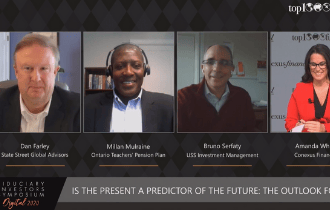
USS’s head of dynamic asset allocation Bruno Serfaty reflects on the inflation risk coming down the track, and suggests ways investors can build alternative liability matching portfolios beyond government bonds.

In recent years, inflation has boosted asset prices and asset owners have benefited disproportionately compared to economic activity. The dark side of inflation however, when wages and costs spike to hit corporate profitability, could be edging closer. Speaking at FIS Digital 2020, Bruno Serfaty, head of dynamic asset allocation at USS Investment Management, the in-house manager for the £68 billion Universities Superannuation Scheme, the United Kingdom’s largest pension fund, warned investors that inflationary dark clouds could soon appear on the horizon.

The shift towards greater state involvement in the economy could lead to higher inflation over the longer-term, while fiscal policy might shift to higher spending and taxing, with a more redistributive tilt to reduce income inequalities. “This may impact, at some point, the profitability of companies,” he said. Elsewhere, he flagged that tariffs on goods courtesy of the China/US trade war and Brexit will also cause prices to rise. “We could be at this cusp where we have moved from the good side of inflation where every asset went up to more of the dark side, and we as asset owners need to be prepared for this.”

Cue recent strategy at the fund like its 2020 £400m investment for a 49 per cent stake in a fuel station portfolio owned by oil major BP.

The annual rent reviews are linked to inflation, providing the scheme with liability-matching cashflows in an investment that will sit in an existing property portfolio of nearly £4 billion and is part of USS’s £18 billion allocation to private markets. Elsewhere, the pension fund has a 6.5 per cent exposure to nominal government bonds and a 26.9 per cent allocation to linkers, increased during the Covid shock to take advantage of the market’s fear of deflation. The fund also believes pricing remains attractive due to lack of inflation hedging demand amongst pension funds.

When the conversation turned to the enduring challenge of rock bottom fixed income yields, Serfaty suggested asset owners reassess why they hold bonds in their portfolio. A similar process has helped inform USS’s construction of a liability matching portfolio based on real assets in private markets and the credit space.

Sponsored Content

The deconstruction process helps clarify the rationale for holding fixed income. Whether that is based on a belief that bonds are an important source of diversification from growth assets; a belief that inflation will stay low and bonds provide good real returns or if bonds are a store of value because they are the safest instrument, and where money is best saved. “If you decompose the reasons why you own bonds, then you can try and find alternatives to that,” he said.

For example, volatility products or credit opportunities could provide alternatives to bonds as a hedge against an equity drawn down. While asking if bonds really do provide the best store of value has to be seen against the backdrop of vast government issuance. “If governments are printing so much money, I do wonder if they are truly a good hedge. Maybe gold or currency diversification could help – these are different avenues we look at.” Here USS recently took steps to improve the diversification of its foreign exchange exposure and increased allocations to currencies with defensive properties during turbulent times such as the Japanese yen.

It leads him to reflect on the long-term impact of the policy response on the portfolio. Government borrowing, coming on top of already high levels of government debt before COVID, will impact asset prices for many years. Expect a highly liquid environment and stoked competition for real assets, he concluded.

“What is really unprecedented is the scale of the policy response that has taken place. We started with a high level of debt before COVID and we are getting to an unprecedented level post COVID. GDP in 2021/22 is going to bounce, but what is not going to bounce is the level of debt – in fact it is quite the opposite. This year in the US for example, debt is 15 per cent of GDP: that’s a large number.”

Leave a Comment

PGGM: Impact begins at home

PGGM: Impact begins at home

PGGM is preparing to build out the third element to its impact strategy targeting biodiversity. By focusing on food and the circular economy, PGGM aims to create most impact at home. Top1000funds.com looks at the fund's impact journey.

Sort content by

What Dutch pension fund reform means for fixed income and risk allocations

As the Netherlands’ overhaul of its €1.45 trillion ($1.6 trillion) pension sector gathers pace, funds are preparing to change their asset mix and hedging policies.

Private equity angst at Oregon

A stubbornly high exposure, lacklustre M&A deals and exit activity as well as a slowdown in fundraising and deployment and market volatility creating benchmarking havoc have all conspired to cause consternation in the Oregon Public Employees Retirement Fund's private equity allocation.

Texas ERS boosts cash allocation as higher rates end era of dead money

Texas ERS has bumped up its allocation to cash to 10 per cent, and revamped its global equities around a core fund with an overweight to AI and other Magic Seven themes, drug manufacturers and aerospace. Another key development in equities includes reducing the number of stocks by half.

Risk management in an age of geopolitical uncertainty: Davos 2024 insights

Geopolitical risk was a key theme at Davos 2024 says FCLTGlobal’s Sarah Keohane Williamson who hosted an institutional investor CEO roundtable at the World Economic Forum. She says investors need to address geopolitical uncertainty in their strategies with the ability to distinguish signal from noise more critical than ever before.

The RFP bonanza emanating from Sweden’s Fund Agency

In an unprecedented bonanza for fund managers, the $100 billion Sweden’s Fund Selection Agency is preparing multiple RFPs as it re-tenders its whole portfolio. With a focus on quality and cost, executive director Erik Fransson explains his ambition for the overhauled system.

ART looks to digital infrastructure, energy transition for opportunities

The $171 billion (A$260 billion) Australian Retirement Trust, which sets itself apart from its Australian peers with the identifying investment features of lower infrastructure allocations and less internal management, is looking to opportunities in digital infrastructure and the energy transition.

Previous



