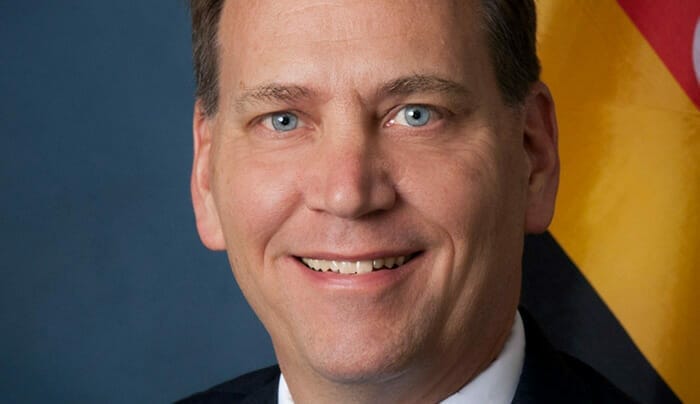

Maryland’s Andrew Palmer reflects on 40 years in investment industry

After a decade in the top investment job at the $69 billion Maryland State Retirement Fund, Andrew Palmer will retire at the end of June. He speaks to Amanda White about his achievements and reflections on an industry where he has worked for 40 years.

As Andrew Palmer looks to his final months as the chief investment officer of the Maryland State Retirement Fund, one of his final tasks is a new asset allocation on the back of a five-year asset liability study and he’s concerned about the impact of the current market uncertainty on the portfolio.

“We have had an unusual period where the US economy, because of its natural strengths, has had some good tailwinds relative to the rest of the globe. I’ve been concerned that was going to end and lead to a crowding out of capital as US debt grew and grew,” he says.

“I’m very concerned that we were already going into a period of time where federal stimulus was going to start to wane, and I do think in the near term we were due for a slowdown.”

He says the market was expecting a resurge on growth expectations with Trump coming into office and the promise of reduced regulations. But he is now really concerned that it won’t happen, prices will go up and activity will come to a halt because of the tariffs and cuts at the federal government level.

“In Maryland we can see physically that activity level has come down. There’s a high concentration of federal jobs here and anecdotally there is evidence of people losing jobs. Even the traffic levels have come down.”

Sponsored Content

Amongst this environment, the fund is in the middle of an asset liability modelling project and a new asset allocation is with the board for approval.

For some time, Palmer has focused on building a resilient portfolio that can withstand uncertainty, managing risk, and trusting an investment policy shaped to work in every kind of environment. But he’s also considering where he can find alpha while protecting the portfolio with diversification.

“We have gone through a decade or more where the US has been the destination of choice for capital – that might be unwinding,” he says. “There is a lot of money that is still here that might decide to go home.”

He says diversification, through geographies, asset classes, public and private assets, is the first step in managing risk.

“What this is doing is undoing the benefits of diversification, because it is forcing investors and business to be more geographically focused, so that utility is not there and investors may have to lower return expectations or accept higher risk,” he says.

“It can be very painful when correlations go to one, and you can have that when the portfolio is concentrated.”

Portfolio changes

The fund has had a low-risk, diversified, risk-balanced portfolio with a non-home country bias since 2010.

That portfolio has a high Sharpe ratio and low volatility but relatively low returns, and the board wanted to look at an allocation that would generate more alpha.

“The board has had a bit of turnover since the last study five years ago, and while they like the diversification and how it protects us on the downside, it wasn’t earning enough. So they are willing to push out on the risk spectrum,” he says. “You can’t pay beneficiaries with a Sharpe ratio – you need cash.”

In the new asset allocation, equity risk has been pushed from 50 to 55 per cent across public and private, and the benchmark has moved back towards a global benchmark of country weights.

The fund has been underweight US and overweight emerging markets for some time. And while the emerging markets allocation has been winding back since 2022 this has been the biggest drag on the fund’s performance.

“When we made that allocation, it was difficult to get to our return target, so we looked to private equity and more emerging market equity because we thought both of those would have higher returns. Private equity did but emerging markets didn’t – it was meaningfully lower. EM stocks returned 4 per cent when US stocks returned 14 per cent, and that’s been the biggest drawdown on our performance.

“With interest rates higher now, we don’t have to be as bar belled. With lots of equity risk and some diversifiers we can move to a less bar belled portfolio. We have more developed market stocks and more credit and are moving more to the middle of the risk return path to drive a bit more return without adding too much to risk.”

The increased allocation to equities will be allocated from the absolute return portfolio, which has a strategic allocation of 6 per cent and has been a recent underperforming part of the portfolio. But while the strategic allocation will be reduced, Palmer is keen to keep on some of the absolute return managers, embedding them in the asset classes as an implementation technique.

“We wanted cash plus 5 per cent from these managers which has been a challenge. But they can be a good diversifier in markets like this. We have some really good managers and can hopefully find ways to continue to use them profitably.”

Reflections

Andrew Palmer began his investment career as a fixed income specialist with a 20-year career at ASB Capital Management. He came into the pensions industry via the director of fixed income position at the Tennessee Consolidated Retirement System where he later became deputy CIO, and then moved to his native Maryland in 2015 as CIO.

“I’ve been in the markets for a long time,” he says. “I started on the bond side and that segment of the world was where financial innovation was happening all the time. Since then, there has been an explosion in innovation. The world has become less delineated by old designs.”

But as he reflects on his career, he says what hasn’t changed is the pension board model, built on business models from the 1970s.

“There could be some work on modernising the governance structures of these plans – I don’t think that has matched the market innovation. Even conversations around asset allocation and asset classes are rooted in the past. There is opportunity there for thoughtful people to make some real innovations and improve outcomes for everyone.”

As Palmer looks to leave the fund, he is proud that he has been able to impact the fund’s future success.

“I am most proud of being able to set up the portfolio and the structure for long-term success,” he says. “When I came in 2015, the resources to manage the then $45 billion portfolio were stretched. We had a small staff and more asset classes than investment individuals. It was expensive and tough.”I didn’t see how we could grow with the structure and resources we had at the time.”

Among other things, the investment staff grew from around 23 people to more than 50, with new governance structures built to allow the fund to expand and introduce new emerging and smaller managers.

“It really has been transformative,” Palmer says. “When I think about how that has worked in practice it’s rewarding to see that over the last five years more than 90 per cent of assets outperformed their respective benchmarks through good implementation, through the staff having the authority and ability to hire managers, build portfolios and mange through time. It’s been highly fruitful for the organisation. The implementation has demonstrated putting some resources into the process was the best investment we could make.”

Palmer is grateful for his time in an industry that is collegiate and dynamic.

“The industry itself is fantastic. The job of investing changes every day and is full of wonderful eager people. You meet all kinds of people and it is so stimulative to be in this space and deal with what could happen tomorrow. But the politics has become a bigger and bigger part of this job for every CIO,” he says. “A lot of politics has crept into a job that should be focused on driving returns for beneficiaries and lowering costs for sponsors.”

Leave a Comment

PMT talks infra equity and how to balance stock concentration risk

PMT talks infra equity and how to balance stock concentration risk

Scenario testing has put inflation risk front and centre at PMT, the Netherlands’ third largest pension fund, and it's driving the investor to take stock of the inflation protection it gets from infrastructure. In an interview with Top1000funds.com, chief investment officer Hartwig Liersch unpacks the risk, as well as another initiative where it's balancing concentration risk in the equity allocation without hurting returns.

Sort content by

How CPP is evolving risk management for a faster, more interconnected world

In an environment where multiple risks are emerging and their effects are compounding on the portfolio, CPP Investments' chief risk officer Priti Singh says the $572 billion fund is rethinking risk management from the ground up, shifting from reaction to preparation and embedding risk thinking earlier in investment decisions. She speaks to Amanda White about the fund's risk approach.

URS bets on nuclear to power AI and lower emissions

Next-generation nuclear energy, and the money pouring into it, will truly change the world, according to CIO of Utah Retirement System John Skjervem. It’s a lonely position as the CIO of a public pension fund but one Utah is embracing as it builds out early-stage investments in nuclear energy as part of its alternative energy portfolio. He speaks to Sarah Rundell in an exclusive interview about how investing in transformational energy technologies can be part of prudent investment management.

Managing volatility and inflation: Constant rebalancing shores up UK’s lifeboat fund

A keen focus on rebalancing, and best in class systems, allows the UK’s £31.2 billion Pension Protection Fund to effectively implement a dynamic hedging strategy for one of the UK's biggest LDI portfolios. Sarah Rundell reports.

Velliv reset: More Danish funds lean into low cost DC model

In Denmark’s fiercely competitive commercial pension industry, Velliv was quick to take action with a root-and-branch overhaul of its pension provision when it experienced a drop in returns in the first half of 2024. It sacked its active equity managers, scaling up internal active strategies and low-cost, index-based investments instead, and stopped allocating to its $4.3 billion alternatives allocation. Thor Schultz Christensen, deputy chief investment officer at Velliv, unpacks the change.

Ohio sounds warning bells on PE liquidity logjam

Farouki Majeed, chief investment officer of the $23 billion Ohio School Employees Retirement System, has highlighted worrying signs in private equity that resulted from a backlog of exits, including industry murmurs that some GPs are having to borrow money to operate their business because LP fees are drying up. In an interview with Top1000funds.com, Majeed unpacks why its 12 per cent PE allocation is shielded from the rout.

Funds SA cuts active risk as CIO puts stable beta first

Australia’s $36 billion Funds SA has slashed tracking error in its equities book and is reorienting its philosophy around stable beta, as chief investment officer Con Michalakis argues the role of alpha in a multi-asset portfolio needs a fundamental rethink.



