
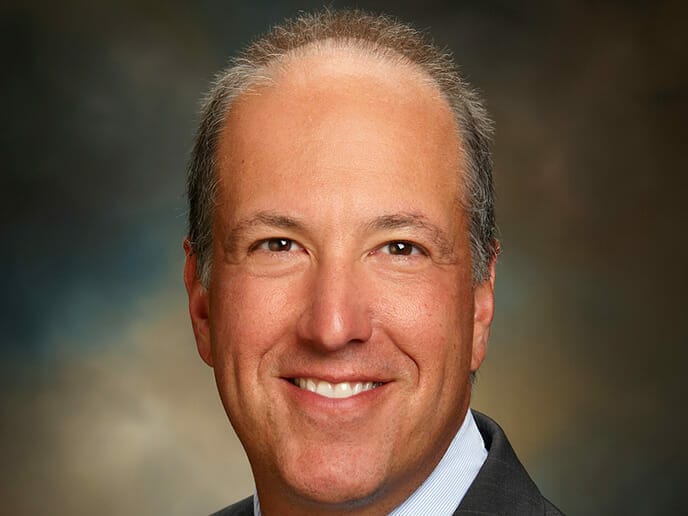

The WK Kellogg Foundation is searching for investment opportunities in AI in its equity and hedge fund allocations.
“AI hasn’t been well-accepted by corporate America and the people who accept it and pursue it will have a competitive advantage,” Kellogg Foundation vice-president and CIO Joel Wittenberg observes.
The $3.5 billion foundation is seeking: public equity managers able to pick companies bringing AI inhouse; private equity general partners (GPs) using AI to inform decision-making; and specialist hedge fund managers using machine learning and big data to make systematic trades in strategies pioneered by industry leader Two Sigma, the $52 billion quantitative hedge fund.
The foundation is also developing an internal AI-driven model that it hopes will implement derivative strategies across asset classes.
“People who have worked their way up to the top of their organisation believe they have earned the right to make decisions,” Wittenberg says. “Yet we know that AI and machine learning can actually make better decisions than someone in their 50s following their gut instinct.”
The hunt for opportunities in AI is just one seam in the foundation’s 16 per cent allocation to hedge funds. For the last year and a half, Wittenberg has focused on selecting hedge funds for the portfolio that have a low correlation to one another. Using a detailed volatility correlation matrix, strategy has focused on picking “reasonably” volatile hedge funds that earn a “fairly high” return to secure a “really nice” Sharpe ratio or risk-adjusted return, Wittenberg explains.
The Kellogg Foundation was established in the 1930s by breakfast cereal pioneer WK Kellogg to support vulnerable children and families. It runs about a dozen different hedge fund mandates, a couple with the same manager, which focus on strategies spanning zero beta, momentum, long/short and credit. Wittenberg was treasurer at the Kellogg company for a decade, before he joined the foundation in 2009.
“People think of hedge funds as a low-volatility strategy with good absolute returns,” Wittenberg explains. “But by focusing on the relationship between the different funds and their interaction with one another, we have been able to go into higher-volatility funds to get additional returns.”
Wittenberg is also adjusting the Kellogg portfolio to gain from a downturn in illiquid credit funds, which he thinks hold the seeds of the next distress cycle. Private credit funds sprang up to fill the void left by the withdrawal of bank lending; their proliferation has led to an enormous amount of uncalled capital. Yet many investments in the sector aren’t based on solid financials, he warns.
“Loans are being made with minimal covenants and the use of leverage, especially in private equity, is high. There are yields of 6-7 per cent on these kinds of assets, but in a distressed cycle with default rates of 10 per cent, returns obviously won’t be positive,” he explains. “Some of these funds sell themselves on never having had a default, but in the last 10 years, we’ve not been through a distressed credit cycle.”
Kellogg recently sold off the bulk of its allocation to credit funds in the secondary market, where it received “incredible bids”, Wittenberg says. The foundation is now developing a multi-strategy fund that includes a dedicated distressed allocation with specialist hedge funds.
“We’ve found a few hedge funds that aren’t taking much risk now but will when the time is right,” Wittenberg says. “We are in the process of getting those accounts open, funding them a little, [being] ready to fund up when the time arises.”
Wittenberg targets an investment return of inflation plus 5 per cent and pays out about 5 per cent of the foundation’s asset value annually to its key causes. The diversified portfolio is split between a small allocation to liquidity, along with public equity, fixed income, hedge funds, and illiquid investments, which account for just over a quarter of the portfolio.
“Our focus is on value investing and downside protection: if we lose less in a down market, we will compound more and achieve our real return of 5 per cent more easily,” Wittenberg explains.
The Kellogg stock legacy
The portfolio was not always so diversified. The foundation was wholly invested in Kellogg stock until 1985. Further diversification came in 1998. Modern portfolio theory has led to diversification of the initial $66 million seeding of the fund, but owning Kellogg for all those years turned out to be an incredible investment.
“Kellogg has beaten the market significantly over the years and helped our success today,” Wittenberg says.
It’s a legacy that endures, since the foundation still holds more than $4 billion in Kellogg stock alongside its $3.5 billion diversified portfolio.
“We can treat the diversified portfolio with different liquidity parameters [than we could] if we didn’t have Kellogg stock,” he says.
The foundation is overweight venture capital – where Wittenberg sees opportunities shifting to European GPs – and opportunistic real estate. The non-core strategy has found “an incredible source of return” in defaulted mortgages and properties requiring renovation.
“We have found managers below the radar who have been visionary,” Wittenberg says. “Real estate has given us some additional returns that we didn’t expect at the start of the cycle.”
The foundation uses a model to measure the fees it pays in illiquid strategies that involves giving each GP a rating. Typically, he deems management fees “excessive” if they go over 2 per cent of invested capital, especially in a low-return environment. If fees reach this mark, he talks to the manager, assesses whether the charges are justified (which he observes can be the case with smaller GPs) and is prepared to walk away from investments, particularly in hedge funds.
“We are not the biggest investors so can’t always move them, but we do tell them our opinion,” he explains.
Wittenberg favours managers who charge management fees only on invested capital but is mindful of a potential payoff in paying fees on uncalled capital, too. The foundation invested in a swathe of funds in 2007 and 2008 that charged on uncalled capital because they couldn’t find attractively priced assets. It caused J-curve losses and led to “tough conversations”, he recalls. Come the financial crisis, these funds had capital at-the-ready and the short-term fee pain proved more than worth it in the long run.








Leave a Comment
You must be logged in to post a comment.
Login