
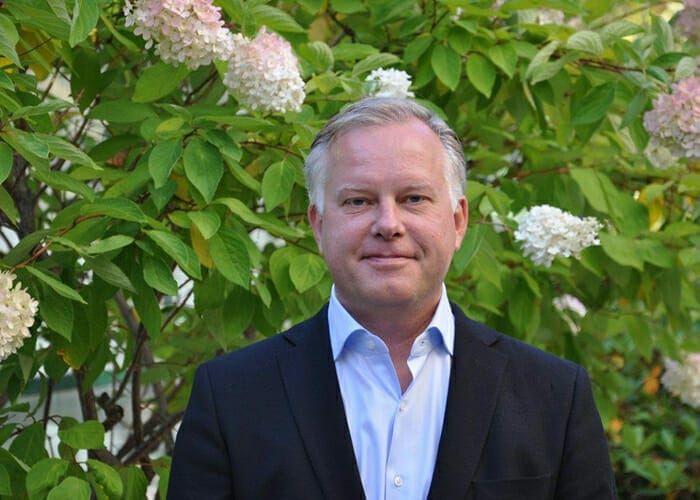

Ericsson Pensionsstiftelse (EPS), the Stockholm-based SEK21 billion ($2.3 billion) pension fund for employees of the Swedish technology company, has recently added active long-only managers in its equity allocation. In a break from the last five years, stock picking is back because of what chief investment officer Christer Franzén calls a “probable” low-return environment from index strategies coming up.
“We haven’t used long-only managers in equity recently because we saw the stock market as a beta market,” he says. “Now, however, because the market is so expensive and future returns are probably low from here, we assume there will be a greater dispersion within indices.”
EPS will work with external managers using a concentrated portfolio of 30-50 shares, not the usual 100, he adds.
EPS is seeking to differentiate itself from the herd. Franzén explains: “Everyone flocks into passive today. It is great for the low fees, but we favour, in general, an active approach. This could be [achieved through] our own in-house activities via derivatives or specialist ETFs, or by using active managers. Regardless of the reasons – from low costs to regulation – you always need to question the wisest route to take and if there is alpha to be found elsewhere.”
A model focused on capital preservation
Strategy at EPS is focused on capital preservation and absolute returns. It is a model afforded by the fund’s structure, whereby EPS’s collateral comes under a mutually owned insurance company, PRI, which secures the defined benefit schemes for larger corporations in Sweden.
“EPS is a pool of assets; liabilities stay with the sponsor, in this case Ericsson the company,” Franzén explains.
Most recently, the fund has been focusing on cash-generating investments, rather than capital gains, in a strategy focused on lowering portfolio volatility and achieving a higher Sharpe ratio. Asset allocations start with a projection of future defined benefit liabilities and the return rate needed to meet them.
“From this, we do a classic asset liability management-study, where we assume the next five-year returns for all the asset classes, which then gives us a total possible return rate.”
The fund mirrors this analysis in a risk-factor model so it can discover if there are any risks that need to be mitigated.
“When this is done, we apply a macro overlay, which helps us decide if we should take more or less risk for the coming year. The board then decides on return targets and the proposed allocation for the year.”
There is a mandate for Franzén to deviate from that decided average within certain limits.
EPS’s current allocation is 35 per cent in fixed income, 15 per cent in credit, 20 per cent in real estate/infrastructure, 10 per cent in alternatives and 20 per cent in equities.
The equity allocation is divided between a 10 per cent allocation to public equity, 5 per cent to private equity and 5 per cent to equity long/short strategies. The fund has lowered its return targets over the last couple of years. It also divested from emerging markets four years ago, although it has started “to look at this again on a very selective basis”.
Strategy up until now has been focused on investing in companies from developed markets that could have exposure to emerging markets, due to stronger corporate governance and compliance.
Franzén doesn’t have a specific allocation bucket for hedge funds. He argues instead that traditional hedge fund strategies are “just another way of expressing an active and flexible approach, rather than being a separate asset class”.
He explains: “Returns from equities are normally, over time, the risk-free rate including inflation plus 4 per cent. This is more a common return target for many hedge funds these days; if higher returns are needed, leverage will be involved.
“Hedge fund fees are generally lower in Sweden compared with, say, London, where [a 2 per cent management fee plus 20 per cent of profits] has been the standard, even though it’s starting to change now.”
Bonds replaced with real estate
The real-estate allocation, three-quarters of which is in Swedish assets, includes social infrastructure such as court buildings and housing.
“We started 2009 searching for stable, cash-generating investments and Swedish social infrastructure and multifamily homes drew our attention. At the time, these assets were overlooked due to low returns and because they were seen as having less of a capital gain possibility. We thought it was perfect since they offered a decent cash flow with long durations, and a low probability for capital loss. After all, we were looking for assets to replace our low-generating bonds.”
EPS also manages the real-estate allocation.
“When we were searching for managers, we realised they were pretty expensive and most of the time the investments were more risky than what we wanted. It meant we started to talk to peers, and that led to starting several real-estate companies with them, which took our costs down significantly.”
EPS counts 20 managers on its roster, down from 35 a few years ago. Franzén considers the fund’s small size an advantage.
“We are…able to pick up stuff that the bigger funds can’t because it doesn’t move their needle. Some players are so huge they are, in practice, indexed themselves. We are small but we are also big enough to move around and take opportunities.
“We are a small organisation and pride ourselves on establishing strong relationships. We tend to stay with managers for a longer period of time if they perform within the top quartile. It’s important to understand how a manager makes money and whether it suits our philosophy. I don’t care too much if a manager has a bad year as long as I understand what is driving the returns. Not shopping around between managers too much saves us a lot of time.”
He also doesn’t use consultants, referring to them as “a layer of unnecessary cost”. The fund manages 40 per cent of its assets in-house, predominantly in fixed income and equity derivatives.
“I believe we need to be able to take care of our own fixed-income risk. My background is as a fixed-income trader, so anything on the macro front we are good at. In the equity allocation, we use derivatives as an overlay and are active if the market gives us the opportunity.”









Leave a Comment
You must be logged in to post a comment.
Login