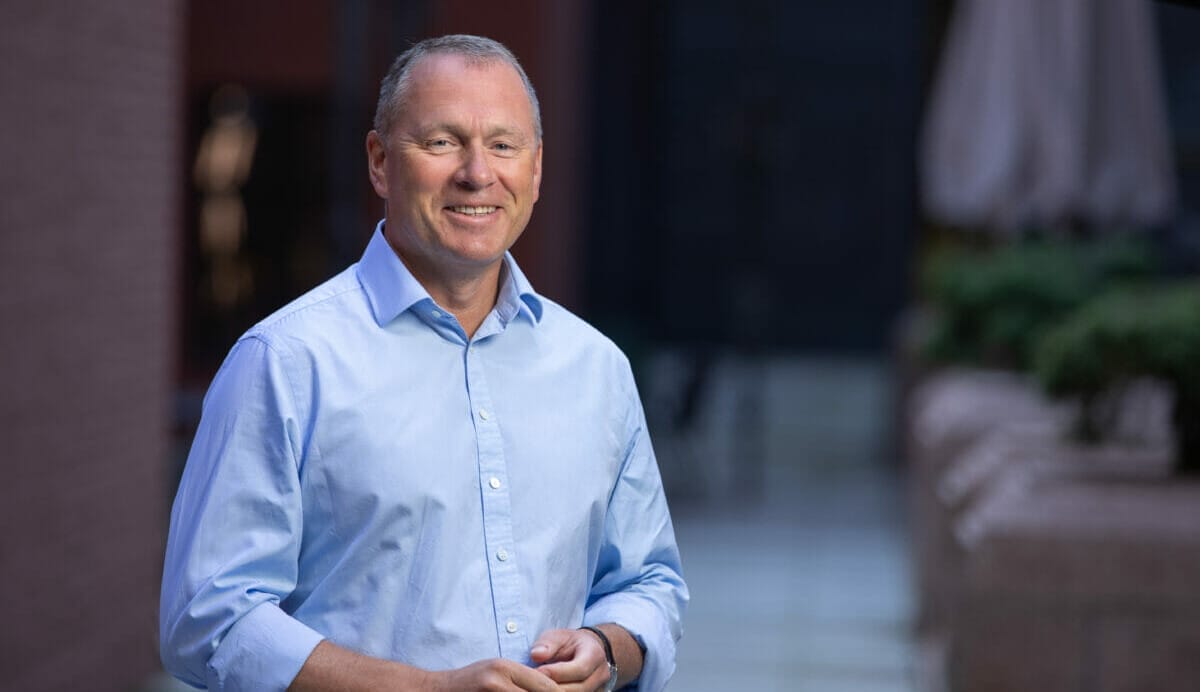

Bank of Ireland pensions’ CIO says regulations are killing liberal economies

“I wouldn’t dare tell a company how it should be run, they are the experts. Rather than tell a board how to behave I would rather have them compete,” says Paul Droop, group pensions CIO of the Bank of Ireland who believes regulation is damaging free market competition in a worrying new shift that  poses the single biggest risk for investors.

That old photograph taken in the early 20th century of a horse and cart alongside one of Henry Ford’s first cars is often used today to describe the seismic energy transition ahead as the world moves from petrol and diesel to electric cars. But it belies one crucial difference. The first cars were a consequence of a market-driven change – no one told people to buy them. Today new rules decree that people can’t drive petrol cars for much longer, discouraging investment in the companies that make them.

Leaving aside value judgements and not expressing a view on the climate emergency, it is this emerging and worrying shift from liberal, market-based economies to centrally planned and regulated ones that poses the single biggest risk for investors, argues Paul Droop, group pensions CIO at the Band of Ireland, overseeing the €7 billion Bank of Ireland’s Staff Pension Fund (BSPF).

“There is an increasing shift away from liberal markets, promoted and driven by a growing range of sources. On a spectrum from very open and liberal market economies to another extreme of centrally planned, the world appears to be moving significantly towards central planning and control,” he says in an interview from the fund’s Dublin headquarters.

It’s not just visible in increasingly pervasive climate regulation. The pandemic has hastened the trend, ushering unprecedented rules and restrictions in response to COVID many of which still haven’t been removed.

“Permanent rules have come about regarding what we can and can’t do; how we behave and how we interact with one another.”

Sponsored Content

And it’s not only governments and regulators driving the shift. Asset owners and managers are hastening the trend too says Droop, particularly concerned about the growing role – and pressure – on shareholders to intervene in corporate governance.

“I wouldn’t dare tell a company how it should be run, they are the experts. Rather than tell a board how to behave I would rather have them compete.”

Only that competition is increasingly stymied in a threatening backdrop for BSPF’s portfolio exposed to the entire market and structured to tap every kind of risk. Droop’s risk management philosophy has virtually no reliance on alpha but emphasises diversity and resilience instead. The listed markets should be a field of competition where every buyer and seller can come together, he argues. That vibrancy and health depends on the best companies securing the most favourable access to capital and the worst falling by the wayside but rules that define what makes a good company distort the field.

“It should be a competition open to all where the best win and those that aren’t as good fail.”

Exposure to everything

Exposure to everything is vital in today’s uncertain world where investors can’t be sure what really lies ahead.

“Information about the past isn’t even that good,” he says. Some investments go wrong, others thrive but that’s competition within the market for capital.

“For every failure, we are on winners as well,” he says. “We don’t filter anything out. If we have diversity, the strategy will naturally benefit from any opportunity, without having to try and predict what it might be and take explicit and specific risk to articulate that view.”

It’s a risk management strategy that is as suitable for ESG as any other source of risk, today and historically.

“A market capitalisation-based exposure to global listed equities would be superior to an approach that screened, tilted, held assets according to some arbitrary rules or was actively managed according to views of the manager. Diversity as a risk management process should still work for any risk presented by ES, or G issues if you believe it does for, say, global monetary policy.”

Effective risk management has to refer to the price of assets and securities, he adds. Yet if managing risk simply means, say, “buying windmills and selling coal miners” without reference to the price, investors aren’t effectively managing risk. Especially in an environment like today when he says everyone seems to be tilting the same way. “From a risk management perspective, this type of behaviour leads people to buy overpriced assets and sell under priced ones – which isn’t very good risk management.”

Diversity wins

Since he joined the fund in 2011, Droop has transformed the asset allocation. He’s increased liability hedging, diversified across asset classes and boosted coverage of private markets with the BSPF allocation currently split between equity (13 per cent) credit (23 per cent) secured income (7 per cent) real estate, infrastructure and absolute return (5 per cent each) and liability hedging (42 per cent)

A risk management philosophy that eschews alpha and champions diversity and resilience to mitigate uncertainty means he avoids all managers with highly concentrated or opportunistic approaches. He also spends less on fees.

“We tend to employ managers at the more ‘boring’ end of the scale. Total management fees across the portfolio are about 30 basis points, which includes some very expensive private and hedge fund strategies.”

Droop, who runs the portfolio with one assistant and is responsible for the thought leadership and idea generation, links the fund’s success to this clear delineation of duties and a willingness to do new things. In the six years to December 2020 the BSPF’s return seeking assets have returned 7.6 per cent. He also credits the trustees and governors for not chasing fads but remaining faithful to a core belief and philosophy. And he has no plans to change anything.

The fund’s liabilities are hedged enough – if he was to hedge anymore he worries he would lose benefits or risk diversification on the margins – and he added two new credit strategies last year. Investment themes like China, or new technologies, are already captured in the diverse approach that doesn’t try to pick winners.

It leads the conversation back to his central argument. A portfolio built to tap all parts of the economic value creation chain in a market-based economy where every investment behaves differently but each individual asset has a role in the play, doesn’t require much maintenance. Or at least until governments start interfering.

“Moving economies to central planning and control amounts to a net loss for everyone. The market should be allowed to sort it out.”

Leave a Comment

The twin forces rewriting the rules of investing

The twin forces rewriting the rules of investing

Portfolios built for the old world will be severely tested as emerging forces rewrite the rules of investing. The Fiduciary Investors Symposium heard that geopolitical and macroeconomic upheaval, together with the disruption wrought by AI, should force asset owners to rethink the structure and composition of portfolios.

Sort content by

AP1: In these markets, fortune favours the bold

Formulating strong views and daring to act on them have been critical success factors for Sweden's buffer fund AP1. And they will remain so going forward says CEO Kristin Magnusson Bernard.

The benefits of external investments: UK’s pooled fund backs outsourcing

Other LGPS pools in the UK have appointed CIOs, risk officers and internal teams but the £56 billion ACCESS pool has outsourced all aspects of investments and will remain externally managed. It's now looking for managers as it  pools illiquid assets in private equity, private debt, infrastructure and real estate.

Measuring outcomes is what really matters: Serafeim

Investors interested in ESG should be aware of the intensity of the commitment and develop their own deep expertise and impact-weighted accounts, according to ESG pioneer and academic, Professor George Serafeim. He will speak at the Sustainability in Practice event at Harvard University in September.

New York State Common’s CIO on Russia, PE and diversity

Investments at New York State Common Retirement Fund, one of the largest pension funds in the US that also boasts a near fully-funded status is run by Anastasia Titarchuk. In an interview with Top1000funds.com she shares her investment outlook, thoughts on private equity and the importance of diversity.

APG talks crypto: Those who got rich in the gold rush didn’t do the digging

APG’s chief economist Thijs Knaap and senior strategist Charles Kalshoven lay out the case for not investing in crypto. They find that only an expected return of 25% pa would make it worthwhile and even then there’s no cashflows. They argue pension funds can afford to ignore this asset.

Best funds for transparency revealed: where did your fund rank?

The Global Pension Transparency Benchmark has revealed the top ranking funds globally for transparency of disclosure across cost, governance, performance and responsible investment. Click here for the results of 75 funds across 15 countries.

Previous