
Looking backwards is a poor way to assess Asia’s future

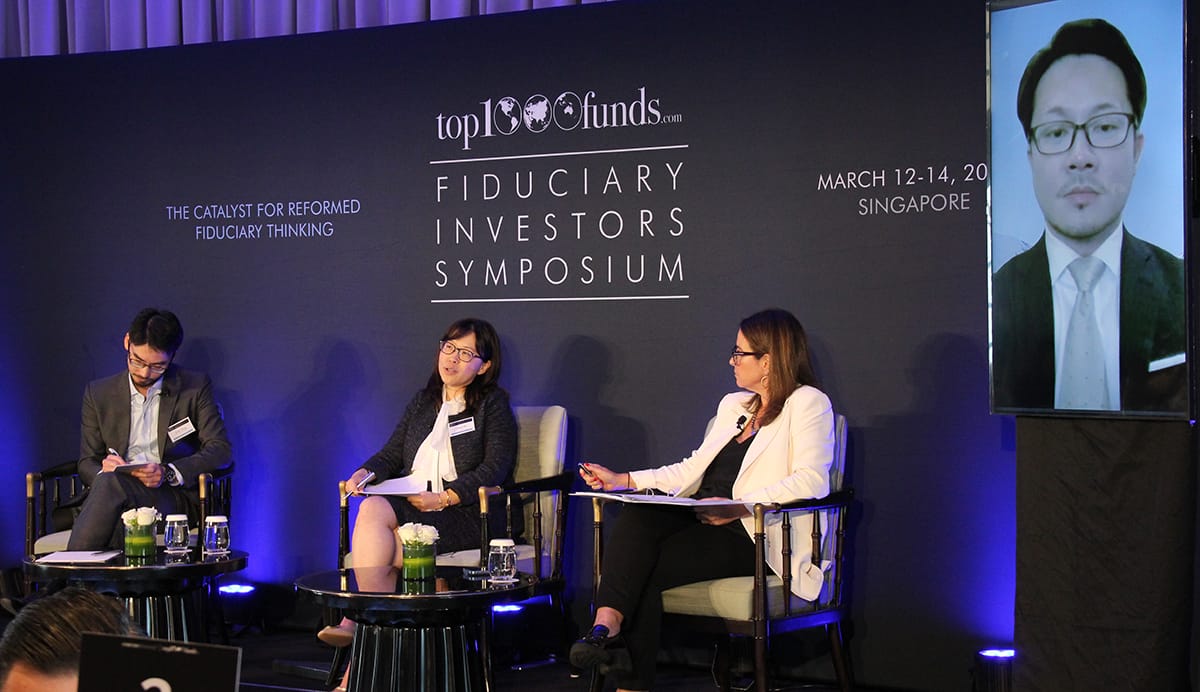
L-R: Andy Wong; Grace Qiu; Top1000funds.com's Amanda White; Kevin Bong (on screen)

The specific drivers of growth for Asian economies means a traditional view of asset allocation is not necessarily the best way to approach investing in the region, the 2024 Top100funds.com Fiduciary Investors Symposium in Singapore has heard.

GIC senior vice president, total portfolio policy and allocation, Grace Qiu told the symposium that the backward-looking nature of benchmarks means that they may not necessarily be the best guides when assessing the potential of developing markets or regions.

Qiu said investors on the ground can often make better decisions.

“Benchmarks may be the best simple and transparent rule-based solution you can come up with in a single asset class. But in a total portfolio context, some of these important decisions can be made by ourselves.”

“As investors, we know the investment objective, the time horizon, and the risk tolerance. So, we should potentially take those decisions in-house, and make the right allocation accordingly.”

Qiu said that in emerging markets “the benchmark may potentially be even worse than…in developed markets”.

Sponsored Content

“Because [the benchmarks] are backward-looking, they’re not really reflective of the true [reason] why we allocate or invest in emerging markets,” she said.

“For us, making more granular decisions on not just the asset class, but also regional allocation, in a consistent manner across the total portfolio is an important task for asset allocation.”

Pictet Asset Management senior investment manager, multi asset Andy Wong agreed that asset allocations based on benchmarks are by definition backward-looking.

“Your variance, covariance matrices [are] mostly backward-looking,” Wong said. “Also, it is quite arbitrarily confined. People say the US economy is doing well, you should buy S&P 500. Actually, half of the revenue is from overseas.”

Wong said he has “a strong view that the semiconductor is the foundation of modern technology”, and being located close to supply chains for major manufacturers provides a useful perspective.

“Understanding some of the bottlenecks, understanding some of where the new technology is going to will help us think about where the world actually globally will be heading next,” Wong said.

Wong said investors shouldn’t use today’s use-case – which might be reflected in current benchmarks – to try to assess the investment potential of technology.

“When Apple was at $200 billion market cap, people were saying that even if every phone in the world is an Apple phone, they were overvalued. At $2.6 trillion today, quite clearly, it’s more than just a phone call machine; it is connectivity, it’s ecosystem, it’s productivity, it’s GPS, iPod, everything in one. All of these things we couldn’t imagine from before.”

Wong said asset allocation needs to be “a little bit more nuanced”.

“You need to look at fundamental drivers,” he said. “If you want to understand risk, you need to understand equities. If you want to understand equities, you need to understand US equities, which is 70 per cent of the market now.

“And then you need to understand Magnificent Seven, you need to understand AI, you need to understand semiconductor. So, from our perspective, themes and ideas are an integral part of asset allocation.”

Senior managing director, chief investment strategist and head of Singapore, AIMCo (Singapore) Kevin Bong said that from a portfolio construction perspective “diversification benefits; differing sector compositions; different stages in the economic and market development cycle; differing political, economic, and policy cycles; they all mean that the investment markets will not be perfectly in sync with what is I think, typically a developed market-heavy portfolio, and most of us have”.

“You could argue that some of it is an unfortunate side effect of slowing or a reversal of globalisation,” Bong said.“But I suppose if the markets give you lemons, you make a lemonade portfolio.”

Bong said that it is “admittedly more aspirational than a reality, but there is always alpha potential in new markets”.

“One could argue that active management opportunities are attractive across the Asia Pacific region, in part because the markets are not as efficient for the most part, but also because there’s meaningful dispersion in the region,” Bong said.

“All of that sums up to a picture where, especially for where we’re starting from Asia is an attractive opportunity.”

Qiu said asset allocation “needs to adapt to the new environment, to the new regime; and under the new environment asset allocation we believe at least, should be more flexible, more deliberate, and more granular.

“What is the next frontier? What is the newest area of innovation in asset allocation that we can think of to actually bring our portfolio to the next step?

“Those activities lie in some of the maybe more traditionally called bottom-up or more granular type of activities that doesn’t necessarily fall into traditional asset allocation mandate or asset allocation job description.”

Leave a Comment

Impact investing’s case for scale

Impact investing’s case for scale

Impact investing has come a long way in the past two decades, going from a niche strategy to a $1.5 trillion industry, but there are still challenges for it to reach institutional scale due to the lack of products and insufficient evidence of outperformance in some parts of the market.

Sort content by

Social Conditions Consideration

The ultimate goal of economic policy is simple and timeless - to ensure prosperity and maximise living standards. Broad macroeconomic measures such as GDP growth, the unemployment rate, and inflation had for decades been a good proxy of rising prosperity, so they have dominated economic policy making and are enshrined in most central bank mandates. But even before the COVID-19 crisis, it had become clear that traditional economic measures have increasingly diverged from social outcomes.

Secular Supply and Demand

Over the past two decades, China's secular rise dominated commodity markets, as its industrialization required a massive amount of raw materials to build up the country. As we consider the future, we see many reasons to be bullish on commodities tactically, but one of the most important secular factors will likely support industrial commodity demand for years to come: the shift in global economies away from fossil fuels and toward greener energy.

Diversity Impact Score

Throughout its history, the U.S. domestic Asset Management Industry, projected by PwC to grow to $71.2 trillion in assets under management by 20251, has exhibited an empirical lack of diversity with respect to gender and ethnicity within its ranks. Numerous studies have shown that Women and People of Color (“POC”) are underrepresented in the Industry, including a 2019 study commissioned by the Knight Foundation finding that Asset Management firms owned substantially or majority-owned by Women or POC managed only 1.3% of the Industry’s total assets under management.

Sustainability in the time of Covid-19

2020 underlined just how closely connected the world is. The pandemic broke out in a market in China but quickly spread to the rest of the world. The health crisis soon escalated into a serious economic crisis – a crisis of which we still do not know the full consequences of. Being able to act quickly and safely in a changing world is more important than ever. Many of PensionDanmark’s members and companies have endured periods of lockdown, and jobs have been lost as a consequence. The hotel and restaurant industry, the transport industry and the many employees at Denmark’s airports have been particularly hard hit. Many of the companies that were not shut down had to implement restrictions and other measures to protect themselves against COVID-19.

Asset Owner Technical Guide: Selection

The incorporation of ESG factors within the investment process has evolved from a nice-to-have to a necessity. Client demand has grown strongly, with 68% of the PRI’s asset owner signatory base addressing ESG considerations in their requests for proposals (RFPs). This means that many asset owners expect investment managers to include financially material ESG factors within their funds and investment strategies. In addition, policy makers around the world are introducing regulatory requirements for both investment managers and asset owners to disclose and report on responsible investment practices.

Asset Owner Technical Guide: Monitoring

A growing number of asset owners now expect their investment managers to incorporate ESG factors into their investment processes. This means that ESG needs to be at the core of the relationship between the asset owner and the investment manager – and that ESG considerations need to be addressed at every stage of that relationship, from setting the initial investment strategy, to drafting requests for proposals, to selection, appointment and monitoring.

Previous



