
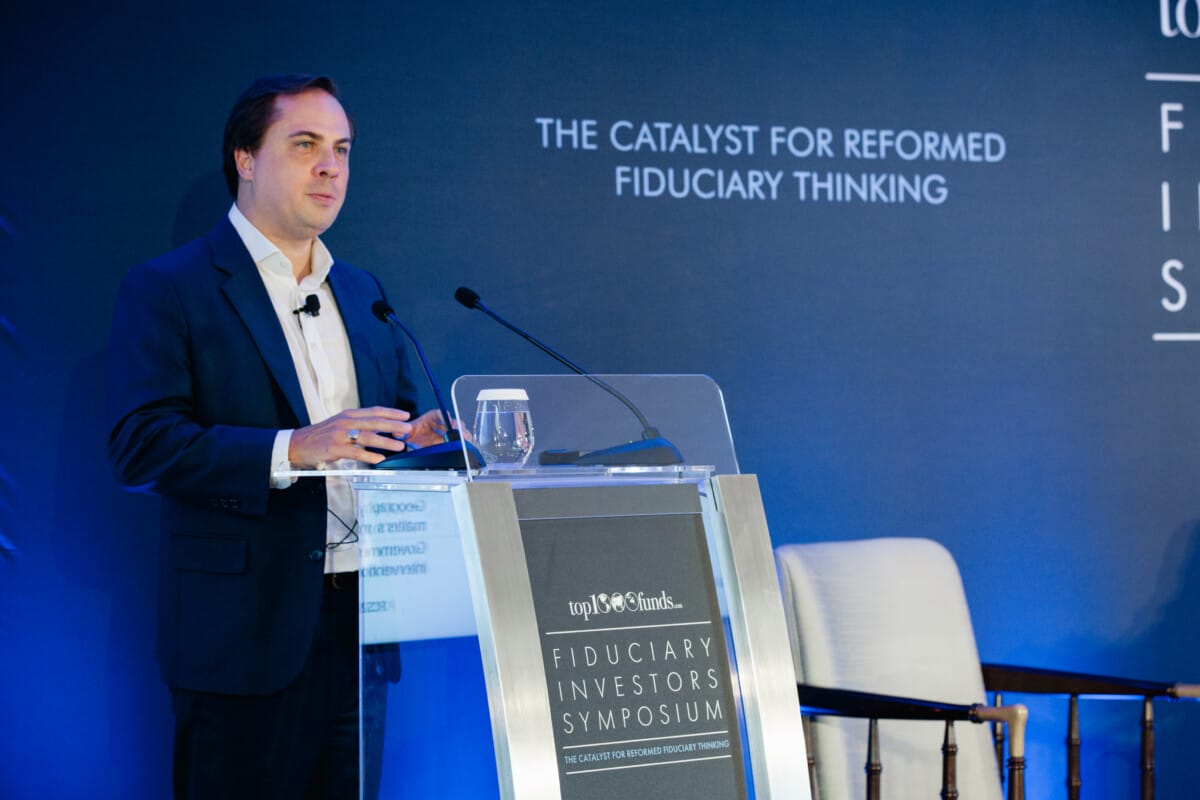

The key to constructing investment portfolios with resilience to rapid and unexpected changes is to remain humble, interrogate the data, and not be fooled into thinking the future can be predicted perfectly, according to head of multi-asset strategy APAC for Wellington, Nick Samouilhan.
In the midst of the COVID-19 pandemic, Singapore-based Wellington Management managing director and head of multi-asset strategy APAC Nick Samouilhan says “his team decided to take a step back and think about what was going on”.
Samouilhan told the 2024 Fiduciary Investors Symposium in Singapore last week that their aim was to analyse whether it could take what was happening in the moment and “try and work out the next five to 10 years – not trying to be too prescriptive, but can we directionally try and understand some of the big changes, which we think will really matter over the next, say, five to 10 years”.
Samouilhan said the multi-asset strategy team have identified four key themes that continue to hold true today.
“It was clear three years ago, [and] it is absolutely clear today, that governments all over the world are potentially going to be far more activist in determining winners and losers and directing capital,” he said.
“And it means that when we invest in a company, that company’s outcome may not be about shareholder maximisation, it may be something else, we need to realise that and address that.”
Samouilhan said it was “clear back then [and] it’s clear now that climate is an increasingly important consideration in driving risk and return in capital allocation.
“We need to address that in our portfolios,” he said.
“What we were seeing back then and, again, we’re also seeing that now, [is] governments all over the world focus on their own economies, their own objectives.
“Because of that, we’re starting to see policy cycles, interest rate cycles, economic cycles, regulatory cycles start to diverge. And that has an increasingly important impact on say, regional allocations, and currencies, and so on.”
This analysis prompted a discussion between Samouilhan’s multi-asset team and the macro team because it led them to believe that “something’s going on, beneath the surface on the macro economy” – and it might be that the principles of investing and portfolio construction that have served investors well in the recent past might not be appropriate in future.
Building portfolios with resilience requires that possibility to be taken into account, and Samouilhan said investors should bear in mind three things when considering how to build resiliency into portfolios.
“First, you should expand the number of asset classes in your portfolio,” he said.
“For instance, there was long discussion yesterday about commodities and how the allocations have generally disappointed over the last decade. But that is because we haven’t spent time in regimes when commodities are helpful.”
Samouilhan explains the second point: if we are in this world where beta is challenged, we need to really look at how are we going to meet return expectations, if beta doesn’t get us there,” he said.
“That might mean alternative ways of getting different returns – hedge funds, and so on. It may mean more skill-based approaches; it may mean more privates. If we can’t rely purely on beta, because the world is slightly different, we need another engine to drive the returns.”
Samouilhan said the final point is that “once you’ve allocated to different asset classes, perhaps we can be a bit more thoughtful on how these asset classes are expressed”.
“For instance, in hedge funds, if we are in this world that’s tougher, maybe ’leaning towards long-short strategies that can potentially discriminate between good and bad companies, where that difference will start to matter.
Can we be better at the expression on the equity side? Do we lean to things like quality, because that tends to do much better in certain regimes?”
Samouilhan said that all of that means that “if we are going into a slightly different world – and perhaps we’re leaving an anomalous world, maybe the world we’ve just lived in is the weirdness and we’re going back to a more normal world – we do need to look at some important things in the portfolio: correlations; the construction of the portfolio, reliance on beta and perhaps the expression; and how we do risk management.”
Samouilhan said the key to success for investors for the coming year was to “be humble”.
“It’s to interrogate the data, to think long and hard, but not to think we can guess the future correctly,” he said.
“Say we’re five years from now, and our expectations on the macro economy proved incorrect. It would not be the first time; I would not be embarrassed by that. If it is completely wrong, I think looking back what we would have missed was this: perhaps most of the inflation we’ve seen recently was entirely cyclical, and COVID-related, and that will wash out of the system; and that all this talk about regionalisation of supply chains is only marginal, and countries continue to trade with each other.”
Samouilhan said it’s also possible that developments in AI could “offset many of the issues around constrained supply”.
“So perhaps inflation goes back to being a non-issue,” he said.
“And, if and if that’s the case, most of what I’ve just said goes away, because central banks then don’t need to worry about re-inflating the economy, because they just can’t, because there’s no inflation.
“We do need to question whether that’s right. This is just a nice, helpful thing to say – well, maybe the last few decades were the anomalous period, and we’re going back to a more normal period. What does that more normal period look like?”








Leave a Comment
You must be logged in to post a comment.
Login