
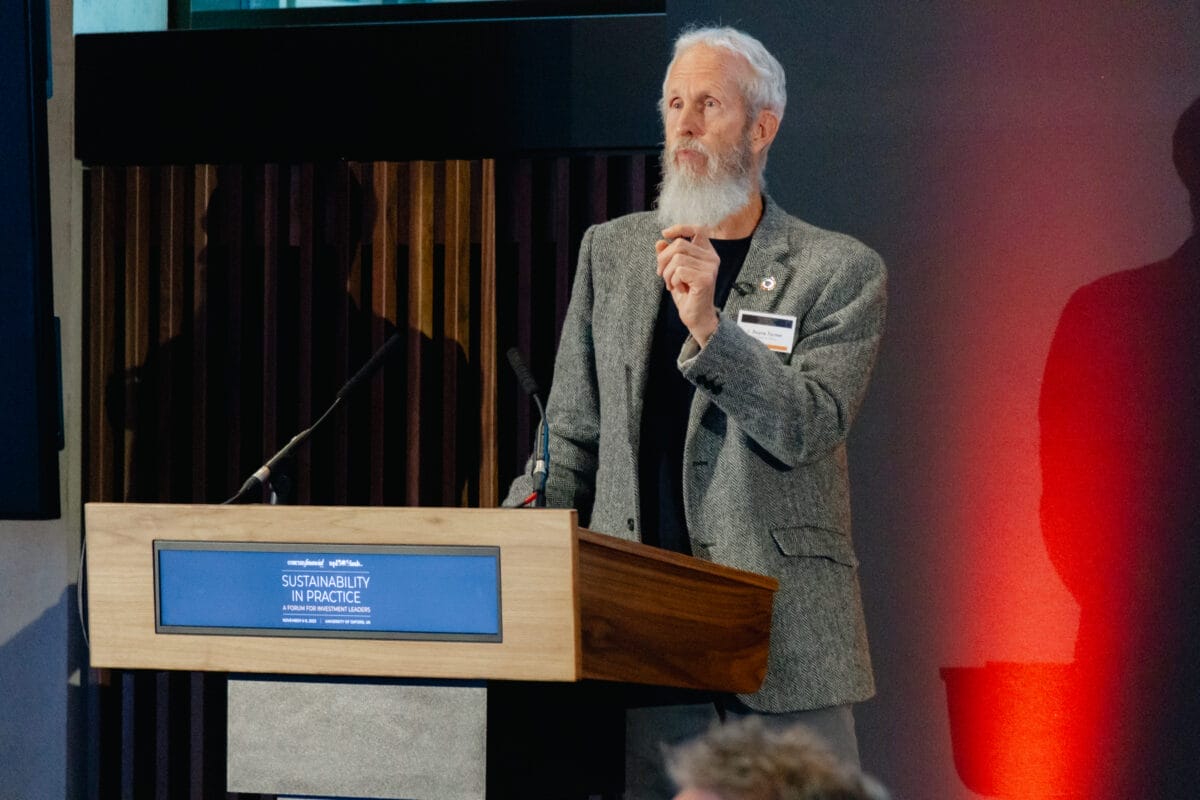

The world is shifting from a regime where climate change is viewed as a shared burden or a hot potato to pass around, to one where it is a “business opportunity that everyone should be scrambling to make money from,” according to University of Oxford Professor J. Doyne Farmer, citing probabilistic assessments by his team.
Drawing from complexity and systems theory, Farmer pointed to the growing deployment of technologies like solar energy, P2X fuel and batteries, and the falling cost of their usage over a long period of time.
“We have batteries coming down in cost quickly, we have windmills coming down in cost quickly, we have hydrogen-based fuels coming down quickly,” Farmer said. “So we have the technologies we really need dropping in price just when we really need them to deal with climate change.”
Technological change is “very inertial,” Farmer said. “Once a technology starts improving at a certain rate, it’s likely to keep improving at that rate for a long time.”
Professor J. Doyne Farmer is the director of the Complexity Economics programme at the Institute for New Economic Thinking at the Oxford Martin School, Baillie Gifford Professor in the Mathematical Institute at the University of Oxford, and an external professor at the Santa Fe Institute.
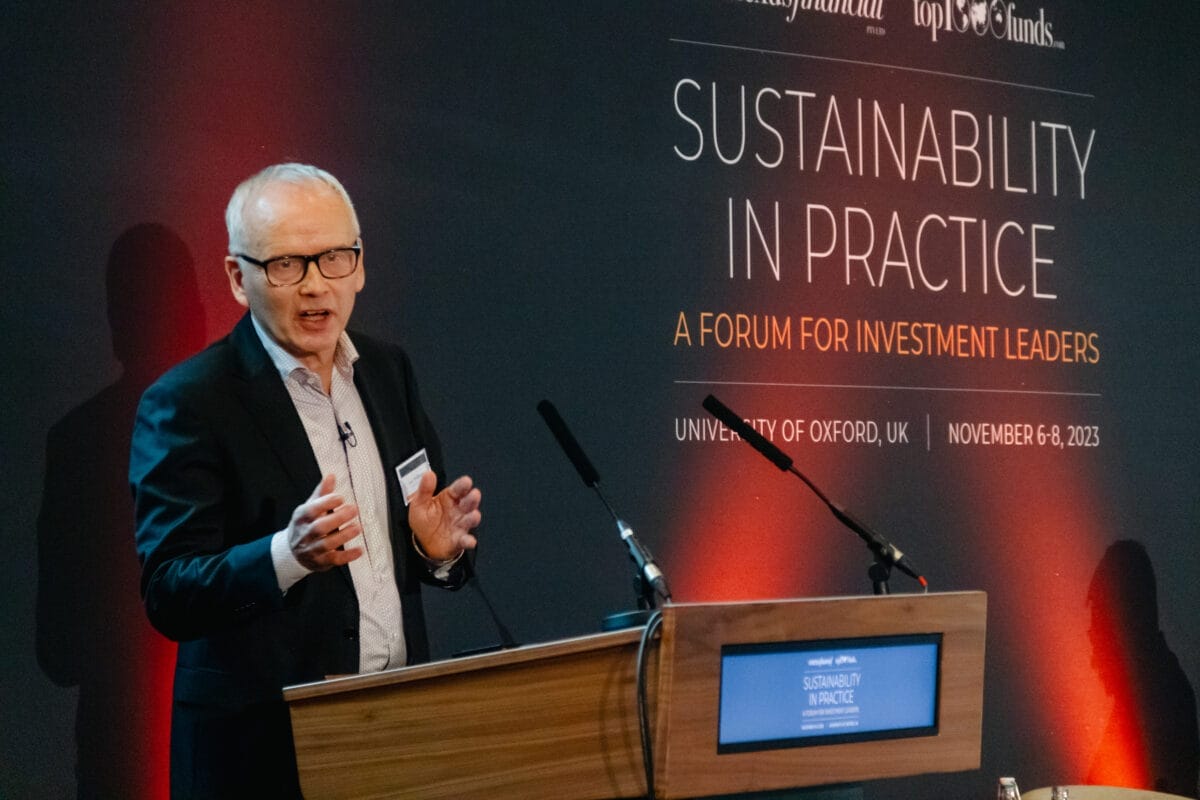
He was speaking with Stephen Kotkin, senior fellow at Stanford’s Freeman Spogli Institute for International Studies, and the Kleinheinz Senior Fellow at the Hoover Institution, at the Sustainability in Practice conference held at the University of Oxford this month, organised by Top1000funds.com.
The topic of the discussion was empirically validated probabilistic forecasts of energy technology costs, and the trillions of net savings that could result in a rapid green energy transition.
A range of predictions about technological change have turned out to be true, Farmer noted. Moore’s law from 1965 predicted computers would improve exponentially through time. Another observation from Theodore Wright from 1936 was that airplanes from a given factory drop in cost of production by about 20% every time the cumulative production of the factory doubles.
“This law turns out to be true for lots of technologies and not just at the level of factories, it turns out to be true globally as well,” Farmer said.
These laws can be used to predict the future behaviour and performance of technologies, “even if you can’t predict the innovations that will enhance future performance,” Farmer said.
Drawing from these findings, Farmer and his team developed a probabilistic method for forecasting technology costs based on historical data, by collecting data on 50 technologies, “pretending we were at some point in the past and making 6000 forecasts for different points in the future.”
They then applied their findings to three different scenarios for the green energy transition: one scenario being business as usual, one being a slow transition, and one being a fast transition.
Despite roadblocks such as political hurdles and land use issues, “greener energy will be widespread and substantially cheaper than energy has ever been in 20 years, with reasonable likelihood,” Farmer said.
“So this will bring us a lot of benefits. We’re going to have cheaper energy than we’ve ever had. We’re going to have lower volatility for energy prices. We’re going to have better energy security. We’re going to have low pollution. We’re going to have lower environmental impact and better sustainability. And most of all, no or minimal greenhouse gas emissions.”
By contrast, the “mainstream” way of doing forecasts practiced by the International Energy Agency and “integrated assessment modellers” has proved consistently wrong over time, Farmer said. “They just consistently were too pessimistic about how quickly the cost of renewables will drop and pessimistic about how quickly they would be deployed, even though the historical data should have been screaming at them.”







Leave a Comment
You must be logged in to post a comment.
Login