

If managers want to reinforce their long-term investor bona fides they should adopt appropriate time horizons for the investments they make, disclose more about how long they hold assets, and reconsider paying themselves based on short-term results. Only then will the interests of asset owners and the managers they employ be truly aligned.
In a world where short-termism is becoming increasingly prevalent, uncovering the truth around market value and company governance is increasingly difficult.
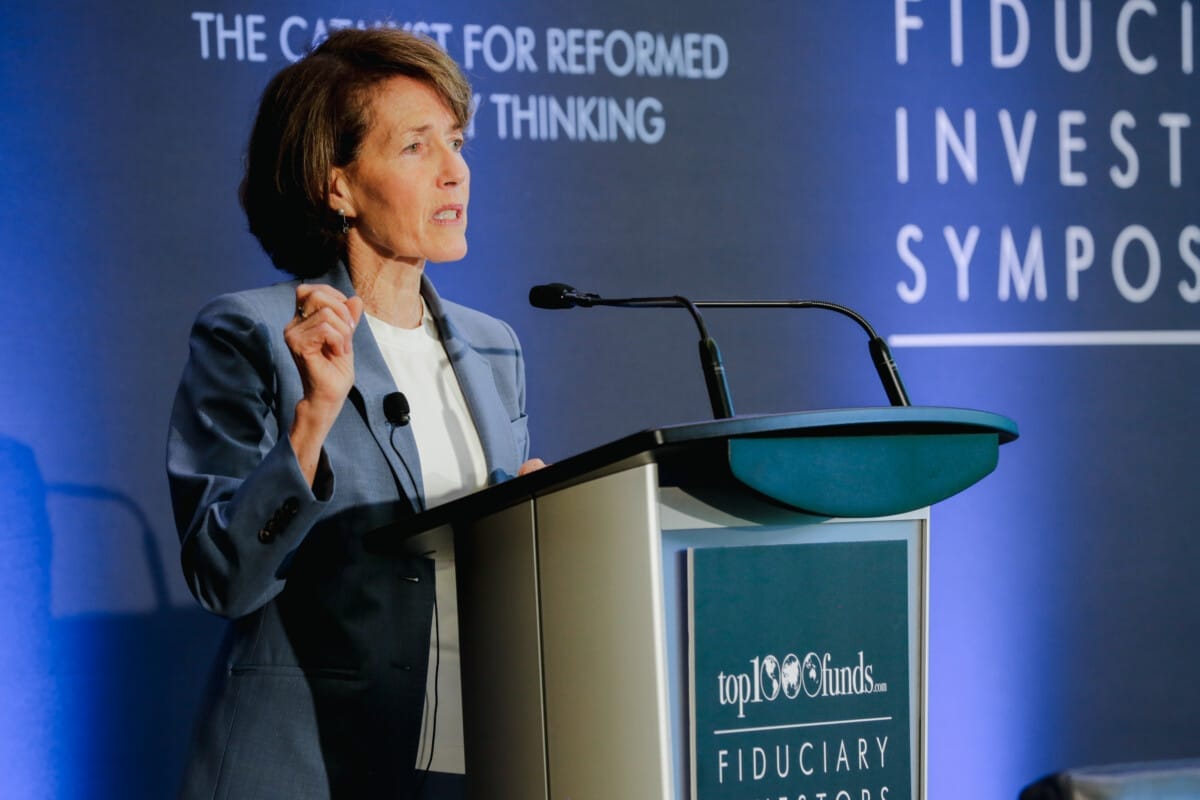
At the Top1000funds.com Fiduciary Investors Symposium in Toronto, MFS Investment Management president Carol Geremia said players in the investment value chain need to adopt different performance metrics and mindset if the industry wants to realign towards long-term value creation.
MFS is known for establishing the world’s first mutual fund a century ago and today has $606 billion assets under management.
Geremia told the symposium that managers today must take five times the level of risk to get the same amount of return as 30 years ago.
“We all know that rates are slowly changing now, but with them being so low for so long, we’ve all had to just dial up risk endlessly,” she said.
“Then what we did is build a measurement system as we took more and more risk to hold ourselves accountable. And we didn’t get longer with the risks we were taking, we actually got shorter.
“I’ve been in the business 40 years, and I’ve always learned that’s not how you take on risk – you extend your time horizons, you don’t shorten them. Yet, we’ve built this measurement system, because it’s so hard to figure out the markers to the longer-term destination.”
Geremia said it is time the industry considering adopting more comprehensive metrics such as the holding horizon, to encourage long-term thinking.
“You could go to every single active manager in the world and ask them ‘what is your average holding horizon of a stock inside your portfolio?’ That should be the number one statistic if we want to measure long term investing,” she said.
“The industry has now gone down to less than two years [of holding horizon]. Sorry, that’s not long-term. So if you say you’re long term [investors], prove it.”
Another approach is to set up an appropriate long-term incentive structure, Geremia said.
“I don’t think paying on short-term performance – if you’re going to say you’re a long-term firm – is aligned. So change your compensation metric,” she said.
“We did quite a long time ago – we do not pay on short term results. It changes how people are managing the money, there’s no question about it.”
However, Geremia said these measures are not justifications for short-term underperformance, but the start of a conversation that aims to address a gap in industry expectations.
Like most “long-term active fund managers”, she said MFS aims to outperform over a full market cycle. Most of the industry define that as seven to ten years, but most can only tolerate underperformance for three years.
“A full market cycle is not one, it’s not three, and it’s not five years, yet the industry has anchored to those periods of time.
“Being a long-term active manager in the public markets is really uncomfortable.
“It is high hurdles, and difficult to think about how we measure long term or hold each other accountable for the future.
“There are some great ideas out there, and I’m inspired with what collective work we can all do.”







Leave a Comment
You must be logged in to post a comment.
Login