
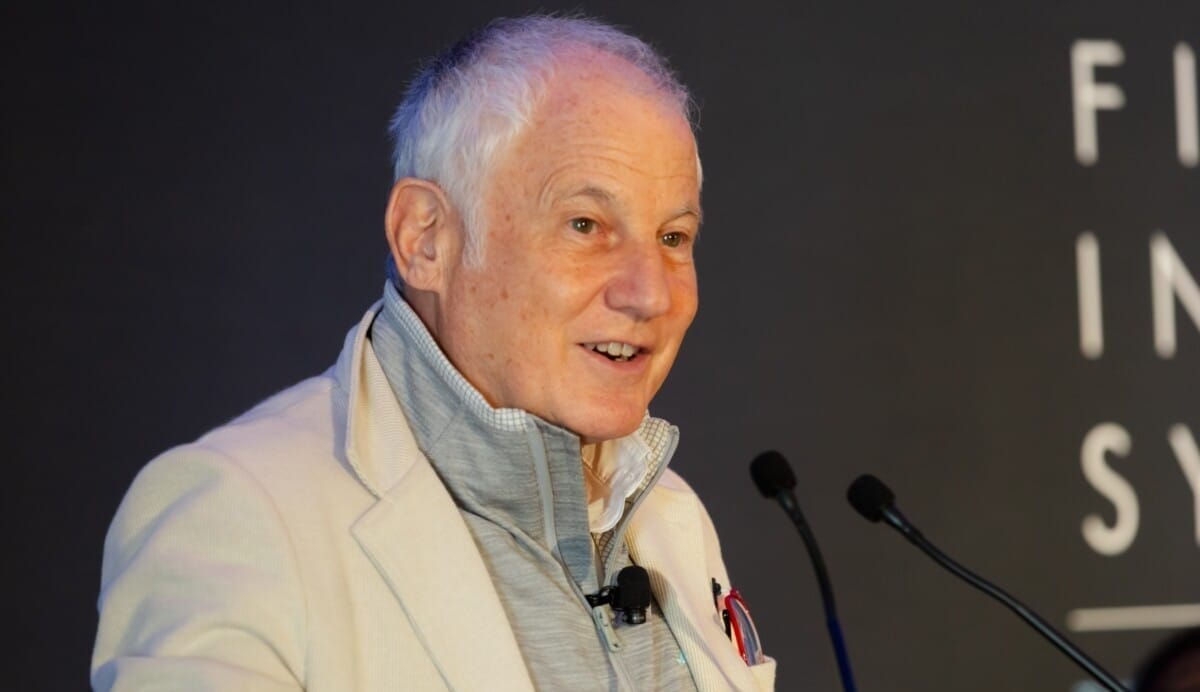

While war weighs heavily on the world’s mind and its portfolio impacts are acutely felt by investors, celebrated geopolitical expert Stephen Kotkin said there is another thing that troubles him even more in today’s society.
Speaking at the Fiduciary Investors Symposium in Singapore, Kotin, who is senior fellow at Standford University’s Hoover Institution, said the “decay of government” and the performance of politicians are what truly instil pessimism in his perspective.
“I want to regain the future,” he told the symposium. “We’ve lost the sense of the future. Many people are worried that things are going to hell, even when things are going okay or really good in their own life.
“Governance is performing badly across the world, including in democracies and the rule of law. There’s a deterioration in governance performance and in satisfaction and trust in institutions on the part of people.
“They’re angry, not just because they’re being bombarded with anger and incentivised to be angry… they’re also angry because things don’t work that well, and there’s a complicated explanation for why governance performance is going down.”
For one, politicians are no longer motivated to engage with complicated legislative processes and to bring about concrete changes. Instead, they are incentivised to take down the other side of politics and “be a celebrity” through sensationalist statements, Kotkin said.
“What used to be called politics or government, is now called trolling. [Politicians say] you know what? I’m going to invade Greenland,” he said.
“So let’s have a three month capture-the-world’s-attention over the invasion of Greenland. Has Greenland been invaded? No. Was Greenland going to be invaded? No, of course not.”
Secondly, governments around the world and notably the US are at administrative capacity with the number of priorities they have to deal with.
“Every time something happens, people say, ‘do something about that,’ so the government does something. It doesn’t really work, but it does something,” he said.
“The structures that were created to do something, they’re still there. They were created for one purpose, and then they persist way beyond that original purpose, and it’s very hard to take them away.
“The Elon Musk DOGE (Department of Government Efficiency) thing was ridiculous in execution, but it was exactly the right idea in the information technology communications revolution, [because] government has not been reinvented.”
But on a more positive note, Kotkin said the US splitting out as an increasingly independent actor from traditional alliances such as NATO is reminding middle-power nations to step up in the world.
In a recent visit to Australia, Canadian Prime Minister Mark Carney urged the two nations to act as “strategic cousins” to enhance security on a variety of areas including critical minerals, defence and trades. The two nations’ major pension funds also formed an alliance during the visit, pledging to invest more in each other’s economies.
“This middle-power horizontalism is underway. It’s been galvanised chaotically, nastily… I think it’s a really good thing. I don’t think it’s there yet,” he said.
“I see that Japan and Australia are becoming really close allies. I see Australia and the EU signed a trade pact and a security pact… I see a lot of really great things happening that should have happened way long ago.”
Kotkin urged investors to look to the structural trends that will outlast any president, individual policy or administration. The adjustments of global powers will be painful but will also throw out interesting investment opportunities, he said.
“I wouldn’t have rebalanced this way, but this rebalancing, there’s no way around that,” he said.
“We’re going to come out the other side, and then we’re going to see maybe [the result of] middle power [horizontalism] is we have a better balancing of what America is supposed to do, wants to do and can do. A lot of positives that could come out of this.”







Leave a Comment
You must be logged in to post a comment.
Login