
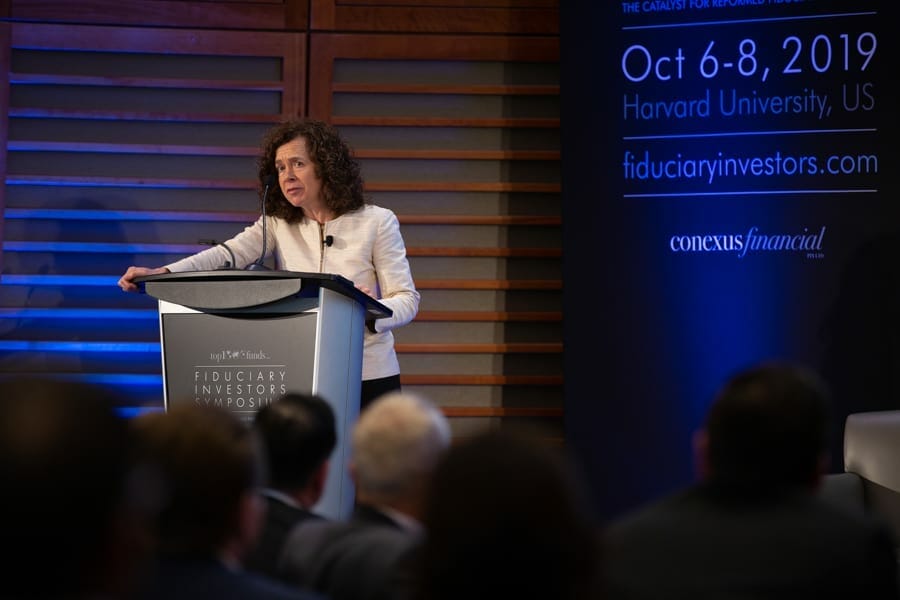

[vc_empty_space height=”10px”][vc_media_type_category]Rebecca Henderson, the John and Natty McArthur University Professor at Harvard University who co-teaches Reimagining Capitalism at HBS, says inequality is equal to climate risk in its potential impact. And she told delegates at the Fiduciary Investors Symposium at Harvard University when a system no longer generates freedom and prosperity it must be changed.
Fifteen years ago, Rebecca Henderson, the John and Natty McArthur University Professor at Harvard University, observed that climate change and all its implications represented a “train coming down the track.” Today, a new train is also fast approaching, this time in the shape of global inequality, she told delegates at the Fiduciary Investors’ Symposium at Harvard University.
Some inequality is good, observed Henderson referencing examples like entrepreneurship and fast-growing businesses streaking ahead of the pack. However, inequality is a problem under two circumstances: where it is a sign of a redistribution of wealth “rather than some people doing better but everyone else doing ok,” and when it starts to hurt aggregate demand.
“Arguably we have both problems now,” she said.
Although worldwide inequality has fallen, thanks mostly to growth in emerging economies like China where hundreds of millions of people have been pulled out of poverty, in the west it has risen dramatically. Most of that is in the US and the UK where the “people at the bottom” are not seeing any gains and falling behind. When the people at the bottom stop believing their life will improve, they grow less tolerant of others getting rich, and “of people who don’t look like them,” she warns. This breeds a feeling that elites have “rigged the game” in their own favour. It also breaks down trust in governments and institutions, leading to populism.
Solutions to inequality
Solutions to inequality are hard to come by. Massive, government-led investment in education, housing or infrastructure is the obvious magic wand. But a policy-led response requires a willing government prepared to put addressing inequality at the top of the agenda, and many governments are “seemingly unable to do anything,” she says. Collective pressure on political institutions could be one solution.
“When I say pressure, I don’t mean pressure to implement policies. I mean pressure to run decent institutions” she says. A proven solution to poverty is found through a balance of free markets and free politics that allows markets and politics to work in balance.
Well-known investor strategies to try and counter inequality like engaging with portfolio companies to pay fair wages and offer employee benefits make a “huge difference” – but they don’t solve the problem. Shadow workers remain outside that umbrella, and employee skills are changing.
“One of the big changes in the world is that the value of high-end skills has gone up in absolute terms,” she says. It means highly skilled workers are earning much more than others, as they are more productive. This leaves the unskilled workforce far behind, and no longer seeing the returns they used to.
“AI and automation make this worse,” she said. Elsewhere, young people struggle to compete, and immense competition makes it difficult to get to the top. Meanwhile education and social ladders are blocked.
Getting the investor community to work together is also a tough challenge. In the “prisoner’s dilemma” investors tend to wait for others to go first. Investing to try and counter inequality is expensive, and investors have returns to make.
“There is a serious collective action problem,” she said, adding that investors also question if they can make a difference when it comes to tackling inequality. The challenges of collective action (and the need for that to be backed up by government policy) are visible in the fight for sustainable palm oil. Many firms have clamped down against using unsustainable palm linked to de-forestation in their supply chains. However, a majority of firms have never signed up to the initiative. Moreover, without government action nothing really changes.
“You need governments involved because you need penalties,” she said.
In a first step, individual firms and investors should begin to invest to improve equality.
“Investors can help firms transition by investing in companies trying to take the high road.”
They can instruct their asset managers to only invest in firms paying better and freeze out those that aren’t, in a “collusion” across the economy. However, she also noted the damaging impact of a yawning productivity gap. This leaves the most productive firms in the average industry more than twice as productive as the least productive firms. Much of that productivity is driven by governance, with publicly listed firms typically more productive than family-held firms. In the top tier, productivity is driven by team-work and promotion based on ability, she said.
Firms that have engendered relationships based on trust with their workers and paid decent wages are most inclined to change. These are “high purpose firms” driven by morals and passion that have the confidence to take risks. A strong voice for labour is another essential requisite in the change process.
“Inequality is accelerating because there is no organised voice on the other side. If we don’t improve our institutions and policies, we lose the whole game.”
Investors also need to be able to measure improving equality, she said. “Finding the right metrics and time frame is hard.” Another challenge comes from the uneven playing field. Companies may increase their wages and invest locally, but without overarching policy, their competitors aren’t subject to the same standards. “It would help if everyone in the industry did the same thing,” she said.
Henderson ended on an encouraging tone. Post WW2, Germany embarked on a new model that combined labour and business in support of education, sills and fair wages that still works today. Further afield in Mauritius, business and labour have worked together since independence in 1968. “A first requirement of development is decent jobs for people at the bottom, and this has helped make Mauritius one of most successful countries in Africa.”
When a system no longer generates freedom and prosperity it must be changed. Change is possible because we have the resources and technology to do it and should be tackled firm by firm, industry by industry, country by country, she said. “It feels to me like we are just waiting,” she said. “Everyone knows what needs to happen; they are just reluctant to move.”







Leave a Comment
You must be logged in to post a comment.
Login