
Global CIO survey: lowered expectations

Connecticut-based financial services management consultant, Casey Quirk, and institutional investment specialist publication, top1000funds.com, joined forces in a global chief investment officer survey to measure the sentiment of asset owners, and the extent to which the 2008 crisis has had an effect on the behaviour of internal investment teams, their outlook and corresponding asset allocation. With combined assets of around $5 trillion, pension funds, sovereign wealth funds, endowments and insurance funds all participated in the survey.

Since 2008, nearly half of the respondents (45.7 per cent) had revised their investment performance targets, with a review of objectives and expectations resulting in lower target returns.

Respondents were asked about the impact the crisis had on five aspects of investing: the investment target return, investment benchmark or policy portfolio, a focus on tactical asset allocation or hedging overlays, a dedicated tail-risk allocation, and time spent on manager research.

More than half of the respondents have increased their focus on tactical asset allocation or hedging overlays since the 2008 crisis. Some of the funds surveyed had implemented factor-based asset allocation and an active hedge overlay and, in particular, had moved towards a more dynamic asset allocation approach. And about 20 per cent of respondents had introduced a specific dedicated tail-risk allocation.

Partner at Casey Quirk, Daniel Celeghin, says the renewed focus on dynamic asset allocation and investment policy changes is very consistent with what the consultant has seen in other research.

“The discussion about dynamic asset allocation use before the crisis was settled. Funds would set their strategic asset allocation and not be market timers, they would trust the long-term and rebalance in a disciplined fashion,” he says. “That question is back open to debate. This survey very definitely shows large asset owners, globally, are willing to give dynamic asset allocation another try.”

Sponsored Content

Downward revision of benchmarks

A related trend, also demonstrated in the survey results, he says is the revision of the target benchmark or policy portfolio. “If you’re going to be doing dynamic asset allocation then your bogey, you’re tying to it also changes. A lot of benchmarks were set many years ago when real interest rates were much higher, and you could get 5 to 6 per cent.”

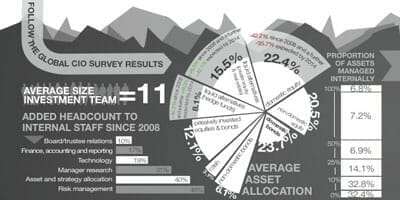
Celeghin says no matter what the policy portfolio is supposed to reflect – be it expected liability, peer risk, or an output of risk tolerance and asset allocation – the benchmark is coming down. Indeed one of the most significant changes measured in the survey was the number of respondents (60 per cent) who had revised their investment benchmark or policy portfolio as a result of the 2008 financial crisis. Within that revised policy, there was a noticeable decrease in domestic equities (42.2 per cent of respondents had decreased this allocation), and an increase in illiquid alternatives (46.3 per cent) and hedge funds (38.5 per cent).

In the next two years this trend will continue. Domestic equities allocations are expected to decrease further: 35.7 per cent of all respondents said they would decrease these allocations, and 42 per cent of those who had already decreased allocations would decrease them further.

Of those who responded, 42.1 per cent said they would increase both hedge funds and illiquid alternatives in the next two years. Of those who had already increased the allocations, 60 per cent said they would continue to increase their allocation to hedge funds, and 63 per cent said they would continue to increase their allocation to illiquid alternatives.

2012 Global CIO Survey Infographic

(Click to expand.)

The ins and outs of management

When it came to assessing managers, the number-one attribute as ranked by the respondents was investment leadership or the people that ran the manager, this was followed by investment performance, thought leadership, market perspective, portfolio construction advice, ownership, incentives and remuneration and finally client service and support.

Two thirds of the respondents managed at least some assets in house, with 7 per cent managing 100 per cent internally. But 41 per cent of respondents said they expected the amount of assets managed in house to increase in the next two to three years.

Cash (51 per cent) and domestic bonds (42 per cent) were the most likely assets to be managed in house, with non-domestic equities and hedge funds the most likely assets to be managed externally.

While cost was the most likely reason for managing assets in house (37.2 per cent of respondents), it was followed quite closely by control (30.2 per cent). Of the investors surveyed, the cost of external managers was much greater than internal investment resources. The most likely cost of external managers was 50 to 100 basis points (41 per cent of respondents) while more than 75 per cent of respondents spent less than 10 basis points on internal management.

With regard to asset allocation and portfolio construction decisions, the overwhelming majority (71.4 per cent) said they would rely more on internal staff, rather than consultants or asset managers, in the next four years. Since 2008 about 40 per cent of investors have reported spending more time on manager research, which has come in the form of more RFPs, more indepth correlation analysis, using the consultant and manager database information more comprehensively, and as part of a function of performing diligence on a broader range of strategies.

“This survey implies that asset managers globally need to evolve their offerings. Institutions will gravitate towards managers that have a clear role in helping meet their overall return objective, preferably in a fee-efficient manner. This could mean managers with expertise in dynamic asset allocation and risk management, as well as managers that have been able to consistently deliver returns that are uncorrelated to the broader public markets,” Celeghin says.


Leave a Comment

Long term lens shields Colorado from private credit jitters

Long term lens shields Colorado from private credit jitters

As concerns in private credit mount, Colorado PERA CIO and COO Amy McGarrity says the pension fund isn’t seeing any strains in its growing allocation to the asset class, arguing that long-term investors are shielded from the risks because they can lock up their capital to weather market cycles.

Sort content by

Coal moves to holistic management

The COVID crisis and the volatility of 2020 has revealed some lessons for the investment team at Coal Pension Trustees (CPT). It has taken a more top down view of managing its portfolio looking at economic themes, risk exposures, cashflows and its manager roster holistically. Amanda White talks to CIO Mark Walker about where it sees return opportunities, the prospect of manager consolidation and how it has embraced technology for better investment practices.

Simplicity rules in South Carolina AA

Executives at the South Carolina Retirement System pulled off a previously unimaginable task in 2020, conducting a complete review of the fund’s asset allocation, simplifying its portfolio, negotiating with suppliers, and gaining approval from the commission, all while working entirely remotely. Amanda White speaks to executive director Michael Hitchcock about the new portfolio and the process of getting there.

Concern about hidden inflation risk: AP4

Driven by active return, AP4 produced a stellar 9.6 per cent in 2020. But its chief executive, Niklas Ekvall remains cautious about the economic outlook and its impact on the portfolio, especially with regard to inflation.

USS takes advantage of dislocations

The largest single pension scheme in the United Kingdom, USS, took advantage of the dislocation due to COVID in 2020 and has bought credit assets and increased inflation and interest rate hedging.

OTPP, SSGA and USS reflect on the future

Three investors reflect on the what lies ahead highlighting a buoyant 2021 but challenges beyond. Their suggestions include allocations to real assets and diversifying out of traditional fixed income as they navigate portfolio construction considerations in a new investment paradigm.

NZ Super debates currency risk

NZ Super's recent five-year reference portfolio review saw much debate over currency risk, with the discussion elevating to the board - an unusual situation for the fund whose internal IC usually makes recommendations to the board.

Previous



