
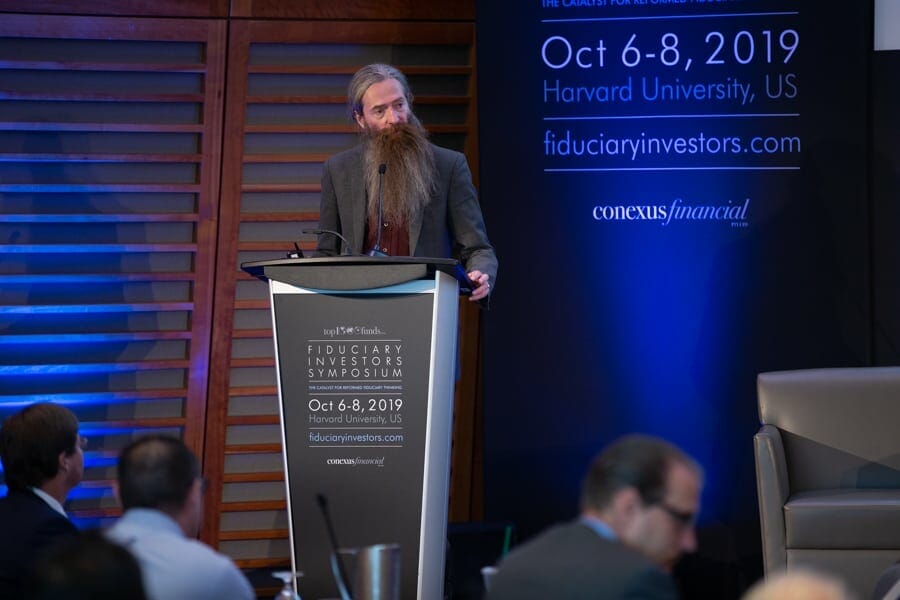

Understanding the economic implications of changing demographics is essential for investors, said Aubrey de Grey, a biomedical gerontologist speaking at the Fiduciary Investors’ Symposium at Harvard University. De Grey, who is also the chief science officer of SENS Research Foundation, a California-based biomedical research charity, warned gathered delegates that they need to urgently position for people living much longer.
“The implications will change your outlook on the future. You need to understand and believe the actual logic of what is coming,” he said.
He noted that medical advancement has eliminated many of the problems that used to kill people when they were young. For example, better hygiene saves lives the world over. In contrast, health problems in later life are still killing many of us in an enduring ageing process. Simply defined, this sees our metabolism generate damage over the years that cause accumulative changes over time. We can only tolerate so much change; inevitably we go down hill until we die, he said. Today the majority of medical effort is concentrated on geriatric medicine and managing the consequences of this ageing process. Yet attacking the consequences of something that is accumulating is the wrong way to approach the problem.
One focus is on preventative measures that look to slow our metabolism and the ageing process. Here the effort is on making our metabolism run so that it generates less damage.
“But this is ineffective as our metabolism is complicated,” he said, noting that it was difficult to “tweak a system to stop the creation of damage.”
Another approach is to separate the aging processes and periodically repair the damage that metabolism creates. This way, even though damage is being generated, it doesn’t reach a threshold of abundance. In what he called a “paradigm shift” this line of thought is now becoming mainstream. Using an everyday analogy – with the obvious caveat that the human body is more complicated – he said periodic repair is something we already do with our cars.
“A 100-year old car, only designed to last 10 years, is still there because of preventative maintenance.”
He said the damage to our metabolism through life can be classified into categories, and for each classification we can develop a way to repair the damage. For example, to prevent cell loss resulting in the harmful division of cells, we can put cells back via stem cell therapy.
Financing these kinds of pioneering techniques, and other breakthrough ideas offers investors real opportunities.
“We have got to the stage where we can spin out projects into start up companies to take damage repair forward,” he said. “Pay attention in terms of investment opportunity.”
He added that “longevity is a side effect of health” and that the ageing process can be combated so that people will live much longer in the future than what they do today.
“Most people just say they will believe it when they see it, and get on with their short life,” he said. Instead, he urged long term investors to think differently and grasp the nettle. These therapies that eliminate aging will be available to the masses soon, with “people in the room” personally benefiting.
He said that investors needed to think about how people living longer will affect consumer behaviour and investee companies.
“Think about the mindset of the people spending money and buying the products that the companies you invest in are creating.”
This leads to questions around the different choices people make when they spend money, he said. Some people are after instant gratification, other purchases are made in expectation of the future and how long we are going to live, stay productive and earn money.
He urged investors not to think about how soon new therapies will be available but how soon they will be anticipated. He said that once the consensus changes to wide acceptance that we will live longer, “there will be a step change in public opinion.” Warning delegates that if they are not ready they “will go bankrupt overnight.”








Leave a Comment
You must be logged in to post a comment.
Login