In this episode Amanda White talks with engagement specialist at Robeco, Peter van der Werf, about the importance of engagement; what good engagement looks like; and what financially material sustainability themes are important right now.


About Peter van der Werf
Peter van der Werf is engagement specialist, covering the consumer staples, healthcare and chemicals sectors. His areas of expertise include impact investing, labor rights, supply chain management, access to medicine and nutrition and social and environmental issues in the food and agri sector. He is an advisory committee member of a number of PRI working groups such as agricultural supply chain, sustainable palm oil and deforestation. He gained over four years of professional experience in business development in frontier markets before joining Robeco in 2011. He holds a Master’s in Environmental Sciences from Wageningen University.

About Amanda White
Amanda White is responsible for the content across all Conexus Financial’s institutional media and events. In addition to being the editor of Top1000funds.com, she is responsible for directing the global bi-annual Fiduciary Investors Symposium which challenges global investors on investment best practice and aims to place the responsibilities of investors in wider societal, and political contexts.  She holds a Bachelor of Economics and a Masters of Art in Journalism and has been an investment journalist for more than 25 years. She is currently a fellow in the Finance Leaders Fellowship at the Aspen Institute. The two-year program seeks to develop the next generation of responsible, community-spirited leaders in the global finance industry.

Sustainability in a time of crisis is a Top1000funds.com podcast collaboration with PRI, with support from Robeco

Sustainability issues have never been more important than they are right now. How can investors work together to use this unprecedented opportunity to put the promise of purpose-driven leadership and stakeholder capitalism into practice? This collaborative work with the PRI, with the support of Robeco, will showcase leadership in sustainability during a time of crisis.

The Canadian model, revered world over for its supreme pension management, is not low cost despite that being one of its oft-described traits. New research by CEM Benchmarking and McGill University shows that these funds are cost efficient, rather than being low cost.

The Canadian Pension Fund Model: A Quantitative Portrait, looks at the success of the Canadian model and estimates that, by managing a high proportion of assets in-house, Canadian funds reduce costs by approximately one third. However they spend those “savings” on larger internally-managed portfolios; and even though they have less external management, they spend more than their peers on external managers.

The paper shows that on average Canadian funds spend 18 basis points on internally managed portfolios, compared with 7 basis points for their peers. And they spend 121 basis points on their externally managed portfolios, versus 86 basis points for their peers. Examples of expenses include risk management units and IT infrastructure where Canadian funds spend more than their peers by a factor of five. And the paper shows that these patterns hold true within each asset class and style.
Chris Flynn, one of the authors of the paper, says it is not always appreciated that while the large Canadians save money by having large internal management, they don’t put those savings in their pockets.

“They are saving because the way they manage money is efficient. They have a high cost asset allocation and high use of active, so they are high cost. Fundamentally they believe they can do things themselves more cost effectively. Their main driver is not for low cost, but for high net performance,” he says.

Associate Professor of Finance at McGill University and co-author, Sebastien Betermier, says the portfolio allocation of Canadian funds is drastically different from other funds.

“There is a complete restructuring of the portfolio away from external management which allows savings, and they take those costs and redirect them and reinvest in all levels of portfolio management. They spend more within the internal portfolio and with external. They have less external but it tends to be more specialised, niche investments and when they do invest externally, they invest a lot and spend a lot,” he says. “They restructure the assets towards those that are more difficult to manage and expensive. They also have a big push to strategic assets and that kills two birds. They have higher efficiency and do a better job of hedging the liabilities. Canadians have twice the share of real assets as other funds.”

This is the third distinctive feature of large Canadian funds – alongside managing assets in-house to reduce costs and redeploying resources to investment teams – the allocation of capital towards assets that increase portfolio efficiency and hedge against liability risks. These assets not only include commodity producer stocks but also real estate and infrastructure.

“We find that, with the cost savings that result from the internal management of assets, Canadian funds are able to allocate 18 per cent of their AUM to real assets, which tend to be more expensive to manage than stocks and bonds. In comparison, non-Canadian funds allocate just 9 per cent of their AUM to real assets,” the paper says.

CEM’s Flynn says this is a lesson for US public pension funds which he describes as “leaving asset liability opportunities on the table”.

“They look too much at the assets. They would benefit from looking closer at the Canadian approach in this regard. The Canadians don’t have the same regulatory restrictions, but they think in terms of asset liability matching and they are willing to take some risk.”

Altogether, these findings reveal a three-pillar business model that goes beyond a simple combination of professional in-house management, scale, and asset diversification the paper says.

It is an integrated model that enables large Canadian funds to spend more on each asset class and allocate more capital to strategic assets while spending less than their peers. On average, Canadian funds spend 57 basis points of their AUM each year to run their fund whereas non-Canadian funds spend 62 basis points.

“We find that by having more internal management and re-allocating the savings internally Canadians spend much more on risk management and their total expenses are higher by an order of magnitude,” Betermier says.

The authors, who also included Alexander Beath and Quentin Spehner, were surprised by the fact that this business model is pervasive among the Canadian funds regardless of size.

“What surprised me was the extent to which the small Canadians look like the large Canadian funds,” Flynn says. “The small Canadian funds trend towards a larger infrastructure allocation versus US funds, and they internalise sooner that US funds.”

On average the smaller Canadian, those with less than $10 billion, have around 13 per cent managed internally, which is much lower than their larger fund compatriots, but a lot more than the average non-Canadian small fund which is about 3 per cent internally managed.

The authors contribute this to a number of cultural factors.

The model started with the larger funds and then with the movement of labour from one fund to the other the characteristics that have worked get replicated.

In addition Canadian funds are all very young so the way they are designed from a governance point of view, and the investment environment in which they were formed specifically with regard to low interest rates, impacts their risk profile.

Lastly the model is normalised in Canada, and all funds want to act like the leaders. That is an easier conversation to have with a board, that you just want to look like your peer group.

It is often argued that an investor who is dissatisfied with a company’s ESG behaviour, and who wishes to remedy the situation, should stay on as a shareholder and engage with it. The reasoning is that when an investor divests, their influence over the company ceases. Moreover, the act of divesting is often presented as a passive approach that has no bearing on the company’s management, a capitulation rather than a form of action.

In a recently published paper (ESG Engagement and Divestment: Mutually Exclusive or Mutually Reinforcing?) we contend that both divestment and engagement are actions that promote change.

Divestment is a force of change when it directly and indirectly contributes to raising the cost of capital for divested companies: this limits their ability to invest in projects the investor deems harmful and gives their management an incentive to improve their ESG performance.

Lower share prices also reduce the value of management’s share-based remuneration, thereby giving top executives an incentive to integrate ESG considerations.

There is some uncertainty on what proportion of equity investors need to divest for the cost of capital to increase and some researchers have pointed to a proportion of more than 20 per cent, which would set a high bar for effective divestment campaigns.

Note however that the proportion of assets invested according to at least one type of ESG strategy has, by 2018, topped the 20 per cent bar in all developed equity markets except Japan (Global Sustainable Investment Review, 2018).

As two thirds of these ESG invested assets follow an ESG strategy that includes normative or negative/exclusionary screening it appears plausible that at least some industries have seen their cost of capital increase due to the implementation of large-scale divestment policies.

There is also some empirical evidence that the announcement of ESG-related divestments may negatively impact stock prices, both through direct impacts on share prices and indirect reputational impacts which participate in creating new norms.

The effectiveness of divestment campaigns, such as the fossil-free divestment movement, could be reinforced by a strong non-linear relationship between the proportion of investors that divest and the impact on share prices/cost of capital, through tipping points that suddenly break any linear relationship.

Properly managed and executed engagement can also contribute to improvement in the ESG performance of investee companies. The empirical results of academic studies thus indicate that both engagement and divestment approaches can be effective in achieving the desired ESG outcomes.

We also argue that these two strategies are entirely compatible: in particular, the rise of collaborative engagement campaigns, in which current and potential shareholders combine their forces, is testimony to the fact that divestment does not put an end to an investor’s possibility to engage with a company.

Divestment and engagement are hence not mutually exclusive.

And a shareholder who engages with a company without signalling a willingness to draw a red line – by exit in case engagement fails – will enter the negotiation in a weak position: the possibility of divestment is in that sense a prerequisite for effective engagement.

Conversely, engagement can make divestment campaigns more effective: noisy exits can be more impactful than silent ones. Therefore, far from being mutually exclusive, both engagement and divestment are mutually reinforcing.

Divestment is often wrongly reduced to two ESG-filtering-based strategies, namely norms-based screening and negative/exclusionary screening.

Proponents of ESG mixing strategies – ie so-called ESG integration strategies whereby ESG data and analysis are mixed with traditional financial inputs in the portfolio construction process – often claim that ESG mixing is more compatible with engagement than ESG filtering, on the grounds that ESG mixing does not lead to divesting.

However, contrary to common perception, ESG mixing strategies – such as over/underweighting based on ESG scores or using portfolio-average ESG scores as a constraint or objective in an optimiser – also lead to divesting based on ESG scores.

This is apparent in the two practical examples of investment processes that mix ESG data with market capitalisation weights and/or traditional factors (value, profitability etc.), which we will now study. And while ESG filtering sends unambiguous and predictable – and therefore actionable – signals to all companies, we will show that ESG mixing strategies send blurred – and therefore less effective – signals.

ESG mixing strategies

Compared with ESG filtering, ESG “reweighting” techniques lead to the divestment of companies with better ESG credentials and sends blurred signals.

One simple example of an ESG mixing strategy consists of applying an ESG tilt to index constituent weights. In the simple case where an ESG metric is used to tilt market-capitalisation weights, ESG reweighting leads to greater divesting from companies with better ESG performances than filtering would, to reach the same ESG target.

In the context of low-carbon strategies, for example, reweighting leads to divesting from companies that are less carbon-intensive than filtering would, for the same reduction in portfolio-weighted average carbon intensity.

To illustrate this point, in Figure 1 below we have ranked the companies in the Scientific Beta Developed equity universe at end 2019 in terms of carbon intensity (as per the definition endorsed by the Financial Stability Board, i.e. the ratio of a company’s Scope 1 and 2 emissions to its revenues).

We then compare the proportion of companies that needs to be impacted by the decarbonisation divesting scheme to reach the same decarbonisation target: all strategies achieve a similar level of weighted-average carbon intensity as the filtering out of the 5 per cent most carbon intensive companies, i.e. the same as a reweighting strategy where a 100 per cent weight reduction of the 5 per cent most carbon-intensive companies is permitted. The X-axis thus represents the severity of the reweighting allowed, the Y-axis plots the proportion of stocks affected by the partial divestment strategy in order to achieve the same carbon exposure reduction as the full divestment strategy. We also show the one-way turnover that the decarbonisation scheme entails to reach its target.

Figure 1: Proportion of stocks affected by divestment (%) and induced turnover (%), as a function of the weight reduction (%) allowed for carbon-intensive companies.
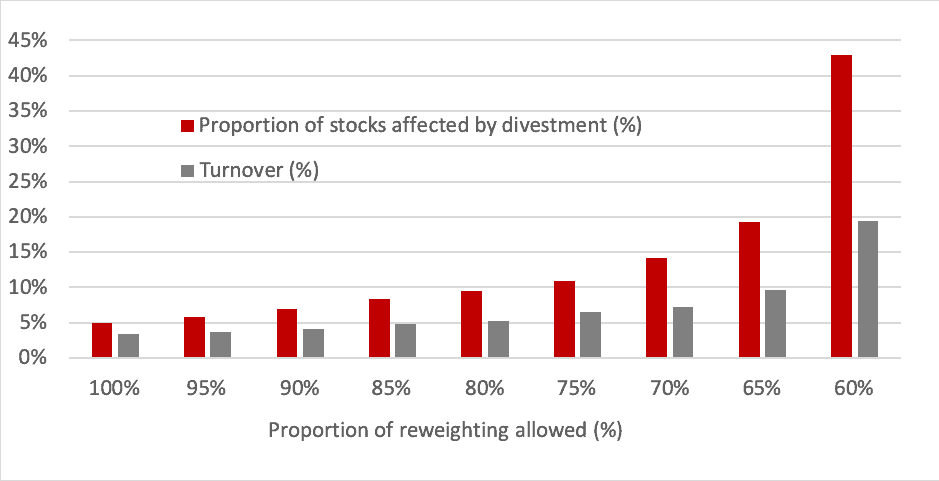
While the filtering strategy by construction leads to divesting the 5 per cent of stocks with the worst carbon intensities, the re-weighting strategy needs to divest from 43 per cent of the stocks if a 60 per cent weight reduction is allowed for, for example, in order to achieve the same level of weighted-average carbon intensity reduction.

By spreading out the divestment more thinly across more stocks, the price impact through which divestment is meant to influence companies’ behaviour will be less significant for the worst ESG performers. Moreover, contrary to a common perception that re-weighting is a less intrusive portfolio construction technique than filtering, re-weighting may induce a larger turnover to reach the same weighted-average decarbonisation target: while the filtering strategy creates a 3 per cent turnover, the re-weighting strategy with a 60 per cent weight reduction, for example, creates 19% turnover.

Another problem with such an approach is that, while divesting from high carbon emitters on average, the weight of a stock in a portfolio can increase over time if the stock is performing well relative to the others, irrespective of the carbon-intensity levels or change in carbon intensity.

To illustrate this point, we construct a portfolio that weights securities based on the product of market-cap and a carbon intensity score.

Table 1 provides the analysis that highlights the signalling problems with this score-weighting approach.

Firstly, while the weighted-average carbon intensity of this portfolio is reduced by 84 per cent relative to the cap-weighted index, on average over the five-year period we consider, the portfolio leads to problematic positions in individual stocks.

Indeed, it increases the weight over time towards more than 30% of the stocks that fall into the category of the “worst emitters”, i.e. 10 per cent of the stocks with the highest carbon intensity.

Table 1: Percentage of deteriorators and worst emitters receiving higher weights in score-weighted portfolio.

Scientific Beta United States
Carbon intensity * market cap weighted portfolio
Percentage of deteriorators  with increasing weight Percentage of the worst emitters (10%)  with increasing weight
2015 47% 41%
2016 41% 61%
2017 48% 44%
2018 40% 40%
2019 48% 33%
The analysis is based on the Scientific Beta United States universe, from June 2014 to June 2019. Each June, we exclude coal stocks and classify the remaining stocks into deciles according to their carbon intensity over the previous year. Carbon intensity is the sum of scope 1 and scope 2 emissions divided by total revenue. Carbon stocks are the ones that (1) belong to the coal industry or derive turnover of at least 30 per cent from thermal coal mining, (2) belong to the utility industry, which makes significant use of coal in its power generation fuel mix (30 per cent), and (3) own coal reserves, except those in the iron and steel industry. The worst emitters are those classified within the highest decile, i.e. top 10 per cent after exclusion of coal companies. The deteriorators are those classified within a higher decile compared to the previous year. The reported figures correspond to the percentage of stocks among the worst emitters and deteriorators that have a higher weight in a score-weighted portfolio than in the previous. The score-weighted portfolio weights securities based on their score times the market-capitalisation. Scores are transformed into a cumulative distribution function of the normalised (truncated z-Score at 3 and -3) Carbon Intensity measures.

Moreover, while score-weighting clearly sends wrong signals to the worst emitters, it also happens to be the case when it comes to the firms that increase their carbon intensities.

We extend the previous analysis by focusing on firms that had significantly increased their carbon intensity relative to its equity universe. If a firm moves from one decile of carbon intensity to a higher decile, we refer to such firms as “deteriorators”.

Here again, the score-weighted portfolio would increase allocation to more than 40 per cen of the deteriorators. These illustrations above indicate that using firm-level scores to tilt towards low-carbon-intensity stocks leads to a blurred message to firms.

Yet another way to send mixed signals

The problem with score-based approaches is only magnified when multiple stock-level information is mixed, in particular when using portfolio-optimisation techniques to respect both ESG/low-carbon and factor exposure objectives.

Such approaches can lead to even greater increases in weights among the worst emitters. This is intuitive even without looking at the results, since optimisation will only care about the average carbon intensity across the portfolio.

Moreover, such mixing approaches also consider other stock-level characteristics, such as factor scores or contribution to tracking error. Pursuing the low carbon objective and other objectives simultaneously can lead to increasing weights to a firm even if its carbon emissions have become much worse over time.

To illustrate the point, we construct a stylised multi-factor portfolio that minimises the tracking error with respect to the broad cap-weighted index, while achieving a similar level of factor-score intensity (sum of individual factor scores) and carbon intensity to a low carbon smart beta strategy which simply excludes the 10 per cent worst emitters. In this illustration, this reference strategy is a low carbon HFI multi-beta 6-factor equal-weighted portfolio, constructed in a top-down manner on a decarbonised universe (excluding the worst 10 per cent emitters).

Unsurprisingly, the optimisation-based portfolio leads to a substantial reduction in weighted-average carbon intensity compared to the cap-weighted index.

During the period we consider, this reduction amounts to 74 per cent on average. Despite this reduction on average, the strategy leads to problematic weights in the worst-offending stocks. The results in table 2 confirm that the optimisation-based portfolio would increase the weight of the worst emitters quite often. For example, each year between 2016 and 2018, the optimisation-based portfolio allocated higher weight to more than 60 per cent of the stocks that were among the worst emitters in the universe. We also observe that, in certain years, allocation across more than 10 per cent of the worst emitters is higher than that of the cap-weighted index.

Table 2: Percentage of worst emitters receiving higher weights in optimisation-based portfolio.

Scientific Beta United States
Low Carbon/multi-factor optimisation-based portfolio
Percentage of worst emitters (10%) with increasing weight Percentage of worst emitters (10%) with higher weight than the Broad Cap-Weighted Index
2015 18% 2%
2016 61% 0%
2017 69% 4%
2018 69% 12%
2019 17% 10%


For more details on this research, please refer to the following publication: ESG Engagement and Divestment: Mutually Exclusive or Mutually Reinforcing?

Erik Christiansen is an ESG and low carbon solutions specialist at Scientific Beta.

In conversation with Fiona Reynolds, chief executive of the PRI, this episode looks specifically at some of the activities of the PRI and its engagement with stakeholders around COVID-19, their ESG priorities and what a sustainable recovery looks like.

Importantly it looks at how to prioritise the long and short term considerations and priorities for investors and what they can be doing to actively shape a sustainable future.

The PRI is working on a new framework to guide investors on the next iteration of sustainable investing, and how to incorporate outcomes or impact into decision making and measurement of investments.

The PRI is also evolving its reporting framework to actually make it more difficult to get the top rankings. It will have new minimum requirements and be more aligned with the SDGs and that new framework will be rolled out in January.

The COVID-19 global health and economic crisis has highlighted the need for leadership and capital to be urgently targeted towards the vulnerabilities in the global economy.

The issues of sustainability have never been more important, and it’s an essential time for investors to be collaborating for better corporate behaviours and economic outcomes. This series explores these issues as well as the actions that investors can take to ensure the recovery is a sustainable one

About Fiona Reynolds

Fiona Reynolds is responsible for global operations. She has more than 20 years’ experience in the pension sector, working in particular with the Australian Government, and has played a key role in advocating pension policy change on behalf of working Australians. She has a particular interest in retirement outcomes for women. Prior to joining PRI, she spent seven years as chief executive at the Australian Institute of Superannuation Trustees, an association for Australian asset owners. Reynolds has been a director of AUSfund, Industry Funds Credit Control, the United Nations High Commissioner for Refugees, and Women in Super. In September 2012, she was named one of Australia’s top 100 women of influence by the Australian Financial Review, for her work in public policy. Reynolds also serves on the International Integrated Reporting Council, the council for Tomorrow’s Company, the Global Advisory Council on Stranded Assets at Oxford University, and the Business for Peace steering committee.

See PRI’s papers at www.upri.org

About Amanda White
Amanda White is responsible for the content across all Conexus Financial’s institutional media and events. In addition to being the editor of Top1000funds.com, she is responsible for directing the global bi-annual Fiduciary Investors Symposium which challenges global investors on investment best practice and aims to place the responsibilities of investors in wider societal, and political contexts.  She holds a Bachelor of Economics and a Masters of Art in Journalism and has been an investment journalist for more than 25 years. She is currently a fellow in the Finance Leaders Fellowship at the Aspen Institute. The two-year program seeks to develop the next generation of responsible, community-spirited leaders in the global finance industry.

Sustainability in a time of crisis is a Top1000funds.com podcast collaboration with PRI, with support from Robeco

Sustainability issues have never been more important than they are right now. How can investors work together to use this unprecedented opportunity to put the promise of purpose-driven leadership and stakeholder capitalism into practice? This collaborative work with the PRI, with the support of Robeco, will showcase leadership in sustainability during a time of crisis.

Amanda White looks back at the past six months, how investors have reacted and what change is yet to come.

When the chaos caused by the COVID-19 health pandemic and related economic maelstrom first started, the biggest discussion investors were having was about risk.

Investors were looking at risk not just in the context of market volatility but more fundamentally what risk is for long-term investors, and a lot of that has to do with liquidity.

Many of the CIOs are focusing on liquidity in the context of rebalancing but also in order to have dry powder to take advantage of the opportunities in a disrupted market.

Some examples of that are:

  • The $60 billion Pennsylvania School Employees Retirement System that in April sold $1 billion of US long treasuries to rebalance to its 6 per cent allocation, which was pushed out by the equities market volatility
  • Many of big long-term investors have been “leaning in” to the opportunities presented by the market volatility, including the $100 billion State of Wisconsin Investment Board which has moved its stance from defensive to offensive
  • The Investment Management Corporation of Ontario, which was only formed about two years ago and manages C$70 billion, being quick to invest in credit and working with Apollo to invest in mispriced credit risk. It only took about six weeks to allocate the capital.

Of course, there are many examples of investors that have lost a lot and bounced back:

  • The London Collective Investment Vehicle, the pooling manager for the pension assets of London’s 32 boroughs with about £18 billion, lost around 15 per cent in April alone
  • New Zealand Super, which has a portfolio that is about 80 per cent equities, lost 20 per cent from December to March. The second time in 18 months its portfolio has undergone such a loss.

There are a couple of important lessons in this:

  • Good governance is everything – so that funds can stay focused on the long term and not react to market movements and make bad decisions, or be distracted by stakeholder management
  • Rebalancing is an opportunity – which again comes back to liquidity
  • And maybe some of the investment assumptions used in the past may not be applicable in the future.

A continued concern for investors – particularly in the US – has been where they’re going to get their returns from.

This is especially  true for larger investors where the smaller opportunities in hedge funds or distressed debt might not impact their overall portfolio too much just because of size.

CalPERS, for example, has assets of $400 billion and a return target of 7 per cent. Their former CIO Ben Meng had a plan to use leverage to get further into private equity. This received a lot of criticism in the public domain and it is unclear since Meng’s resignation if this plan is still on track.

Portfolio resilience

Nearly all the conversations I’ve had over the past few months have involved a conversation around scenario testing.

Perhaps the best at incorporating this into their process is CPP Investments  – one of the world’s most sophisticated pension funds, employing about 800 people and managing a lot of assets internally and direct. Optrust, another Canadian fund, is concentrating on building a resilient portfolio designed to withstand all environments. And it stress-tested its current portfolio under thousands of different macro scenarios.

But overall while investors have been looking at opportunities there is also a consensus that things will get worse before they get better.

According to CPP Investments global economic activities will not be back to pre-COVID levels until 2022 and they expect the situation to get worse before it gets better.

Related to resilience is a conversation around trust.  The CEO of GIC, the Singaporean SWF, Chow Kiat Lim, talks about how the pandemic has revealed examples of how companies have been able to take bold actions because they have built trust over many decades.

Investors expect their investee companies to be positioning their business for the continued difficult economic conditions and what resilience looks like. If companies have trust – from their workers, partners, suppliers and investors – they can take bolder actions to be resilient in difficult times.

This is a lesson for investors and their service providers too. Working together for a common goal, with shared beliefs and shared interests, is important more than it has ever been. A low return environment, combined with general market uncertainty – extending beyond investment risk to operational risks – is the perfect time for service providers to be proving their worth.

Sustainability 2.0

Investors have been focusing on engagement and active stewardship, and with Climate Action 100+ proving to be an effective, collaborative model many investors are also looking at how they engage for change around labour rights with regard to companies’ treatment of workers and stakeholders.

Investors are moving their stewardship activities to COVID-related disruption and the Investor Statement on Coronavirus response is an example of the priorities.

New research by the Responsible Asset Allocator Initiative at New America finds that the top investors are actively allocating capital to COVID-related issues. It shows that the 25 leading public pension and sovereign wealth funds, with assets of $6 trillion, are investing tens of billions of dollars in COVID-19 solutions and in funds to support stricken companies.

This is a sign that many investors are taking sustainability issues more seriously, perhaps one of the silver linings of this pandemic. And in particular the move to sustainable investing 2.0 which is an evolving framework from risk/return to risk/return/outcome is a discussion among leading investors.

The PRI is working on a new framework to guide investors on this exact thing, and how to incorporate outcomes or impact into decision making and measurement of investments.

The PRI is also evolving its reporting framework to actually make it more difficult to get the top rankings. It will have new minimum requirements and be more aligned with the SDGs and that new framework will be rolled out in January.

With fires raging in California and continued racial injustice in the United States there is plenty to think about in terms of sustainable investing. The Sustainable Development Goals, which celebrate five years in September, continue to be a guiding path for investors and are a clear indicator of what the global risks are and where capital needs to be directed.

Harvard endowment is the latest investor to commit net zero by 2050 and a big part of their plan is how they work with external managers to achieve that. Over the past seven years or so HMC, which manages the endowment, has moved from external investment management to internal and now is working towards external again.

Anne Simpson, who is the head of sustainability at CalPERS, says it’s important for investors to think about whether climate change is a portfolio issue or systemic issues. CalPERS has approached it as a systemic risk partly because of the size and influence of their portfolio.

CalPERS is involved in Climate Action 100+ which is a focused list of the biggest emitters. Those companies would be third largest emitters if they were a country after China and the US. The fund is also increasingly looking at different asset classes including fixed income with regard to climate.

Nigel Topping, who is champion of COP26 – and will speak at the Sustainability 2020 Digital conference – says COP26 will be the first time that people wake up to the fact this transition is inevitable.

He says the world is finally waking up to the fact that some business models and cultures are not fit for the future. Topping said an example of that is the behaviour and accountability of Rio Tinto executives in choosing to destroy 46,000-years old Aboriginal rock shelters in order to access iron ore.

But this transformational change will not happen in a linear way and that the herd mentality of the finance industry could mean it misses the early signs of transformational change and gets caught out.

“So basically, if you’re not ahead of the curve, you’re choosing to be behind the curve because an exponential curve is always ahead of you,” he said.

He added that investors have been the last to be held to account by the rest of the world on these issues, and the next decade will see corporate CEOs fed up with banks, fund managers and asset owners telling them what to do but not having their own house in order.

There is much more change to come.

Sustainability Digital 2020: A Planet in Trouble

The COVID-19 global health and economic crisis has highlighted the need for leadership and capital to be urgently targeted towards the vulnerabilities in the global economy. The issues of sustainability have never been more important and it’s a critical time for investors to be collaborating for better corporate behaviours and economic outcomes.

According to the IMF, more than $20 trillion is needed over the next 20 years to be invested in climate change and other sustainable development goals. But countries can not achieve this on their own. Governments need to make it easier for business to finance and invest in sustainable development projects, the private sector needs to mobilise for long-term investment, and new solutions for financing the SDGs must be created.

This conference is an urgent call to action for all investors to influence investee companies to change their focus and put people before profits to create a more sustainable economy, and to wake up to the crucial role they play in ensuring a sustainable recovery.

Through case studies of investors and corporate collaboration, investors will hear how their peers have been engaging for change on issues relating to the environment, labour practices and better long-term outcomes. The conference will address the social and economic consequences of the coronavirus and outline the role that investors can play in the path to a sustainable economy.

The conference will address the social and economic consequences of the coronavirus and outline the role that investors can play in the path to a sustainable economy.