The Responsible Asset Allocator Initiative (RAAI) at New America finds that 25 leading public pension and sovereign wealth funds, with assets of $6 trillion, are investing tens of billions of dollars in COVID-19 solutions and in funds to support stricken companies.

One thing the global COVID-19 pandemic has made abundantly clear is that healthcare policy and economic policy are inextricably intertwined. We have seen tremendous damage inflicted on the global economy, not to mention terrible loss of life, as many elected officials have been unable and sometimes unwilling, to respond to the crisis with steadfast leadership and effective policies.

Asset owners charged with safeguarding national wealth and growing long-term savings cannot afford to sit on the sidelines during this pandemic. They must adapt their environmental, social and governance (ESG) frameworks to respond effectively to the crisis or suffer potentially far-reaching consequences in their portfolios. The pandemic is forcing asset owners to recalibrate their thinking about the financial system and its fragility in the face of shocks that threaten the collective well-being of society.  Such risks include not only disease, but also social injustice, racial inequality, and climate change.

COVID-19 TRACKER

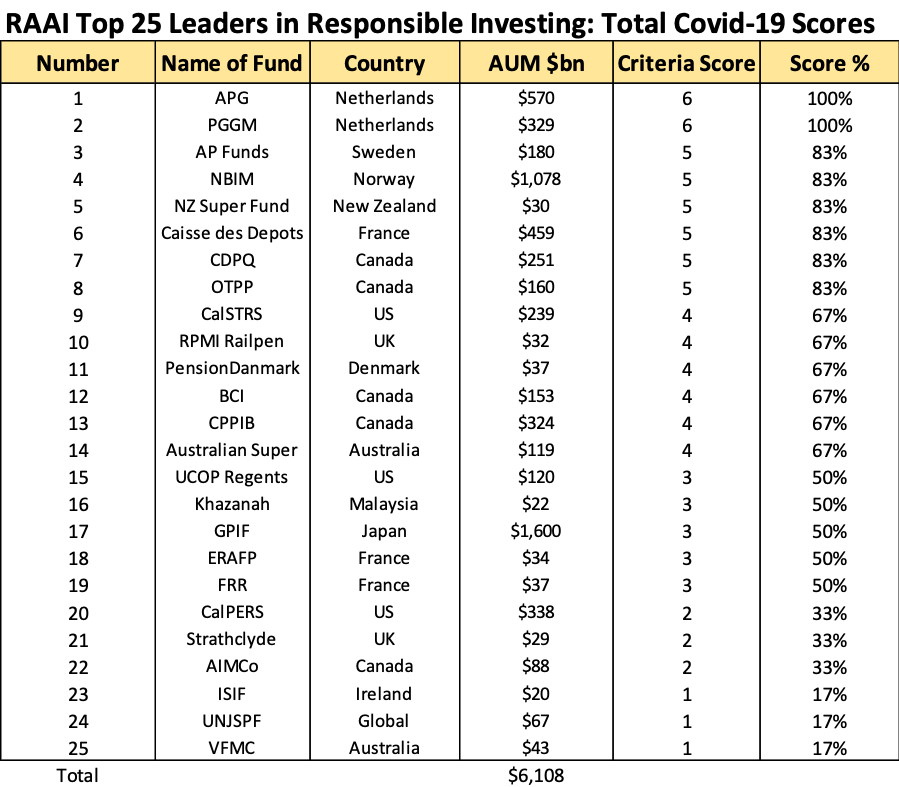
The Responsible Asset Allocator Initiative (RAAI) at New America analysed how the top 25 RAAI Leaders in responsible investing are responding to the COVID-19 crisis. The RAAI found that the leaders, composed of public pension and sovereign wealth funds controlling $6 trillion in AUM, are adapting their ESG frameworks to meet challenges created by the pandemic. The RAAI created a “COVID-19 Tracker” looking for actions taken in response to the crisis under six ESG criteria:

  1. Disclosure: Is the asset allocator providing critical disclosures to stakeholders and beneficiaries on business continuity during the crisis?
  2. Commitment: Is the asset allocator sticking with its responsible investing principles and maintaining a long-term investment horizon?
  3. Intention:  Is the asset allocator adapting its portfolio to respond effectively to the Covid-19 crisis?
  4. Accountability:  Is the asset allocator supporting portfolio companies that prioritize employee safety, job security, and relief for supply chains, even at the expense of short-term profits? Is it holding companies accountable?
  5. Partnership: Is the asset allocator working with others to fight against the pandemic?
  6. Impact: Is the asset allocator investing in Covid-19 solutions, for example tests, equipment, and medications? Is it supporting local businesses or global firms impacted adversely by the crisis?

Only four to six months have passed since COVID-19 became a global pandemic, but already most of the asset allocators tracked in the RAAI study are moving quickly to adapt their ESG frameworks and take concrete actions in the fight against COVID-19.

Over two thirds of the asset allocators tracked in the study reiterated their commitment to ESG principles and long-term investing, provided critical disclosures to stakeholders on COVID-19, adjusted their portfolios in response to the crisis, and joined partnerships in the fight against the pandemic. Most impressively, one third of the asset allocators examined had already invested tens of billions of dollars into COVID-19 solutions and into funds to support companies stricken by the pandemic. The pandemic is leading asset allocators to take a hard look at investing more heavily into the “S” factor in their ESG frameworks, in addition to environmental considerations.

TRACKER RESULTS

Topping the list of RAAI leading asset allocators responding to the pandemic were two Dutch pension funds APG ($570 billion) and PGGM ($329 billion), who both scored a perfect 100 per cent across the six criteria in our COVID-19 tracker.  Other top scoring asset allocators in the fight against COVID-19, included the AP Funds ($180 billion) of Sweden, CDPQ ($251 billion) and OTPP ($160 billion) of Canada, Caisse des Depots ($459 billion) of France, NBIM ($1.1 trillion) of Norway and New Zealand Super Fund ($30 billion).

Disclosures on business continuity: 21 of the 25 Leaders tracked, or 84 per cent, provided information on office closures, pension payment schedules, withdrawal or contribution options during the crisis, and links to helpful websites on COVID-19. CDPQ gets special mention for imposing a salary freeze and postponing bonus payments for senior executives, to show solidarity with beneficiaries during the crisis.  AP3 ($45 billion) of Sweden took a contrarian view, publishing a statement urging an early reopening of the economy, in March 2020, despite the coronavirus.

Commitment to ESG and long-term investing:  75 per cent of the asset allocators analyzed stressed maintaining a long-term approach to investing, sticking with ESG principles and investing in a sustainable recovery during and after the crisis. For example, NBIM published a guide for voting on sustainability issues and GPIF ($1.6 trillion) of Japan published a stewardship report. Other asset allocators doubled down on climate change action, including PensionDanmark ($30 billion) of Denmark which committed to a renewable energy fund, and RPMI Railpen ($32 billion) of the UK which invested in wind farms.

Intentionality and portfolio adjustments: 84 per cent of funds took actions such as adding or reducing risk in response to the crisis, searching for unique investment opportunities and shifting exposure to asset classes. For example, Australian Super ($119 billion) of Australia shifted to credit and private equity in response to the crisis while Caisse des Depots adjusted its housing portfolio. NBIM continued its exclusion program, eliminating more coal and energy companies from the portfolio while PGGM expanded its investment into healthcare.

Making portfolio companies accountable: only four, or 16 per cent of the 25 asset allocators examined, showed support for companies taking socially responsible actions that could have negative impacts on short-term performance.  For example, APG demanded that Amazon account for worker safety measures during the pandemic while AP4 ($46.4 billion) of Sweden expressed willingness to forego dividends from companies hurt by COVID-19.

Partnerships against COVID-19: two thirds of the Leaders joined collaborative efforts in the fight against COVID-19. For example, over 100 Canadian CEOs, including BCI ($153 billion), CDPQ, CPPIB ($324 billion) and OTPP, signed a letter urging Canadian firms to care for employees during the crisis even though “this could have significant economic impact on businesses in the short term.”

Another example, four asset allocators, AustralianSuper, BCI, APG and PGGM formed a coalition to launch a green ESG investing tool during the period.

Impact investing in COVID-19 solutions: a third of the asset allocators tracked are investing into COVID-19 solutions and into funds to support companies impacted by the crisis.  For example, CDPQ established a C$4 billion fund to support Quebec businesses temporarily affected by the COVID-19 pandemic;  ISIF ($20 billion) from Ireland created a €2 billion fund to support medium and large Irish firms; APG invested over €550 million in COVID-19 bonds;  Khazanah is considering investing up to $1.2 billion into hard-hit Malaysia Airlines; and Caisse des Depots of France not only issued a COVID-19 bond but also is investing up to €42 billion in listed French companies impacted by COVID-19.


Scott Kalb, is director and Marina Guledani is senior fellow at the Responsible Asset Allocator Initiative.

Despite good words and intentions, corporate and government support for the UN’s Sustainable Development Goals is falling behind.

  • The flow of capital and tangible action needed to deliver on the United Nations’ (UN) Sustainable Development Goals (SDGs) has fallen well below target.
  • The UN estimates that the successful delivery of the SDGs could ultimately add US$12 trillion to the global economy, alongside 380 million new jobs.
  • The latest report from the World Business Council for Sustainable Development reveals that while 84% of member companies referenced specific goals in their sustainability reports, only 15% had aligned their business strategy to specific target-level SDG criteria
  • The money currently raised for SDG delivery goes largely to existing activities or entities, rather than bringing together new entities designed to deal with a specific issue.

Despite the near ubiquitous presence of the United Nations’ (UN) Sustainable Development Goals (SDGs) in the latest investment and corporate reports, the flow of capital and tangible action needed to deliver on them is behind target, with an estimated US$5 to 7 trillion of annual expenditure needed if pledges are to be fulfilled.

Our view is that the SDGs clearly make enormous economic sense, with the UN estimating that their successful delivery could ultimately add US$12 trillion to the global economy, alongside 380 million new jobs.[1] In a world beset by the challenge of recovering from the Covid-19 crisis, this would represent a much welcome growth opportunity.

Action Not Words

Increasing enthusiasm for sustainable investment has led to a greater awareness of the role of the SDGs in potentially identifying exciting new areas for growth and mitigating risk, as well as opportunities for corporate engagement. While the SDGs have captured the imagination of many in the investment and corporate worlds, actions have often belied good words.

For us, achieving a sustainable future is as much about minimizing harm as it is about delivering solutions. Investors keen to burnish their sustainability credentials have often been too ready to use the SDGs as a convenient label that focuses on existing activities, and only then on positive associations. The same charge can be levelled at companies that rarely get beyond the headline goal in the relevant SDG. A simple test to see if many of these references are simply a case of ‘SDG washing’ is to see if there is any mention of the 169 underlying SDG targets – the granular opportunities backed by research – or the 231 unique key performance indicators used to guide measurement of whether the better outcome has been delivered.

Reporting Inconsistencies

The latest report by the World Business Council for Sustainable Development[2] illustrated the inconsistency across the corporate world when reporting on SDGs. While 84% of member companies referenced specific goals in their sustainability reports, only 15% had aligned their business strategy to specific target-level SDG criteria, and only 6% used the key performance indicators for measurement purposes. More concerning was that only 1 to 2% made reference to human rights in relation to the goals. This goes to show the extent to which the SDGs are used as a communicative tool rather than as a broader framework to support capital-allocation decisions.

Cementing Public and Private Sectors

In our view, using the SDGs as a simple mapping exercise renders them no more than a simple relabeling tool, replacing existing index or sector classifications. However, used well, the SDGs can selectively identify the areas of social and environmental deficit that investors and companies can address. The UN is aware that despite the growing adornment in reports making reference to the SDGs, more urgent action is needed over the next decade as we recover from the Covid-19 crisis. Partnership is a key element of the SDGs and, for the first time in living memory, we have an opportunity to cement an alliance between public and private sectors to mobilize capital given that reservations over government intervention in the economy appear to have been swept aside for now.

The UN Conference on Trade and Development (UNCTAD) set out six policy packages to help address the shortfall in sustainable finance that will only be exacerbated by the pandemic. In a world awash with liquidity, but short of attractively priced risk assets, this represents an opportunity for the financial sector to work in partnership with civil society to find innovative solutions to tackle some of the major issues in the global system.

Avoiding Past Mistakes

One mistake of the past has been to assume that the launch of a strategy aligned to delivering on the SDGs or ‘impact’ is what is needed to tackle an area of deficit. As we have discovered through the shortfall in funding the goals, the money currently raised goes largely instead to existing activities or entities, without delivering additional funding.

Our view is that a better approach is to acknowledge these global challenges that the SDGs seek to address, to develop solutions to them, and, subsequently, determine how these solutions can be funded. Once that is done, there will be investors – public or private or a combination – who can buy the instruments to support the delivery of the solution to a particular problem. The best impact strategies work on this basis, often in partnership with communities, local government or not-for-profit organizations.

Sources

[1] https://www.un.org/sustainabledevelopment/development-agenda/
[2] https://www.wbcsd.org/Programs/Redefining-Value/External-Disclosure/Reporting-matters/Resources/Reporting-matters-2019

Important information and disclosures

Any reference to a specific security, country or sector should not be construed as a recommendation to buy or sell this security, country or sector. Please note that strategy holdings and positioning are subject to change without notice.

Important information

This is a financial promotion. Issued by Newton Investment Management Limited, The Bank of New York Mellon Centre, 160 Queen Victoria Street, London, EC4V 4LA. Newton Investment Management Limited is authorized and regulated by the Financial Conduct Authority, 12 Endeavour Square, London, E20 1JN and is a subsidiary of The Bank of New York Mellon Corporation. ‘Newton’ and/or ‘Newton Investment Management’ brand refers to Newton Investment Management Limited. Newton is registered in England No. 01371973. VAT registration number GB: 577 7181 95. Newton is registered with the SEC as an investment adviser under the Investment Advisers Act of 1940. Newton’s investment business is described in Form ADV, Part 1 and 2, which can be obtained from the SEC.gov website or obtained upon request. Material in this publication is for general information only. The opinions expressed in this document are those of Newton and should not be construed as investment advice or recommendations for any purchase or sale of any specific security or commodity. Certain information contained herein is based on outside sources believed to be reliable, but its accuracy is not guaranteed. You should consult your advisor to determine whether any particular investment strategy is appropriate. This material is for institutional investors only.

Personnel of certain of our BNY Mellon affiliates may act as: (i) registered representatives of BNY Mellon Securities Corporation (in its capacity as a registered broker-dealer) to offer securities, (ii) officers of the Bank of New York Mellon (a New York chartered bank) to offer bank-maintained collective investment funds, and (iii) Associated Persons of BNY Mellon Securities Corporation (in its capacity as a registered investment adviser) to offer separately managed accounts managed by BNY Mellon Investment Management firms, including Newton and (iv) representatives of Newton Americas, a Division of BNY Mellon Securities Corporation, U.S. Distributor of Newton Investment Management Limited.

Unless you are notified to the contrary, the products and services mentioned are not insured by the FDIC (or by any governmental entity) and are not guaranteed by or obligations of The Bank of New York or any of its affiliates. The Bank of New York assumes no responsibility for the accuracy or completeness of the above data and disclaims all expressed or implied warranties in connection therewith. © 2020 The Bank of New York Company, Inc. All rights reserved.

In Canada, Newton Investment Management Limited is availing itself of the International Adviser Exemption (IAE) in the following Provinces: Alberta, British Columbia, Ontario and Quebec and the foreign commodity trading advisor exemption in Ontario. The IAE is in compliance with National Instrument 31-103, Registration Requirements, Exemptions and Ongoing Registrant Obligations.

Global economic activities will not be back to pre-COVID levels until 2022 according to CPP Investments’ outlook, with the giant Canadian investor expecting the situation to get worse before it gets better.

Speaking at a FCLTGlobal discussion on resilience, CPP Investments’ head of Asia Pacific, Suyi Kim said that long-term investors like CPP expect companies and leaders to prepare for the pandemic’s effects on their businesses.

“We are seeing negative news every day. It is proven that fear and insecurity shuts down our long-term thinking and creativity,” she said. “My advice to companies is to resist fear and seize the opportunity to come out of this crisis stronger.”

Kim pointed to the innovative behaviour of Starbucks during the 2008 financial crisis which was forced to close stores that were loss making when its customers reacted to the environment and opted for cheaper coffee.

“Importantly over the crisis they shifted their focus from bureaucracy back to the customer, and implemented new ideas based on free thinking and community involvement. Following the GFC their profits grew three times and their stock price went up more than four times.”

But while Kim encouraged optimism and confidence from corporate leaders, she said that needed to be coupled with realism and preparedness.

“We need to be prepared for the situation getting even worse and the recovery taking even longer,” she said. “When COVID first hit I was talking to portfolio companies and target companies and all of them were predicting their businesses would be back to normal by this summer, we know now that will not be. And despite support from central banks and governments the real economy is still very much struggling. We have seen the speed of the recovery slowing down.”

Also speaking on the webinar, Chow Kiat Lim, the chief executive of GIC said the pandemic had revealed examples of how companies have been able to take bold actions because they have built trust over many decades.

“If you have trust you should use it in times like this,” he said, spelling out that trust is made of two elements: competence and alignment of interest.

“If you have those two things then you get a lot of trust, which means you have the benefit of being able to take bolder actions. If you have trust behind you, then you can behave decisively. Leadership is making something happen that otherwise would not happen and to do that you need the trust of stakeholders so you can act on it.”

He said that competence is a matter of preparedness, in building resources and capabilities, and practice.

“A pandemic or any other form of dislocation of the day to day operations is something you can prepare for, create a business contingency. We have been doing that for more than 25 years. Every year we split the team to go somewhere else to see if computers work and the desk is functioning. Competence is one thread to build trust.”

But he also said alignment of interest was important and urged companies to look after the health, safety and wellbeing of their employees and stakeholders.

Resilience was about being able to recover quickly, he said.

“The pandemic teaches us not just to recover on your own, individual resilience is not sufficient, we need collective resilience,” he said pointing to the closing of borders as an example.

“Closing of borders is necessary to stop the spread of the disease, but yet as long as some countries are not able to have that under control then we are looking at prolonged periods of borders being closed, that is not good for business, the economy, jobs or investors,” he said. “It is drawing down our social capital and at some point we need to find a way to build it back up. Resilience requires us not having weak links, we need a collective way to be able to deal with it. If every organisation can internalise and think about these things, then collectively will have a lot of resilience coming out of this crisis.”

CPP Investments’ Kim also said the pandemic was an opportunity to build loyalty from employees, customer and suppliers.

“Employees are your key assets – take care of them and adapt to their needs,” she said.

CPP Investments has implemented a number of HR measures to adapt to the situation including special COVID days off, allowances for home office set up, and flexibility around returning to the office.

“Demonstrate compassion for suppliers and customers and ensure they too can quickly recover.”

Some active examples from CPP Investments’ portfolio of companies making concessions include a Hong Kong-based broadband network which was offering free broadband to underprivileged families and an Indian toll road company distributing food to migrant workers making their way back home from city to countryside.

The coronavirus pandemic sparked a surge of volatility across global financial markets. What lessons could investors draw from the COVID-19 crisis? In this paper, MSCI looks at five key lessons for investors:

  • Global investing provided diversification opportunities, as the crisis spread to different regions at different times and with varying intensity.
  • Managing factors was more critical than picking stocks, as cross-sectional dispersion due to factors rose more sharply than stock-specific volatility.
  • Markets have not been indiscriminate during the crisis; large performance variation across factors provided opportunities for active management.
  • Companies with strong environmental, social and governance (ESG) characteristics suffered lower declines in relative terms during the crisis.
  • Index-based strategies played a critical role in facilitating price discovery and providing tools that enabled investors to make asset allocation changes.


To read the paper click here

Five Lessons for Investors From the COVID19 Crisis

Andrew Siwo is the first director of sustainable investments and climate solutions at the $200 billion New York State Common Retirement Fund (CRF). Here he talks about the fund’s approach to ESG integration.

  1. How has the fund integrated sustainability?

In June of 2019, Comptroller DiNapoli released a Climate Action Plan, which provides a roadmap for CRF to address climate risks and opportunities across asset classes.

I manage the Sustainable Investments and Climate Solutions (SICS) portfolio, which aggregately is a $20 billion commitment to investments closely aligned to the UN SDGs. SICS began the year at $8 billion, and now the portfolio contains approximately $11 billion in capital commitments. SICS is a thematic portfolio consisting of investments in funds across nine sustainable themes split equally in three categories, which are: resources and environment, human rights and social inclusion, and economic development.

SICS portfolio contains sustainable investments across more than several dozen investments, such as managers that target reducing the effects of climate change through low carbon initiatives (climate and environment), target making resources more efficient (resource efficiency), as well as minimize pollution (pollution and waste management). Many of the fund managers included in the SICS portfolio target climate-related UN SDGs such as clean water and sanitation (SDG #6), climate action (SDG #13), and affordable and clean energy (SDG#7).

  1. How do you work with external managers?

An expectation of managers included in the SICS portfolio is that their core investment strategy advances at least one of the nine sustainability themes. This allows us to determine both the motives of managers we evaluate as well as distinguish eligibility for the portfolio. Another item that has worked well is that investments are underwritten in conjunction with the asset class teams to ensure uniformity in standards and expectations. Finally, we have a corporate governance team that leads ESG integration and monitoring. The team frequently communicates with managers to oversee how managers address ESG risks and opportunities. While ESG is not an asset class nor viewed as unique, we believe it is a tool that can improve risk-adjusted returns.

  1. Where have you found the biggest challenges?

Fundamentally, climate risk has proven to be an investment risk. We are aware that reliance on fossil fuels in the future can imperil an investment portfolio; as a result, investments in renewable energy (e.g. wind, solar) and less carbon-intensive sources can be a risk mitigant. When assessing prospective Green Bonds, for example, we review the prospectus to analyse the “use of proceeds,” third party ratings, and the overall goals of the issuer to ensure that there is alignment. Although standardization of climate or environmental data is often a challenge, disclosure has improved over the years leading to the axiom “what matters gets measured.”

  1. What lies ahead?

Due to Covid-19, the UN postponed COP26, which was to take place in the UK and focus on reducing the cost of clean energy. COP26 would have been the fifth anniversary of the Paris Agreement. In the most recent World Economic Forum Global Risks Report, “extreme weather events” was the number one risk, followed by “climate action failure.” Six of the top ten risks predicted to have the most significant effect are climate-related. It’s reasonable to ponder whether climate change moving forward will be deprioritized based on the attention of Covid-19, as well as the international reaction and social unrest from the extrajudicial slaying of George Floyd and other police-related tragedies.

Social factors, or the “S” in ESG, have historically been viewed to be on the sideline and have less predictive investment value than environmental and governance factors, however will likely be topical for the foreseeable future. While social factors have come to the fore recently, climate change taking a backseat is unlikely for two reasons: first, there is no other planet to run to. Second, the detriment of Covid-19 is expected to be measured in months/years as opposed to a more extended period that some expect to reverse the effect of climate change.

  1. What is your advice for your fellow asset owners?

The primary motivation for our investment actions is protecting the retirement assets of over one million members, beneficiaries, and retirees by seeking optimal risk-adjusted investment returns, as well as actively seeking and rigorously assessing investment opportunities. The awareness of ESG factors as well as engagement with managers and companies allows us to better evaluate risks and opportunities associated with secular trends that have emerged. In terms of advice, we are very open to and have partnered with various industry groups and field builders to strengthen our awareness of successful practices.

Andrew Siwo will be one of the speakers at the Top1000funds.com Sustainability Digital 2020 conference. To view the agenda and register, click here
