New research looking at the impact of COVID-19 under different scenarios – from opening of economies to no vaccine – suggests the economic consequences of COVID-19 under all scenarios is substantial and the ongoing economic adjustment is far from over.

The COVID-19 global pandemic has caused significant global economic and social disruption. In an article in March, the authors used data from historical pandemics to explore seven plausible scenarios of the economic consequences if COVID-19 were to become a global pandemic.

In this paper, Global macroeconomic Scenarios of the COVID-19 pandemic, they use currently observed epidemiological outcomes across countries and recent data on sectoral shutdowns and economic shocks to estimate the likely impact of COVID-19 pandemic on the global economy in coming years under six new scenarios.

The first scenario explores the outcomes if the current course of COVID-19 is successfully controlled, and there is only a mild recurrence in 2021. Then they explore scenarios where the opening of economies results in recurrent outbreaks of various magnitudes and countries respond with and without economic shutdowns. They explore the impact if no vaccine becomes available and the world must adapt to living with COVID-19 in coming decades. The final scenario is the case where a given country is in the most optimistic scenario (scenario 1), but the rest of the world is in the most pessimistic scenario.

The scenarios in this paper demonstrate that even a contained outbreak (which is optimistic), will significantly impact the global economy in the coming years.

The economic consequences of the COVID-19 pandemic under plausible scenarios are substantial and the ongoing economic adjustment is far from over.

Allocations to investments closely aligned to the United Nations 17 Sustainable Development Goals have grown from $8 billion to $11 billion at New York State Common Retirement Fund (CRF) so far this year. The public pension fund has committed to allocate a total of $20 billion of its $200 billion portfolio to SDG themes in a sustainable investments and climate solutions portfolio equally split between resources and the environment, human rights and social inclusion, and economic development.

“The sustainability portfolio contains funds that target reducing the effects of climate change through low carbon initiatives, making resources more efficient, as well as minimising pollution,” explains Andrew Siwo, director of sustainable investments and climate solutions at the public pension fund. “Many of the fund managers included in the sustainability portfolio target climate related UN SDGs such as clean water and sanitation (SDG #8), climate action (SDG #13), and affordable and clean energy (SDG#7).”

NY Common is not alone. Five years on since the SDGs were launched, an increasing number of investors are putting capital to work to earn returns alongside helping solve global scourges like the climate crisis, poverty and inequality. For example, Denmark’s PKA aims to invest 10 per cent of its $40 billion assets under management in green investments by the end of this year, equivalent to DKK 30 billion ($4 billion) and targeted to grow to DKK 50 billion ($7.9 billion) before 2030. Of this, an increasing portion includes a specific SDG fund in emerging markets.

“We have included the SDGs in our investment considerations,” says Dewi Dylander, deputy executive director at the Copenhagen-based pension fund. “We specifically focus on SDG 5, 6, 7, 8, 9, 11 and 13.”

Elsewhere, Dutch asset managers like APG have led the charge, crafting a strategy overseen by Claudia Kruse, managing director of APG’s responsible investment and governance that is rooted in the wishes of client fund beneficiaries wanting to align their investment with the SDGs.

Integrating sustainability via the SDGs is just one trend shaping the sustainability conversation within funds.

Sweeping new sustainability themes include the unprecedented opportunity to ‘build back better’ in the wake of the pandemic and the impact for investors of the EU’s new regulation on green investments, the first of its kind.

Meanwhile, asset owners are readying for the possibility of a new round of national pledges to cut emissions at next November’s rescheduled COP 26 gathering.

Unlike the SDGs, formerly adopted by world leaders in September 2015, stewardship has been around for years. Rather than “abandoning the investment”

PKA has been engaged in dialogue with investee companies to encourage change since 2007, says Dylander, who was formely the head of the department at the Danish Ministry of Climate.

“Our active ownership spans our exclusion, dialogue and observation lists. Overall, we believe that focusing on ESG considerations contributes to long-term value creation not only for us and our members, but also for the companies in which we invest,” she says.

It is the kind of active ownership championed by CalPERS’ Anne Simpson who led the fund’s ESG strategy and is a co-founder of Climate Action 100+, the investor collaboration to target and engage with the worst climate offenders. Stewardship, she has long argued, involves support and partnership and is not a soft option like divestment where walking away allows companies off the hook.

As stewardship packs more punch when asset owners collaborate, so success in other areas requires more collaboration. For Siwo, one of the biggest challenges inherent in sustainable investment is sifting through the abundance of data. “When assessing prospective green bonds, for example, we look through the prospectus to analyse the ‘use of proceeds’ as well as third party ratings and the overall goals of the issuer to ensure that there is alignment. There is a lot of information available and determining the material performance drivers is a continued challenge.”

Siwo also flags the possibility that investors’ focus on sustainability and climate could lose out to the new prominence of “S” issues within ESG following the pandemic, despite the World Economic Forum Global Risk Reports naming extreme weather events as the number one risk.

“It’s reasonable to ponder whether climate change moving forward will be deprioritised based on the attention of COVID-19, as well as the international reaction and social unrest from the May extrajudicial slaying of George Floyd and other police-related abuses and tragedies.”

However, he concludes that while the “S” in ESG has come to the fore, climate change is unlikely to take a backseat.

“First, there is no other planet to run to. Second, the detriment of COVID-19 is expected to be measured in months and years as opposed to decades – or even a century – that some expect to reverse the effect of climate change.”


Dewi Dylander, Andrew Siwo, Claudia Kruse and Anne Simpson are all speakers at the Top1000funds.com Sustainability Digital 2020 conference which will run online from September 8-9. To view the agenda and register, click here

At the beginning of this year the chief investment officer of the C$70 billion ($53 billion) Investment Management Corporation of Ontario (IMCO), Jean Michel, was talking with his team about the strategy for the portfolio in preparation for a market crash.

While Michel concedes there was no way for the team to predict when the next crisis would come, they wanted to be positioned to take advantage of it when it did.

“We did a lot of preparation for the next crisis,” he says. “In January and February we were talking about the game plan if the market crashed.”

The preparation turned out to be fortuitously well-timed and the fund was able to make some commitments during the market volatility that would position it well for the future.

One high profile example was its very quick commitment of $250 million to Apollo’s credit fund, which focuses on mispriced credit risk and raised $1.75 billion in about eight weeks.

“Our participation in this fund demonstrates how nimble our team can be in seeking valuable opportunities,” says Jennifer Hartviksen, managing director of global credit. Hartviksen noted that the process, from analysis to fund close, only took about a month. “This is an example of IMCO adapting to market conditions and exploiting our liquidity very quickly so that clients have access to dislocated opportunities as they arise,” she says.

IMCO’s chief executive, Bert Clark, says the fund spent a lot of time talking about liquidity at the board and executive level.

“You can’t be a long-term investor if you don’t have your eye on liquidity,” he says. “If you don’t then you will be forced to sell at the wrong time or you can’t buy when you want to. This seems super obvious, but every time there is a market crash there is someone who is forced to sell at the wrong time. We weren’t and we could buy.”

The investment team believes in diversification, not just at the asset class level but also as it applies to return enhancing strategies.

“There are only so many ways to make more money once you leave government bonds,” Clark says pointing to illiquidity, leverage, or adding more risk assets. “Jean is a big believer in making money in lots of different ways. Everything works until it doesn’t, so you have to have a very diverse set of strategies for making money. And you also have to have some courage and use the liquidity when opportunities arise.

“We are in unchartered waters to state the obvious,” Clark says. “What’s amazing is that in 2019 it was a spectacular year for most investors capping off a spectacular decade. You made double digit returns if you had a long bonds portfolio, it was pretty hard to go wrong. But the longest bull run in history came to an abrupt end.”

While Clark is a “big believer that you can’t predict the future” that doesn’t mean you can’t have a strategy.

“But in having a strategy you need to acknowledge you don’t have a crystal ball. In some ways we have the same strategy as we did in January but with some optimism because we have some dry powder,” he says.

In putting together portfolios the fund’s strategy is grounded in the belief it is important to build balanced portfolios that perform in different market environments, which in bull runs can seem a little prudish.

“We continue to run a balanced portfolio and stick to our asset mix and this has meant some rebalancing out of bonds into equities. As Jean said, we have spent a lot of time over the last few years talking about what happens when things go badly, we wanted to precondition the board for when it does,” Clark says. “We were telling them that when things go bad we will be buying equites. We didn’t want to be having that conversation in a crisis.”

The fund’s asset allocation at the end of 2019 was public equities 37 per cent, fixed income 21 per cent, real estate 16.5 per cent, public market alternatives 12.6 per cent, infrastructure 8.1 per cent, global credit 2.8 per cent and private equity 2 per cent.

The asset allocation has evolved considerably since the fund was launched in 2017. Since that time the focus has been on developing a global credit portfolio, increasing private assets and inhouse investments.

In this very volatile market condition, Michel sees opportunities changing over time and while credit opportunities were obvious at first, private market opportunities took longer to present.

“In March and April we saw a significant sell off in credit which created a certain amount of opportunities, especially in public markets, and we tried to move quickly on those with our partners. The credit discussion has continued since then, and as a pure relative value we are overweight credit compared to equities,” he says, adding this will lead to distressed opportunities as well.

“It’s a good time for distressed managers and we haven’t previously had an allocation to distressed. The problems to fix are much bigger than the money available, it’s a good opportunity from a timing point of view.”

On the private side Michel is expecting the activity to pick up. In the meantime, the fund has seen opportunities in public markets that will “fit” its private allocation.

“We can buy in public markets and take them private, this accelerates a build we are already doing. In real estate we are doing something similar, it’s more a shorter-term opportunity set.”

In the last month IMCO committed an additional €250 million to a European bandwidth infrastructure company, euNetworks, where it has invested since 2018.

IMCO also recently sold its interest in Spanish electricity provider Viesgo, which it held since 2015. Within infrastructure it has sold a number of select energy and utility holdings, and entered into a number of key strategic partnerships.

In real estate the fund also entered into a joint venture with WPT Industrial Real Estate Investment Trust, committing $150 million to increase exposure to industrial properties in strategic US logistics markets, and closed on its first investment which was a 772,800-square foot industrial development in New Jersey.

Before the COVID-19 health and economic crisis hit markets, IMCO was in the middle of what might be called a portfolio transformation.

For the past two years, really since the creation of the fund, the team has been transforming the portfolios that it inherited from its clients.

“We have undertaken a lot of analysis and research and then implementation, and we were really in the middle of transforming the portfolios, especially on the public side,” Michel says.

This transformation included new fund managers, more direct investments and more co-investment.

“We are building an organisation based on two fundamental principles: strong investment teams that can do direct and co-invest but also very strong partnerships. It’s a dual model where we have external partners and strong internal teams and this will allow us to have a different type of relationship,” he says.

The expectation is that this will mean fewer partners and bigger allocations with more dynamic relationship between managers and the internal team.

“There is a component of internalisation and also revamping the list of partners we want to work with. This means turning over some portfolios 100 per cent.”

In the wake of the onset of the COVID-19 pandemic, the fund has also spent time pondering the big trends that affect investors and what it means for how they manage money.

“The trick is not to identify something that no one else sees, it’s actually just to have the discipline to act on those big trends and take advantage of them and the risk they represent,” Clark says. “The advantages of a big organisation including scale and cost efficiencies are sometimes offset by lack of agility and getting locked into strategies. You need to see the big trends coming and adapt.”

He points to some powerful trends already in play that have been accelerated by the crisis including lower for longer returns, inflationary effects, globalisation and supply chain issues, as well as the relationship between trade and growth.

“We are saying ‘so what?’ What do we do in response to those and how do we adapt our portfolio?”


It is critical to analyse how much COVID-19 could impact the US economy and stock markets but most of the traditional factors or economic indicators will lag the market movement. Therefore, alternative datasets other than the financial data show their explanation power to provide insights into the pandemic. This article, by academics at Tsinghua University, University of Illinois and Carnegie Mellon University, looks at the pattern of the market fluctuation from the perspective of alternative data.

To access the article click here

Economic impact of coronavirus

Responsible investors need to take into account how fund management and investment structures may be exacerbating wealth and income disparities, as well as systemic market risk. Raphaele Chappe and Delilah Rothenberg from the Predistribution Initiative have some suggestions for how PE could be adjusted in this regard and how building back better post-COVID-19 requires a more thoughtful private equity model.

COVID-19 has exposed fragility in our globalised economy that impacts workers, companies, and investors alike, but there were already strong signs of weakness prior to this health crisis.  As of 2019, non-financial corporate debt had doubled since the Global Financial Crisis (GFC), with historically high average leverage ratios and much of it covenant-lite (“cov-lite”).  High debt burdens not only put companies at risk of bankruptcy in cases of a slight drop in revenues or rise in interest rates, but they also put pressure on companies to cut costs like payrolls and benefits to service the debt.

In the U.S. many households were not prepared to withstand even a small financial shock – in 2018, the Federal Reserve found that about 40 per cent of Americans would have difficulty covering a $400 unexpected expense. This lack of resiliency is now having profound impacts on society as workers are laid off and companies wither.  To “Build Back Better,” we must self-reflect on the investment and capital structures that weakened the foundations of our economy and identify a stronger path forward.

Structural weakness

Given historically low interest rates that have declined over the past decades, private equity (PE) Leveraged Buyout (LBO) strategies and associated investment products including private debt, high yield bonds, leveraged loans, and collateralized loan obligations (CLOs) have grown significantly to meet corporate demand for historically cheap debt and investor demand for higher yields.  Regulation that restricted bank financing also contributed to this trend.

Much of this debt has been used to magnify financial returns, including through strategies such as dividend recapitalizations (dividend recaps) in PE.  In public companies, debt has often been used to fuel stock buybacks and dividends, and what some consider to be unhealthy M&A, leading to corporate consolidation that can squeeze out opportunity for SMEs, workers’ bargaining power, and consumer choice.  As investor appetite for risk increased, so too, did corporate leverage ratios – at historical highs as of late last year – and credit ratings declined.  July 2020 Moody’s data now highlights that over 50 percent of rated company defaults are LBOs.

Moreover, particularly in the case of PE, the contribution of high executive compensation to growing wealth inequality is concerning.  In a recent working paper, Oxford’s Saïd Business School’s Professor Ludovic Phalippou found that for $1.2 trillion invested between 2006 and 2015, PE funds captured an estimated $230 billion in carried interest (profits from portfolio companies that fund managers make – typically after a threshold return), not to mention management and other fees.  A few billionaire founders and executives – 19 new individuals with net-worth over $2 billion since 2005 – were disproportionately rewarded, mostly within large funds.

Professor Phalippou notes: “This wealth transfer might be one of the largest in the history of modern finance.”

Indeed, research by the New York Times and other sources – including public PE firms’ own 10-Ks – over the years have confirmed that annual compensation of executives at “mega fund managers” often exceeds $100 million.  This compares to banking executives who receive average annual compensation around $20 to $30 million.

It is easy to see how the distributional impact of carried interest is problematic, particularly given increasing recognition that inequality is a systemic risk for the economy.  And, the COVID-19 crisis has taught us that workers and communities often bear significant risks of business operations and create a lot of value.  Why shouldn’t they also share in some of the profits captured by fund managers?

PE’s influence in the economy

These trends contributing to inequality and economic instability related to PE are important to consider given the growth of the industry and rising influence over society.

A recent McKinsey study notes that the industry’s, “…net asset value has grown more than sevenfold since 2002, twice as fast as global public equities.”

It goes on to highlight that there was over 100 per cent growth in US PE-backed companies, from 4,000 in 2006 to over 8,000 in 2017, while public companies fell by 16 percent during that period (46 per cent since 1996) to 4,300.  In the US, the industry is estimated to support 26 million jobs and directly employ eight to 11 million people.

The growth of the industry is both a threat and opportunity.  It is important to note that not all PE strategies are dependent on or facilitate significant leverage, and compensation structures can be modified.  Moreover, PE firms often have stronger control over their portfolio companies and investment structures than investors in other asset classes.  As such, they are well-positioned to integrate strong ESG standards.

With institutional investors increasing their allocations to this asset class in a low-interest rate environment, they might consider PE strategies and fund managers who are willing to adopt more regenerative growth structures that can still help asset owners and allocators meet their required rates of return and avoid further contributions to systemic risks.

The future of PE

Professor Phalippou questions the industry’s future potential, particularly in light of his and other studies that suggest PE offers investors comparable returns to public equities.  He points out that outperformance depends on whether returns are net or gross of fees paid by investors and carried interest, the benchmarks used, and financial analysis techniques.

The devil, of course, is in the details.  Additional research shows significant fluctuation in performance between funds, particularly different types (both size and strategy) of funds. While a more granular performance assessment would require data distinguishing a number of characteristics, including fund size, strategy (e.g. LBO, growth, VC), size of portfolio companies, and geographic exposure, limited available information makes it difficult to conduct such analysis.  If the industry could reform to be more transparent, it might be easier to see which types of PE outperform and use the appropriate benchmark in doing so.

Outperforming public equity may also be a matter of timing market cycles.  Homogenization of returns between private and public equity could be the result of more capital flowing into the asset classes, competition for deals heating up, and resulting increases in valuations.

In a COVID-impacted low-earnings economy, legacy PE portfolio companies may perform poorly, and value creation and attractive exits may be hard to come by.  On the other hand, the combination of depressed equity valuations, a proliferation of cheap debt, and an estimated $1.5 – $2.5 trillion in dry power (capital available to invest) could see PE firms take on an ever larger share of our economy and influence in society. If this trend continues, it is critical to engage the PE industry in reform so that it does not – as Professor Phalippou apprehends – further exacerbate inequality.

A new and improved private equity

Many conclude that there is no good case for the PE industry’s existence.  However, even Professor Phalippou is not opposed to PE.  He acknowledges that PE can offer benefits including diversification for investors, and that growth strategies and adjustments to investment structure (e.g. improved alignment of incentives) have strong potential to generate attractive returns for all stakeholders.

At the Predistribution Initiative, we have been advocating for some time – particularly as investor demand grows for ESG and impact investing – that responsible investors need to take into account how fund management and investment structures may be exacerbating wealth and income disparities, as well as systemic market risk.

In the post-COVID-19 world, the industry should do more to be self-reflective about its core practices. Examples we’re evaluating include, but are not limited to:

  • Simple adjustments to the standard PE model, such as sharing carried interest / profits with portfolio company workers. Properly incentivising workers, particularly when combined with lower management fees for large funds, has potential to produce stronger investor returns while reducing systemic risk stemming from inequality.
  • Reduced use of high-risk leverage and more patient and thoughtfully structured growth capital could help institutional investors meet their required rates of return, while also providing more support for companies and stability for our economic system.
  • The industry needs to be more transparent. Less criticism and stronger co-creation of solutions are possible when more information is available.

Robust solutions require input from diverse stakeholders, from industry actors to workers and communities.  Building back better depends on thoughtful co-creation of these solutions and many more.

Raphaele Chappe is an economic advisor and Delilah Rothenberg is the founder and executive director of the Predistribution Initiative


How can portfolio construction handle the challenge of ‘good and bad’ scenarios?

Uncertainty is ever-present whether related to health, social, economic, market, geopolitical or a myriad of other areas. There are many possible scenarios which form in our minds and the challenge is to incorporate these insights into our portfolio construction decisions. The question is how to best integrate scenarios into portfolio construction.

Academics have been actively exploring these types of problems for decades – indeed it has been a research interest for some of the most well-known and respected names in financial academia. In this article I look at some of these techniques and their usefulness for investors, but first we need some background. Some of the academic approaches have great merit but are difficult to apply in practice.

A primer on portfolio construction

Basic portfolio construction theory, as applied by industry, is built on three inputs: estimates of expected return and variability (typically volatility) to summarise the distribution of asset returns, accompanied by a clear objective. Given the prevalence of labelled products (e.g. balanced, growth etc.) and peer group awareness in industry, the objective is commonly to maximise return for a fixed level of risk. This is broadly reflected in what is classically known as the mean-variance framework.

Commonly this standard approach is complemented by stress tests and scenario analysis to explore the impact of extreme events.

How do we account for uncertainty and possible scenarios?

Return to the outlined problem: investors are uncertain of the future and identify many possible scenarios. Can these scenarios be accounted for in portfolio construction? To keep the analysis as simple as possible consider only one risky asset (stocks) and define two scenarios (good and bad). Then consider the more detailed problem (a “real world” setting) of multiple asset classes which helps to illustrate the complexity-based barriers to industry adoption.

Simplified case of stocks only

I assume a one-year timeframe because it most conveniently illustrates the outcomes of different techniques. Our two scenarios are defined as follows:

  1. A good scenario (70% likely) where expected real stock returns are 20%
  2. A bad scenario (30% chance) where expected real stock returns are -10%

For both scenarios stock volatility is assumed to be 12%.

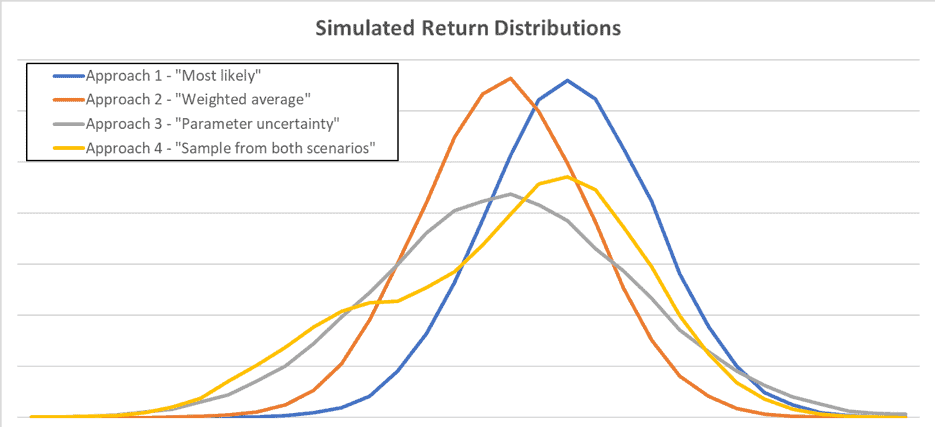
The first approach uses the most likely scenario, in this case the good scenario where expected real stock returns are 20%. The problem with this approach is obvious: by not incorporating our knowledge of the alternative scenario it fails to consider the full range of possible market outcomes. As can be seen in the diagram and table below (blue line) the expected return is overstated and volatility is understated (compared to the more advanced techniques). This would result in a flawed decision to over-allocate to stocks.

A second approach calculates expected return as a probability-weighted average of these two scenarios (so expected stock returns are 11% real). As displayed by the orange line in the diagram, the bias in expected returns identified in the first approach is removed, but the range of potential outcomes remains understated as this approach ignores the existence of two distinct scenarios. This approach would still result in over-allocating to stocks.

A third approach applies a technique known as parameter uncertainty. This approach also uses the weighted average expected return, but acknowledges that there is uncertainty around the expected return itself (after all it is unknown which scenario will be experienced). The expected real return is 11% real but, based on two possible scenarios, the expected return itself has a standard deviation of 12%[i]. So, in simulating possible outcomes the expected return itself is simulated and then the return itself. The return distribution (illustrated by the grey line) is much wider (simulated volatility is over 18%) which would reduce the optimal demand for stocks. However, this approach still doesn’t perfectly translate our two-scenario view into portfolio construction.

The final approach does just that. It samples from the two scenarios to form a distribution of possible outcomes from investing in stocks. The volatility remains high but the diagram (yellow line) shows the presence of two scenarios in the return distribution itself. This approach best incorporates knowledge of possible scenarios.


Simulation results Approach 1 – “Most likely” Approach 2 – “Weighted average” Approach 3 – “Parameter uncertainty” Approach 4 – “Sample from both scenarios”
Average 20.1% 11.1% 10.3% 11.9%
Standard Deviation 12.1% 12.1% 18.4% 18.6%

In practice it is complex

It appears logical for portfolio construction approaches to account for possible scenarios. I’ve illustrated the benefits using the simple case of stocks. But this is the crux of the issue: it is a simplified setting. Let’s consider a more detailed problem.

To apply the scenario sampling approach in a broader setting requires the need for parameter estimates (expected return) for every candidate asset under each scenario. There is an important reflection here: unless all the individual asset return forecasts move in perfect unison across each scenario, there will be a different optimal portfolio for each scenario. So, what is the optimal portfolio across all scenarios? This is a complex problem which requires a lot of computational power to solve, which becomes even more complex as more scenarios are considered.

Hopefully it is now easier to understand why the theoretically appealing portfolio construction practices used by academics aren’t commonly replicated in industry. However, there are two important learnings that can be taken from academia. First, forecasts are only point estimates and are uncertain so it would make sense to acknowledge this forecasting uncertainty when constructing portfolios. The second learning is that scenario analysis, already part of good industry practice, could be extended to consider not only extreme scenarios, but likely scenarios as well.

[i] This is estimated based on a Bernoulli distribution.

David Bell is executive director of The Conexus Institute.