
New economy needs big public sector

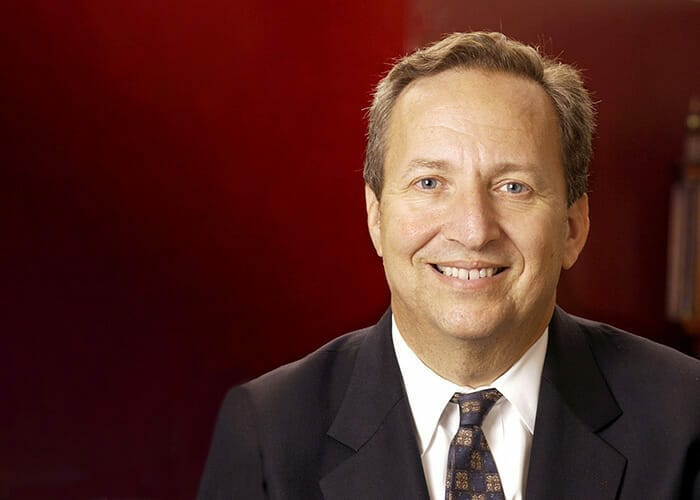
A larger and better public sector is necessary to achieve economic prosperity, reach full employment and meet the needs of the population, according to former US Treasury Secretary, Larry Summers.

“We need government with more market power, a larger function, and that is more competent in carrying out the tasks required,” Summers said.

Summers, who is President Emeritus of Harvard University and was Treasury Secretary under President Bill Clinton, said it is the “task of the centre left to recognise it won’t just work out if everyone stands back”.

He spoke on the “profound structural changes that will and are transforming economies and to which policymakers need to respond” and said it is essential that government plays an active and forceful role in ensuring there’s demand for all the goods introduced.

“The industrial world has a problem it hasn’t acknowledged. People are saving more, there is inequality, and at the same time, capital goods are less demanded,” he said.

“How do we sustain prosperity? There needs to be greater acceptance of fiscal deficits, and policies regarded as imprudent will become necessary. There have to be significant and strong levels of demand, and this needs to be a concern of progressives because a strong economy is the path to the best social progress.”

Sponsored Content

Summers recently wrote a book on the end of economies built on mass-produced goods, The Post-Widget Society: Economic Possibilities for Our Children. He said it is not possible to rely on the private sector for economic success. For example a social network satisfies none of the assumptions for economic success; it has asymmetric information, imperfect information, and a monopoly position.

“We need a larger public sector that is going to need to do more to employ everybody. So much of economic debate focuses on strengthening the widget makers – [but] that doesn’t matter,” he said.

“In the US, the share of workers in manufacturing is lower than the share of farmers was in 1950. If you look at the jobs that the Bureau of Labour Statistics projects will grow, three out of four of the top categories are a version of a nurse or medical technician. We need a larger more effective public sector.”

Summers also called for more responsible nationalist approaches to global economic issues including corporate tax evasion and intellectual property.

“It is right that countries concerned with innovation pursue the protection of intellectual capital internationally,” he said. “Making sure the capital can’t run and hide and avoid tax plus intellectual capital issues are global economic concerns.”

But he said discussions about global economic cooperation should be broadened, rather than a handful of leaders at the World Economic Forum in Switzerland.

“The agenda we have is an elite agenda. We need an agenda that resonates with the concerns of those that have never heard of Davos,” he said.

“I’m pretty sure if we don’t find a way for global economic cooperation that resonates with local people, management of the economy largely outside the widget sector, and sustained economic growth, then there are elements of populism and authoritarianism that are ready to fill any vacuums.”

Summers was former chief economist at the World Bank and Director of the National Economic Council for the Obama Administration. He was speaking in Sydney at the McKell Institute.


Asset Owner:World Bank

Leave a Comment

The twin forces rewriting the rules of investing

The twin forces rewriting the rules of investing

Portfolios built for the old world will be severely tested as emerging forces rewrite the rules of investing. The Fiduciary Investors Symposium heard that geopolitical and macroeconomic upheaval, together with the disruption wrought by AI, should force asset owners to rethink the structure and composition of portfolios.

Sort content by

China tech rivalry is ‘existential’ for the US – and diversification

Decades of US economic and financial supremacy have made diversification away from it a drag on returns for many investors, but the forces that have underpinned that supremacy may now be coming to an end.

AustralianSuper built scale – now its new CIO needs to make it work

The $295 billion AustralianSuper has spent two decades building scale, but Shaun Manuell's task as the fund's new chief investment officer is to ensure Australia's largest pension fund can operate effectively with it. As short-term performance pressure mounts on the fund and its assets set to hit A$1 trillion ($718 billion) by 2035, the local equities boss-turned-CIO will see his legacy defined by whether he can transform AustralianSuper from a domestic giant to a global leader.

Why Asian equities’ growth will outlast the AI-driven semiconductor cycle

In the latest episode of the Fiduciary Investors Series, Liao spoke with Top1000funds.com Asia Pacific correspondent Darcy Song on why the convergence of innovation, demographics and improving shareholder returns makes Asian equities an increasingly compelling diversification trade for asset owners navigating a geopolitically fractured world.

How CPP is evolving risk management for a faster, more interconnected world

In an environment where multiple risks are emerging and their effects are compounding on the portfolio, CPP Investments' chief risk officer Priti Singh says the $572 billion fund is rethinking risk management from the ground up, shifting from reaction to preparation and embedding risk thinking earlier in investment decisions. She speaks to Amanda White about the fund's risk approach.

Pension funds confront the question of who owns AI

As the use of AI within asset owners evolves, organisations are grappling with the governance question of where the strategy and accountability sit. Darcy Song looks at the treatment of AI organisationally within a number of high-profile funds, including OTPP, AustralianSuper, CPP and Norges Bank.

URS bets on nuclear to power AI and lower emissions

Next-generation nuclear energy, and the money pouring into it, will truly change the world, according to CIO of Utah Retirement System John Skjervem. It’s a lonely position as the CIO of a public pension fund but one Utah is embracing as it builds out early-stage investments in nuclear energy as part of its alternative energy portfolio. He speaks to Sarah Rundell in an exclusive interview about how investing in transformational energy technologies can be part of prudent investment management.



