
GPTB shows pension transparency improvement

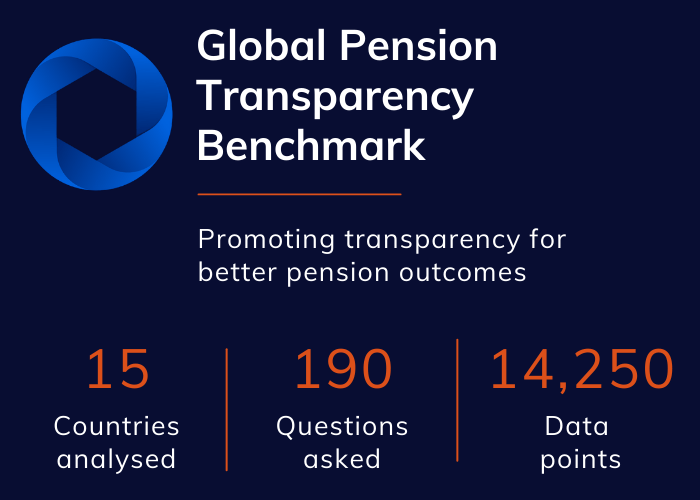
The transparency of pension fund disclosures has improved in the past year across the 15 countries and 75 pension funds measured in the Global Pension Transparency Benchmark, a collaboration between Top1000funds.com and CEM Benchmarking.

The GPTB, now in its second year, examines the transparency of disclosures across four drivers of value, namely cost, governance, performance and responsible investing.

In this second year, governance disclosures showed the biggest improvement with the average score of 65 out of 100 marking an improvement of seven from last year’s average score of 58. Governance was the best overall average score of the four factors.

The Canadian funds continue to excel in this category which CEM Benchmarking’s Michael Reid says is consistent with their reputation for excellent governance.
In last year’s review CEM noted that governance scores were most closely correlated with the overall score: good governance produces positive results and creates greater incentive (or perhaps less disincentive) to be transparent with stakeholders.

This year responsible investing disclosures showed an equal correlation with governance. Good governance allows funds to move beyond simply managing assets and towards addressing wider environmental and social issues.

The overall average performance score was 62, a slight decline from 64 last year and the second highest scoring factor after governance. The performance factor was the only factor to have a decline in the score this year. Average country scores ranged from 43 to 84.

Sponsored Content

The average country cost factor score was 48, unchanged from last year’s review, with individual scores ranging from 10 to 77.

The average country score for responsible investing was 49 out of 100 up from 42 in last year’s review, marking the biggest relative improvement among any of the four factors. These improvements mean that responsible investing is no longer the lowest scoring factor overall, having surpassed the average score for the cost factor. Improvements to disclosures were evident across all components and most countries. RI did continue to have the greatest dispersion of scores reflecting that countries are at different stages of implementing responsible investing within their investing framework. Average country scores ranged from 11 to 77, a slightly smaller range than last year.

“It was apparent from the reviews that many funds are actively taking steps to improve communications on responsible investing to stakeholders. In particular, many funds are expanding their disclosures to include quantifiable measures and progress towards climate related targets,” Reid says.

The GPTB ranks countries on their disclosures and found the following countries to be the outstanding performers in each category:
• Canada for governance
• The Netherlands for cost
• The Netherlands for responsible investing
• The United States for performance.

The Netherlands continued to lead the way in cost disclosure with the highest country score of 77. Scores were tightly banded from 71 to 89 and the top four cost factor scores were held by Dutch funds.

The Netherlands also ranked number one in the responsible investing factor, usurping last year’s winner of Sweden, with a score of 77. Both countries had improved disclosures over the past year. The Nordic countries – Sweden, Denmark, Finland, and Norway – continued to do very well on RI as a region, with all countries receiving scores well in excess of the overall average.

In the performance factor, the components with the highest scores continued to include asset mix and portfolio composition and risk policy and measures. Similarly the lowest scores were seen for asset class returns and value added and benchmark disclosures.

The US funds continued to lead the way, with an average country score of 84 for the performance factor. The US funds typically had extensive and good quality reporting across all performance components.

To examine the results for 2022 across factors, countries and the underlying funds click here.

Leave a Comment

Aware Super maps AI exposure as it sharpens whole-of-portfolio risk focus

Aware Super maps AI exposure as it sharpens whole-of-portfolio risk focus

Australia’s third-largest pension fund Aware Super is taking stock of its investment exposure to AI and the initial analysis suggests at least 15 per cent of the fund’s assets are exposed to the thematic. In a project deep dive, head of investment strategy Michael Winchester says finding the portfolio's true concentration around AI will require looking beyond simple dollar aggregation.

Sort content by

Why Asian equities’ growth will outlast the AI-driven semiconductor cycle

In the latest episode of the Fiduciary Investors Series, Liao spoke with Top1000funds.com Asia Pacific correspondent Darcy Song on why the convergence of innovation, demographics and improving shareholder returns makes Asian equities an increasingly compelling diversification trade for asset owners navigating a geopolitically fractured world.

How CPP is evolving risk management for a faster, more interconnected world

In an environment where multiple risks are emerging and their effects are compounding on the portfolio, CPP Investments' chief risk officer Priti Singh says the $572 billion fund is rethinking risk management from the ground up, shifting from reaction to preparation and embedding risk thinking earlier in investment decisions. She speaks to Amanda White about the fund's risk approach.

Pension funds confront the question of who owns AI

As the use of AI within asset owners evolves, organisations are grappling with the governance question of where the strategy and accountability sit. Darcy Song looks at the treatment of AI organisationally within a number of high-profile funds, including OTPP, AustralianSuper, CPP and Norges Bank.

URS bets on nuclear to power AI and lower emissions

Next-generation nuclear energy, and the money pouring into it, will truly change the world, according to CIO of Utah Retirement System John Skjervem. It’s a lonely position as the CIO of a public pension fund but one Utah is embracing as it builds out early-stage investments in nuclear energy as part of its alternative energy portfolio. He speaks to Sarah Rundell in an exclusive interview about how investing in transformational energy technologies can be part of prudent investment management.

Managing volatility and inflation: Constant rebalancing shores up UK’s lifeboat fund

A keen focus on rebalancing, and best in class systems, allows the UK’s £31.2 billion Pension Protection Fund to effectively implement a dynamic hedging strategy for one of the UK's biggest LDI portfolios. Sarah Rundell reports.

Velliv reset: More Danish funds lean into low cost DC model

In Denmark’s fiercely competitive commercial pension industry, Velliv was quick to take action with a root-and-branch overhaul of its pension provision when it experienced a drop in returns in the first half of 2024. It sacked its active equity managers, scaling up internal active strategies and low-cost, index-based investments instead, and stopped allocating to its $4.3 billion alternatives allocation. Thor Schultz Christensen, deputy chief investment officer at Velliv, unpacks the change.

Previous



