
Factor rebalancing superior for managing liquidity

Factor rebalancing a portfolio is a better way to manage liquidity and leverage implications of illiquid assets compared to traditional rebalancing to a static asset allocation, according to new research presented at the Fiduciary Investors Symposium in Singapore.

A research paper, (Re)Balancing Act: The interplay of private and public assets in dialing the asset allocation, published in the Journal of Portfolio Management in April, proposes a new way to rebalance portfolios that more deliberately considers a more stable risk and leverage profile of a portfolio.

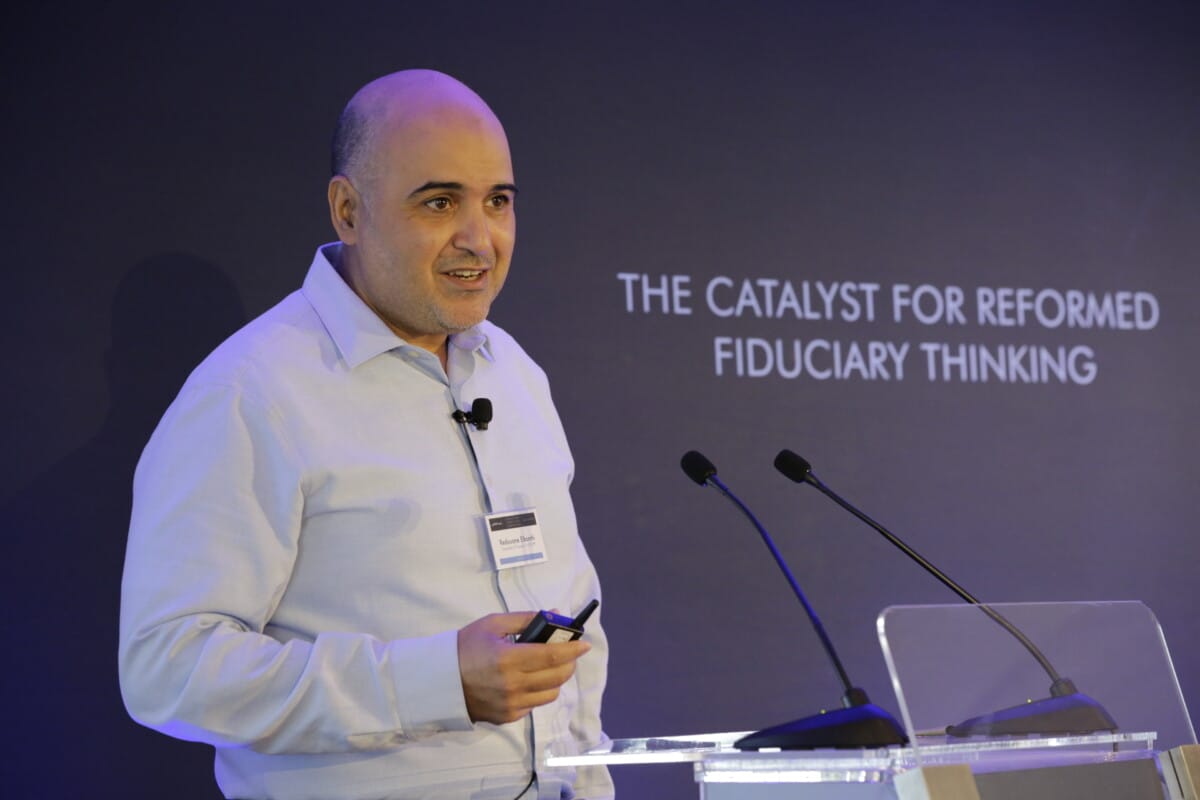
Co-author Redouane Elkamhi (pictured), Professor of Finance at the Rotman School at the University of Toronto, who presented the research in Singapore, said this approach allows investors to rebalance to the same underlying exposures – such as growth, inflation, and real rates – without being forced to rebalance to the fixed allocations.

“Generally, we think if you have come back to the SAA and rebalance, that is an active decision at each point in time that that is the best portfolio you can hold,” he said. “Coming back to that starting point is a big call. We need to be more dynamic in the face of uncertainty and the framework we have worked under for a long time.”

The factor rebalancing approach focuses on addressing a number of problems when it comes to rebalancing illiquid assets. For example, during market downturns, private assets can become significantly overweight due to stale valuations and the depreciation of public assets.

And standard rebalancing strategies can unintentionally introduce leverage due to the illiquid nature and potential stale valuation and lead to a deterioration of the fund’s liquidity position.

Sponsored Content

“You can’t easily rebalance illiquid assets, but the way people deal with that is by leverage, which means an unintended active decision that has implications on value-add,” Elkamhi said.

“This is a plumbing issue – a serious issue in asset management. As the privates get bigger it creates liquidity and leverage problems.”

Liquidity and leverage

The paper demonstrates how liquidity and leverage changes with a traditional rebalancing approach and using factor rebalancing which is designed to help the portfolio achieve more stable profiles in terms of leverage, risk, and liquidity.

This is done by considering public assets as complements to the illiquid private assets and making adjustments to the allocations of public assets to maintain the desired factor allocation for the overall portfolio.

Elkamhi said the approach gives investors a framework that allows a portfolio to be tilted without unintended active decisions.

Elkamhi said the paper was not a view on the optimal allocation to private versus public assets but a tool to rebalance to desired allocations without the unintended impacts on leverage among other things.

“If you have constraints to come back to the fixed allocations this is giving you a degree of freedom to give you a better liquidity coverage ratio and to better deal with privates in the portfolio,” Elkamhi said.

“We are not advocating for more privates but if that is the aim our methodology allows you to have more private without effecting the liquidity coverage ratio (LCR) level the same way traditional rebalancing will do, with a huge magnitude.

Redouane Elkamhi is part of the faculty of the University of Toronto and will speak at the Fiduciary Investors Symposium on campus from May 29-31. For information click here.

Leave a Comment

The twin forces rewriting the rules of investing

The twin forces rewriting the rules of investing

Portfolios built for the old world will be severely tested as emerging forces rewrite the rules of investing. The Fiduciary Investors Symposium heard that geopolitical and macroeconomic upheaval, together with the disruption wrought by AI, should force asset owners to rethink the structure and composition of portfolios.

Sort content by

China tech rivalry is ‘existential’ for the US – and diversification

Decades of US economic and financial supremacy have made diversification away from it a drag on returns for many investors, but the forces that have underpinned that supremacy may now be coming to an end.

AustralianSuper built scale – now its new CIO needs to make it work

The $295 billion AustralianSuper has spent two decades building scale, but Shaun Manuell's task as the fund's new chief investment officer is to ensure Australia's largest pension fund can operate effectively with it. As short-term performance pressure mounts on the fund and its assets set to hit A$1 trillion ($718 billion) by 2035, the local equities boss-turned-CIO will see his legacy defined by whether he can transform AustralianSuper from a domestic giant to a global leader.

Why Asian equities’ growth will outlast the AI-driven semiconductor cycle

In the latest episode of the Fiduciary Investors Series, Liao spoke with Top1000funds.com Asia Pacific correspondent Darcy Song on why the convergence of innovation, demographics and improving shareholder returns makes Asian equities an increasingly compelling diversification trade for asset owners navigating a geopolitically fractured world.

How CPP is evolving risk management for a faster, more interconnected world

In an environment where multiple risks are emerging and their effects are compounding on the portfolio, CPP Investments' chief risk officer Priti Singh says the $572 billion fund is rethinking risk management from the ground up, shifting from reaction to preparation and embedding risk thinking earlier in investment decisions. She speaks to Amanda White about the fund's risk approach.

Pension funds confront the question of who owns AI

As the use of AI within asset owners evolves, organisations are grappling with the governance question of where the strategy and accountability sit. Darcy Song looks at the treatment of AI organisationally within a number of high-profile funds, including OTPP, AustralianSuper, CPP and Norges Bank.

URS bets on nuclear to power AI and lower emissions

Next-generation nuclear energy, and the money pouring into it, will truly change the world, according to CIO of Utah Retirement System John Skjervem. It’s a lonely position as the CIO of a public pension fund but one Utah is embracing as it builds out early-stage investments in nuclear energy as part of its alternative energy portfolio. He speaks to Sarah Rundell in an exclusive interview about how investing in transformational energy technologies can be part of prudent investment management.



