Flawed Fed encouraging excessive risk taking

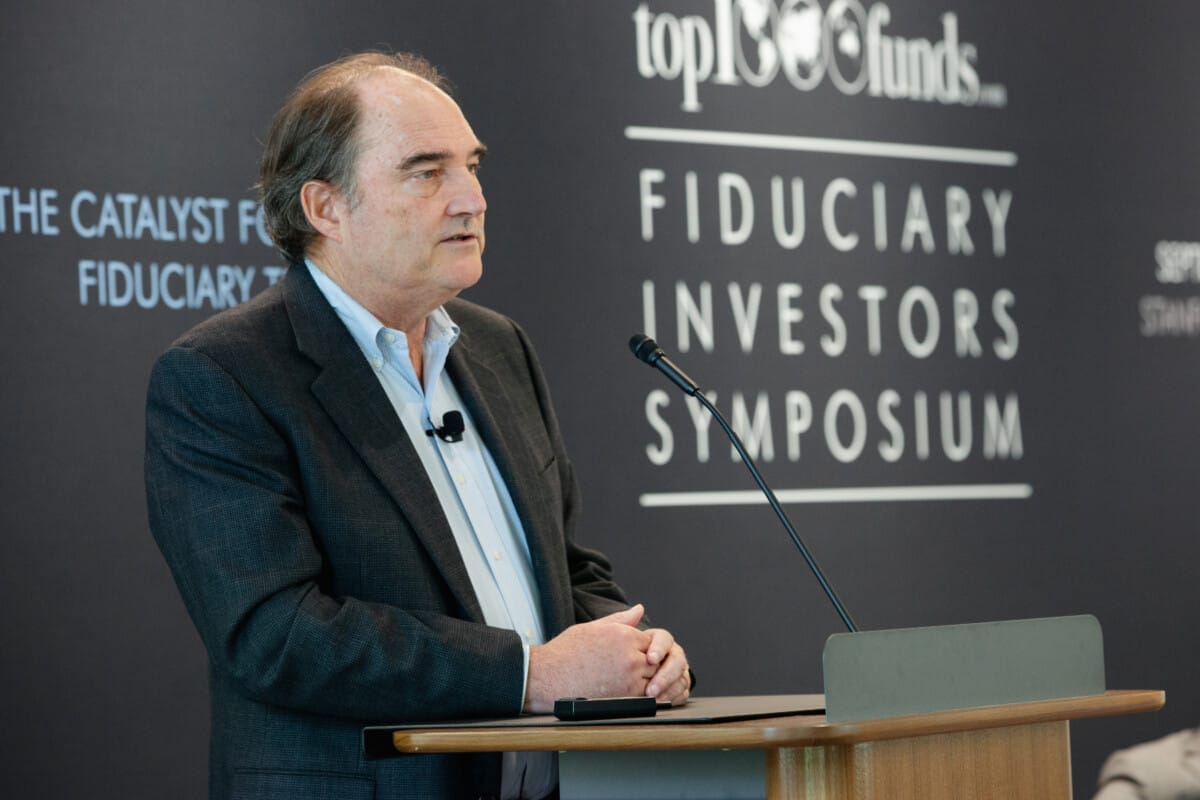
Ross Levine. Image: Jack Smith.

The increasing willingness on the part of regulators such as the Federal Reserve to bail out investors at times of crises is reducing the competitive environment in which banks and financial institutions operate, the Fiduciary investors Symposium at Stanford University has heard.

Ross Levine, the Booth Derbas Family/Edward Lazear Senior Fellow at the Hoover Institution, said the Fed’s practice of insuring the liability holders of financial institutions was encouraging more risky behaviour and creating a fragile system in the longer run.

“This means those financial institutions are likely to take excessive risk, because the people with the money on the line don’t have their money on the line, because the government will bail them out.”

“Without those entities providing governance over the financial institutions, the degree to which they are going to allocate capital effectively to the people with the best entrepreneurial ideas is diminished,” he added.

Levine, who is also a research associate at the US National Bureau of Economic Research, has previously criticised the Fed’s perceived lack of regulatory power through the global financial crisis and other banking crisis in the US. He has also criticised the high incentives of financial services executives.

The question I always asks regulators when a major bank fails in the US: what decision maker at that institution loses their house? And the answer is either silence or murders of ‘nobody’, he said.

Sponsored Content

“If you have a financial system in which the decision makers don’t share in the downside, this simply cannot be sustained for the long run, and so that incentive is what scares me.”

He says the Fed has essentially insured all liability holders in financial institutions, except for shareholders, even though by regulation, a large bank in the US cannot have a shareholder that controls more than 5% of the equity.

That means all liability holders who are supposed to provide governance are insured, so the only entity that can really be in a position to monitor excessive risk taking, are the regulators.

“I think the Fed is caught within the context of a political and social expectations in the US. We don’t interfere with free markets, but at the same time, we don’t want people to lose money, so we’re going to provide this insurance for liability holders,” Levine said.

“You can’t have both of those. You can’t have insurance of the liability holders, which encourages excessive risk taking, without the regulation that constrains the excessive risk taking, and philosophically, the US doesn’t seem to be able to resolve this.”

Reliable Indicator

Levine says his research has shown that the financial sector has been fundamentally important for promoting economic prosperity across the US states and across the world more generally.

It is also one of the most reliable indicators about how an economy is going to perform in the long run.

“How an economy’s financial sector is performing, how open it is for competition, is its regulatory system one that promotes competition?. These sets of analysis are a very useful way to understand and predict which countries are going to succeed.”

Responding to a question about using growth as an accurate measure for the health of an economy, Levine said that GDP growth, over long decades, is a pretty good summary statistic for how the economy is doing. It’s not perfect, but there are no good alternatives.

That is because GDP growth, if measured correctly, is not just about more stuff but also about better stuff.  “I’m thinking about that as a proxy for a better standard of living on average, not just, you know, more TVs per capita.”

Levine criticised both major political parties in the US for moving away from a focus on growth, and considering the economy as a zero sum game. That has meant people are worried about the relative slice that they’re getting, and less about increasing the size of the economic pie.

The reduced focus on growth feeds into the fact that the US is in the midst of a major fiscal crisis, with the overall debt to GDP ratio somewhere between four and five times as great as it was after World War II.

“That’s a gigantic problem and and very difficult decisions are going to have to be made. Those decisions are going to be easier and less severe if the economy is growing,” he said.

Leave a Comment

The ‘most momentous’ in living memory: The 2024 US presidential election

The ‘most momentous’ in living memory: The 2024 US presidential election

Douglas Rivers, chief scientist at pollster YouGov, said data coming out of the current US presidential election confirms significant cultural and demographic shifts that are reshaping the political map. Rivers told the Fiduciary Investors Symposium that the once-popular “demographics is destiny” mantra predicting permanent centre-left majorities has lost meaning in the Trump era.

Sort content by

Synthetic biology can save us – if it gets the capital it needs

In years gone by, governments underwrote the development of new technologies before opening the doors to the private sector to exploit the applications. Today, the private sector is the primary source of R&D funding, and foundational research in technologies such as biotech are struggling to attract capital.

Focus on engagement to drive faltering climate transition

As the global fight against climate change shows signs of slowing down, some large asset owners are taking a more pragmatic approach to investment returns from the transition by focusing on more targeted engagement in order to drive more lasting impact, the Fiduciary Investors Symposium has heard.

How AI ‘allows you to be the investor that you grew up wanting to be’

Success in AI integration may vary for different investors, as some asset owners are reaping alpha benefits while others look for administrative excellence. The Fiduciary Investors Symposium heard how three major institutional asset owners define and measure AI success.

Real growth opportunities in evolving AI sector still to come

The biggest paradigm shifts in technology history - the internet and cloud computing - both had common characteristics: an initial cycle of investment in infrastructure before the applications were delivered to consumers. the Fiduciary Investors Symposium has heard that artificial intelligence is unlikely to be any different.

Unified view boosting appeal of total portfolio approach

The changing nature of volatility in financial markets and a more client-centric approach that allows allocations to be tailored is helping more institutions adopt a total portfolio approach (TPA) to investment management, the Fiduciary Investors Symposium at Stanford University has heard.

Policy framework, private capital key to financing energy transition

Public authorities need to develop regulatory frameworks that create incentives and provide policy support in order to attract long-term private capital for infrastructure needed for the ongoing energy transition, the Fiduciary investors Symposium at Stanford University has heard.