
Asset owners must prepare for ‘fast and furious’ AI debt wave

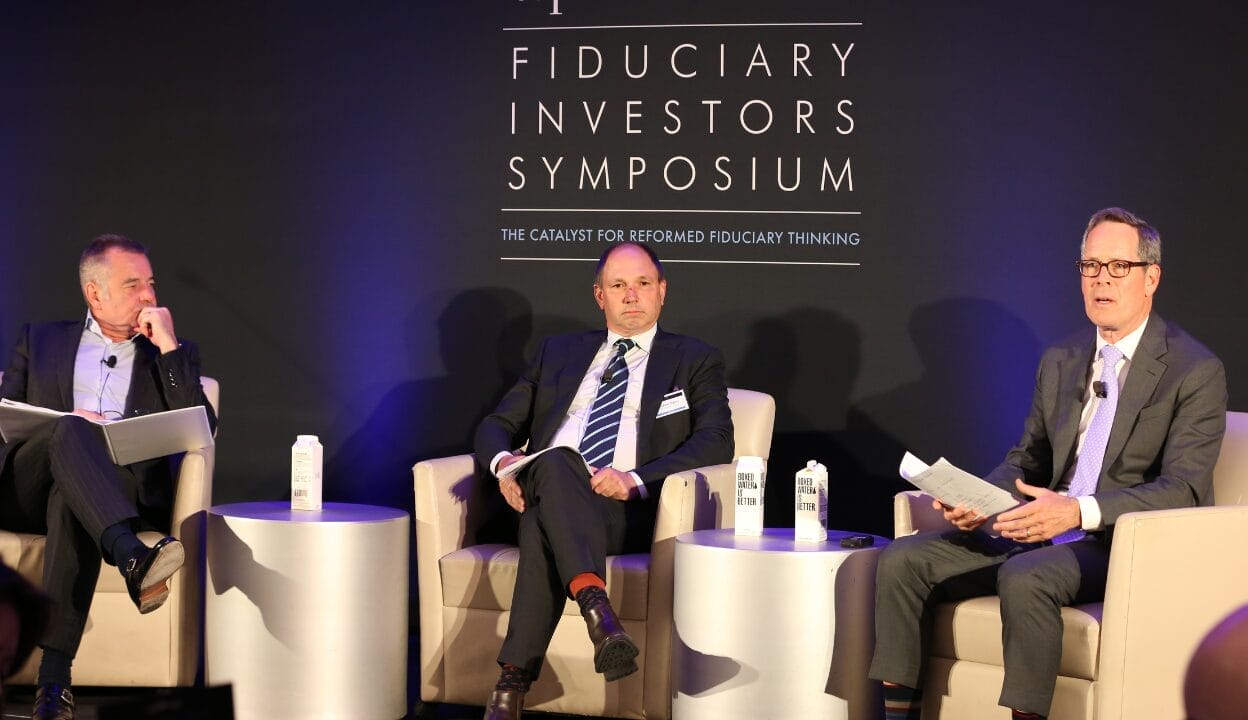
Andrew Owens (L) and George Bory. Photo: Jack Smith

Corporate AI implementation is accelerating, not decelerating, all around the world, and the capital need is vast, with significant debt issuance still to come. Asset owners have to decide where they want to get involved, and how, according to George Bory, chief investment strategist for fixed income at Allspring Global.

“This is not going away,” Bory told the Top1000funds.com Fiduciary Investors Symposium at Harvard University. “It’s pervasive. And we need to decide what to do about it now.”

AI is a “huge resource draw”, Bory said; so far, 40 gigawatts of power have already been built at a total cost of about $2 trillion, but estimates are that that amount will need to double or triple. The actual demand for capital is “nothing short of colossal”.

“This is on the order of government funding, and this is sort of the challenge we face – how do we allocate across that? It’s coming fast and furious,” Bory said.

“Over the next three to five years, you’re going to see somewhere between $2.5 trillion to $4 trillion of new debt funding that will be marketed to you. You’ll be having a great opportunity to invest in this, and you have to decide, do I want to be part of it? If so, where in the capital structure, in the evolution of the AI revolution, and importantly, for how long?”

The “good news” from a bondholder and a credit perspective, Bory said, is that much of the borrowing sits on top of “huge, huge cash flow”. Allspring estimates that the hyperscalers alone have a cash flow stream of about $600 billion a year, and that cash flow is growing at about 20 per cent per annum, with still benign leverage metrics.

But Andrew Owens, managing director and head of investment strategy at GE Investment Management – which manages the General Electric pension – was more cautious, saying “we don’t like idiosyncratic risk with respect to bond investing”.  

“If you think about a company that has a 90 per cent chance of doing a 10x return on its market value and a 10 per cent chance of going bankrupt, and a company that is trading on the same spread which only has a 10 per cent chance of going up 10 per cent in value and a 90 per cent chance of losing 10 per cent of market value – I like that bond a lot better,” Owens said.

“In this case you’re much better off buying a Treasury bond and a VC investment in an AI company and splitting that blended return stream than trying to be heroic in corporate bond investing.”

While grappling with the potentially deflationary impacts of AI, Owens said that the full effects of the US-Iran war, which has pushed up yields and will potentially push up interest rates in the short-term, may not become completely clear for some time.

“When we think about what is happening with the supply shock in Iran… there is a case for higher long-end rates for a while; I don’t think necessarily that we’ve seen the full extent of the inflation shock, the second-order shocks.

“Just like in COVID we can be surprised when the impact of something affects us many months after the initial event, and I think that’s likely to occur in this scenario as well, where it takes a while for the disruption to really feed through.”

Sponsored Content

Leave a Comment

Impact investing’s case for scale

Impact investing’s case for scale

Impact investing has come a long way in the past two decades, going from a niche strategy to a $1.5 trillion industry, but there are still challenges for it to reach institutional scale due to the lack of products and insufficient evidence of outperformance in some parts of the market.

Sort content by

Macquarie: Deglobalisation the next inflection point in real assets

Global governments are partnering with private investors to boost their domestic infrastructure and become more self-sufficient in a geopolitically fragmented world, according to Ben Way, global head of Macquarie Asset Management, who said that constrained public balance sheets are increasingly reliant on private capital to meet their infrastructure needs.

Investors put private equity performance under the microscope

Investors are seeking better performance attribution in private markets to better understand underlying return drivers – especially in private equity, where metrics such as IRR or multiples are increasingly criticised for being opaque. HarbourVest made the case for an alternative attribution method at FIS Harvard.

The ‘space economy’ is a legal and literal vacuum for investors

The looming SpaceX IPO has put the spotlight firmly on the so-called ‘space economy’, but asset owners have been urged to exercise caution about investing in a sector that still resembles the wild west, with no legal or governance framework to protect capital. That’s not to say money will not be made, but it might not be in the areas investors first expect.

Photo gallery: Fiduciary Investors Symposium 2026 at Harvard University

mrec4inarticleinline Sponsored Content scnative1 scnative2 scnative3

The twin forces rewriting the rules of investing

Portfolios built for the old world will be severely tested as emerging forces rewrite the rules of investing. The Fiduciary Investors Symposium heard that geopolitical and macroeconomic upheaval, together with the disruption wrought by AI, should force asset owners to rethink the structure and composition of portfolios.

CPP outlines risk playbook for a new world order

The $570 billion CPP Investments is strengthening efforts around scenario analysis as volatile fiscal, geopolitical and economic risk factors plunge the macro environment into a state of flux, with the fund naming four scenarios for the future world order within its risk management framework.



