
Purpose set to drive investment

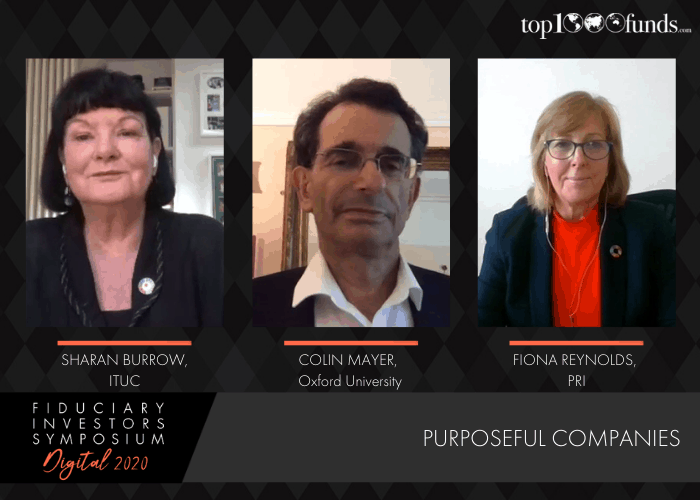
[vc_empty_space height=”10px”][vc_media_type_category]Investors should use stewardship to encourage purposeful companies that provide long-term value by meeting the needs of multiple stakeholders and helping improve society. FIS 2020 Digital panellists discuss the characteristics of a purposeful company and the challenges in their evolution.

Denmark’s Novo Nordisk embodies the latest evolution in good corporate citizenship. In an expert panel discussion at FIS 2020 Digital on how today’s companies can and should incorporate purpose, delegates heard how the global healthcare group has moved from mission to a modern day purpose in its evolution from producing insulin to a broader offering helping to treat diabetes. Today the company works to eradicate the disease, all the while inspiring multiple stakeholders and delivering shareholder value.

Navigating the consequences of COVID-19 could see more companies adopt purpose, said Colin Mayer, professor of management studies at the Saïd Business School, Oxford University. Mayer, who led the British Academy’s The Future of the Corporation project, said purpose involves finding profitable solutions to the challenges confronting society and the natural world – rather than profiting from those problems.

He said companies today face difficult trade-offs between cutting costs, supporting their employees or paying dividends to their pension fund investors. Yet having a purpose will help corporates navigate these trade-offs and come out of the crisis. He urged companies to embed purpose in their activities and encouraged boards to lead in the area.

“We should measure the performance of a company against its purpose,” he said to the investor audience. “Purpose helps make companies more resilient and reduces risk for investors.”

He also said that purpose has replaced the dated concept of corporate social responsibility by defining how a company does business and the reason it was created.

Sponsored Content

Sharan Burrow, general secretary, ITUC, named consumer goods group Unilever and European food group Danone as other prime examples of companies driven by purpose.

She noted how both multinationals have worked with trade unions to protect employees, focused on environmental risk and careful monitoring of their supply chains.

She said purpose driven companies report on purpose to their shareholders and can help “fundamentally reshape a future” where “everybody wins.”

Only when multiple stakeholders work together will companies adopt a purpose that will ultimately lead to a better world, she said, adding that companies without purpose lack resilience or core values. When profits and shareholders come first, it prevents freedom of association and the ability of collective bargaining to solve problems.

“We say let’s transition to a world where everyone’s rights matter,” she urged delegates. Reflecting on whether corporate America is “ready” for purposeful companies, she said appetite was mixed.

Fiona Reynolds, chief executive, PRI, told delegates that some pension fund investors are “good” at stimulating companies to adopt purpose.

However, many investors still think through the prism of “risk and return.” She said the PRI is increasingly working to move the discussion on ESG to incorporate risk, return and impact. Urging delegates to stop thinking “traditionally,” she said valuing companies on just profit and endless growth is flawed.

Reynolds added that institutional investors have a chance to push purpose now because they will be vital contributors to financing the economic recovery in the wake of the pandemic. “Governments can’t do this alone,” she said.

“Stewardship is one of the most powerful tools investors have.”

Here she urged investors to spend more on stewardship, suggesting that only via a collective engagement that looks at systemic issues, will change truly happen. She said building back better could see sustainability come to the fore with a new realisation that without a healthy planet, we can’t have a healthy economy.

“Sustainability needs to be built into the recovery.” She also urged governments to incorporate the transition to a low carbon economy and jobs for the future into their reconstruction packages.


Mission to purpose

Panellists discussed how companies should change their mission statement to new statements on purpose. A mission statement details what a company does, whereas a purpose statement details why a company exists; why it was created and what it is there to do, providing a “North Star.”

Panellists also said it should be possible for investors to measure a company for purpose. Mayer urged for integrated reporting to help purposeful companies show investors how they are delivering for all their stakeholders.

He said purpose needs to be integrated into standard accounting measures, and until this happens there won’t be a “bottom line number.” Similarly, Reynolds said purpose should be integrated into a company’s KPIs.

To listen to the podcast conversation about the British Academy’s The Future of the Corporation project, click here.

Leave a Comment

Florida: Opportunities in a crisis

Florida: Opportunities in a crisis

The Florida State Board of Administration has made some strategic moves to take advantage of opportunities in the dislocation, including in private equity, distressed debt and active listed equities.. But CIO, Ash Williams, is concerned about the underlying real economy.

Sort content by

America, China and Donald Trump

As trade wars between the US and China dominate financial markets, Princeton historian Stephen Kotkin has assured pension funds that the world order that has been in place since World War II remains intact.

Understanding US/China relations

Understanding the fractious relationship between US and China is more important– and simultaneously more confronting – than it has been in the past, according to Stephen Kotkin, professor of history and international affairs at Princeton University. While the China investment challenge has always been to capture the aspirational middleclass, the high-profile historian says “the big money that’s going to be made in China is going to be made from the dislocation”.

What can the past teach us?

Institutional investors' investment strategy should be serving the China middle class and the dislocation from within Asia, according to Stephen Kotkin,Professor of History and International Affairs at Princeton University speaking at the Fiduciary Investors Symposium at Cambridge University. He explored what the geopolitical conflicts of the past can teach us about the future. He looked at some of the key points in history, how China, the European Union and the US have survived, and what it means for the future.

A ‘Sputnik Moment’ with China?

Whither United States-China? Stephen Kotkin, Professor in History and International Affairs at Princeton University and adviser to conexust1f.flywheelstaging.com, discusses the changing nature of the complex relationship between the US and China and the struggle underway as these two large economies find their positions in the economic and technological hierarchy. So what should investors watch for?

Taiwan epicentre of geopolitical risk

The China-US trade war is the latest development in a tense relationship that threatens to bubble over into war over Taiwan, “incinerating” portfolios, Stephen Kotkin said.

Kotkin weighs in on geopolitical risks

Global tensions are an important consideration in decision-making. At a recent roundtable, geopolitical expert professor Stephen Kotkin discussed the risks related to China and the US.

Previous