This article is the third in a series about the recently released CFA Institute report, the Investment Professional of the Future. In the first article, we outlined the accelerating changes and disruption facing the investment management industry. And in the second, I shared a roadmap that investment professionals can use to navigate these disruptions.

Now we turn to a roadmap for investment firms. Specifically, the report recommends that firms enhance the employee experience, invest in empowering leadership, and become change-savvy.

Enhance the employee experience

Investment organizations that want to attract and retain outstanding professionals should develop a people-centered culture that makes employee well-being central to the firm’s practices and policies. As part of the research, 3,800 CFA Institute members and exam candidates were asked about which aspects of a company or organization is most important to them. The results are below.

The responses clearly demonstrate that investment professionals seek employers that can provide opportunities for both personal and professional growth, as 83 per cent of CFA Institute members and 89 per cent of exam candidates value firms that encourage and provide opportunities for training and development. Personal growth also embraces work-life integration, where new skills are valuable in both professional and personal situations. The second most important factor is working for an employer with an inclusive culture, meaning one that considers and appreciates their employees’ views and ideas.

Invest in empowering leaderships

In terms of leadership skills for the future, industry experts believe that the most important skill is the ability to articulate a vision and to motivate colleagues toward a shared purpose. A quickly changing environment makes this even more important, and communication is the key.

According to the 2019 Edelman Trust Barometer, employees across all industries have strong expectations that their jobs will provide purpose and have some meaningful societal impact, that their firm will have an inclusive culture where they have a voice in its planning and operations, and that their employer will provide opportunities for personal and professional growth. More than 40 per cent said they would need more financial compensation to give up any of these expectations, and about a third of those surveyed would never work for a firm that lacked these qualities.
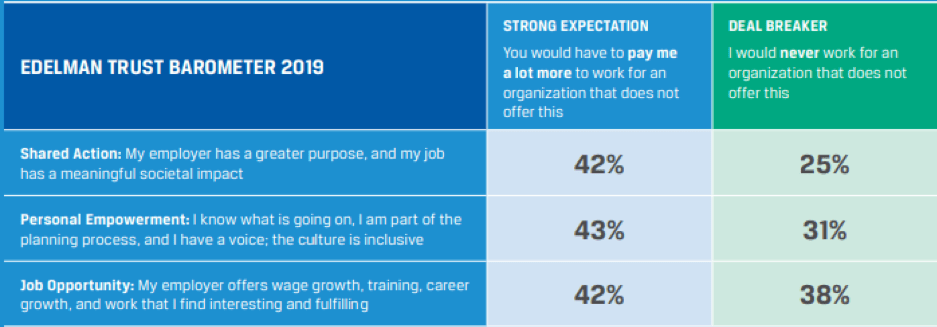
These findings are relevant for investment organizations, which need more leaders and cultures that better engage the workforce. Specifically, employees, clients, and society more broadly are looking for leaders who:

  • Speak out and communicate about the values important to stakeholders and other important issues that may be outside the boundaries of the business
  • Speak with legitimacy within their area of knowledge and for appropriate stakeholders
  • Are empathetic and understand who they are addressing
  • Have the leadership courage necessary to convey the need for change and motivate others to facilitate it
  • Are clear, consistent, and authentic about putting organizational values into action

It is particularly important that leaders are clear, empathetic, and sincere when communicating with employees about new topics that are becoming more important due to the continuous and increasingly rapid changes to the industry. This includes the future of work in the organization and in the industry.

Some roles and positions are likely to be displaced by technology and other disruptors, and employees will need guidance on how to approach the new working environment and ongoing career management. Firms must also be focused on their employees’ need for meaning and significance in their work. Employees want to work on teams and for firms where they are respected and where their contributions are noted and valued. Leaders must also have much higher levels of emotional intelligence to understand and revere the whole-life needs of employees.

Become change savvy 

Just as individuals must become tech-savvy, organizations must be change-savvy. Our research found that the following are the largest concerns of industry leaders related to looming changes for investment professionals:

  • Industry consolidation driven by streamlining and a focus on cost-cutting
  • How artificial intelligence (AI) + human intelligence (HI) will require people to perform new roles and tasks and to perform traditional roles differently — and in some cases how AI will displace jobs
  • The impact of technological and other industry changes on organizational culture

There is a high level of trepidation about how organizations will manage through these transitions or change their processes to leverage the human-machine collaboration.

Despite the level of unremitting change in the industry, the purpose of the investment industry will continue and concern itself with increasing the wealth and well-being of society, although the strategies and tools that firms use to realize it will vary significantly.


Bob Stammers, CFA, is the director of investor engagement at the CFA Institute and a member of the Future of Finance team at CFA Institute.


Focusing on ESG, benefits a company’s bottom line, the investment return and, of course, society. ESG measures were initially implemented in the equities investment context and the time has come to apply them to fixed income investment as well.

Responsible investment entails assessing ESG-related risk factors in order to improve returns and promote efficiency and transparency in the capital markets. Folketrygdfondet’s approach to responsible investment is not primarily about ethics, but rather, generating returns based on robust risk assessments that incorporate ESG considerations. This may appear obvious, but how can it be done in practice?

Folketrygdfondet’s objective is to achieve the highest possible returns over time. To succeed, we depend on our portfolio companies to create value. If we are to maximise the return on our fixed income portfolio, our credit analyses cannot avoid considering ESG risks.

Our portfolio companies must be able to service their debts. Whether they are prepared to address material ESG risks is a relevant consideration in this regard. The underlying theory is that if a company addresses the challenges it faces successfully, it is also more likely to achieve strong financial results. Equally, we try to avoid companies in which sub-optimal ESG management undermines creditworthiness.

As well as examining material ESG factors, responsible fixed income management entails taking an integrated approach across the investment chain. This includes contributing to the efficient functioning of the markets and improved allocation of capital. Folketrygdfondet is a large investor with a long-term perspective, and it is in our interest to promote well-functioning markets. Our investment strategy makes several contributions in this regard:

  • Increasing the diversity of our portfolio helps broaden the market.
  • Conducting robust, comprehensive credit analyses supports more efficient capital allocation.
  • Investing in a wider range of, and less liquid, bonds fosters greater market liquidity.
  • Counter-cyclical investment helps dampen market volatility.

In recent years, responsible investment has assumed an increasingly central role in fixed income portfolios. In our experience, adopting a responsible investment focus builds more integrated understanding and deeper insight into companies. This in turn facilitates better investment decisions and more efficient capital markets. We therefore warmly welcome further developments in this area.

Jørgen Krog Sæbø is CIO, fixed income at Folketrygdfondet, and Lars Tronsgaard is deputy managing director. Folketrygdfondet is a professional investment manager whose main task is to manage the Government Pension Fund Norway on behalf of the Ministry of Finance. With NOK 255 billion ($27 billion) AUM, Folketrygdfondet  has a benchmark allocation of 60 per cent equities and 40 per cent fixed income. Around 85 per cent of the portfolio is invested in Norway and 15 per cent in the other Nordic countries. Norway’s Government Pension Fund comprises the Government Pension Fund Norway, managed by Folketrygdfondet and the Government Pension Fund Global, managed by Norges Bank.

“Diversification is the only free lunch” is one of the most over-used – and perhaps dangerous – phrases in finance. The idea derives from Modern Portfolio Theory (MPT), developed by Harry Markowitz in the 1950s, for which he shared the Nobel prize in Economics in 1990. MPT provided mathematical tools, in the form of mean-variance optimisation, to help investors maximise their expected return for a given level of risk. In essence, such tools embedded the idea that by diversifying across a range of assets, investors could obtain a more attractive risk-return trade-off.

The legacy of MPT is that diversification has become one of the easiest and most commonly used justifications for any investment decision. However, rather than being seen as a universal good, diversification should more accurately be viewed as a trade-off: we can reduce the downside of being wrong, but only at the cost of reducing the upside from being right. As Buffett once remarked: “diversification is protection against ignorance; it makes little sense if you know what you’re doing.”

Putting this a little less bluntly, we might think of diversification as a useful defence against uncertainty; but one that dilutes the impact of our highest conviction insights and often raises the governance burden. The dilution effect is clear in relation to actively managed portfolios: the more diversified a portfolio, the less impact any high conviction positions can have on overall performance. The governance cost relates to the additional work – in the form of due diligence and ongoing monitoring – that results from adding new assets to a portfolio.

That diversification, conviction and governance considerations are in tension is perfectly natural. However, in the presence of principal-agent dynamics, the temptation is for asset managers to over-diversify portfolios – by moving in the direction of a flawed benchmark – resulting in a less attractive risk-return profile for the end investor.

Defensive decision-making

In his 2014 book, Risk Savvy, the decision-making expert Gerd Gigerenzer defined defensive decision-making as follows: “a person or group ranks option A as the best for the situation, but chooses an inferior option B to protect itself in case something goes wrong.” Much of the literature on defensive decision-making focuses on the medical setting, where examples of “defensive medicine” include ordering unnecessary tests and over-prescribing medications in order to reduce the risk of being sued for malpractice. However, Gigerenzer points out that defensive decision-making is commonplace in the modern world, often arising in relation to political or corporate decisions where blame can easily be assigned.

Defensive decision-making flourishes in situations where decisions are taken by one party (the “agent”) on behalf of, or that impact, another party (the “principal”). The danger is that instead of assessing the risks and opportunities in a balanced way, the agent chooses to focus primarily on managing downside risk, fearing that poor outcomes will be felt more intensely by the principal than good outcomes. Such principal-agent problems abound in the investment industry, where trustees often take responsibility for decisions on behalf of beneficiaries, and trustees invariably delegate stock selection to external asset managers – sometimes further mediated by a fiduciary manager. The aggregate effect of these layers of intermediation is a potentially serious misalignment of interests which creates the conditions for defensive decision-making.

An example of “defensive diversification” would be where an asset manager holds a security primarily in order to reduce the risk of underperforming the benchmark, but where there is little or no expectation of positive long-term returns. Diversifying a portfolio to manage benchmark-relative risk in this way may reduce the portfolio manager’s career risk, but does nothing to improve the end-saver’s long-term return prospects. Indeed, there is a growing body of academic work suggesting that over-diversification imposes a cost on the end saver in the form of lower returns.

In Best Ideas, Cohen, Polk and Silli show that active equity managers’ highest conviction positions outperform the market andother stocks in their portfolio by a large margin (c.4-10% p.a. depending on the methodology and benchmark employed). The results are statistically and economically significant and robust across a range of specifications. The authors suggest “that while the typical manager has a small number of good investment ideas that provide positive alpha in expectation, the remaining ideas in the typical managed portfolio add little or no alpha.”

The authors put forward a number of reasons why managers might proactively choose to dilute their best ideas with what turn out to be value-destructive diversifying positions. These include a desire to avoid extreme benchmark-relative performance; attempts to maximise risk-adjusted returns (as opposed to just returns); or a commercial preference for running a strategy with a large volume of assets (which precludes holding a small number of relatively concentrated positions).

Related research by Cremers and Petajisto (2009)showed that the most active stock pickers – as measured by Active Share – delivered the greatest long-term outperformance. Managers seeking to remain within a certain distance of the benchmark ultimately delivered disappointing long-term returns. This work supports the idea that an overreliance on benchmarks as a solution to the principal-agent problem creates a situation in which diversification undermines managers’ ability to deliver alpha.

This is not to lay all the blame for defensive diversification at the feet of the asset management community. In many ways, managers are simply responding to the instructions and incentives provided by asset owners. In particular, any shared understanding between the asset owner and manager on what would constitute a tolerable limit for short-term underperformance (whether formalised in a tracking error constraint or not) would tend to mitigate against holding a concentrated portfolio dominated by high conviction positions. Procyclical hire and fire decisions on the part of trustees – terminating managers after a bad 3 years, hiring after a good 3 years – also provides a strong motivation for managers to avoid concentrated bets that might give rise to extended periods of benchmark underperformance.

Furthermore, the widely followed and reported Morningstar Ratings disincentivise concentrated portfolios by penalising volatility in their rating methodology. In order to maintain a high Morningstar Rating, managers need to avoid benchmark underperformance over 3- and 5-year periods and to minimise the overall volatility of their portfolio. So while most institutional investors should be able to diversify manager-level volatility themselves, asset managers are presented with a host of reasons to reduce portfolio volatility – both in absolute and benchmark-relative terms – in the process diluting their highest conviction positions.

Mitigating defensive diversification

While MPT has created the impression that diversification is always and everywhere a good thing, asset owners would benefit from a more sceptical attitude. Indeed, the argument outlined above suggests that over-diversification favours managers – giving them the ability to raise larger funds while managing career and business risk – at the expense of returns to investors.

Long-horizon investors, whose beliefs and governance structure enable them to tolerate substantial benchmark-relative risk, may wish to consider whether their managers are running portfolios that adequately reflect their high conviction views. Clearly there is no “right” level of diversification, but asset owners conscious of the incentives leading managers to over-diversify, should be willing to challenge their managers over the extent to which their best ideas can have a meaningful impact on performance.

Concentrated portfolios offer no guarantee of superior long-term performance. But asset owners pursuing an active investment strategy need to ensure that principal-agent conflicts do not undermine their ability to deliver long-term returns in the interest of their beneficiaries. This requires careful scrutiny and engagement with managers at the outset of any relationship, a monitoring approach that identifies performance-chasing and defensive diversification, and a decision-making process that can cope with volatile benchmark-relative performance at the individual manager level.


Philip Edwards is co-founder and chief executive of Ricardo Research


Shareholders, including institutional investors, were at the core of the obsession with short term returns by corporates, and are key to its reversal, according to Sir Winfried Bischoff chair of the UK regulator, the Financial Reporting Council.

Bischoff, who is also chair of JP Morgan Securities, started his career at Schroders in the 1960s, at a time where the Schroders family owned 48 per cent of the company, something he attributes to its very long-term business-model thinking at the time.

But he says as ownership has shifted to shareholders they have been driving for higher returns.

“In the 2000s shareholders were demanding returns well over 15 per cent when inflation was 3 per cent, that is not sustainable and shareholders drove that. It’s up to investors to recalibrate that,” he says.

Bischoff encourages institutional shareholders to interact with the companies they invest in on an individual basis, and if they have no traction to then act collectively via groups such as the Investor Forum in the UK.

“There were two calls I’d always return as chairman of a company, no matter what happened, to my largest shareholder and to the regulator. I don’t think large shareholders have been as proactive as they could be,” he says.

“At the moment the power of the company is bigger than the power of the shareholder, it’s the principal-agent idea. The farmer produces the income but ultimately the owner of the land is more important. The shareholder is ultimately more important.”

He says the recent Business Roundtable statement expanding what the purpose of a company is, does not discount the importance of shareholders.

“I’m delighted the Business Roundtable came out that way. The statement does not say shareholders are not important but that it is wider than that. It takes me back to Joe Bower’s famous saying that ‘it is not the wealth of shareholders but health of the company that is important, and that includes the wealth of shareholders’.”

Bischoff has devoted his career to financial services, serving in many senior roles in banking including chair of Lloyds Bank, CEO and then chair of Schroders, chair of Citigroup Europe, and interim CEO (during the crisis) and then chair of Citigroup.

He says he is very worried about the level of debt in the global financial system. In addition to the huge amount of illiquidity and low interest rates, the fact investors were willing to invest in investments that are illiquid or not very credit worthy was a concern.

“I worry about that, it is very odd being driven into less and less credit worthiness in search for yield,” he said. “Pension funds have a fiduciary duty but invest in these structures. They are being driven by consultants to invest more in debt instead of equity, but pensions are there for the long term, this obsession with de-risking pension funds is overdone.”

Commenting on the recent independent review led by John Kingman, which recommended the dismantling of the FRC to make way for a new regulator, he said regulators are in a tough situation.

“He saw the FRC construction as a ramshackle set of buildings and wants it more connected. A regulator can’t win, if they are too tough they are seen as holding back business if there are business failures they are seen as not tough enough. We have had quite a number of corporate failures and John says you’re not tough enough,” he said.

On governance

Bischoff says good corporate governance is essential and can be kept under review through effective investor engagement.

The FRC has consulted on the UK Stewardship Code, which was world leading when introduced in 2010, but now needs to be, and is being, refreshed.

“Investors – those who put up their own money, not those who manage it – should demand high quality stewardship by their fund managers, and managers in turn must respond to that demand,” he said. “The new Stewardship Code – which has not yet been published, but the consultation on which has been largely completed – most significantly demands that fund managers not only explain their policies, but also then report on the outcomes they have achieved. This proposed major change, the disclosure of outcomes, rather than spelling out policies only, will be far-reaching and should allow clients and customers to make better informed and differentiated judgements on the distribution of their fund management mandates.”

Speaking on the regaining of trust, Bischoff says that respect needs to precede trust in business.

“Without respect, you cannot achieve trust. To achieve that, boards must be held to account to challenge senior management and the decisions they make for long-term viability of their company. For this challenge to work, it has to be realised that culture is an important factor of business success,” he said.

During his five years as chair of the FRC, there have been a number of steps to help business regain respect and trust including the updated Guidance on Board Effectiveness alongside the revised UK Corporate Governance Code.

He will step down as chair of the FRC next year but will remain as chair of JP Morgan Securities.

Chief risk officer at the World Bank Group, Lakshmi Shyam-Sunder, says the extreme uncertainty of the global economy requires a new risk management framework.

“We are now faced with an uncertain environment and it is useless to apply probabilities of outcomes,” she said. “Don’t take for granted anything in scenario planning.”

“When I look at back at my career it was much easier, we were dealing with a world where we could rely on certain structures and who the players were, we knew what monetary and fiscal policies were and what the levers were. In the last few years there has been a breakdown of that structure and relationships, everything is moving under our feet. The relative power dynamics are changing quite significantly.”

She says the increase in uncertainty, in both advanced and emerging economies, has been triggered by monetary and fiscal policies, geopolitical factors, growth prospects and trade uncertainty.

“Overall this is a very sobering picture. This is not traditional risk management,” she said.

Looking at monetary policy, Shyam-Sunder said that while the overall consensus is that quantitative easing worked in that it got the global economy back on track, it has also created a lot of uncertainty about the future including:

  • How low can interest rates really go
  • The instability of the unwinding
  • Divergence across countries, and implications for exchange rates
  • And uncertainty about immediate measures. By way of example she said the US just went through a tightening of credit and there is an expectation of more rate cuts.

“The textbooks say that the Fed sets market expectations but now it looks like the Fed is reacting to the market, it is very perverse. The Fed seems to get nervous worrying about a recession. All of this is unsettling markets,” she said.

In addition fiscal policy is extremely unclear, as is the interaction between monetary and fiscal policy.

“These are new issues. There is less and less space to use fiscal policy as a tool,” she said.

The uncertainty around fiscal and monetary policy tools also coincides with increased geopolitical risks and the recent spike in trade protectionism with many countries becoming more inward looking.

“The global order of collective problem solving is breaking down and countries are tending to their own problems first,” she said.

These issues combine to paint a pretty grim picture for the global macro environment with the World Bank’s most recent estimates of global growth being revised downward, with global GDP forecasts moving from 3 per cent to 2.6 per cent for 2019, and an expectation it will remain below 3 per cent until 2021.

In perhaps a significant sign of how bad the situation is, the World Bank in assessing the impact of global uncertainty on its own balance sheet is looking at what could happen if US interest rates became negative.

Debt developments

Shyam-Sunder says the US banking sector has done a good job of deleveraging, but that is not true of other countries. Meanwhile government debt has increased.

“Some say this is a good time to buy debt which is true if it is being used for productive developments and the debt can be repaid,” she said. “But we’re concerned that some countries won’t be able to repay the debt.”

She estimates that around 50 per cent of lower income countries are at high risk of financial distress, and this is something the World Bank is very focussed on.

The World Bank and the IMF have a joint project on sustainable debt and use a tool called debt sustainability analysis to assess the borrowing decisions of low-income countries.

But there has been a change in the landscape here too, and with the increase of alternative sources of debt, such as private debt, the data is more difficult to capture and so there are issues of debt transparency.

She also warned about the escalation of the trade war between the US and China, demonstrating that both countries’ imports and exports had declined. The seriousness of the situation is when it hits the US consumer.

The World Bank’s assessment of the Asian region is quite low, with the forecast of Asia GDP falling below 6 per cent for first time since Asian financial.

“Overall this is a very sobering picture,” she said. “This is not traditional risk management. The way were are dealing with it is to focus on our clients and helping them weather these events and focusing on responsible lending and borrowing, and debt that is sustainable. We don’t think borrowing should be for spending but linked to specific reforms, and to helping build countries’ foundations for the future.”

She said despite the move to protectionism the World Bank will continue to focus on solving collective global problems, which is what it was set up to do.

“We’ll continue to work at what we do and try and make the world a better place.”

Passive investing is in the ascendancy, and active management under considerable pressure. Those advocating for a passive approach often draw on two concepts from the academic research. First is a proposition put by William Sharpe back in 1991 that active investing is a zero sum game prior costs, and negative sum game after costs. Second is a large body of findings that the average active fund has generated negative returns for investors after costs.

In a recent paper, Is active investing doomed as a negative sum game?, I examine whether these two concepts suffice to support a general conclusion that investors should rule out using active funds. I argue that the academic evidence is not sufficient to write-off an active approach. My main message is whether active or passive is preferred depends on the circumstances.

The broad thrust of Sharpe’s argument is that active investing must fail on average as a matter of an adding-up constraint. Passive investors who hold the market will earn the gross market return, before costs. The remainder are active investors who each deviate from market weights in some way, but in aggregate must also hold the market for the holdings to add up. Thus active investors will also get the gross market return in total, with any one active investor’s gain being another’s loss. In aggregate, active investors must therefore do worse than passive investors as they are incurring greater costs in terms of fees and trading. QED.

Sharpe’s proposition grates against an alternative perspective put forward by Grossman and Stiglitz in 1980. They describe an equilibrium where those that invest in ‘information’ receive higher gross returns on average, but these returns are just enough to cover the costs of seeking out the information. Meanwhile, those who do not invest in information get lower gross returns, but incur lower costs. However, the net expected return is the same for both groups on average.

To sort out which view is correct, one needs to examine aggregate returns. If active investors in aggregate earn the same gross returns as passive investors – and lower net returns after costs – then Sharpe is supported. If active investors earn greater gross returns than passive investors but are near to line-ball in net terms, this would support Grossman and Stiglitz.

While the total returns for ALL active investors are hard to observe, some evidence exists on aggregated fund returns. Berk and van Binsbergen examine value-add by US equity mutual funds; and a recent paper by Leippold and Rueegg examines aggregate returns for all equity and fixed income fund categories within the Morningstar database. Both studies find that total gross returns for active funds are positive, and greater than those from investing passively. These results far more consistent with Grossman and Stiglitz than Sharpe.

So what about all that academic research that finds active management underperforms? A deeper dig reveals two main elements at play. First, the bulk of evidence relates to US equity mutual funds. This is just one fund category. It also reflects the most competitive and institutionalized market in which it should be hard for active managers to outperform. Once one steps outside of this category, active management performs much better. In fact, Leippold and Rueegg find that only three out of 63 fund categories look like Sharpe’s world, one of which is US Equity Large Cap Blend. The rest look more like a Grossman and Shiller world. Meanwhile, other research examining institutional segregated mandates finds that they perform even better than pooled mutual funds.

The second element is the fees. Many academic studies focus on average net returns, and these are estimated after deducting the average fee which is something like 1.3 per cent pa in the databases being used. These average fees are heavily influenced by retail fees that are not representative of that charged on the bulk of assets under management. Institutional pooled funds charge lower fees than retail funds; and fees on segregated mandates can approach 1.0% below the retail rack rate. Not only do the higher retail fees within the databases contribute to the impression that the average manager does not create value, but the message that active management may have created value for some investor groups and not others due to fee differences gets lost in translation.

As Sharpe’s proposition seems like a mathematical truism, how can it be wrong? Various gaps exist, of which I will mention three. First, Sharpe does not preclude active managers outperforming at the expense of other active investors, e.g. private investors. Second, the indices that passive funds aim to track are an incomplete representation of the market. They typically do not span all securities, and sometimes use less than full cap-weighting. Third, index funds need to trade in response to investor flows, index reconstitutions, income received, and so on. This creates wiggle room for active managers to generate value through trading with passive funds.

All this leads to the conclusion that Sharpe’s proposition is far from watertight, and in any case does not generally accord with the research on active funds once one takes a deeper and broader look. Further, the broad generalization that active management has failed to create value for investors after costs is not always supported. Rather, whether active managers have created value for investors depends on aspects such as the type of investor, the fees they pay, and the fund category or market being considered.

For me, the important issue is the best choice for a particular investor given the circumstances they happen to face. To this effect, in my paper I describe a framework that may assist investors to choose between active and passive. The framework looks beyond whether the average active manager can outperform. It also considers the availability of a suitable passive alternative, and the capacity to identify skilled managers. In short, the key message is that ‘it depends’.

Geoff Warren is associate professor at The Australian National University