The US Federal Reserve has fired its last round of ammunition, cutting interest rates to zero, in a move that continues to see it play from the monetary policy songbook. Some market commentators doubt whether it will be enough to prop up markets, raising the question of whether it is finally time for a more coordinated fiscal and monetary policy approach.

On Sunday the US Federal Reserve cut interest rates to zero and announced it would buy at least $700 billion in government and mortgage-related bonds. Announcing the move, it said it was “prepared to use its full range of tools to support the flow of credit to households and businesses and thereby promote its maximum employment and price stability goals”, not to mention the smooth functioning of markets.

The general mood around commentators is that monetary policy will no longer be enough to stimulate markets and limit the shock caused by the coronavirus.

Nathan Sheets, chief economist and head of macroeconomic research at PGIM Fixed Income, says while monetary policy is helpful it cannot address the underlying tensions on its own.

“It’s like taking an aspirin when you’re sick, it’s not going to really address the underlying problems we face. For that it’s about a crisis response first to the health crisis and then fiscal policy responses. Monetary policy by itself won’t be sufficient.”

Fiscal policy initiatives seen around the globe last week, including in the UK and Italy, came in the form of packages that roughly amounted to 1 to 1.5 per cent of GDP. For the US this would mean about $200 billion.

The key, according to the Center on Budget and Policy Priorities, is fast and aggressive fiscal policy responses, in a bid to get resources in to the hands of middle and lower income households.

“The main thing is to get the money out there in size and fast. The fundamental economic situation is deteriorating pretty quickly so last week’s number may not be enough this week,” Sheets said.  “Secondly, it should be targeted to those most adversely effected such as workers not getting paid or firms that are on the verge of going out of business. Get the money into the hands of the households as quickly as possible.”

But Sheets is sceptical that the US response is going to meet the dual necessities of speed and size.

“I haven’t seen any concrete proposals that give me confidence we are moving in the right direction. On the flipside of that, necessity is the mother of invention, particularly for the US political system. As it becomes more daunting the political players will have incentives to come together.”

In addition to the need for more coordinated monetary and fiscal policy, Sheets said coordinated regulatory and structural tools should be added too.

“I think this is what Abenomics was trying to get at,” he said, pointing out some of the current problems in the US are reminiscent of what Japan has faced.

“The fact monetary policy has less ammo than it used to is raising the bar to coordinate polices more effectively. But there are big challenges with that. Central Banks are very protective of their independence, and that coordination can be difficult while preserving independence. And fiscal policy is dependent on the political process which is unpredictable and slow.”

The other concern, of course, is there is more bad news to come and that the Fed now has limited tools to stimulate growth. With the Fed already using up all its ‘ammo’, what course of action can it take? What impact on the global economy would negative interest rates in the US have?

“Once we get to zero it’s very hard to escape. I’m less worried about being at zero than [I am about] the conditions that might motivate the US to be at zero – that would be the US economy struggling to hit inflation expectations and soft growth. The impact of that would be quite severe.”

Sheets believes that if this round of action doesn’t relieve liquidity stresses then the Fed will take further action to ensure those parts of the market are adequately liquid – markets like asset backed securities, commercial mortgage-backed securities and some of the corporate markets including high yield.

“The Fed has a deep responsibility to have the market functioning,” he said. 

The case for a V-shaped return

Joachim Fels, PIMCO’s global economic advisor said while there have been some quick responses from governments and central banks to underpin the markets and the economy, a global recession is likely.

“Fiscal and monetary policy makers around the world will have to pull out all the stops to prevent what currently looks like an inevitable recession from turning into a depression, and financial markets to go from a drawdown to a meltdown,” he said.

The initial response from the market was hard to interpret, according to Sheets, referring to the fall in markets following the Fed’s March 3 cut of 50 basis points.

“I do think market participants will welcome this recent move but I don’t think they ‘re going to go back to normal,” he said. “On the margin it’s supportive. Market conditions will be a little better due to QE and liquidity conditions. I expect the market functioning to be better and asset prices to be somewhat higher – but it’s not a game changer.”

The PGIM view is this is a fundamental shock that has hit the system. This means regardless of where asset prices were, the market would have fallen sharply when the economy and system absorbed the uncertainty.

“The moves are a function of the shock rather than the initial level of asset prices,” Sheets said. “They were priced aggressively, but economic fundamentals supported that.”

The fact that underlying fundamentals were solid, and that there is now a lot of stimulus in the economy through monetary policy, gives Sheets some hope for a V-Shaped recovery.

In addition, he said the coming weeks will see a number of countries implement fiscal policy and pent up demand on purchases could kick in.

“There is a good case for a V shape. But the longer and more severe the virus, the more it reduces the vibrancy on the economy and there will be a longer lived down run,” he said. “The key question will be: when will we feel comfortable returning to our normal lives? Will it be two months, three months, six months? The shorter that is the more comfortable I am.”

Long-term investors

Most large pension funds have been acting responsibly to the shock, reminding their beneficiaries of the long-term nature of their investment horizons.

A CalSTRS statement reflects this: “The spread of COVID-19 has impacted global markets over the short term. CalSTRS is a long-term investor, and we think in terms of decades—not days, weeks or months. The CalSTRS investment portfolio is broadly diversified in order to respond to periods of market volatility and uncertainty. Our members’ retirement benefits continue to be secure.”

PGIM’s Sheets agrees that “broadly speaking investors are well served to look through it, and keep their eyes on where we are likely to be once the virus passes”.

He suggests at some point there will be meaningful buying opportunities.

“This is time to hunker down, not turn and run,” he said.

He also points out there has been a big focus on the shock to the market from coronavirus, but over the last week the global economy has also been hit by the collapse in oil prices, which was a pretty heavy blow to the US high yield.

This could also have a longer lasting effect if it is a nod to the future of energy and the impact of renewables on the energy sector. This again points to the importance of sustainability factors in long-term investors’ investment philosophy.

“Investors could think about who wins and loses as a result of that,” Sheets said. “It is a challenging time to make money now. If we can look through [the crisis] we can ask the question is it laying the foundation for future returns?” Sheets said. “The last time the market got hit, in late 2018, it laid the foundation for a strong 2019. Is that likely to repeat is a key question.”



Kevin Hassett, the former economic adviser to US president Donald Trump, has warned that the chance of the global economy falling into a deep recession from the coronavirus outbreak was “pretty close to 100 per cent.”

Hassett, who chaired Trump’s Council of Economic Advisers between 2017 and 2019, estimated that if any given government closed down its economy for just one week to contain the spread of the virus, as Italy had done for much of the country, it was equivalent to around a 2 per cent drop in gross domestic product for a quarter. On an annualised basis, it was -8 per cent.

“If you shut down for two weeks, then you looking at something like a -16 per cent quarter,” he told delegates at the AFR Business Summit in Sydney this week. “You are looking at the worst quarter than most developed nation economies have ever seen.”

The former US Federal Reserve economist said epistemological models would suggest that once 100,000 people have contracted the virus worldwide, the number would likely expand into the millions which could result in governments shutting down economies for multiple weeks. Recent figures compiled by Bloomberg suggest the number of confirmed cases worldwide has already hit 117,895.

“Imagine this thing spreads to millions of people and economies all around the world start to have quarantines,” he said. “Then you are looking at scale, a drop in global recession, that is of the scale of the global financial crisis or even the great depression as an impulse.”

Unlike the global financial crisis, however, Hassett said that once a vaccine and or cure was discovered, governments and markets could then see an end in sight. He also said that while it was very likely that the world would fall into a global recession, it would not be an enduring one.

“We have got a really big negative shock coming but we would also know pretty well when it’s behind us,” he said. “So there is clarity potentially about this process which is quite a big different to other disruptions.”

The Future Fund chair Peter Costello told delegates at the same event that Australia would see a negative quarter for GDP in March, but whether that extended in a second quarter would depend on how long the Coronavirus continued to spread.

“Are we now on the tip of containment? Or is there a second (leg)?” he asked. “To be frank, not one of us knows, but you prepare as if it will go for another month, months, quarters. You would hope you get on top of it quickly. It was the same with SARS.”

The former Federal Treasurer added that the correction in equities, which has erased trillions of dollars from the global market, would reverse once the threat of the virus passed thanks to record low interest rates.

“The thing that has created these huge values (in equities), the underlying driver will still be there once the coronavirus passes,” he said. “That is cheap money and in fact money could be cheaper still. Cheap money builds up asset prices and that always causes corrections.”

Costello also said that the Reserve Bank of Australia’s recent interest rate cut to 0.5 per cent would do little to stimulate the economy.

AustralianSuper’s chief investment officer Mark Delaney said at the same event that there was now a 50 per cent chance that RBA would start using quantitative easing to try and stimulate growth. He also said that the sell-off had not changed his view on the market and or sectors.

“The markets have been rewarding secular growth stocks,” he said. “As long as they don’t become too expensive and that secular growth seems to remain in place, I think they will continue to be a place to invest.”


A total portfolio approach overcomes the governance, benchmark and inertia drags inherent in strategic asset allocation, and can add returns of 50-100 basis points above SAA, according to global head of investment content at Willis Towers Watson, Roger Urwin.

A total portfolio approach (TPA) to portfolio construction has been described as a “more joined up” process. Importantly it starts with clearly specified investment goals, there is competition for capital among all investment opportunities, rather than filling asset class buckets, and it is dynamic.

According to Urwin, SAA as an approach was a perfect construct for a time when boards were dominant, investment issues were less complex and managing outsourced fund managers was the major focus of asset owners. TPA is applicable now in part because internal teams have grown and portfolio construction has become more complex. It allows for a more dynamic asset allocation process where one team has one focus.

“SAA came about in the 1980s, starting in the US with consultants such as Frank Russell using it as a model of choice. At that time investors had limited internal teams and very few asset classes, now there are large internal teams and there are many asset classes they invest in,” Urwin says.

SAA measures a lot of things, according to Urwin, but not the most important.

“Lots of funds target outperformance of a policy benchmark by say 50 basis points, what could be more unmeaningful than that?”

He says TPA allows for improved dynamism, and so less inertia drag, is goals driven so eliminates benchmark drag and improves the quality of decision making through integrated decisions lowering governance drag.

TPA is also a more natural bed-fellow for allocating to more obscure assets such as esoteric forms of credit or catastrophe bonds; as well as the refreshing of a portfolio when new information, or prices, become available.

Around the world there are only a handful of asset owners that use TPA to good effect, most noticeably Canada Pension Plan Investment Board, ATP, the Future Fund and New Zealand Super.

Last year Urwin conducted an independent five-year review for NZ Super which included a rare AAA-rating for governance.

The review acknowledged the innovation the fund has shown in the early adoption of TPA, and that a combination of a high risk-profile and TPA have been the main contributors to added value, relative to the reference portfolio. The dynamic nature of TPA is demonstrated through the fund’s tilting program which has added 1.1 per cent to the fund’s reference portfolio over the past 10 years.

TPA is an evolution of the way capital is allocated and managed but is not used by many large institutional investors, in part due to the governance and cultural changes needed to implement it effectively.

“There has been limited progress in adopting the total portfolio approach which highlights the difficulty in innovation and governance in the industry,” Urwin says.

The $107 billion TCorp has just spent the past three years moving to a total portfolio approach.

“Mechanically it is not that hard, but culturally it is very difficult,” says Stewart Brentnall, chief investment officer of TCorp. “It is a cultural journey. You can’t just design a good process and give everyone an instruction manual, it needs a cultural change.”

From a structural point of view the TCorp team is now organised along skill or function lines, with an asset class specialisation nowhere in sight. Instead of allocating teams to asset class specialty the teams now include investment advisory, portfolio construction, partner selection, stewardship, and exposure management.

“The de-centralised model of SAA has introduced a lot of agency risk,” Brentnall says. “TPA means everyone has an eye on the investment objective.”

Urwin says the total portfolio approach also overcomes the Goodhart’s law inherent in strategic asset allocation or benchmark-oriented investing. Goodhart’s law, also referred to as “munchkining” in video game role playing, states that when a measure becomes a target it ceases to be a good measure.

“Munchkining is a video game concept where in role-play games the users play to the measure not the spirit of the game. SAA has more of that,” Urwin says.

Importantly, the use of a total portfolio approach, also means that risk can be monitored and managed at a total portfolio level.

“TPA allows us to dynamically look at the price of risk, and focus on risk not on assets. One of the problems with SAA is assets don’t describe the complexity of the risk that comes with them and the nature of the risk may be unhelpful to the total portfolio,” Brentnall says.

Risk across the total portfolio is now more easily managed and TCorp is using Blackrock’s Aladdin platform to “cut and dice” the portfolio on a security level, analysing the risks that different investments bring to the total.

“We can conduct risk analysis on many levels including a mandate, sector, client portfolio, or the whole of the state of New South Wales.”

TCorp manages a third of its assets inhouse across domestic cash and bonds and real assets. It still largely relies on external managers and Brentnall says that the whole of portfolio approach explicitly recognises that any partner needs to have a proposition strong enough to impact the total portfolio. This naturally has meant the fund has a smaller number of strategic partnership.

“We hire them on the basis that they improve the risk/return of the whole portfolio,” he says, adding a natural part of this is an evolution in the manager reporting.

Urwin says this means external manager relationships are deeper and “less alpha-ish” and more about value add.

TCorp and Willis Towers Watson’s Thinking Ahead Institute recently published a paper on TPA summarising a study of current and future asset allocation practices of leading asset owners. It looked at 18 funds across the US, Europe and Asia Pacific. Among the group portfolio construction practices varied widely, with the approach largely determined by the organisational design and governance structure.

Half of the investors surveyed in the report said they expected to get an upside return of 50-100 basis points from TPA.


Strategic asset allocation Total portfolio approach
Performance assessed by: Benchmarks Fund goals
Success measured by: Alpha Total fund return
Opportunities for investment defined by: Asset classes Assets
Diversification principally via: Asset classes Risk factors
Asset allocation determined by: Board centric process CIO-centric process


In the three and a half years from 2009 that Scott Kalb oversaw investment strategy at South Korea’s sovereign wealth fund Korea Investment Corporation, assets under management grew from $19 billion to $60 billion. In a reflection of the seemingly unstoppable growth in SWF assets, KIC now manages an estimated $150 billion.

“The growth in SWF AUM is enormous. Part of it is money coming in and part of it is returns,” says Kalb, now chairman of the Washington-based Sovereign Investor Institute at Institutional Investor, and director of the Washington-based Responsible Asset Allocator Initiative at New America.

It’s a growth trajectory that assumes even more resonance given the number of sovereign funds setting up shop. In the past 20 years their number has jumped fivefold from 20 to approximately 100 today, most recently joined by Indonesia, seeking to set up a fund modelled on Singapore’s state investment vehicle $224 billion Temasek Holdings and $39 billion Khazanah Nasional Berhad, the Malaysian equivalent, to support local start-ups and boost economic growth. There is even talk of the EU 27 establishing a fund to finance European industrial champions to compete with US and Chinese tech giants. Kalb estimates SWF assets currently grow at an estimated $400-500 billion a year. If even half the new cohort get going, that would quickly become a drop in the ocean.

SWFs come in all different shapes and sizes and they’re not springing up in every corner of the globe.

“Latin America isn’t paying much attention to these types of vehicles or institutions,” observes Abdiel Santiago, chief executive and CIO at $1.5 billion Fondo de Ahorro de Panamá, guardian and investor of the nation’s shipping revenues from the Panama Canal since 2013. Nevertheless, there are common drivers behind the wave of new funds, and key things to get right.

Sovereign Development Funds

Resource-rich countries’ desire to manage and ring fence surplus revenues remains one explanation behind the rising numbers. Witness Russia’s $124 billion National Wealth Fund, storing away extra revenue on all oil sold at more than $40 a barrel since 2017 to create a rainy-day fund that now accounts for around 7 per cent of GDP.

But SWFs are no longer the preserve of resource-rich countries. In recent years a new cohort of Sovereign Development Funds, SDFs, have arrived on the scene seeking to catalyse investment and growth in their own economies. Today, around 52 SDFs manage approximately $1.6 trillion in assets, says Diego López, managing director, Global Sovereign Wealth Fund Capital in New York.

“In the past five years alone 16 governments from Asia, Africa, Europe, Latin America and Middle East have set up their own SDF, with the most recent cases in Indonesia and South Africa,” he says.

It’s a trend Eugene O’Callaghan, director of Ireland’s €8.7 billion ($10.7 billion) Strategic Investment Fund (ISIF), established in 2014 with a double bottom line to both invest commercially and support economic activity and employment in Ireland, links to the rise in impact investment.

“The increasing realisation that both impact and return are achievable is driving more of these funds,” he says. For many countries it’s also an effort to counter dwindling foreign direct investment, estimated at 20 year lows in emerging markets in recent figures from the Institute of International Finance.

India’s government-seeded National Investment and Infrastructure Fund’s (NIIF) unique model to crowd in infrastructure investment rests on a GP/LP structure whereby anchor LP investors are also NIIF’s majority owners. Global names including $700 billion Abu Dhabi Investment Authority – its first anchor – AustralianSuper, Temasek, Canada’s Ontario Teachers’ Pension Plan and, as of last December, Canada Pension Plan Investment Board, have all signed up as founding LPs.

“We have very credible local and international investors in our funds alongside the Indian government. We are also working with globally respected infrastructure operators,” says Saloni Jhaveri, head of investor relationships at NIIF.

SWFs invest in SDF

NIIF’s model illustrates SWFs enthusiasm to invest in SDFs in a trend that comes as no surprise. Not only is investing with emerging economies increasingly on the radar at SWFs, hunting returns further afield to counter low performance in developed regions. There is also a natural empathy and trust between state actors because they come from “a similar place” that sets them apart from commercial, private sector investors, says Duncan Bonfield, chief executive of the International Forum of Sovereign Wealth Funds, which this year added Spain’s Compania Espanola de Financiacion del Desarrollo, and the Natural Resource Fund of Guyana to its membership of funds from nearly 40 countries.

“SWFs are definitely speaking to new development funds about specific investments and partnerships,” he says, pointing to recent interest from Gulf-based SWFs in new SDFs in South Africa, Ghana, Kenya and Egypt. “Emerging and frontier markets have so much potential but so little is investable,” says Bonfield, who predicts these new funds could steer more investment to emerging markets.

NIIF’s progress shows how. The policy team in its Delhi-headquarters works closely with the Indian government, exploring commercial viability and suitable structures for multiple projects. There is no government pressure to invest if projects aren’t right, with NIIF’s investment team independently deciding if projects are good enough to bid for, says Jhaveri.

“The most important factor in attracting and crowding in co-investment is that SDFs are accepted as commercial investors,” says O’Callaghan. “If they are seen to provide soft money, nobody will invest alongside. They also need to operate at the same pace as the private sector. You don’t want to hold up transactions.”

In another trend the new cohort of SDFs are more transparent than many traditional SWFs.

“SWFs are not compelled to publish their annual reports or disclose their AUM. At the end of the day, SWFs, are only accountable to their boards and shareholders, the Ministry of Finance or Central Bank,” says Lopez. In contrast, SDF’s won’t attract inward investment unless they put transparency centre stage, as NIIF does trading best practice with its LP partners.

If “things come up” the GP is quick to pick up the phone to LP partners, says Jhaveri. “We say this is what we talked about, these are the things that are not working, these are the concerns.”

Governance

Key to all new sovereign funds’ success and credibility is governance, ensuring the relationship with government, withdrawal rules and risk appetite is cast into law. Six of the nine directors on ISIF’s controlling National Treasury Management Agency are independent, private sector experts. “If you don’t have that independence, then a sovereign fund risks becoming perceived as a vehicle that could be used by a government for non-commercial investments”, says O’Callaghan.

“Everything starts with governance,” agrees Panama’s Santiago, explaining how at the Central American fund this rests with a seven-member board of directors who set the strategic asset allocation but leave the day-to-day investment decisions to the team.

Panama’s arms-length relationship with the government was recently tested – and strengthened – when the fund shook off pressure to withdraw funds.

“The government did have the power to withdraw funds, but the law was recently changed following pretty intense lobbying, especially by our former chairman, Jose N. Abbo,” he explains. Now the government can’t tap the fund until its AUM hits 5 per cent of GDP – it is currently 2.3 per cent of GDP. “They can’t withdraw any funds until we double in size,” he says.

Private markets

Panama’s growing confidence is also reflected in the fund embarking on a more adventurous investment strategy. In a bid to diversify its plain vanilla portfolio, it is about to invest 5 per cent in private equity, focused on the secondaries market in a marked change from its current global, primarily developed market, public equity and fixed income allocations.

“It [the secondaries market] provides us with a little more visibility and a little more liquidity and we can access potential long-term investment opportunities at costs that are more reasonable,” says Santiago. “We are trying to step into the asset class in a methodical way. It’s not a large amount, but it will help solidify and diversify the portfolio.”

All Panama’s assets are externally managed via three relationships, and Santiago states that the private equity allocation will likely involve a new relationship.

“It’s a bit tough to comment on this at this stage but we are very close to announcing our decision here. I think one of the key factors we will take into consideration is diversification.” He also imagines a future whereby the fund invests in Panama – like a SDF.

“We don’t invest any of our assets in Panama. But could we one day be a catalyst for opportunities in infrastructure and entrepreneurship inside our own country? It is always a possibility,” he says.

SWFs increasing dominance in private markets shows the strides Panama’s first steps could become. Unimpeded by liquidity concerns, deficits or the need to pay pensions, private markets have become a natural home for SWF assets. The $940 billion China Investment Corporation now counts alternatives as 44.1 per cent of its overseas investment portfolio, up from 39.3 per cent in 2017.

It’s a trend Kalb believes is as significant as SWFs rising number, and assets under management.

“Allocations to private market strategies have been going up,” says Kalb. “As a group, half of them have up to 20 per cent in private markets and a quarter of them have up to 40 per cent in private markets. Ten years from now, half will have up to 30 per cent in private markets and a quarter will have up to 50 per cent of their assets in private markets. The numbers just keep going up.”

An IFSWF report last year details the private market allocations of SWFs including a specific analysis of venture capital investments and the sectors favoured by these investors, which include private technology and healthcare companies.

It has ratcheted up the competition for private assets, forcing public pension funds to fine tune their investment processes. Like California’s $252.4 billion CalSTRS, currently putting in place a new model for investment that will allow the fund to partner with GPs to identify higher-return, lower-cost strategies and respond more quickly to investment opportunities. For private equity particularly, “this will increase the speed of decision-making, expand co-investment reach and improve CalSTRS’ desirability as a co-investment partner,” says a spokesperson at the fund.

Human capital

New sovereign funds are also boosting their domestic investment sectors. Not all SWFs hire investment teams and in-source. The core investment function of Panama’s small team is strategic asset allocation where it works with partners like the World Bank in a relationship that allowed the fund to “get smart, fast” on the fundamentals of asset allocation, says Santiago. Building out the tiny team will now depend on whether the mandates change and require a new skills set, he says. Elsewhere, López points to statistics revealing how SWFs (including SDFs) have increasingly set up offices overseas.

“When we analysed human capital and the international footprint of SWFs back in 2015, there were 70 representative offices overseas. Today, there are 142. It’s easier to recruit top talent in these geographies,” he says.

Some of the SWFs are big organisations, Norges Bank Investment Management for example employees 540 employees from 38 countries and has offices in Oslo, London, New York, Shanghai and Singapore.

Yet India’s NIIF illustrates a parallel in-sourcing trend. It has built a 55-strong team where the focus has recently evolved to building out operational and technical skills as well as ESG. NIIF is also playing an important role seeding local managers. For example, its fund of funds (it also has a master fund and a strategic opportunities fund, all focused on core infrastructure and related sectors) allocates to India’s top quartile fund managers. Mandates are “meaningful” and extend, in some cases, to substantial anchor investment for those funds, explains Jhaveri, who moved home from the US to become one of NIIF’s first members of staff.

“Nigeria’s Sovereign Investment Authority is a good example of a SWF drawing on their Diaspora. It’s managed to attract investment professionals back home to create a real strength and quality in the investment team,” says Bonfield, who notes that when in-house staff inevitably move on, they often establish their own businesses in their home country.

Indeed, such is SWFs emphasis on home-grown talent today, Kalb believes his experience as a foreigner leading at a SWF where he oversaw KIC’s 75-member team and testified to Parliament, is now increasingly rare.

“SWFs will always hire foreign talent, but it is unlikely we will see many of those foreign professionals in a position where they are actually running the show,” he concludes.

Analysis of institutional investor private equity allocations shows the differences in implementation styles and related costs are a key driver of a wide dispersion in private equity results. Researchers at CEM Benchmarking recommend smaller investors should consider investing in small cap equity rather than PE, and larger investors should consider internal or co-investment options. Regardless, costs matter, a lot, in PE.

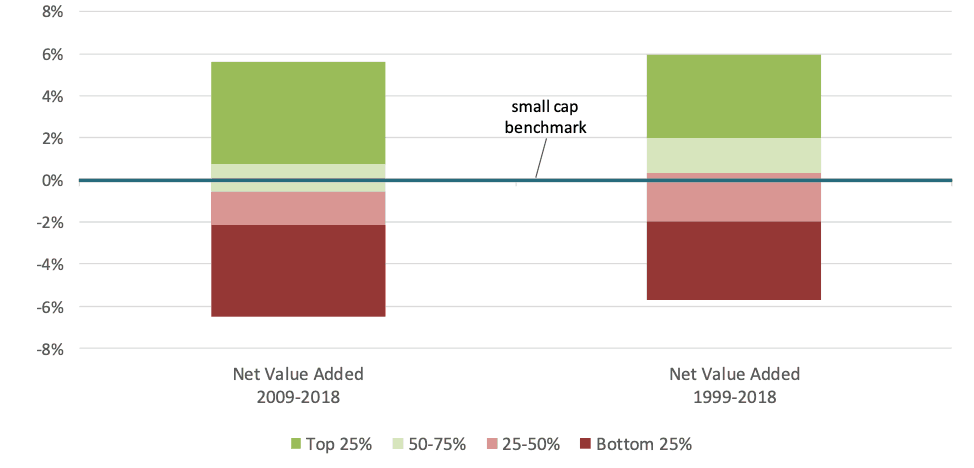
Do you have what it takes to be a top-quartile private equity investor?  Research from CEM Benchmarking sheds light on why this is an important question.  Long-term private equity (PE) portfolio results achieved by institutional investors were very dispersed.  From top to bottom, relative to a small cap public equity benchmark, 10-year net value added (NVA), for the period ending December 31, 2018, ranged from -6 per cent to +6 per cent. Top quartile was good. Bottom quartile was not.

NVA results were strongly associated with implementation style choices:

  • Low cost internal and co-investment outperformed
  • Limited Partnerships (LPs) underperformed some-what
  • High cost Fund-of-Funds underperformed by a wide margin

Private equity and the CEM database

The CEM database includes over 8,000 investor data sets spanning 27 years. In 2018, 325 institutional investors, mostly pension funds, held $10 trillion total assets under management (AUM).  Key PE portfolio data captured includes holdings, net returns, benchmarks and costs. PE allocations have tripled over the past 25 years, from 1.4 per cent to 4.5 per cent of investor AUM.  In 2018, 241 investors held $679 billion of PE.

Long term (1994 -2018), 65 per cent of investors increased their PE allocations in what seems a broad move to diversify away from classic 60/40 portfolios. Generally, they reduced public equity and fixed income holdings while increasing hedge fund, real asset and PE.

More recently (2013 – 2018), 37 per cent of investors increased their allocation to PE while 18 per cent decreased their allocation.  The latter, who were predominately smaller corporate pension funds, also decreased their public equity holdings and increased their fixed income and real asset holdings. This pattern is suggestive of de-risking strategies.

Private equity implementation styles

The PE implementation style approaches used by investors have a huge impact on their long-term PE results. Exhibit 1 summarises key implementation style data.

Exhibit 1: Selected Private Equity Implementation Style Data from the CEM Global Database (2018)
Implementation Style Investors using style Investors exclusively using this style Total PE AUM Median costs*
Fund of Funds 150 52 $97.5 bn 488 bps
Limited Partnerships 186 75 $453.7 bn 331 bps
Co-investments 43 0 $37.2 bn 38 bps
Internal 29 0 $91.1 bn 44 bps

* Costs expressed relative to NAV. These costs include base manager fees, carried interest and internal costs but exclude transaction costs.

Limited partnerships are investments made with General Partners (GPs).  LPs were the predominant implementation style, used by 77 per cent of all PE investors, and accounting for 67 per cent of total PE AUM.
Seventy-five investors used LPs exclusively.  All investors with internal and co-investment programs also used LPs.  The median LP cost in 2018 was 331 basis points.

Fund of funds are vehicles that invest primarily in LPs, creating a two-tier fee structure.  Fund of fund investing is a common approach for smaller investors and is often the ‘starter’ approach to PE.  In 2018, 52 investors used it exclusively to implement their PE programs.  Their average PE AUM was only $300 million.  It is a very expensive approach – the median cost for 2018 was 488 basis points. Over 2013-2018 fund of fund usage declined, as 33 per cent of PE fund of fund investors reduced their allocations.

Internal investments are made directly into operating companies by investor staff. Canadian investors are over-represented in this group. Although used by only 29 investors, internal represented 14 per cent of PE AUM.  These investors are large, with median total AUM of $83 billion. Their average PE portfolio was $11 billion, including $3 billion of internal.  At 44 basis points, median internal costs were much lower than both LPs and fund of funds.

Co-investments are minority investments directly into operating companies alongside a GP with whom an investor invests as an LP.  43 investors reported a total of $36 billion of co-investment AUM in 2018. At 38 basis points, co-investment programs have the lowest reported costs. Co-investment usage has grown substantially, 52 per cent of these investors increased their co-investment allocation between 2013 and 2018.

Private equity performance

Benchmarks used to evaluate performance for any asset class should meet three key criteria:

  • An accessible alternative available at low cost
  • Similar risk profile to the actual portfolio
  • High correlation with actual portfolio returns over time

Unfortunately, the PE benchmarks used by many investors don’t meet these criteria and create more noise than information.  Performance evaluation issues include differences in benchmarks types, as well as the use of lags and inclusion of un-investable premiums.  Therefore, to enable fairer, ‘level-playing-field’ comparisons, CEM applies a custom-lagged, regional blend of small cap equity indices. This benchmark meets the criteria above and is much better than most investor-reported PE benchmarks.

Exhibit 2 shows the wide range of PE portfolio NVA achieved by investors with consecutive years of PE data for the 10 and 20-year periods ending 2018.   Some investors did exceptionally well. Top quartile NVA was 2.0 per cent over 20 years and 0.8 per cent over 10 years. Top decile was 2.8 per cent and 2.1 per cent respectively for the same time periods.  Unfortunately, the story is very different for some investors. Bottom quartile NVA was -2.0 per cent over 20 years and -2.2 per cent over 10 years.  Bottom decile was -2.9 per cent and -3.7 per cent respectively for the same time periods.

Exhibit 2: Dispersion of Private Equity Net Value Added in the CEM Global Database


*Includes only investors with consecutive private equity data for each time period. Net value added shown versus the lagged small cap benchmark.


Isolating the implementation styles that comprise PE portfolios adds important insights about this wide dispersion.

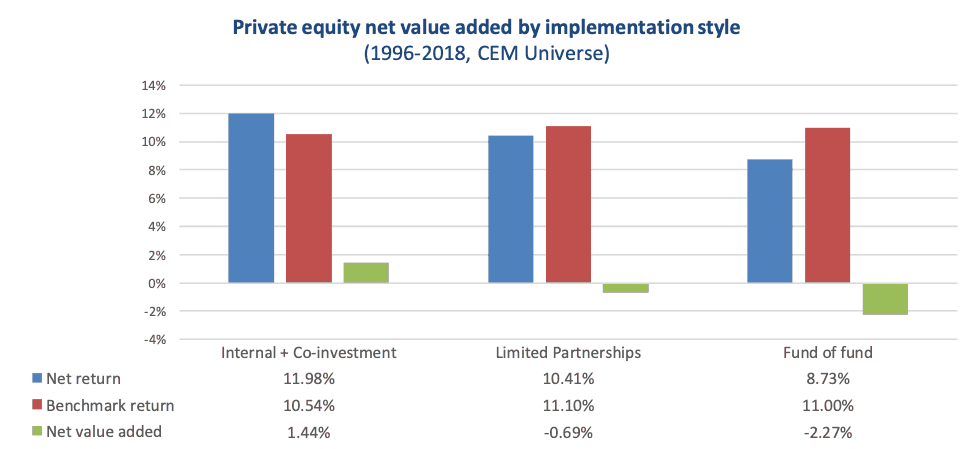
Exhibit 3 shows these long-term NVA results.  Internal and co-investment are combined because their costs are similar but very different from both LPs and fund of funds.  Average internal plus co-investment NVA was best at 1.4 per cent, followed by LPs at -0.7 per cent, while fund of funds trailed considerably at -2.3 per cent.  Although not described here, NVA was also widely dispersed within implementation styles.

Exhibit 3: Average PE NVA by Implementation Style in the CEM Global Database (1996 -2018)

* Research Exhibits 3 and 4 are based on a recent PE study by CEM Benchmarking and are based on 2,200 fund of fund observations,
1400 LP observations and almost 300 internal and co-investment observations. NVA shown is versus a lagged small cap benchmark.


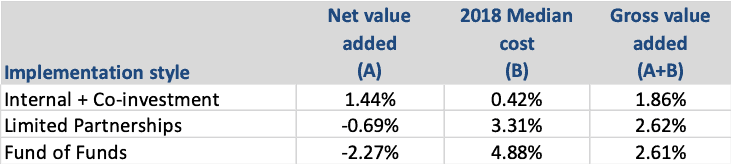
Adding back implementation style costs to its respective NVA provides an estimate of value added before costs (GVA).  Exhibit 4 shows these results.

What stands out is that all implementation styles did much better than the small cap benchmark before considering costs. In fact, the highest cost fund of funds style outperformed the lowest cost combination of internal plus co-investment by 75 basis points gross of costs.

Net of costs that differential swings dramatically to 371 basis points in favor of internal and co-investment.

Costs matter.

Exhibit 4: Net and Gross PE NVA in the CEM Global Database

Implications for investors

Relative to an investable small cap equity benchmark, PE has been a good asset class for many investors but a poor asset class for many others.  Empirical evidence points clearly to differences in implementation style usage and related costs as a key driver of this wide dispersion.

Implications for smaller investors:

  • High cost fund of fund structures are often used by smaller investors to implement PE programs. The most probable outcome is substantive underperformance.
  • Consider investing in small cap equity rather than PE.

Implications for larger investors:

  • Better PE performance has historically come from more lower cost internal and co-investment. Large investors have the scale to use internal and the clout to partner with their GPs to secure co-investment opportunities.
  • Adding internal is a major change that has serious implications. Prerequisites include quality governance, long-term organisational commitment and aligned culture, talent and compensation.

Implications for all investors:

Costs matter, but a lower cost implementation approach does not guarantee superior PE results; nor does a higher cost approach guarantee poor results.

NVA is very dispersed across all investors and within implementation styles.

LP-only PE investors have generated top-quartile, long-term results.  Even some fund of fund programs have produced good results.  Other factors matter, including decision and risk management processes, organisational talent, and relationships with leading GPs.

Mike Heale is a principal and Janjaap Weeda is a senior analyst at CEM Benchmarking.


The coronavirus has triggered a market correction, bringing the S&P 500 off its all-time high. But as always an analysis of fundamentals, and the relationship between price and value, is essential for allocating capital. So could this be a time to buy?

How far and fast the coronavirus will spread and its economic and social impact is anyone’s guess. S&P Global is forecasting the US economy to slow to 1 per cent annual growth in the first quarter from 2.1 per cent in the fourth quarter of last year. About 0.5 per cent of that is attributable to the coronavirus.

Most commentators are forecasting that any slowdown caused by the COVID-19 will be short lived, a couple of months or less. This was certainly true of SARS in 2003, where the market recovered quickly. But the key differentiator this time around is that China’s economy is more interconnected than it was 15 years ago.

Standard & Poor’s has lowered its forecast for Chinese GDP growth in 2020 to 5 per cent from 5.7 per cent on the back of the outbreak. But it is forecasting a rebound in 2021 where the economy will grow by 6.4 per cent, up from its initial forecast of 5.6 per cent. Meanwhile, the OECD believes China’s growth will slip below 5 per cent this year and will recover above 6 per cent next year.

The OECD has also updated its global growth forecast for 2020 to 2.4 per cent, from an already weak 2.9 per cent in 2019.

If the coronavirus outbreak is longer lasting, global growth could drop to 1.5 per cent in 2020, half the rate projected before the virus outbreak, according to the OECD.

In his March 3 memo to Oaktree Capital clients, Howard Marks points out the uncertainty is in part because of the lack of authority in knowing what the virus will do. But he says it seems “unlikely that the coronavirus will fundamentally and permanently change life as we know it, make the world of the future unrecognizable, and decimate business or make valuing it impossible”.

Marks points out is that the supply chain effects of the coronavirus are particularly important. The unavailability of a small Chinese component, for example, can cripple the production of a large piece of equipment.

In addition, several airline carriers have cancelled flights in and out of China, businesses are suspending travel unless it is non-critical (the meaning of which is unclear) and many manufacturers are facing supply chain delays.

Equities markets

In reaction to the coronavirus outbreak the S&P 500 declined by 432 points or 12.8 per cent from February 20 to February 28. But it was coming off an all-time high of 3386.15 on February 19. As at the time of writing the benchmark index was at 3130.12, a point it surpassed on December 5 last year. And in the bond market the 10-year treasury hit an all time low of 0.9 per cent.

According to Marks, the market was overvalued on February 19 and is now closer to fairly valued. He says what really matters is not that the market has dropped, but whether the price change is proportional to the worsening of fundamentals.

Marks thinks it could be a time to buy. Not “the” time but “a” time to buy.

He acknowledges that there is no way to know if the market will decline further, or bounce back, as this is largely based on investor psychology.

A notable feature of the outbreak, according to an Oxford Analytica briefing of March 2, is the amount of misinformation in the market, negatively impacting investor sentiment.

It says the misinformation in the market is drowning out official advice and creating hype that is difficult to manage – impacting investor psychology. Part of the problem is how the misinformation is being reported by the mainstream media, giving it reach and credibility. Indicative of how crazy this has become, the Word Health Organisation has joined the social media platform Tik Tok in a bid to distribute factual information. It seems the panic on the streets is creating a secondary crisis, and the dozen or so fund managers that Top1000funds.com has spoken to in the past few days all say that social reactions are out of proportion and inappropriate.

In this regard, Marks also acknowledges that there can be no way to know how actual developments around the virus will compare against the expectations investors have already factored into prices.

“…intelligent investing has to be based – as always – on the relationship between price and value,” Marks says in his memo of March 3. “… has the collapse to date caused securities to be priced right, or are they overpriced given the fundamentals, or have they become cheap? I have no doubt that assessing price relative to value remains the most reliable way to invest for the long term.”

If investors choose to buy, another consideration is the sector and country selection.

The 2008 global financial crisis was largely a demand shock to the global economy, but the coronavirus is a supply side shock.

According to an Oxford Analytica daily brief on March 3, rate cuts and budget spending can feed through to final demand for goods and services relatively quickly but may take longer to feed through to sectors that depend on complex supply chains.

This means while tourism, retail and hospitality sectors may bounce back once travel restrictions and quarantines end, manufacturing supply chains in sectors such as automobiles and electronic equipment may take longer.

Looking at supply chains also extends to trade considerations, with Asian economies, notably Hong Kong, likely to experience more vulnerability given its trade share with China.

Government action

Monetary policy continues to be the rescue remedy of choice for global economies with the US Federal Reserve and the Australian Reserve Bank among those cutting rates. The Banks of England and Canada are also both expected to act, while  the European Central Bank has said it is “monitoring the outbreak carefully.” Both the German and Japanese governments have also said they would support economic activity. In the emerging markets, a number of economies have cut interest rates including Malaysia, Thailand and the Philippines.

An article by PIMCO analysts points out that large areas of the corporate private credit market are vulnerable to a general deterioration in economic growth.

“While epidemics have tended to have temporary effects on markets, small to midsize companies, which make up 70 per cent of US employment, are very sensitive to tighter credit conditions and slower growth,” the article points out.

The authors say with this in mind, the equity and credit market response to the Fed’s announcement is troubling – it didn’t have the impact that was expected – and the central bank may need to do more.

According to research published by MIT, a recession in the US was likely regardless of this latest catalyst. But now the US Fed only has 100 basis points to play with if a recession does come.