
Atleast 2023 until ‘normal’ returns

Coronavirus vaccines are being rolled out in various jurisdictions – including the UK and Russia – but it will take at least an additional two years from now to eradicate the pandemic, according to health experts.

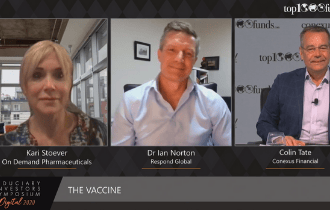
Speaking at FIS Digital 2020 Dr Ian Norton, founder and managing director of Respond Global and the former global head of WHO’s Emergency Medical Team Initiative warned the 185-odd asset owner attendees with a collective $11 trillion assets under management that a long road to normal still lies ahead.

“We’ve never seen a pandemic end in less than two years,” he said.

Now the key challenge lies in the logistical and supply chain challenges of rolling out the vaccine. Moreover, success depends on the vaccine reaching all corners of society, and all countries in the world.

“We can’t just look at one country’s management of COVID; each country is only as strong as global management. International borders won’t open until we have got rid of the bulk of the disease.”

And all the while fresh spikes will occur.

Sponsored Content

“It’s not over; there are several waves to come.”

There are investor opportunities with regard to bio-medicine that have been highlighted by the pandemic, and the innovation around the vaccine development, and the focus should be on ongoing technological innovation, said Kari Stoever chief external relations officer at On Demand Pharmaceuticals.

She also highlighted the need for innovation around cold chain storage and flagged that healthcare supply chains will increasingly onshore.

“The global supply chain won’t go away but we will see a shoring up of domestic manufacturing to meet rapid demand responses to surges,” says Stoever, who recently wrote the document for President-elect Joe Biden on the future of pharmaceutical manufacturing in the US.

Indeed, fierce nationalisation regarding healthcare provision is a key lesson from the pandemic, said Norton who noted how manufactures in the West closed off their supply to developing nations.

“We will see more regionalisation of supply,” he predicted.

Norton, whose experience includes coordinating WHO’s emergency health response to Ebola in West Africa, also forecast a rebound in demand for healthcare away from COVID-19 that stretched governments won’t be able to meet. Expect a hybrid of ethically-driven businesses to fill the gap, he said.

Reflecting on why the US has struggled to contain the pandemic, Stoever said that successful policy depends on both top down and bottom-up strategies.

“In the US there has been a failure at both levels,” she said.

The challenges inherent in mandating behaviour depend on successful public education. Moreover, she flagged that gaps in public education in the US could impact vaccine take up.

“I am already seeing a lot that worries me like unsubstantiated claims about safety; I hope these don’t scare the public,” she told delegates.

Noting the different levels of resistance across the US at a community level to public health messages, she said: “We live in an individualistic society and people are seeing their rights violated.”

Adding again that changing that message to one of interconnectedness won’t ever be heard without top down, bottom-up messaging.

Panellists heard how America’s travails contrast with countries like South Korea, Australia and many African countries which have successfully got their public health message across.

“It is about taking people with you,” said Norton who witnessed first-hand Liberia’s success in containing Ebola. “Liberia invested in a public health message and Liberia got rid of Ebola.”

Similarly, South Korea, which learnt early lessons from MERS, has got the virus under control but he noted that “alternative news” makes public messaging difficult.

Norton also reflected on the challenges facing WHO.

“It is an underfunded agency, and has been for a long time,” he said, also describing how WHO is buffeted by contributing countries trying to control how money is spent. The organisation’s strengths lie in its ability to set standards and manage research; its weaknesses lie in operations and logistics. With this in mind, he warned that WHO should prepare for another wave of criticism in response to its ability to lift the vaccine.

“It will not be able to do this,” he said, adding that the organisation’s window of opportunity to create an operational entity has now passed.

Instead, he forecast that health institutions in regional blocs like the EU, ASEAN and ECOWAS could become the future focus of global health management.

Leave a Comment

The twin forces rewriting the rules of investing

The twin forces rewriting the rules of investing

Portfolios built for the old world will be severely tested as emerging forces rewrite the rules of investing. The Fiduciary Investors Symposium heard that geopolitical and macroeconomic upheaval, together with the disruption wrought by AI, should force asset owners to rethink the structure and composition of portfolios.

Sort content by

Future Fund looks to slash external tech spend in cost-cutting drive

Australia's Future Fund is hoping to find tens of millions in cost savings by consolidating arrangements with external data and tech providers and putting a number of roles under review as it reconsiders resourcing in a volatile investment environment that it “expects to endure”.

CalPERS ties pay to collaboration, total fund results under TPA

The $556 billion CalPERS is considering a more complete integration of “collaboration” and total fund results as performance metrics for its executives and investment team as it makes headway in its shift to the total portfolio approach.

The future belongs to investors who can adapt

Canada's HOOPP has officially adopted the total portfolio approach since the start of 2026. Unpacking the move, the fund's managing director and head of total portfolio group Jacky Lee writes that while the approach doesn't magically make the return better, the fact that it frees the investment team from outdated processes and gives investment leaders the flexibility to act is what gives it an edge.

The world won’t wait for the investment committee 

What does it actually mean to be a long-term investor when the ground beneath your feet is shifting faster than your investment committee can convene? 

Rethinking portfolio construction at the human-AI nexus

As artificial intelligence models become more sophisticated, asset owners and managers are rethinking portfolio construction as an activity sitting at the nexus of human and machine, which means gaining an edge over the market increasingly needs investors to tap into the wisdom from both sources.

Investors boost inflation-hedging amid geopolitical conflicts; eye tactical shifts

Inflation hedging is back on top of the agenda for investors as conflict in the Middle East drives up energy prices globally, but the FIS Singapore heard that many portfolios are not well-prepared for the broad ways through which inflation can creep through. The new era of significant trade and capital flow shifts driven by modern mercantilism is also throwing out TAA opportunities.  

Previous



