
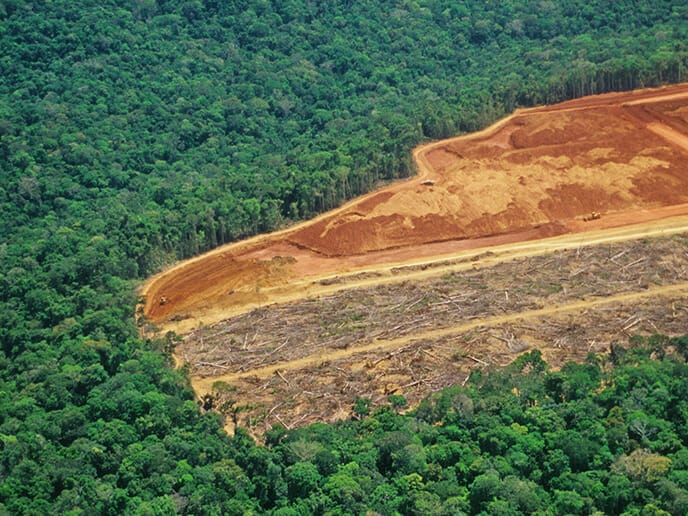

Halting deforestation is essential to reaching the goals of the Paris Agreement, an expert panel argued at the PRI in Person conference in San Francisco.
Forest restoration is a natural way of reducing carbon emissions, yet 17 per cent of South America’s Amazon rainforest has suffered deforestation and been cleared. Scientists say the tipping point at which deforestation is irreversible is 25 per cent clearance.
If the tipping point were reached, about 60 per cent of the forest would fall into degraded savanna, they estimate, releasing more carbon into the atmosphere and destroying the climatic stability of the region. It would be irreversible because new rain forest wouldn’t be able to spring from the degraded area.
“If we want to be on the safe side, let’s stop Amazon deforestation and bring it to zero completely,” argued Carlos Nobre, Institute of Advanced Studies, University of São Paulo, and senior fellow of World Resources Institute Brazil.
The agricultural sector has an enormous global footprint, Nobre said. It takes up 40 per cent of the earth’s surface, consumes 70 per cent of water resources and pumps out greenhouse gas emissions linked to deforestation. Deforestation is running at the rate of one football pitch of clearance a second, attributed to palm, soya and cattle production, Nobre said.
The destruction of South America’s savannas is also a grave problem, he said. These mostly flat, forested plateaus are being lost to industrial-scale agriculture, particularly soya production driven by automation and shifting diets away from animal protein – despite low productivity in Amazon lands for soya and cattle.
It is not only farming that’s putting the Amazon at risk. Global warming is accentuating the problem, changing the crucial “short episode” rainfall patterns on which the forest depends and heightening the risk of fire, particularly through more lightning strikes.
“The dry seasons are becoming longer,” said Nobre, who added that unprecedented periods of drought and flood in recent years illustrated the changing climate and instability in the system.
At €486 billion ($568.5 billion) Dutch asset manager APG, the position is that combating deforestation is part of its fiduciary duty to ensure an orderly transition to a low-carbon world.
“When investors talk about climate change, they talk a lot about fossil fuels and energy, but forestry, land use, food and farming [are] a huge part of climate transition,” APG Asset Management’s Lucian Peppelenbos said.
But investing to combat deforestation and in support of sustainable land use is challenging. It involves navigating land use and country risk.
“We need to bring down the risk profile of land use,” Peppelenbos said. Nevertheless, he does note a strong underlying investment case. “Farm and timberland have strong fundamentals in the transition to a low-carbon economy that make a great investment case.”
Together with other investors, the pension fund engages with companies on sustainable palm production and is now pushing its investee companies on sustainable soya and beef production. The fund also benchmarks companies on how they are addressing deforestation, particularly how they reach out down their supply chains.
Investment opportunities in the sector include new funds such as Amsterdam-based SAIL Ventures’ &Green fund, which invests directly in sustainable land use. It provides long-term stable capital that seeks a double bottom line of zero deforestation and a financial return from commodity production.
“Investors like how increased engagement on the environmental side reduces asset risk,” Sail Ventures CIO Johnny Brom said. “The &Green funds prove that commodity supply chains can be delinked from deforestation.”
Dutch agribusiness Bunge has a zero-deforestation commitment across its supply chain.
“We have to meet our commitments and apply policy regardless of complexity on the ground,” said Stewart Lindsay, vice-president, global corporate affairs, at Bunge, which operates in 40 countries.
Technology is allowing the company to monitor deforestation in new ways, access new suppliers and increase supply-chain transparency.
“We are spending more time doing independent satellite monitoring of farms where we buy palm oil; it gives us a closer independent look at where we are buying to monitor changes on the ground.”
This is allowing the company to integrate deforestation planning into its investment strategy, making decisions based on low environment risk and high agricultural return.
In another initiative to help combat deforestation, the company is offering 10-year finance to farmers in its supply chain. Lindsay observed that just because palm production is not certified doesn’t mean it isn’t sustainable and cited the need to increase downstream – or consumer – demand for certified palm.
“It is a premium product. If that demand doesn’t go up for certified products, [we] will have to maintain commitment in different ways.”[vc_subscription_cta s_cta_text=”Sign up to our weekly newsletter for regular news flashes and industry insights.” text_color=”#0c0c0c” bg_color=”” button_url=”/subscribe/” button_text=”Subscribe” btn_color=”” btn_bg_color=”#c0091f”]








Leave a Comment
You must be logged in to post a comment.
Login