

A recent visit by Top1000funds.com to Apollo Go’s robotaxi operation in Wuhan offered a ground-level view of how China is building a parallel technology system in response to US-led restrictions. The opportunity set across technology and especially AI adjacent industries is expanding exponentially, but governance and geopolitical constraints could make it hard for foreign asset owners to participate in the upside. Darcy Song reports.
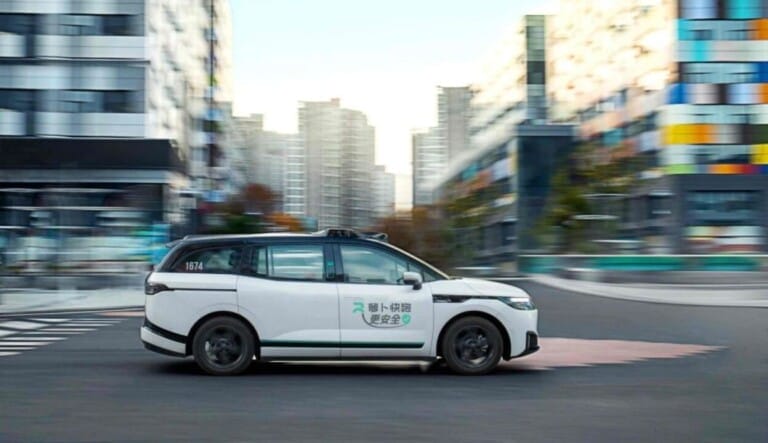
On the bustling streets of Wuhan, a white SUV looks slightly out of place. Not only because it’s diligently following the road rules in a city known for having some of the most unpredictable drivers in China where sudden lane changes and other high-risk manoeuvres are regular occurrences, but also because there’s no one behind the wheel.
A closer look reveals two passengers lounging in the massage-enabled backseats experimenting with the in-car karaoke function. Later, the vehicle pulls into a designated parking spot near a dental clinic, its automatic door slides open to let the riders out before merging smoothly back onto the road to meet its next customer.
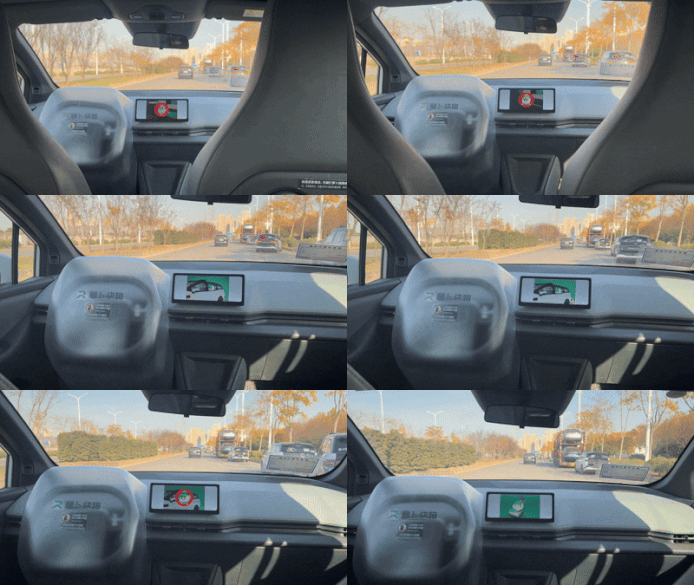 The vehicle is a part of the latest generation of driverless fleet from Baidu’s autonomous driving subsidiary, Apollo Go. It hosts close to 1,000 robotaxis on the road servicing consumers of Wuhan, which was picked strategically as a major testing hub due to its extensive car parts manufacturing capacity.
This latest model (RT6) is equipped with an in-house developed artificial intelligence model and cost less than 230,000 yuan (around $33,000) to make due to domestically-sourced automobile parts and radars. This is about one-sixth of the cost to produce a Waymo vehicle, Alphabet’s robotaxi that services the citizens of Austin and San Francisco, as Top1000funds.com learnt during a recent visit to Apollo Go’s factory.
Each RT6 is equipped with seven sensors for environment detection, which were previously imported from the US for $100,000 per piece, says a Baidu staff member at Wuhan who requested anonymity. While there has been a significant drop in price for imported sensors, Chinese-produced ones are still cheaper and could cost as low as 1000 yuan ($143) each.
The factory visit to Apollo Go is a keyhole to the microcosm of a parallel, self-sufficient ecosystem that China is building in the technology arms race with the US, with the ultimate purpose of freeing itself from relying on the US for crucial hardware or algorithms.
For asset allocators, it could mean the chance to invest in an attractive thematic in a less-concentrated and richly-valued market compared to the US, as Chinese technology companies seek private partnerships to fuel expansion.
The result is a bifurcated investor landscape. For some asset owners, governance and mandate constraints will continue to place opportunities in China out of reach. For others with fewer limits, the pressing question will be whether staying on the sidelines of investing in China carries its own risk as the next generation of tech champions mature largely outside of the Western institutional portfolios.
The decoupling
Signs of two parallel innovation ecosystems began to emerge between the US and China when it became clear technological dominance was crucial to the next global order.
The battleground has been focused on advanced chips, with a slew of measures aiming to control US exports to China rolled out during the Biden administration and only accelerated under President Trump. International relations analysts suggest three critical objectives behind these measures: choking off China’s access to high-performing chips, preventing China from domestically producing alternatives, and mitigating US corporations’ losses by allowing China’s access to less cutting-edge chips.
China, meanwhile, wants businesses to look inward for solutions. Despite Trump stepping back from the Biden-era export ban of Nvidia’s second-most advanced chip, H200, the government has reportedly asked tech companies to halt purchasing the chips as it decides under what conditions access will be allowed. It was also reported that Beijing is looking to mandate domestic chip purchases from providers like Huawei.
A further injection of $48 billion last year announced by the Chinese government alongside major state finance institutions to the National Integrated Circuit Industry Investment Fund (better known as the Big Fund) to foster semiconductor supply chains and address critical bottlenecks, like high-bandwidth memory, is evidence that tech self-sufficiency has become an urgent objective.
The market is pushing tech companies which may aid this ambition into new heights. Moore Threads, a chipmaker touted as ‘China’s Nvidia’, surged 425 per cent in its first day of trading after a stunning IPO in December 2025.
Appetite for foreign capital
But outside of semiconductors, the race is wider-ranging – companies like Elon Musk’s Neuralink and robotics company Boston Dynamics are spoken about in the same breath alongside Chinese counterparts like BrainCo and Unitree Robotics.
The presence of foreign investors can offer global visibility and facilitate knowledge sharing for Chinese companies. The latter has become more important as the state government turns conservative around protecting domestic IPs in critical technology industries.
Apollo Go’s Wuhan branch frequently receives requests from foreign investment firms to tour its showroom, but it’s rare that the company get approvals from the local government to accommodate such trips.
“The ideal partnership model for us in the future, should we launch our service in a new trial city, is to attract third-party investors who can bring in capital and together lobby the local policymakers,” a Baidu staff member says.
“While the capital is important to us, we value the knowledge-sharing aspect in foreign partnerships more these days.”
Robotaxi is another nascent yet attractive sector for investors due to its place at the nexus of AI, electric vehicle manufacturing and energy industries. While Apollo Go’s 250,000 weekly ride figure is short of Waymo’s reported 450,000 weekly trips, China is a deep market waiting to be explored.
A taxi fare in Wuhan currently costs an average of 1.5 yuan per kilometre thanks to cheaper electricity powering the vehicles but could fall under one yuan per kilometre after robotaxi is popularised, cutting out the human cost, says the Baidu staff member. There is still huge room for growth before that objective becomes a reality.
At the same time, Apollo Go has already launched trials of its service in Switzerland and Abu Dhabi and planned entries into the UK and Germany in 2026 through partnerships with Uber and Lyft and more overseas trial destinations like Australia and Southeast Asia in its sights.
Investor reality
With that said, the reality for foreign investors to tap into the well of opportunities in China is complicated due to significant government presence.
State capital accounted for 52.5 per cent of the LP investments in Chinese private equity in 2024, according to figures from Chinese alternatives data platform Zerone, which would make a huge portion of innovative Chinese companies out of bound for allocators like US public funds which have country investment restrictions.
Politicians from US states including Indiana, Florida, Texas, West Virginia and many more have forbidden their public funds from investing in companies where the Chinese government owns a large stake, or in the country altogether.
Asian and Middle Eastern asset owners, though, have a different approach: Singapore’s S$434 billion ($337 billion) Temasek has 18 per cent of its portfolio allocated to China and 24 per cent to Americas, according to its 2025 annual report.
Abu Dhabi-headquartered Mubadala Investment Company invests 13 per cent of its $330 billion portfolio in Asia, of which China accounts for half with more than 100 investments in the country. This month, the city’s other SWF Abu Dhabi Investment Authority ploughed into a $770 million China-focused multi-asset continuation fund as the lead investor, establishing itself as a secondaries buyer while others in the market look for exits.
These investors are acutely aware of the delicate geopolitical environment as well as the need to spread their investment bets. As Qatar Investment Authority’s technology, media and telecommunications head Mohammed Al-Hardan said at a Doha conference last May, it was trying hard to “avoid situations that potentially jeopardise relations with the US” while actively seeking deals in China.
And soon, all allocators have to decide on whether the risk of being left out of China may outweigh the risk of leaning in.







Leave a Comment
You must be logged in to post a comment.