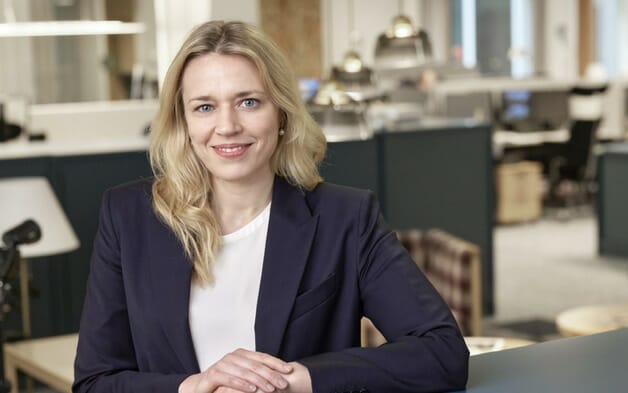

AP4: Why a dynamic, shorter term allocation is paying off

Volatile markets have provided a rich hunting ground and opportunistic best ideas have come thick and fast for AP4’s new five-pronged global allocation made up of systematic equity, currency and rates, asset allocation, hedge funds/external mandates and analysis. Magdalena Högberg explains the risks and opportunities of the best ideas allocation.

Last year, AP4, the SEK548.2 billion ($56.7 billion) Swedish buffer fund, launched a new global asset allocation to harness its rich internal resources to invest more dynamically and shorter-term.

Since then, volatile markets have provided a rich hunting ground and opportunistic best ideas have come thick and fast for the five-pronged allocation made up of systematic equity (including defensive equity and environmental factor strategies) currency and rates, asset allocation, hedge funds/external mandates and analysis.

For example, higher interest rates have allowed AP4 to switch between equity and rates to various degrees. The team have profited from curve bets in fixed income, taking positions on the curve steepening and flattening at points in the year, as well as around long-end US interest rates moving up and down.

Currencies have provided a rich seam like when the usual correlation between the US dollar and Swedish Krona changed: since January this year the Swedish Krona has appreciated around 5 per cent and 12 per cent against the EUR and USD respectively.

Swedish real estate also threw open a window of opportunity in 2023 (a few months before the new asset allocation was formerly established) when it was hit by negative sentiment that caused a dislocation of the pricing in credit markets.

Sponsored Content

“We reasoned that the expected return in credit would be greater than what we could achieve in equity and sold the equity portion of the portfolio and bought credit instead,” says Magdalena Högberg, head of asset allocation, liquid markets and analysis (ALMA) at AP4 in conversation with Top1000funds.com.

Currencies and rates have provided particularly strong returns, but Högberg says AP4 hasn’t yet revealed first-year returns. Still, although the risk budget is opportunistic and will vary over time, she believes that given what is going on in financial markets, the allocation is coming into its own and she hopes her 20-person team will get more resources as the merger of the AP funds progresses.

The team has covered its open positions and is hiring a quant analyst after the summer.

The mandate captures either relative value trades within an asset class like a best ideas portfolio or takes positions across asset classes where AP4 can provide its long term, patient capital to the market at times of stress, explains Högberg who closely follows similar allocations at peer funds like AP3 and New Zealand Super where a strategic tilting allocation has become one of the investor’s top-performing programs since it was introduced in 2009 contributing approximately NZ$4.6 billion ($4.2 billion) to date.

“The relative value portfolio within the asset allocation mandate provides a way for our internal PMs to add or size up relative value trades,” she explains. “We also complement the idea generation with ideas from a dedicated team of analysts that are supported by our robust internal technical platform to capture the returns from markets behaving in interesting ways, dislocations and/or volatility.”

A typical investment will have a life of between six months to three years. Given AP4’s operational strategic asset allocation is 10 years, these positions are more short-term, but Högberg insists AP4’s edge does not lie in short-term tactical asset allocation and trading. The portfolio is merely dynamic and shaped around a medium-term outlook that takes advantage of cycles.

What are the risks?

The risk of events not playing out to plan is high. Strategies combine a quant fundamental approach with macroeconomic scenario analysis that seeks to map out ways the world could evolve. Positions depend on, say, the Fed lowering rates or inflation being high, and often require catalysts.

Moreover, successful prediction is a tricky business. Witness how although tariffs were widely predicted, the strength of Trump’s policy caught the market unaware.

“Going into April, the risks of tariffs affecting the world in some way we couldn’t foresee was high so we reduced the size of our positions as well as the overall equity risk in the portfolio. After the tariffs were announced we tried to see if the markets had gone too far, and what new positions would be most beneficial to our portfolio,” she recalls.

Another risk lies in hidden correlations. The team looks at positions from standard and statistical risk models to identify patterns to try and ensure positions don’t overly rely on, say, equity going up. Another risk comes from tying-up capital for too long in low conviction trades that utilise the risk budget and could limit dry powder on hand to take advantage of other opportunities that could be more profitable for the portfolio.

“It’s an opportunistic portfolio, so you need dry powder to step in when you see something enticing from a risk reward perceptive. We have to make sure that we have the best ideas available to us in the portfolio,” she says.

Developing an internal quantitative platform

The team has developed an internal quantitative platform that it uses for decision making based on statistics as well as time series modelling that incorporates views, and updates the models as new information arrives in the market. Specific models, or signals, also seek to incorporate things in the macro-economic environment like a spike in recession risk or signals that flag comparisons with other types of market environments.

“The quantitative platform and signals are not something we use to automatically take positions on. It’s more of an idea generation feature that identifies interesting deviations from fair value that we can analyse from a more fundamental perspective,” she says.

The model is also evolving. For example, the platform now complements time series models with one-country models, and the team is incorporating more currency models with a focus on combining long-term models like fair value using purchasing parity with short-term single country models where the team can capture other things driving returns to capture carry signals in emerging markets.

“We want to be more dynamic at identifying the regimes currencies sit within,” she says, explaining that multiple drivers influence currency markets from speculators and corporate hedging strategies to interest rate differentials or geopolitical risk. “The AP4 team has spent a lot of time on developing new, more fast-moving modules for G10 currencies and we are are now looking at ways to better trade emerging market currencies and capture signals in emerging markets.”

Asset Owner:AP Fonden 4 (AP4)

Leave a Comment

The Austin advantage: Texas Teachers talks optimism, innovation and growth

The Austin advantage: Texas Teachers talks optimism, innovation and growth

Jase Auby, TRS' celebrated chief investment officer, explains why TPA doesn't fit with its culture; his view that community pushback on data centres could turn out to be an investor advantage, and argues the case for continuing to invest in fossil fuels. Top1000funds.com sat down with the CIO in his Austin office for an all-encompassing conversation.

Sort content by

Sampension: Why there are many reasons to be optimistic

Now is not the time to reduce risk, argues Henrik Olejasz Larsen, chief investment officer of Sampension, Denmark’s $50 billion pension fund for public and private sector employees. In an interview with Top1000funds.com, he says corporate profits have not deteriorated, and although the market has been tested from multiple directions, the underlying optimism driving equities is strong enough to overrule the negative impact of geopolitical risk.

France’s Banque des Territoires looks for data centre opportunities

France’s Banque des Territoires, a subsidiary of Caisse des Dépôts, the country’s €323 billion state-owned financial institution, plans to invest more in data centres in France. The push is in line with government policy to build out AI infrastructure off the back of the country's access to cheap, green, nuclear energy that uniquely positions France to provide power to the AI industry while maintaining net zero credentials.

Why NYC pensions CIO hasn’t drunk the ‘TPA Kool-Aid’

Three decades of investing have given Monte Tarbox sharp eyes for recognising risk and opportunities, and he’s putting it to use as the new permanent chief investment officer of the $306 billion NYC Bureau of Asset Management. In an interview with Top1000funds.com, Tarbox outlines his vision for the fund, why he’s bullish on infrastructure but “nervous” on PE, and why he hasn’t drunk the TPA “Kool-Aid”.

How CPP is evolving risk management for a faster, more interconnected world

In an environment where multiple risks are emerging and their effects are compounding on the portfolio, CPP Investments' chief risk officer Priti Singh says the $572 billion fund is rethinking risk management from the ground up, shifting from reaction to preparation and embedding risk thinking earlier in investment decisions. She speaks to Amanda White about the fund's risk approach.

URS bets on nuclear to power AI and lower emissions

Next-generation nuclear energy, and the money pouring into it, will truly change the world, according to CIO of Utah Retirement System John Skjervem. It’s a lonely position as the CIO of a public pension fund but one Utah is embracing as it builds out early-stage investments in nuclear energy as part of its alternative energy portfolio. He speaks to Sarah Rundell in an exclusive interview about how investing in transformational energy technologies can be part of prudent investment management.

Managing volatility and inflation: Constant rebalancing shores up UK’s lifeboat fund

A keen focus on rebalancing, and best in class systems, allows the UK’s £31.2 billion Pension Protection Fund to effectively implement a dynamic hedging strategy for one of the UK's biggest LDI portfolios. Sarah Rundell reports.



