Robert ‘Vince’ Smith, chief investment officer of the $21.5 billion New Mexico State Investment Council since 2010, believes turbulent times lie ahead, and he’s getting ready.

Smith has shaped strategy at NMSIC around protecting the fund from the high prices in traditional investment markets – and the lower rates of return that they promise in years to come. The fund calculates its valuations according to the cyclically adjusted price earning (CAPE) ratio, developed by celebrated Yale professor of economics Robert Shiller.

The real over-valuation this metric reveals, by comparing today’s prices with the 10-year moving average of historical earnings, is ringing alarm bells with Smith: stocks and bonds have rarely been priced so highly at the same time over the last 100 years.

“We are seeing stocks priced at the 95th percentile, so they have only been more expensive than they currently are 5 per cent of the time back to the late 1800s,” he explains. “We are also seeing fixed-income markets around the 90th percentile, so yields are very low relative to typical yields over time. [These situations usually] doesn’t happen together. Normally, if we see expensive stocks, we see cheap bonds and vice versa.”

He lays the blame at the door of central bank monetary policy.

“The low interest rate environment central banks have engineered is materially responsible for the high valuations in many markets.”

The US Federal Reserve raised rates in December 2015 for the first time in a decade, and although it has raised rates three times since, they remain historically low, in a range of 1 to 1.25 per cent, well below forecasts for 2017.

Smith’s response has been multipronged. He has steadily reduced equity exposure; the portfolio is now 40 per cent equities – equally split between US and non-US – 24 per cent fixed-income and 12 per cent each to private equity, real estate and real return. This contrasts with 2010, when the fund had a 60 per cent allocation to public equity, combined with equity-centric, opportunistic and credit strategies across real estate and fixed income.

Only a big sell off in US equities would make him rethink increasing the current allocation.

“Our publicly traded equity exposure is at a level that makes sense for now,” Smith says. “Here, at these valuations, we are comfortable with a more diversified portfolio.”

Smith has also switched 60 per cent of the US public equity allocation into diverse, factor-based strategies, away from cap-weighted benchmarks.

“We are avoiding the cap-weighted benchmarks because we think they are top heavy – as they usually get in late-stage equity bull markets.”

It’s also one way of diversifying away from the risk of the “huge multiples” of so-called FANG stocks, the acronym for tech stocks Facebook, Amazon, Netflix and Google (via its parent, Alphabet), where valuations are, he believes, reminiscent of the late ’90s tech bubble.

Another 20 per cent of the US equity allocation lies in traditional active domestic equity strategies, where the focus is on value with downside protection, and using managers with strong performances in tough markets.

Donald Smith is a “favourite” small-cap manager here, along with Brown Brothers Harriman, which has a $600 million investment from NMSIC.

“We think they do a great job in tough markets,” Smith says.

The final 20 per cent of the US equity allocation remains in a cap-weighted index strategy.

An appetite for income producers

Smith has also steadily built up income-producing assets across energy, infrastructure, timber, farmland and real estate.

“High valuations can be managed by favouring investments that produce income as a large part of their total rate of return,” he says. “If we have two investments with similar expected rates of return, we’ll almost always take the one that has the higher component of income as part of that total rate of return over one that has a higher equity or capital-gain exposure.”

The real-estate portfolio is split between core real estate – where most of the return over a cycle comes from income – and value add and opportunistic investments, which are also biased towards income.

In private equity, this focus means a shift towards growth capital, investing with managers that improve margins at companies. These managers typically buy a company, increase its margins, then sell it on the basis of its higher earnings.

“It’s not dependent on a capital gain driven by revenue growth like public equities,” he explains. “We like this model more than the public-equity model, where an extra dollar of revenue is turned into a few cents of profit, and that additional profit gets capitalised and up goes the stock. Everywhere in the portfolio we are looking for ways to generate income and reduce dependence on growth-related capital gains for return.”

NMSIC expects to make $600 million in annual commitments over the next three to five years to reach the 12 per cent target for its private-equity portfolio.

Hello cash, goodbye absolute return portfolio

Smith’s crisis mitigation has also made him mindful of the need for cash. In a recent liquidity study, the fund looked into what kind of cash it would need on hand in a crisis market – something Smith defines as a time when stocks are down 35 per cent – to rebalance and meet capital calls. He also wanted to ensure a little in hand for opportunistic investments “if something really falls apart and we want to take advantage”. The process has resulted in NMSIC now ensuring 10 per cent of the fixed-income portfolio is liquid and available.

He has also just axed the absolute return portfolio. Despite acknowledging the work previous teams put in around the portfolio’s construction and strategy, Smith and his 11-member investment team reluctantly concluded it didn’t work.

“We took it out. Just this last month,” he says. “[It] has been a change on a par with our move away from equities – not in terms of dollars moved, but in terms of strategy. Seven years ago, we had a 10 per cent allocation in our funds-of-hedge-funds strategy. But it just wasn’t clear what it was doing, other than costing us a lot of money and delivering low returns.”

The few remaining hedge fund strategies – about 1 per cent of assets under management – won’t be in a bespoke portfolio but accessed through the non-core fixed-income allocation, where absolute return had the most success.

“It was difficult to find successful equity strategies, and macro funds weren’t putting up numbers that impressed us either. Most of the hedge funds we like have been in fixed income,” he says.

After a distinguished 30-year career in US public sector investment, Smith’s commitment and passion for public service is undimmed. He says nothing equals the reward of watching investment returns at the permanent endowment get ploughed back into the state.

“The tax-burden relief our investment income provides is the most impactful thing we do,” he enthuses. “Last year (ending June 2016), we distributed $900 million to the state that is mostly spent on education. That’s $900 million the tax base doesn’t have to come up with.”
As public pension plans grapple with how to meet funding liabilities amid historically subdued investment returns, the desire to focus on elements that can be controlled – namely, fees – has led to growing use of low-cost index or passive strategies.

But reports of the death of active management may be exaggerated. Growth in the use of passive and index strategies, even by quite sophisticated investors as pension funds seek ways to address the underfunding of their liabilities and the prospect of lower returns, does not undermine the case for active management, says BlackRock head of active investments for Asia-Pacific, and chief investment officer of emerging markets, fundamental active equity, Belinda Boa.

Boa says that while the money in passive strategies is growing quickly in percentage terms, and that the trend will continue, it’s coming from a low base and is still dwarfed by the money invested in active strategies.

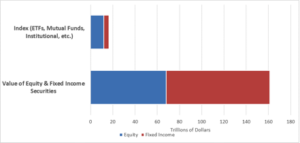
Figures supplied to conexust1f.flywheelstaging.com by BlackRock show that in mid-2016 there was about $11.9 trillion invested in equity index strategies – including exchange-traded funds (ETFs), mutual funds and institutional money – while the total value of equity securities was about $67.9 trillion. About $4.7 trillion was invested in fixed-income index strategies and the value of global fixed-income securities at that time was about $93.4 trillion.

Combined, about $16.6 trillion was invested in equity and fixed-income index strategies, while the total global value of equity and fixed-income securities stood at $161.3 trillion. In other words, index strategies account for a little more than 10 per cent of the value of global equity and fixed-income securities.

Notes: ETFs as of Sept 2016, Global market as of Aug 2016, MFs as of Aug 2016, ETPs as of Aug 2016. Source: Bank for International Settlements, Strategic Insight Simfund, BlackRock, Bloomberg

Sharper focus on fees

The CIO of the A$130 billion ($103.7 billion) Australian sovereign wealth fund, the Future Fund, Raphael Arndt, told the Investment Innovation Institute forum in Melbourne this May that low prospective investment returns have put the spotlight on the impact of fees on portfolio performance.

The Future Fund has a long-term return target of inflation plus 4.5 per cent a year, and Arndt said the fund is looking at ways to get “more bang for our listed-equities buck”.

“Lower forward-looking returns [make] fee drag a much more significant issue than in times of healthy returns,” Arndt said. “Fees are a greater proportion of gross expected returns than they were in the past. And while expected returns are uncertain, fees are certain.”

Boa says a black-and-white distinction between active strategies and passive, or index, strategies is not helpful. She says the best way to answer the fundamental question, “What is passive?” may be to define what an active strategy is first, and then define passive as “everything else”.

“Active is when you’re taking risk in the market versus something that’s more broad-based and representative, whether it’s through market caps or smart beta or factor strategies,” Boa says.

In fact, she argues that the whole passive-vs-active discussion is misguided.

“As an industry, I don’t think we’ve done ourselves any favours by talking about active versus passive.” The conversation should be about “active and passive”, she argues.

“Every time you make a decision, even investing in the S&P 500, which is a very broad-based market index, you’re still making an active decision, because you could have been in cash, or you could be in the Russell 2000 or you could be in something else,” Boa explains. “So it’s an active decision and I think we’ve created all these anxieties and questions in the marketplace around active versus passive, whereas it isn’t as clear-cut.

“Historically [an index meant a] market-cap index, now [there are] more fundamental indices and smart-beta strategies, factor strategies and active strategies…There’s no clear point where you say, ‘Well, that’s exactly index and this one is exactly smart beta.’ The continuum across the industry and the way the world has tried to force these things into two separate buckets isn’t entirely right and, therefore, is not helpful.”

Active in name only

Boa also says a proliferation of so-called active funds over recent years – which, in reality, hug an index or other benchmark but charge a higher fee than funds explicitly branded as passive or index – has not been helpful.

Given the index-like returns produced by some so-called active strategies, investors may consider “for a pretty similar outcome, choosing something that’s got a lower fee”.

The Future Fund’s Arndt says there are other issues that sometimes arise from the use of active managers, including the fundamental fact that “listed equity managers in general aren’t particularly good at making macro calls”.

“Likewise, when we analyse positions in our portfolio, we are increasingly discovering managers are knowingly, or unknowingly, taking significant factor positions.

“For example, an active manager with a strong value style may have a process that, in effect, hugs a value index and does not add much by way of true stock selection risk. Alternatively, a manager may adopt a combination of styles but still fail to deliver idiosyncratic stock selection and instead rely on a mechanical style-based process, which can be cheaply replicated.”

The concern that then arises for many investors is whether their fund is paying an active fee for what is, essentially, an index portfolio. This can also happen if the positions of individual managers offset each other at a portfolio level.

“This is of no value to us, but results in us paying active fees for close to beta returns,” Arndt says.

These issues demand a different approach to active equities investing, Arndt says, which involves far deeper analysis of individual managers’ security selections, macro calls, tilts and factor bets.

Despite these concerns, Boa and Arndt agree that the place of active strategies remains assured.

Arndt says: “We believe there is a place for active managers with genuine and reasonably priced stock-picking skill. You will not see the Future Fund adopting a fully passive portfolio any time soon.”


Inside the research

A sometimes-underrated benefit of passive strategies has nothing to do with cost, per se, but relates to the degree of accuracy they afford pension funds in implementing asset allocation.

The CIO of the $40 billion Public Employees’ Retirement System of Nevada (NVPERS), Steve Edmundson, told top1000funds.com in August that while low costs are a clear and welcome result of an index approach, the bigger benefit is enabling the fund to set, monitor and rebalance its asset allocation accurately with reference to its long-term targets.

All of NVPERS’ public-market assets are managed in index strategies, a total of about $32 billion of the fund’s $40 billion in assets.

There’s a growing body of evidence that moving to low-cost index and passive strategies can play a material role in helping pension plans meet pension liabilities, even as returns remain depressed by historical standards.

An article published in the Journal of Financial Counseling and Planning, “Active Versus Passive Investment Management of State Pension Plans: Implications for personal finance” says state public pension plans face “the apparent underfunding of pension liabilities in every state”.

The article’s author, Michael L. Walden, the William Neal Reynolds Distinguished Professor of Agricultural and Resource Economics at North Carolina State University, in Raleigh, N.C., examines the benefits for pension plans of adopting low-cost, passive or index strategies.

Walden’s analysis of 46 state pension plans, using data from the funds for the decade from 2003 to 2012, suggests there are potential cost savings, and therefore improved long-term returns, to be had by adopting low-cost diversified strategies.

“States could both improve their annualised after-fee rate of return and reduce prospective underfunding of pension commitments by shifting from managed portfolios to low-fee, diversified portfolios provided by mutual funds,” Walden maintains. “The findings support the arguments made by the passive investment management approach – that simple is better, and that aspiring to ‘beat the market’ was unsuccessful from 2003 to 2012.”

But there’s an important proviso; Walden’s conclusions must be assessed in light of the level of investment risk that pension plans are prepared to take.

“This result only occurs for alternative portfolios that are broader than a standard stock/bond combination,” Walden’s paper states. “The alternative portfolios need to be diversified to explicitly include geographic markets (such as emerging and Pacific) and sector markets (such as energy, real estate, and metals), therefore potentially implying greater risk than some state pension plans now take.”

In addition, he warns that his paper’s findings should not be considered an exhaustive analysis of the active-vs-passive debate. There are other factors at play, which also must be considered.

“It may be that directors of state pension funds have simply selected poor active investment managers,” he says. “Or, it could be the case that legislated state restrictions on how state pension funds are invested inhibit the ability of investment managers to earn competitive returns.”

Changes to the time period of the analysis may produce different results, and extending the time period would “reduce uncertainty about the relationship between the portfolio composition of state pension plans and rates of return by including market conditions that may not have been present during the 2003-12 period”.

This pinpoints one of the greatest criticisms of index strategies, and especially market-cap index strategies – namely that investors are “strapped in” and will bear the full brunt of a market downturn, whereas an active strategy may enable a manager to mitigate some of the downside, protect the pension plan’s assets and better preserve its pension funding position.

Nevertheless, Walden says the paper contains clear implications for workers and retirees covered by state pension funds.

“The paper certainly raises questions about how state pension fund investments are managed, and whether the current preference for active management is yielding the highest after-fee returns for workers,” he says.


An investment belief shared by many is that those investors able to take a long-term view have a competitive edge over others that don’t. In this article, I will explore and explain what I believe defines this competitive edge.

For any investment opportunity, there are probably two questions that are of most interest:

  • Will this opportunity lead to a positive payoff in the future?
  • Assuming yes, when will this positive payoff occur?

For me, the defining characteristic of any long-horizon investor is that the decision to invest is based on high conviction of a positive answer to the first question and has little to do with the answer to the second. This expands the opportunity set available to them.

Let me elaborate. Financial markets are not completely efficient (see the Thinking Ahead Institute paper Stronger Investment Theory for more). In the short term, swings in investment sentiment can create large divergences between prices and fundamental values. In the long run, however, financial markets may act as a “weighing machine”, in value investing legend Benjamin Graham’s words; that is, prices and values will probably converge eventually. If this is indeed the case, an investment opportunity can be identified when price-value divergence is detected – a difficult but plausible task.

On the other hand, the timing of the price-value convergence is extremely difficult to predict, if possible at all. Prices can over- or undershoot values for a sustained period, leaving short-horizon investors at the mercy of whether markets move quickly enough to reflect their views. As John Keynes rightly pointed out, “The market can stay irrational longer than you can stay solvent.” Its activity can be challenging, if not dangerous (particularly with leverage).

As a result, the key competitive edge of long-horizon investors involves their skill and their mindset. The key skill is their ability to identify the price-value divergence and the relevant mindset is their willingness to wait patiently for the convergence to take place.

In other words, long-horizon investors can participate in opportunities with uncertain timing regarding their future payoff, as long as they have high conviction on the investment proposition itself.

In practice, it results in long-horizon investors being able to embrace many more investment opportunities.

An example

Let me use provision of liquidity as an example. During stressed markets, as in the global financial crisis, risky assets become under-priced due to a large number of investors being forced to sell to meet redemptions, among other reasons. Long-horizon investors can exploit this opportunity and harvest a premium when values and prices do converge. In fact, Warren Buffett made a handsome $12 billion with just one banking stock he purchased back in 2011.

This type of opportunity is not suitable for investors who do not have that willingness and ability to wait for the opportunities to play out regardless of the time required. It is entirely possible that divergences will continue to grow larger in the short term. (For a more comprehensive review of all opportunities available to long-horizon investors, see Eight paths to long-term premia.)

Long-horizon does not mean buy-and-hold

So, if long-horizon investors have the mindset and skills to wait patiently for investment opportunities to play out, does it mean they are buy-and-hold investors? No.

In my opinion, the concept of a long-horizon investor emphasises the mindset and skills of the investor. It is the ability to be flexible, not an obligation to hold assets for a prolonged period of time. Long-horizon investing is by no means a rigid buy-and-hold approach. The length of the holding period is driven by the speed at which price and value converge; it’s not pre-determined.

Even with a long-term approach, an element of dynamism can be important, as conditions and circumstances change fundamentally over time. Long-term risk-return premia and investor risk tolerances vary through time, leading to necessary real-time portfolio changes. This involves responding to new prices and investment conditions with changes to portfolios that retain the essential long-horizon framework but trade positions where price-value convergence has occurred to new situations where it has yet to occur.

Patient and active – that defines long-horizon investors.

Liang Yin, CFA, PhD, is senior researcher in the Thinking Ahead Group, an independent research team within Willis Towers Watson and executive to the Thinking Ahead Institute.

Consideration of environmental, social and governance (ESG) factors is becoming a key feature of bond pricing and credit-risk assessment – slowly.

Once the sole purview of investors, such consideration is earning a place on the agenda of credit ratings agencies globally. Given the weight ratings agencies carry in fixed-income markets, their heightened interest can give added impetus for ESG investment in different corners of the world, particularly where support for it is weak or where progress has recently stalled. The potential for positive impact is huge, given that global bonds – the largest asset class in capital markets – total nearly $88 trillion, Securities Industry and Financial Markets Association data shows.

Many investors are still questioning why they should incorporate ESG factors into fixed-income instruments, but more and more are also asking how to do it, and focusing on which factors might affect bond price performance.

Ratings agencies can play a unique role in enhancing ESG integration in financial assets, given that credit ratings feature highly among the factors investors consider when determining the suitability of a bond investment. Indeed, credit ratings cover most fixed-income instruments. They may define or limit investment mandates, and markets trade on potential credit rating upgrades or downgrades.

Better and systematic ESG integration in credit risk is important for fixed-income investors who buy bonds for capital preservation, particularly insurers and pension funds, which own considerable amounts of long-term fixed-income securities for asset-liability management, as in Australia’s well-established pension industry.

Evidence of a link between ESG factors and credit risk – the risk that a bond issue or its issuer will default – continues to emerge. As such, it is critical that these factors are systematically included in bond valuations where material. This issue is particularly pressing for asset owners, which have a fiduciary duty towards their beneficiaries.

On a positive note, fixed-income investors and ratings agencies are allocating more resources to ESG issues, including appointing dedicated analysts and publishing research. This is one of the main findings of Shifting Perceptions: ESG, credit risk and ratings – part 1: The state of play – a new research report by the UN-supported Principles for Responsible Investment (PRI). Investors and ratings agencies are also looking for new ways (internally or through external providers) to quantify and incorporate ESG factors more systematically into their risk assessments.

The report follows the 2016 launch of the Statement on ESG in credit ratings, which endeavours to enhance the systematic and transparent consideration of ESG issues when assessing credit risk. The statement, which is still open to new signatories, has already been endorsed by more than 120 investors representing more than $19 trillion in assets under management, and 11 ratings agencies.

More work to do

The agencies have yet to demonstrate, however, that refined methodologies and improved competence in ESG issues are prompting changes to credit ratings (some evidence exists, but it is patchy). Meanwhile, investors also have work to do, as ESG integration can often be advisory in nature and the responsibility may fall on ESG analysts alone to raise red flags, rather than on credit analysts or portfolio managers.

The report also highlights several disconnects between investors and ratings agencies, with the time horizon over which ESG factors are deemed material being the most contentious point. For example, ESG analysts tend to be more long-term than portfolio managers, while ratings agencies vary on this point.

Not all ESG factors are material to credit risk; some won’t trigger an issuer or issue default. However, all may negatively affect the trading performance of a bond and may become material in the future. For example, a company may meet the costs of an environmental accident easily, but if the frequency of accidents starts to increase (all else being equal), its financial strength may deteriorate.

Next steps

Investors are asking for greater guidance from ratings agencies about the direction of risks. This is provided to an extent by credit watches, outlooks and outlook statements, but investors are demanding that the agencies become more proactive in addressing long-term trends, risk trajectories and their potential triggers.

Against this backdrop, several questions remain open that will shape the agenda of industry forums the PRI will lead over the next year. These will serve as a platform for engagement between investors and ratings agencies.

It is encouraging to see that the dial is beginning to move in the right direction, but more work lies ahead. ESG consideration is gradually gaining prominence, but still seems to be viewed as nice to have, rather than a must-have.

Carmen Nuzzo is senior consultant, credit ratings initiative, at the Principles for Responsible Investment.


Structure and strategy continue to take shape at the UK’s Brunel Pension Partnership Ltd.

BPP is the new manager for the pooled assets of 10 of the UK’s local government pension funds. It will manage about £28 billion ($37 billion) in 22 different portfolios from April next year.

The BPP is one of eight asset pools formed out of 89 local government pension funds as a result of the UK Government’s July 2015 budget. The aim is lower investment management costs and more effective management of assets, along with savings through the pools’ collective buying power.

The 10 funds combined in the BPP pool will continue to make their own investment decisions and allocate their own assets; however, the BPP will select the investment managers, execute the investment decisions and monitor performance.

Current mandates among the 10 number well over 100, with about 90 fund managers. Getting down to 22 portfolios will reduce the number of managers to about 60. The pool will save an estimated £16 million ($21 million) annually and have the potential to increase that to £70 million ($91 million) a year over time.

“We agreed to the specifications of the portfolios over a year ago with our clients, the underlying pension funds, and we are revisiting these now to ensure that any changes to investment strategy statements are incorporated and we can finalise the portfolios – essentially the BPP Ltd prospectus,” explains BPP chief executive Dawn Turner, formerly chief pensions officer at the Environment Agency Pension Fund, one of the bigger funds in the pool.

Mark Mansley, former chief investment officer at the EAPF, is BPP’s CIO. Investments will not be managed internally at the start but this is likely to change going forward, Turner says.

“We are aware of the opportunities of some internal management and as we establish ourselves, we will look at the business case for [this],” she explains. “Moving to any internal management will be a shareholder decision. We will, though, from the start, have a much more direct approach for our private-market portfolios, moving away from funds of funds.”

Setting strategy, with emphasis on responsible investment

Investment strategy at the pool will have a strong focus on responsible investment and stewardship, led by the best-practice standards well embedded at the EAPF.

Responsible investment, “a key investment principle”, will apply across all the assets within the pool, Turner says, especially responsible stewardship in terms of voting and engagement. Infrastructure will be an important asset class, as BPP clients will be better able to access such opportunities through collaboration.

Establishing the pool’s investment principles has provided the bedrock to strategy.

“We had to ensure that we all agreed to the investment principles,” Turner says. “This was fundamental and our starting point. [They were agreed upon in] May 2016.”

Another foundation for strategy was the creation of portfolios that could deliver the outcomes required from 10 different investment strategies in “a small enough number of portfolios to gain economies of scale, manage risk and create opportunity for improved performance”, TURNER explains.

She adds: “We had to ensure that we had our eyes wide open to the cost of transition and the level of fee savings possible.”

More recent steps include legally establishing BPP Ltd and gaining 10 administering authorities, along with settling on the shareholder agreement and service agreement.

It has, she says, been a process defined by “open conversation, the commitment to working in equal partnership, transparent communication and the professionalism of officers and committee members. The challenge would have been so much more without these good behaviours and good attitudes.”

Consultants advise on costs

BPP has used 12 strategic partners and consultants so far. Consultancy bfinance was tasked with providing independent advice on the proposed portfolios, fee levels and projected savings, as well as reviewing the portfolio specifications. It has also helped build a structure to maximise efficiency while preserving the independence of the respective schemes.

“Analysis determined the potential fee savings that could realistically be expected in the relevant investment sectors as a result of asset aggregation, as well as prospective transition costs and other elements,” bfinance stated.

BlackRock has also worked on analysing the potential transaction costs the pool may face. Its work was based on assumptions about manager selection and how estimated costs changed given different manager choices.

Other advisers include Russell Investments, which has helped member funds determine how to optimise portfolios to ensure efficient management, and how to handle the complexities of using multiple managers.

Between now and next April, BPP will continue its transition plan, focused on revisiting its 10 funds’ strategic investment strategies, finalising the portfolios and continuing to engage with investment consultants and fund managers. Next steps also include staff recruitment, completing Financial Conduct Authority approval for BPP Ltd, and working with new administrator and custodian State Street.

There is an imperative for building long-term strategy into corporate-shareholder communications and providing guidance on how chief executives can go about that.

Existing corporate-shareholder communication is biased towards short-term horizons. Little time is spent addressing the future or providing forward-looking information.

Pressure on chief executives to deliver short-term results has intensified in recent years. CEOs that respond to these pressures by cutting back on research and development and losing sight of business fundamentals may damage long-term corporate performance.

As CECP Strategic Investor Initiative set out in our recent paper, this is a problem for corporations, their investors and the broader community of stakeholders. The evidence indicates that corporations that manage business-relevant sustainability issues and adopt long-term strategies outperform peer companies. Corporations focused on the long term also reduce the negative impact on the various systems (natural and financial) on which they rely. With better sustainability credentials, corporations are also better placed to protect their brand, innovate, operate a more resilient business model, and retain and motivate employees.

The major mutual fund managers – with a collective $11 trillion in assets under management (AUM) – agree that short-termism is a major problem, having raised concerns about “quarterly earnings hysteria” at the expense of “long-term value creation”.

And Vanguard chief executive Bill McNabb also made the case for a long-term focus in a recent open letter to directors of companies worldwide on responsible stewardship. There is broad agreement that the dialogue between corporations and their shareholders should be reoriented to address long-term value-creation. But how?

The CECP Strategic Investor Initiative’s response to this challenge is the CEO-Investor Forum – a new platform to enable chief executives of leading listed companies to present plans for long-term value creation to investors.

The inaugural CEO-Investor Forum was held in New York in February. Corporations with an aggregate market capitalisation of $600 billion presented long-term plans to investors representing AUM of $20 trillion.

The long-term plan presentations augment the existing schedule of corporate-shareholder communications. These plans can help reorient quarterly calls so they address long-term targets and meet investor expectations for improved disclosure aligned with long-term horizons. Investor-facing public disclosure of these long-term plans can also help attract more long-term “investor allies”, embed environmental, social and governance (ESG) principles in business models and give investors an understanding of the mega-trends relevant to a company (such as the transition to a low-carbon economy).

We think long-term plans should be a mainstream element in corporate-shareholder communications. To this end, the next CEO-Investor Forum will be held on Tuesday, September 19, at Bloomberg in New York – with further forums in New York and San Francisco next year.


Five tips for CEOs telling the long-term value creation story


Following the inaugural CEO-Investor Forum, we developed the following criteria (elaborated upon in our recent paper), in consultation with institutional investors, that chief executives should consider when putting together their long-term plan.

  1. Talk about the future: A long-term plan balances a long-term value creation story (about the past) and a long-term value creation plan (about the future). To fulfil the potential of a long-term plan, a chief executive should spend two-thirds of the presentation on forward-looking information.
  2. Have a five-year plan: corporations and investors have fundamentally aligned long-term investment horizons. A long-term plan should reflect this and present a plan, with appropriate measures, for five years forward.
  3. Mission-critical stakeholders: A corporation has many stakeholders but not all are critical to its long-term performance. Chief executives should demonstrate an awareness of the corporation’s “mission-critical” stakeholders and how they are managed.
  4. ESG: Financially material ESG factors are core to resilient corporate performance over the long-term. Through using frameworks as the Sustainable Accounting Standards Board and telling “ESG war stories”, a chief executive can help investors understand how a corporation manages its business-relevant ESG issues.
  5. Capital allocation and mega-trends: Long-term plans can rely on many strategies to generate growth, including acquisitions, divestments and organic growth. Unpacking that strategy and setting out how it is funded and aligned with mega-trends (like technological disruption), helps investors understand the future corporate context.


CECP’s Strategic Investor Initiative is an effort to shift trillions in investor assets to companies that adopt and communicate long-term strategies that integrate financially material ESG factors. The CEO-Investor Forum is a core element in that effort. The work of the Strategic Investor Initiative will be to deepen and broaden the practice of presenting long-term plans. Over time, we expect the pioneering corporations and CEOs presenting long-term plans at CEO-Investor Forums to reap the benefits of enhanced long-term returns and supportive investors with a long-term focus.


Mark Tulay is director, Tim Youmans is research director, and Brian Tomlinson is senior research adviser for the Strategic Investor Initiative at CECP.

If you are an investor and are interested in attending CEO-Investor Forums, please contact Mark Tulay for more information: mtulay@cecp.co.