The true value story of people is rarely told well in corporate disclosures. For asset owners, improved human capital disclosure should promote efficient capital allocation that maximises value through this time of technological disruption.

The disruptive effects of technological change on corporations occupy much space in the business press, and for good reason. Investment markets have witnessed value destruction in companies and sectors exposed to disruption over the last 15 years, and there is much more to come, with rapid advances in automation, big data, machine learning, and artificial intelligence. Some commentators say these forces are combining to create a fourth industrial revolution, with profound implications for businesses. Few companies or industries will escape, as new business models compete with incumbents, creating new risks and opportunities.

Market understanding of these forces remains patchy, however, making for a challenging landscape for long-term investors. How people are managed and organised strategically in corporations to protect existing products and expand new markets represents an information gap, therefore, and filling it can shed light on a company’s future prospects. After all, acquisition of digital and technical capabilities is only one response to disruption; full organisational responses will be required to, for example, engender greater workplace agility and flexibility.

The ways in which knowledge, skills and abilities are organised to achieve corporate objectives – strategic human capital management – are an increasing determinant of corporate market value. We hear company representatives claim that ‘people are our most important asset’ so often it has become clichéd. Yet the reality is that for the majority of companies today, a significant portion of company value is deeply connected to their people, through intangible value. This under-recognised proportion of corporate value has grown with the decline of manufacturing in Organisation for Economic Co-operation and Development economies and the increased representation of service-oriented businesses, technology and finance.

Without a fulsome picture of the value of people communicated to the market, company valuations are probably misinformed. This affects the entire investment chain, including asset owners.

To date, disclosure in this area has not kept pace with the changing business landscape. For asset owners, improved human capital disclosure should promote more efficient capital allocation that maximises value through this time of disruptive change.

Disclosure becomes more important

Where business models are highly vulnerable to disruption, it follows that investors need information beyond that available in financial accounts to inform investment decisions. In the Australian market, for example, one of the country’s largest banks divulged that it would comprehensively restructure its work organisation by removing hierarchies and bureaucracy – adopting organisational structures akin to those in fast-moving tech companies – as a direct response to disruption risk.

Reorganisation of work on this level is directed at increasing the responsiveness of the organisation to business threats, identifying opportunities in new markets, products or services, and reducing the time required to bring new products and services to market – or all of these.

Greater attention to strategic human capital disclosure aligns to investor-driven demand for greater qualitative reporting and integrated reporting formats, which seek to provide greater visibility on corporate prospects and outlook. In Australia, for example, changes to the Corporations Act in 2013 expanded reporting to include an operating and financial review (OFR) for such disclosures. Additions to statutory reporting and listing requirements reflect similar trends, the furthest advanced being the Strategic Reports in the UK and integrated reporting expectations for companies listed on the Johannesburg Securities Exchange.

Use existing frameworks

We believe an effective way to address the information gap further is for companies to disclose under the OFR and similar reporting requirements, as they provide an existing structure for enhanced disclosure of strategic human capital. Indeed, we believe where human capital reporting is absent and strategic human capital risks are material, companies may not be fully meeting their disclosure requirements.

While the volume of human capital reporting has increased over the last decade, primarily in environmental, social and governance reporting, the quality of reporting is little progressed when viewed through a financial materiality lens. Therefore, we believe pension funds and other asset owners should support greater disclosure on strategic human capital management to address this gap, the importance of which will continue to escalate as the fourth industrial revolution takes hold.


Regnan’s paper on strategic human capital disclosure can be accessed here.


Doug Holmes is head of research at Regnan’s. Regnan supports institutional investors in employing active ownership strategies that account for all the risks and opportunities relevant to value creation over the short, medium and long term.
The chief investment officer of the A$7.3 billion ($5.8 billion) Statewide Super, Con Michalakis, has three framed photographs on his desk. They are of alleged drug smuggler, and fellow South Australian, Cassandra Sainsbury, Russian President Vladimir Putin and United States President Donald Trump – with a red “Make America Great Again” cap balanced on the frame.

The three photos act as a constant reminder of risk.

“I come in every day and look at their faces and it reminds me to always be thinking about risk. Personal risk, geopolitical risk and WTF risk,” he laughs, pointing at Sainsbury, Putin and Trump in that order.

On the day in August 2017 that Michalakis was interviewed, Trump was making headlines for stepping up his antagonism towards nuclear warhead-enabled North Korean dictator Kim Jong-un.

But despite the many frightening geopolitical risks in play Michalakis believes the biggest threat to financial markets is simply that investors have become too complacent.

“What worries me now is that the world was pretty messed up in 2008 and 2009, and people say, ‘If you weren’t scared back then you didn’t really understand how bad things were’,” he says.

“Well, now, nine years later, we’ve pretty much gone full circle, from absolute fear at the height of the GFC to, well, it’s not quite exuberance because people are still carrying the scars, but I’ve never seen complacency like this.”

Interest rates are very low, credit spreads are very tight, equity valuations are quite high and volatility is very low. But at the same time, major economies – the US and Australia included – are showing signs of strength as indicated by improving employment data and this is lulling investors into a false sense of safety.

“The problem is that markets are saying, ‘There’s nothing that worries us, we can buy risk assets, gear up and buy shares and property, buy debt, buy all these structured products, buy ETFs and go passive.’ I think it’s all a bit too easy,” Michalakis says.


A period of rebuilding

In the two years before the global financial crisis, Michalakis had been living in New York working as a director of marketing and client services for hedge fund Pzena Investment Management.

When he left at the start of August 2008, to take a short holiday before returning to his hometown of Adelaide, the capital of South Australia, for his current job, it looked like markets were getting back on track after the collapse of Bear Stearns a few months earlier.

Less than a month later, when he landed at Statewide, US mortgage brokers Freddie Mac and Fannie Mae were nationalised, and a week later Lehman Brothers was nationalised.

“So here I was, with my first gig running a pension fund and the world had turned pretty ugly,” he recalls.

Statewide head of alternatives and direct investments Chris Williams joined a few months later and the pair bunkered down to spend the next year getting the basics right. JANA was appointed as the fund’s asset consultant. An investment committee was formed, a new investment governance framework was formulated and the strategic asset allocation was reset. Former Sunsuper chief investment officer Jack Gray was brought in as a special adviser to the investment team and stayed seven years, having a huge influence.

In 2008, Statewide Super had about $1.6 billion in assets and was one of the worst-performing superannuation funds in the country. Today, following a 2012 merger with $1.3 billion rival Local Super, Statewide manages $5.8 billion in assets and is one of the country’s top performers. The fund’s MySuper option delivered an annual average return of 10.65 per cent from inception on July 1, 2013 to June 30, 2017.

Michalakis says success as a chief investment officer comes down to three things: getting the investment governance structure right, putting the right people into that structure and developing a sound set of investment beliefs.

“Today, we’ve got those big important things in place,” he says. “So the focus is on thinking about how to position the portfolio to be resilient, which you can’t really do but you can achieve a little bit at the margin.”

Tilting to absolutes

In recent months, Statewide has reduced its equity holdings to run a bit more cash, while retaining its preference for active management in local and global shares. It is slightly under-hedged in the Australian dollar.

“At the margin, we’re adding some absolute return strategies,” he says. “Taking the overall equity weight down a bit, not adding too much illiquidity. Just trying to diversify the portfolio.”

The fund has already done a lot to build its tilt to absolute return strategies over the past five years. When Michalakis joined Statewide, it had no allocation to absolute return strategies, while today they make up about 12 per cent of the portfolio.

Adelaide Airport and Flinders Ports are two direct infrastructure investments, inherited in the Local Super merger, that have performed well and helped diversify the portfolio.

Statewide’s exposure to listed equity markets has been reduced to 50 per cent, split roughly evenly between local and international markets.

“Everyone says go buy a low-cost option, but net of fees we’ve smashed it with active managers, so there’s no reason to change,” Michalakis says, noting that the Australian market in particular, with a benchmark index dominated by a handful of big banks and miners, is a dangerous index to be passive against. “Our size gives us an advantage because we can be in the small to mid-cap strategies and hire interesting managers.”

That is not to say he isn’t focused on implementing active strategies at the lowest possible cost. In his desk drawer, he keeps a full arm’s-length veterinarian’s plastic glove. It has proved a disarming prop when negotiating with managers over fees on more than one occasion.

“I really hate paying high fees,” he says.

Michalakis is prepared for returns to be lower, he expects that to be the case, forecasting that cash and bonds to be in the low single digits, and equities mid-single digits, and alternatives probably the same, over the next seven years. Diversification is the key he says.

Statewide’s MySuper offering, the default fund, has an asset allocation of Australian shares 31 per cent, international shares 25 per cent, property 10 per cent, growth alternative 4 per cent, infrastructure 10 per cent, alternative debt 3 per cent, diversified bonds 11 per cent, cash 6 per cent.

Team effort

Williams says Michalakis likes to act the joker, on Twitter and in real life, but when it comes to business he is incredibly focused. Michalakis says of Williams and the rest of the fund’s small investment team: “I don’t manage them, they manage me – and I really like that,” he explains.

Domestic equity and property manager David Obst and special adviser David Smelt joined the team via the Local Super merger. More recently, Daniel Dujmovic was promoted from the fund’s finance team working across cash and fixed income, while actuary Susannah Lock was recruited from the Responsible Investment Association of Australasia as a quantitative analyst.

Michalakis is certain the team will have their work cut out for them over the next few years.

“No one knows the future,” he says. “But I can say with relative certainty we’re in for an extended period of low returns and it’s likely to be combined with increased volatility, which will certainly test everyone’s behavioural responses.”

The biggest challenge for professional investors today, he says, is that the “signal-to-noise ratio is the lowest it has ever been”. In light of this, he thinks it’s an advantage for his team that they’re not based in Melbourne or Sydney.

“It means we don’t get infiltrated by the herd,” he says.

A frequent conversation among limited partner (LP) investors goes something like this:

LP #1: “How much of your private equity (PE) portfolio is invested in venture capital (VC)?”

LP #2: “None. We can’t access top-tier VC funds and if you can’t invest with these top-tier firms, the returns don’t justify the risk. Therefore, we avoid venture capital altogether (‘the Statement’).”

For the purposes of the Statement, a top-tier VC firm is one whose flagship fund has performed in the top 5 per cent of the US VC universe or is generally recognised as top-tier by the market. Current top-tier VC firms include Accel, Benchmark, Greylock Partners, Kleiner Perkins Caufield Byers, and Sequoia.

Not only is the Statement a commonly held belief among LPs, but also it’s something I have said numerous times. But the more I said the Statement, the more I wondered if this commonly held belief was true. What would happen if the underlying hypothesis for the Statement were tested against historical data?

Before proceeding, it’s important to highlight one obvious, but meaningful, fact: PE performance data is subject to change in the future, which has the potential to alter the conclusions from a study done today. For example, you might form a hypothesis that one of your US buyout funds ranks in the top quartile versus a relevant US buyout benchmark. But when you run the analysis using the most recent performance figures [i.e., net internal rate of return (IRR), ratio of distributions-to-paid in (DPI), and ratio of total value-to-paid in (TVPI)], you may discover that the fund ranks in the fourth quartile; therefore, your top quartile hypothesis would be rejected. However, fast forward two years and the fund’s performance may have improved due to a few investments that were realised significantly above the previous carrying values. When you benchmark the fund at that point, it would rank in the top quartile.

In this example, the results of the test changed with time and, ultimately, your hypothesis proved to be accurate. I highlight this point because it’s possible that VC data from years ago led to the conclusion that only top-tier VC funds outperform the top-quartile returns of all other PE strategies, but since that time, the data may have changed.

Reasons LPs stay away

Investing in VC funds is a complex task and many organisations appear to have thoughtful reasons for avoiding the strategy:

  1. Limited impact on returns for large LPs: Even a stellar 5-times net return from a small commitment to a VC fund would have minimal impact on performance for an LP with a multibillion-dollar PE portfolio.
  2. Lack of resources: There are hundreds of VC firms and some institutions have only one or two investment professionals to prosecute new LP commitments.
  • Some LPs with resource constraints leverage funds-of-funds to obtain VC exposure (Cambridge Associates data shows VC funds-of-funds consistently perform above the US VC median TVPI).
  1. Lack of predictive metrics/lack of visibility on company development in early-stage companies: How many people could reliably predict that WebVan would go bust while Jet.com would be a homerun?
  2. Transparency/terms: Some organisations require economic or transparency terms that VCs won’t provide.

Another argument for avoiding VC if you can’t invest with the top-tier funds is dispersion of returns. Historical data shows that the dispersion of returns between top- and bottom-quartile VC funds is much wider than in top- and bottom-quartile buyout funds. Therefore, if you can’t access top-tier VC funds, you may not be appropriately compensated for the downside risk and would be better off sticking to buyout funds. The counterargument would be that instead of avoiding VC funds, LPs should be even more selective and diligent when committing capital to funds in this strategy. This topic is worth exploring in more detail, but would require a lengthy discussion that is outside the scope of this article.

Some necessary assumptions

Notwithstanding the constraints above, let’s test the Statement. Should LPs that can’t access top-tier VC funds avoid the strategy altogether?

In order to answer this question, I needed to make a few assumptions. First, I assumed that LPs that don’t invest in VC funds do invest in buyout funds. It’s rare to meet a PE investor who has meaningful exposure (5 per cent or more of total assets) to PE and doesn’t invest in either VC or buyout funds. Some invest in only one or the other, but rarely in neither. Second, I assumed that a top-tier VC fund is a fund that is in the top 5 per cent of the Cambridge Associates US VC benchmark in any given vintage year. This assumption is not perfect but directionally it should be accurate. If you accept these assumptions, please continue reading.

An LP that makes the Statement believes:

  1. It can’t access top-tier VC funds but can access top-tier buyout funds or at least top-quartile buyout funds
  2. Returns from top-quartile buyout funds consistently outperform top-quartile VC returns.

More top-quartile funds in VC than in buyout

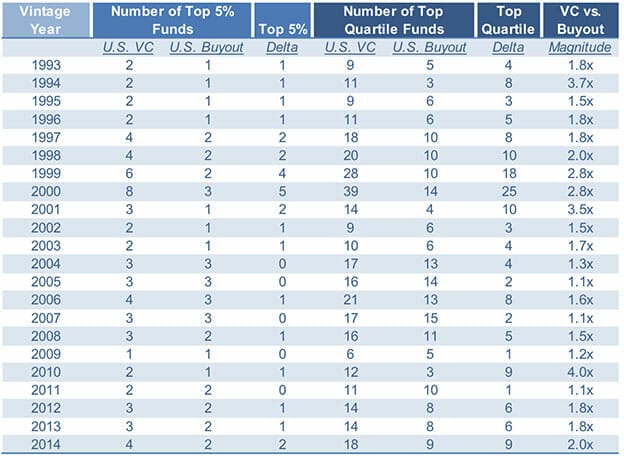
Let’s see what the data shows. The chart below highlights the number of funds in the top 5 per cent and the top quartile for Cambridge US VC and US buyout benchmarks. As you can see, the number of funds in the top 5 per cent for both strategies is quite small (one to four funds each year since 2001). Therefore, I would say that it is equally difficult to access top-tier funds in both US VC and US buyout. When you examine the top-quartile data, there are more funds in both strategies, but look at the magnitude of the delta in number of funds. In every year since 1993, there have been more top-quartile US VC funds than top-quartile US buyout funds. In addition, there has been only one year since 1993 when there weren’t at least nine US VC funds in the top quartile (2009). On average, there have been 15 top-quartile US VC funds each year and only nine top-quartile US buyout funds. Even if you assume that three top-tier VC firms raise a fund every year, that still leaves 12 VC funds in the top quartile for LPs to try to access.

Source: Cambridge Associates, as of December 31, 2016 Note: the column on the far right (VC vs. Buyout Magnitude) is the number of VC funds divided by the number of buyout funds in that vintage year (i.e., 2008 vintage year has 23 VC funds and 11 buyout funds in the top quartile; 23/11 =2.1x

So there are a significant number of top-quartile US VC funds to access, but do they ever outperform US buyout funds? The chart below highlights the delta in net IRR between the top 5 per cent, top quartile, and median US VC funds and US buyout funds by vintage year. These figures represent the thresholds a fund would need to reach to achieve top 5 per cent, top quartile, and above median status in that vintage year. Top 5 per cent VC funds outperformed top 5 per cent buyout funds in 12 of 22 vintage years, top-quartile VC outperformed in 10 of 22 years, and median VC outperformed in six of 22 years. As you can see, the number of years where top-quartile US VC outperformed US buyout was nearly identical to the years when top 5 per cent US VC numbers outperformed. The magnitude of outperformance is significantly greater for top 5 per cent US VC funds, but there is still material outperformance for top-quartile US VC funds.

Source: Cambridge Associates, as at December 31, 2016 Note: (negative) means VC underperformed buyout and positive means VC outperformed buyout. The top 5% and top quartile net IRRs shown are thresholds to reach top 5% and top quartile status in a given vintage year. These are not actual pooled IRRs of the top 5% and 25% funds.

Based on this data, our conclusion is that top-quartile US venture capital has the ability to outperform top-quartile US buyout, depending on the year. Even if you can’t access the very top-tier VC funds, you still have the potential to invest in US VC funds that could outperform US buyout funds and generate reasonable absolute returns. This conclusion is consistent with findings from a Cambridge Associates study related to company-level returns in the venture industry and how 60-plus firms accounted for value creation in the top 100 investments each year.

This conclusion raises numerous questions: How do the results change if you parse the data by stage (i.e., early vs. late stage)? Are US buyout funds truly less risky than US VC funds? Why has the delta in returns between top-quartile US VC and US buyout funds compressed over the last 14-15 years? These are all great questions but, for now, all I can say is that the top-tier VC fund myth has been busted. You should always strive to access top-tier funds in any strategy, but the data doesn’t support LPs avoiding US VC simply because a handful of firms are inaccessible.

Wes Bradle is senior portfolio manager at the State Board of Administration of Florida.

Disclaimer: The views and opinions expressed in this article are those of the author and do not necessarily reflect the official policy or position of his employer, the State Board of Administration of Florida.

Jeb Burns, chief investment officer of the $10.5 billion Municipal Employees’ Retirement System of Michigan has developed a valuation-driven investment strategy that eschews rigid asset allocations in favour of flexibility. It allows the fund to take bold steps such as seeding new managers and increasing allocations as and when opportunities appear.

Under Burns’ 16-year tenure, MERS’ internal investment team has grown to nine professionals, who oversee a broad range of assets, develop bespoke research and strategies, and manage about 30 per cent of the portfolio in house.

Two focuses for the fund are diversifying outside of the US, and continuing to build exposure in real assets. Current strategies include moving 15 per cent of the equity allocation out of US stocks and into emerging-market and international developed equities.

“The rationale is from a valuation perspective; stocks are cheaper in these markets relative to the US and although there has been a good run in emerging markets, there is still a lot of opportunity to go to the upside,” Burns explains. “There is a good chance that volatility will be elevated in these markets, but we are making these shifts on a minimum three- to five-year time horizon, and as long as we believe the market has enough breadth to weather geopolitical risk, we are comfortable.”

MERS’ assets are now divided among equities (55 per cent) fixed income (18.5 per cent) real assets (13.5 per cent) and diversifying strategies (12.5 per cent).

Still room for active managers

About two-thirds of the US equity allocation is in passive strategies and most is managed internally. However, unlike peers who have concluded outperformance is difficult in US equities, Burns still uses three active managers here, favouring longstanding 10-year relationships that have “had outstanding performances”.

Mike Charette, director of public markets at the fund and Burns’ first hire back in 2002, adds: “We aggressively negotiate fees. When people say active US doesn’t work, they are paying closer to 1 per cent for their allocation. We pay our active managers closer to passive prices.”

MERS also runs three internal active model-driven US equity strategies. In international equities, active management includes an underlying passive sleeve that gives the fund the liquidity to move the allocation around to “make sure we are getting the most bang for our buck where we see value in the market”, Charette says.

The increased allocation to emerging market equity will be mostly passive, using indices with State Street Global Advisors. However, true to his flexible ethos, Burns remains open to interesting active strategies.

“We don’t have an active search going on, but if we see the right strategy, we will allocate capital there,” he says.

Existing active strategies in emerging markets include a small-cap bias. Here, managers include Polunin Capital Partners as well as Lee Munder Capital Group, which was initially in MERS’ emerging manager program but was recently promoted to a full mandate with a $100 million allocation.

Private equity sits within the equity bucket, allowing the fund to swap between public and private equity as opportunities arise.

The private equity allocation can be anywhere from 0 to 8 per cent of assets under management, depending on opportunities. It now accounts for 4.5 per cent of fund assets but is forecast to shrink to 3 per cent in the next 12 months because of realisations in the portfolio.

Manoeuvres in real assets

MERS will continue to build its exposure to real assets – which is now 11 per cent of the fund – in targeted opportunities for real estate, private infrastructure, timberland and especially agriculture.

As in equities, Burns is most interested in opportunities beyond US shores for the real assets portfolio. He’s looking at Latin America and Australia, where the fund has already invested in nut and livestock farms. It is a marked contrast to his peers, who typically hold stakes in US energy projects, timberland and real estate as part of their real asset mix.

Within real assets, Burns is adjusting the real-estate allocation.

“We are not deploying to core real-estate funds. It doesn’t mean we won’t in the future, but right now we think valuation levels are a bit high.”

Instead, he favours real-estate assets such as triple net lease property investment, in which the tenant is responsible for paying property taxes, insurance and maintenance costs during the term of the lease.

“We’ve been involved in triple net leases over the last four years and have built up our holdings here. It has fixed income-like returns but a better risk-return profile.”

Another strategy includes more direct investment in real assets alongside other investors, bypassing traditional general partner relationships for more control and investor alignment.

It’s a strategy Burns began five years ago and includes investments such as MERS’ 45 per cent stake in Olam Australia’s almond farms alongside Switzerland’s Adveq Real Assets and Denmark’s Danica Pension.

“We want to do more of this,” he says. “It’s about putting in structures that are more LP [limited partnership] friendly; if we design the structure, it is going to be LP friendly.”

Last year, real assets were the fund’s top-performing asset class, returning 19.2 per cent against a total portfolio return of 11.1 per cent.

A portfolio of diversifying assets includes allocations to private credit, traditional hedge funds and one-off, return-seeking strategies. The portfolio targets an overall beta of 0.2 to the equity market and the allocation has been raised from 10 per cent to 12.5 per cent of assets under management.

“We want equity-like returns, but with the risk coming from somewhere other than equity,” Charette says.

Here, MERS is looking to hire about two more managers at $100 million mandates but, again, Burns is keeping his options open.

“It will really depend on what we find,” he explains. “We are not locked into anything in particular, but are looking for something that meets our overall return goals for the diversified strategies. It is an open allocation and we have room to add 2.5 per cent to the portfolio if we find a manager we believe in.”

Charette adds: “We’ve got a good idea of [who will be] one of the managers.”

MERS is prepared to back new managers, having seeded about 15 to date. These include hedge fund SPI Strategies, which was also recently promoted from MERS’ emerging managers program to a core mandate within its diversifying strategies portfolio, after initially receiving $25 million in seed funding to manage a long/short equity portfolio.

“We’ll seed new funds on the private side and be a first or second mover with a manager on the liquid side,” Burns says. Contenders need proven experience and a proven ability to execute.

“We won’t seed people who don’t have experience or a track record,” he concludes. “And even if they are small, [whether] they have taken the time to build the compliance and back-office systems that are necessary to operate in today’s regulatory market is also important.”


The world’s biggest funds are gaining even more market share, and arguably more influence, over the world’s pension capital. The largest 300 funds now account for 43.2 per cent of all global pension assets.

Further, the capital is becoming even more concentrated at the very top, with the largest 20 funds in the world accounting for 40.3 per cent of the assets of the Willis Towers Watson 300 ranking, the Pensions & Investments/Willis Towers Watson 300 Analysis for the year 2016 states.

The report shows that assets under management (AUM) at the world’s largest 300 funds totalled $15.7 trillion at the end of 2016, up by 6.1 per cent for the year.

The top 20 funds increased assets by an even greater proportion, 7.1 per cent, bringing their combined assets to about $6.9 trillion. These funds invest about 41.7 per cent of their assets in equities, 37.2 per cent in fixed income and 21.1 per cent in alternatives and cash.

North America remained the largest region in terms of AUM, with 44.1 per cent of all assets, including 134 US-based funds in the top 300. The Asia-Pacific region’s funds and European funds each accounted for 26.1 per cent of AUM in the top 300.

The Government Pension Investment Fund of Japan remains the largest fund in the world, with assets of more than $1.2 trillion at the end of December 2016.

The size of this fund is overwhelming, with its assets 39 per cent larger than the second fund in the ranking, the Government Pension Fund of Norway.

The P&I/WTW report states that, of the top 20 funds, nine emphasised the increased volatility and uncertainty in global markets. These funds mentioned several key factors to explain such high global market volatility.

“[The year] 2016 was truly an extraordinary investment year. Unexpected political events like Brexit and a new US administration as well as changed monetary policy signals from several central banks had a significant impact on financial markets,” said Bjarne Graven Larsen, chief investment officer of Ontario Teachers’ Pension Plan, which ranks number 18.

Despite the volatility, positive market returns for all major asset classes helped boost pension assets during the year.


2016 P&I/WTW 300 ranking (in $ million)

Rank Fund Market Total assets
1 Government Pension Investment Fund Japan $1,237,636
2 Government Pension Fund Norway $893,088
3 Federal Retirement Thrift US $485,575
4 National Pension Service South Korea $462,161
5 ABP Netherlands $404,310
6 National Social Security China $348,662
7 California Public Employees Retirement System US $306,633
8 Canada Pension Plan Canada $235,790
9 Central Provident Fund Singapore $227,102
10 PFZW Netherlands $196,461
11 California State Teachers Retirement System US $198,871
12 New York State Common US $184,461
13 Pension Fund Association for Local Government Officials Japan $183,161
14 New York City Employees’ Retirement System US $171,574
15 Employees Provident Fund Malaysia $165,464
16 State Board of Administration of Florida US $153,942
17 Teacher Retirement System of Texas US $133,221
18 Ontario Teachers’ Pension Plan Canada $130,642
19 Government Employees Pension Fund South Africa $119,186
20 ATP Denmark $113,160


The A$133 billion ($105 billion) Future Fund could manage money on behalf of other institutions, said the chair of the fund, Peter Costello, who did not rule out the idea of managing money for a default super fund.

“The Future Fund is a sovereign wealth fund and all of the money is owned by the taxpayers through the government of Australia,” said Costello, at the fund’s end-of-year results briefing. “It is not a superannuation fund. That means the Future Fund can’t run a super fund, it can’t mix other money into this sovereign wealth fund, it also doesn’t have the mechanism to secure money, keep members accounts or pay out money. But could the Future Fund manage money? Maybe it could do that.

“If someone else sets up ‘default super’ and [the fund is] looking for managers, it could go to, say, MLC, or I suppose it could come to the Future Fund.”

How the Future Fund would manage money for another fund is unclear. By law, the Future Fund has to outsource investment management, and it employs about 117 investment managers. It does pride itself on adding value, in part, through good manager relationships, and has a reputation for close relationships that enable it to get the most out of managers, in terms of both investment ideas and value for money.

The Future Fund has generated $73 billion on top of its seed capital of $60 billion, and in the year to June 30, it returned 8.7 per cent against a target of 6.4 per cent. Its 10-year return is 7.9 per cent a year.

Later draw out date, new return target

In the last year, there have been two changes to the Future Fund’s mandate that could affect the way it runs its portfolio. First, the government will now not draw out money before 2026, six years later than the original mandate of 2020.

The implication of this, Future Fund chief executive David Neal says, is that the fund can now maintain its allocation to unlisted markets – which is 11.6 per cent in private equity and 8 per cent in infrastructure and timberland – rather than becoming more liquid.

“We were keen to have the announcement because we were about to have to do things differently, now we don’t have to,” he said.

In the second change, the government has moved the expected return target of the fund to CPI + 4 to 5 per cent, down from CPI + 4.5 to 5.5 per cent.

“While this is still extraordinarily challenging, it is more commensurate with expected returns over the next decade,” Costello said. Costello served as a member of the House of Representatives from 1990 to 2009 and was Treasurer of the Commonwealth of Australia from March 1996 to December 2007

The Future Fund continues to have a fairly conservative asset allocation, Neal says, which has changed little in the past year.

“Risks are a little elevated and expected returns are a little depressed, so it is prudent to carry a little less risk than normal,” Neal said.

In the last year, the fund has taken off risk and, at the same time, moved to become more liquid.

Neal explained: “This is the other part of our strategy, to be more nimble, and we have increased the [ability] of the portfolio to react.”

More venture and growth activity

The fund has retained its high allocation of 21 per cent to cash. This is partly because sovereign bonds are viewed as expensive, so cash is the lower-risk investment for the fund.

Neal said, however, that the high cash weighting should be viewed in the context of the fund’s assets in property, debt and infrastructure, which are all higher risk/higher return-seeking than normal.

In the last year, there has been activity within the fund’s asset sectors and a fair amount of selling.

For a portfolio highlight from the last 12 months, Neal pointed to the Future Fund’s purchase of a 50-year lease on the Port of Melbourne, with a consortium including QIC, Global Infrastructure Partners and OMERS (the Ontario Municipal Employees Retirement System) last September.

There is expected to be more activity in the Future Fund’s venture and growth portfolio, which Neal said the fund was looking to build.

“There is a disruption theme that this plays into, but [these assets] are also very diversifying,” Neal explained. “They are inherently risky but uncorrelated to the broader economy. What matters is if it’s a good idea or not. We are building this with good managers.”