Traditional benchmarks and indices are under the spotlight as Europe considers how to make a sustainable financial system a reality.

Christian Thimann, who is chair of the UNEP Finance Initiative and chair of the European Union’s high-level expert group on sustainable finance, told delegates at the PRI in Person conference in Berlin that the use of “classic benchmarks” was under review.

“Users of indices always look at the classic benchmarks,” Thimann said. “We are looking at the use of benchmarks and indices as part of our review, and asking whether moving away from those is a way to move to a more sustainable system.

“This is a complex point because it’s not driven by regulation but by industry standards. But investment flows are heavily influenced by benchmarks. Are they sustainably aligned or not? Maybe there are some that are better than others.”

Thimann said there was momentum towards a sustainable system with political, corporate and regulatory players all making headway.

“If sustainability means to be broader in scope and have a longer horizon, then we are making more progress on breadth than length,” he said. “There have been advances in taxonomy, green bonds, disclosure, sustainability, integration and supervision. But overall, how can we get the financial system to have more patience so investment horizons are more like the real economic horizon [is the question].”

Meanwhile, former North Carolina state treasurer Janet Cowell said she believed markets, rather than governments and policy, would drive change.

“I was elected treasurer in the midst of the financial crisis, and my first press conference was to announce a $20 billion loss to the portfolio,” Cowell said. “But we have seen a number of changes in that time – a decrease in leverage, more disclosures, a lot of progress on alignment of interest with managers, how carry would be calculated and distributed, or if it would even be paid, and more managers’ disclosure.”

But she said in the US there has not been progress in inequality, inclusion, retirement, healthcare, or immigration, and there had been a shift back to fossil fuels. Overall, she said, the financial system was still a very short-term system.

Thimann agreed and said there needed to be a move in the market towards long-term research, earnings and management.

“The big question in Europe is how we go from short-term stabilisation to impact – does this system finance the real economy that we want?” he asked. “Bank lending has heavy charges, insurance companies are compressed on a short-term horizon and invest little in equity. We need to move to the long term.”

He said a huge amount of spending was needed in infrastructure to make the move to a sustainable system, estimating about $100 billion in infrastructure investments each year.

“The money is there, but there is a lack of projects, we need more development capacity and the early stage of infrastructure development,” he said. “We need to build the infrastructure that a sustainable economy needs.”

Leading asset owners have integrated environmental, social and governance (ESG) elements into their investment policies and processes in order to harness the opportunities of global systemic drivers, a panel of investors told the PRI in Person conference in Berlin.

Since 2008, the giant Dutch pension fund ABP’s policy has evolved to integrate objectives for sustainability and corporate social responsibility completely. Josepha Maijer, vice-chair of the $453 billion ABP, said that until 2008, it had a traditional policy and assessed investments on risk, return and cost. But since then, ESG criteria has been added, and then a lens of sustainability and responsibility were added to enhance the policy.

“We promised our beneficiaries we would achieve the returns required to pay current and future pensions in a responsible and sustainable manner,” Meijer said. “We have a fiduciary duty to contribute to a more sustainable society, and believe sustainable companies will perform better in the long run.”

The implementation of this revised policy is through the concrete investment objectives of: reducing carbon dioxide by 25 per cent by 2020; increasing the allocation to investments that contribute to a better and cleaner future from €29 billion to €58 billion ($69 billion) by 2020, including investments in renewable energy to the tune of €5 billion by 2020, and €1 billion in communication infrastructure and education. The fund is also focusing on specific ABP themes, including banning child labour, cocoa, human rights, and safe working conditions.

Meanwhile, Chris Ailman, the chief investment officer of the $214 billion California State Teachers’ Retirement System (CalSTRS), told the audience that ESG is an integral part of every asset class and every stage of the investment process at the fund.

CalSTRS has individual teams for each of the three sub-sectors of ESG – environmental, social and governance – with the belief that specialists are needed to deal with the complexity of the individual issues in each sub-sector.

“We have at least one or two staff people who are E, S and G within every asset class,” Ailman said. “If you look at the things that will affect us, things like demographics, urbanisation and climate change, they are different when you look at different asset classes,” he said. “We are constantly monitoring how we have done on the integration.”

The fund’s asset allocation as at June 30 was global equities 56.4 per cent, fixed income 14.7 per cent, real estate 12.6 per cent, private equity 8.1 per cent, risk mitigating strategies 5.1 per cent, cash 2 per cent, inflation sensitive 1.3 per cent, innovation and strategic overlay 0.3 per cent.

Philippe Desfossés, chief executive of the $14 billion French fund ERAFP, who was also on the panel, said it’s important for investors to pay attention to “anything that might derail your mission of paying pensions”.

“We see that as the three main challenges of social, governance and environment, so we designed a charter around those three issues, and decided to implement this in a no-nonsense approach,” Desfossés said.

This was through a best-in-class policy, where the bottom quartile of investments rated on ESG scores were excluded.

“It is very hard to out-guess the market, the only thing you can do is apply criteria to lead you to exclude the bottom quartile,” he said.

ERAFP also paid particular attention to measuring manager performance on ESG scores.

“Now we have regular meetings with managers on the way they’ve been delivering on ESG,” he explained.

Desfossés urged the members of the audience to collaborate with one another.

“Together, we can make a big difference,” he said.

Three managers presented their wares in a mock mandate pitch at the PRI in Person in Berlin that sought to identify how leading asset owners are assessing their managers’ investment practices and how they integrate ESG.

Jennifer Anderson, investment manager at the $13.5 billion TPT Retirement Solutions, formerly The Pensions Trust, played the role of the asset owner.

Before listening to the mock pitches, Anderson detailed the attributes of a successful manager and explained the criteria TPT uses in its evaluations.

She said all of TPT’s managers are rated on ESG criteria, including integration, stewardship, communication and transparency. TPT is committed to being a responsible investor, is a 2010 signatory to the Principles for Responsible Investment, and is working to embed the principles into its processes and practices across asset classes and managers.

TPT’s experience with investment managers is extensive. All its investments are outsourced, and it usually works with about 20 investment managers.

Anderson stated that a successful manager would be: 100 per cent staff owned or operating at arm’s length from significant long-term shareholders; a specialist in a single asset class; of modest size but with sufficient assets under management for critical mass; and willing to close to new business.

She explained that a manager’s people should be able to articulate clearly its investment process or philosophy. She added that they should not be afraid to show conviction or fear being viewed as contrarian or visionary; they should have a successful track record, a long-term mindset and the ability to separate trends from noise.

A successful manager’s process involves, Anderson said: a benchmark-agnostic, concentrated portfolio; long-term projections of key financial metrics; low portfolio turnover; a focus on the quality of management, cash flows and earnings; strong engagement with management; some different way of filtering the stock universe that provides a competitive edge; and a focus on responsible investment as part of the sustainability of future earnings and cash flows.

She explained that TPT’s evaluation process involves three stages. The first stage is creation of a long list, using Mercer’s manager database. The second stage is to reduce that to a short list, based on research on about 20 candidates and to do more in-depth research on that group. Stage three is to interview the shortlisted managers and agree on a preferred provider.

“Appointment of a new manager is where we get the greatest say,” Anderson says, “We assess many things. ESG is part of what we assess. Mercer awards each manager an ESG score. Where we engage is in the interviews.”

The manager interviews that Anderson conducts usually last about three hours, but in this session at PRI in Person, titled, ESG Integration: how to assess investment managers’ practices, the three managers were given 10 minutes each to make a mock pitch for a mandate.

The candidates make their pitches

Alex van der Velden, partner and chief investment officer of Ownership Capital, presented for a mandate on global equities; David Sheasby, head of stewardship and ESG at Martin Currie, presented for emerging markets; and John William Olsen, fund manager at M&G Investments, presented for European equities. Each gave their investment philosophy, potential edge and track records.

There were several relevant similarities among the managers. All three said ESG concerns were fully integrated into their investment process and addressed by portfolio managers; all three also had active shareholder engagement as part of their process and long-term horizons. They all had concentrated portfolios as well, with Ownership Capital holding only 20 stocks, Martin Currie about 40 and M&G beginning with a universe of 100. Finally, all three managers reported spending much time on company due diligence before deciding to invest.

Pitch 1: Alex van der Velden, Ownership Capital – global equities

Ownership Capital is a Dutch fund manager, started in 2008 at PGGM, focused on long-horizon investing with engaged ownership. The fund uses a unique 10-year financial model. Ownership has $2 billion in assets under management, serving only pension funds and endowments, which have long-term goals. The manager has returned 16.8 per cent since 2010, compared with the MSCI World Index return of 11.5 per cent (and Credit Suisse Hedge Fund Index of 8 per cent)

In making his pitch, van der Velden argued that traditional approaches to investment are no longer ideal and that engagement on ESG and ownership concerns is a better way of managing capital.

“The problem with traditional approaches [is that] a rapidly changing world is being met by business-as-usual methods like divestment, reactive engagement, focus on the best in class, and thematic strategies,” he explained. “They are all point solutions, not structurally better, so remain outside the mainstream of how most people invest…We think the solution is engaged ownership, where engagement is part and parcel of the investment process. It’s part of how you manage the portfolio for every company you own.”

He outlined three parameters for Ownership’s process.

“The first evaluation parameter is performance,” he said. “We believe ESG issues can affect the performance of investments. So then ESG integration must deliver better performance. The second evaluation parameter is ESG integration into investment analysis and decision-making processes.

“The third parameter is engagement outcomes; not only engaging when things go wrong but, as active owners, preventing companies from going off the rails in the first place. To achieve that you need a different process.”

Anderson questioned van der Velden based on these parameters. She noted that many global equities managers are saying ESG integration is an important part of their process and asked how Ownership Capital is different.

Van der Velden said assessing ESG integration, “should involve a meaningful differentiated selection process that evidentially enhances risk/return. We started by building 10-year financial models. Portfolio managers were asking themselves where this company would be in 10 years. [This gets them] thinking more about ESG because financial models can’t capture the long tail like ESG can. You need your own tools to analyse risk. There’s a lot of greenwashing going on out there.

“The carbon intensity reduction of our portfolio has been double the benchmark. We can persuade even large companies to consider sustainability.”

Anderson asked if the manager could evidence better risk-reward and better engagement outcomes.

“Engagement is so hard to measure,” van der Velden replied. “We often focus on the engagement activity rather than outcomes. Have them show you their models. [Perform] proactive engagement, before something goes wrong, and ask them how they are dealing with sustainability or succession planning.”

Pitch 2: David Sheasby, Martin Currie – emerging markets

Sheasby’s pitch stressed differentiators that hinged on ESG factors.

“The key distinguishing factor is how we embed ESG,” he said. “We believe ESG plays a core role in understanding businesses. Underlying our approach is that the market underestimates the ability of companies to generate long-term returns, and ESG is an important contributor to that. ESG is incorporated throughout the process, and [managers are] inherently risk aware.

“There are four key aspects of our process – idea generation, fundamental analysis, stock selection and portfolio construction. Each idea we come up with is pitched to the team, to leverage their experience and [facilitate collaboration]. Fundamental analysis is the core of what we do – understand the drivers of cash flows and capital allocation.”

Anderson asked what resources support that; for example, is there a separate team?

“We believe it has to be the portfolio managers themselves to make it fully integrated,” Sheasby answered. “We think it makes us better investors, gives a more holistic view of the company. We think governance is the most important criteria. If that’s done right, then the company has a better chance of generating long-term sustainable returns.”

Stock discussion, he explained, is subject to broader peer review from the whole investment team. Martin Currie is building a concentrated portfolio of 40-60 stocks.

Anderson then asked whether there are style biases in Martin Currie’s portfolios.

Sheasby responded: “We don’t start off with a view to have a style but, if anything, a slight bias towards quality.”

He described the firm’s engagement with Credit Corp, a leading financial services group in Peru. It is among the world’s most profitable financial groups, with a 20 per cent return on equity. An assessment identified some issues with disclosure and risk management, particularly on the environmental side, as mining sector investment is key in the country. Martin Currie staff spent some time with management, working with them on the risks and opportunities, addressing some of the issues, and introducing them to a bank in another country. Credit Corp adopted the Equator Principles and did a benchmarking exercise versus industry best practice.

Engagement and active ownership informs ongoing analysis, Sheasby said. In emerging markets, some companies are interested in speaking to engaged investors. They may be at a stage where they need help; for example, Credit Corp was interested in making the changes but didn’t know what to do.

Anderson asked how a long-term focus is reflected in portfolio turnover.

Sheasby said Martin Currie is running a concentrated portfolio so returns are driven by the high active share. Portfolio turnover is relatively low, 20 per cent to 40 per cent, he said.

Pitch 3: John William Olsen, M&G Investments – European equities

Olsen’s pitch emphasised the long term and taking everything into account.

“You need a holistic approach,” he said. “You can’t just latch onto the numbers, or the management team, or the strategy – it’s all important, you need to look at everything.

“For us, the starting point is to have a long-term investment edge, if you are long term, you have to [focus on things] short term investors don’t. You have to do your homework, buying into the culture and investment model. My holding period is about six years.

“[There is a] limited number of stocks we look at, in Europe a universe of about 100. We spend a lot of time analysing them before deciding to invest. Mostly we examine them, and then put them on the shelf, we don’t invest immediately. We do the work ourselves.”

Olsen noted that, in some cases, ESG can be a competitive advantage – it can be a tailwind or a headwind; for example, he noted that at Unilever, sustainability was being driven by the top.

He also mentioned the importance of connecting with management in assessing companies.

“You need to get under the skin of management teams to understand the culture – and make sure there’s not just greenwashing,” he said. “Try to meet as many levels of management as we can.

MSCI is the main source of ESG research but Olsen said M&G’s analysis adds to that.

“Standardising too much, making things too objective, you can lose out. We can add something on top of [for example] MSCI or Sustainalytics,” he asserted. “The average age of our companies in the portfolio is 100 years; they have a sustainable culture.”

Anderson asked the implications of being part of a larger investment house, and how much autonomy M&G has.

“We have a franchise [arrangement] where we can amend our own models,” Olsen said, adding that this provides M&G the strength of a large firm.

In the last year there has been a quiet revolution taking place as asset owners have been moving to integrate ESG into index designs for new mandates on core passive portfolios.
Integrating sustainability into investment strategies was a “minority sport” when David Harris joined FTSE 15 years ago. “Over this period, we’ve seen a dramatic change,” said Harris, who is now Group Head of Sustainable Business, London Stock Exchange Group, and Head of Sustainable Investment at FTSE Russell.

“For many years all the action on ESG integration has been in active asset management, whilst for passive, the focus has been limited to engagement and voting – in the last year that has all changed – for new mandates integrating climate and sustainability parameters into index design is being applied at scale and to core portfolios,” said Harris.

The rise in the use of “smart beta” has been central to enabling an investment approach to ESG, and has also bridged the divide between active and passive investing. “Using a smart beta approach enables passive managers to integrate a range of different factors into the design of an index,” noted Harris. “Once an asset owner decides that they will move away from a standard market benchmark and introduce other factors or design elements it’s an easy step to incorporate their investment beliefs on ESG as part of this,” he said.

Banking on climate risk 

Late last year, HSBC Bank UK Pension Scheme, after 11 months of collaboration with FTSE Russell and Legal & General Investment Management (LGIM), switched its defined contribution (DC) equity default fund to follow a new passive fund with a 3-pronged climate change tilt, the Future World Fund. The LGIM fund tracks FTSE Russell’s first ‘Smart Sustainability’ index, the FTSE All-World ex CW Climate Balanced Factor Index that is designed to combine a smart beta factor approach with parameters that account for risks and opportunities associated with climate change. The index incorporates a range of factor tilts, including volatility, value, quality and size, and underweights companies with high relative carbon emissions and fossil fuel assets, while increasing index weight for companies with revenues that contribute to the transition to a green economy.  With a further defined benefit (DB) allocation being added to the DC mandate HSBC Bank UK Pension Scheme has now allocated around £4billion to the fund.

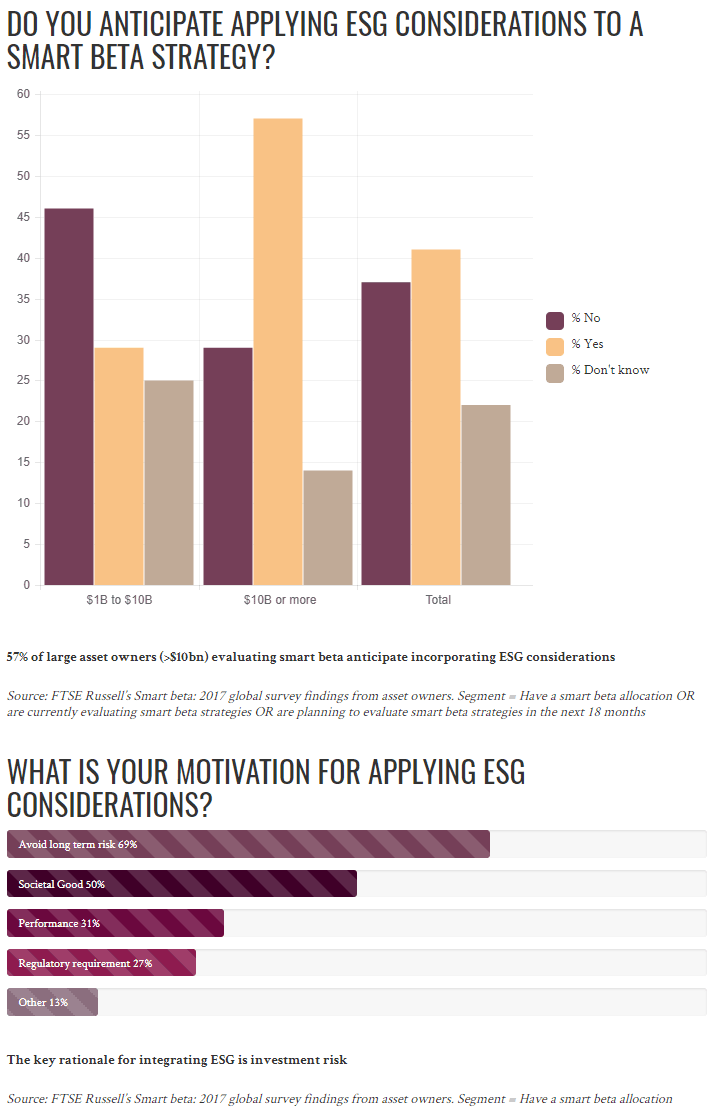
“This was a game changer less than 12 months ago, but I would say it’s rapidly becoming the norm in terms of new smart beta mandates that we’re seeing come through from our clients,” said Harris. This trend is evidenced by FTSE Russell’s fourth annual smart beta survey of global institutional asset owners. The survey, which covered almost 200 asset owners globally, finds firstly that a majority of asset owners, by AUM, have or plan to have smart beta allocations; and secondly among those managing larger funds (with over $10 billion in AUM) 57% would like to incorporate ESG into their smart beta strategies. The main rationale provided for ESG integration into smart beta was investment risk. “As someone who has worked on ESG indexes for over 15 years I find this incredibly exciting – finally, now, this is the core of the market in terms of new mandates,” said Harris. “Obviously if you look at existing and incumbent AUM, the picture is very different, but when you look at the changes, the trends are all moving this way.”

The importance of green revenue disclosure

At the turn of the century, it’s fair to say that ESG reporting by listed companies was scant. “This has changed radically over the last 15 years,” said Harris. “A lot more information’s now available and the reliability is improving, but it’s still a long way off from where it should be in a number of market segments.”

However an area that FTSE Russell has been dedicating resources to has been that of corporate revenues across green industries and sectors, from advanced batteries and electric vehicles to flood defences and water desalination.  This enables them to provide a breakdown of green revenues at a stock or portfolio level, and to use this data in index construction.  However, Harris expressed concern that although there has been much focus on “operational” ESG reporting there has not been the same focus on encouraging more detailed revenue breakdowns from companies for green product lines.

“The reliability of revenue data is strong, as it’s generally audited data, but what we’ll find is, some of those companies aren’t breaking out in enough detail to be able to get the green revenue data. So, for example, you may have a lighting company that isn’t breaking out its LED lighting sales versus its tungsten or halogen.”

Companies must answer the call

The growing demand from investors for standardised, comparable information on material ESG issues means that company boards need to pay attention.

In February, FTSE Russell’s owner, London Stock Exchange Group (LSEG) issued a guide to ESG reporting for companies setting out recommendations for good practice. A global guide, it responds to demand from investors for a more consistent approach to ESG reporting, which is now a core part of the investment decision process. It has been provided to more than 2,700 companies that have securities listed on LSEG’s UK and Italian markets with a combined market capitalisation of more than £5 trillion.

The development of the guide was a year-long process led by three different LSEG executives; Raffaele Jerusalmi, CEO of Borsa Italiana; Mark Makepeace, CEO of FTSE Russell; and Nikhil Rathi, CEO of London Stock Exchange plc. “Each of the three CEOs ran workshops with listed companies and investors to develop recommendations on what corporate ESG reporting is valuable from an investment perspective,” said Harris. “Given the unique make up of the group, from major exchanges to a global benchmark provider, we work across the investment chain and can help convene the market to address important questions.”  The guide sets out key attributes of “investment grade data” including green revenue reporting as well as setting out details of potentially relevant reporting metrics for different industries.

Growing sophistication in the future

Institutional investors now have better data and more tools to integrate ESG than ever before. “We are at a very exciting time where there are efficient approaches to integrate ESG into index design, using the same technology and models that we apply for any other smart beta index, which can also control, or limit, any inadvertent exposures.  Investors can now reflect their investment beliefs on sustainability and climate change into the design of future indexes,” concluded Harris.

No member of the London Stock Exchange Group plc or its applicable group undertakings, which includes FTSE International Limited and Frank Russell Company and its subsidiaries, nor their respective directors, officers, employees, partners or licensors (a) make any claim, prediction, warranty or representation whatsoever, expressly or impliedly, either as to the results to be obtained from the use of the FTSE Russell Indexes or the fitness or suitability of the Indexes for any particular purpose to which they might be put; (b) provide investment advice and nothing in this article should be taken as constituting financial or investment advice; (c) accept any responsibility or liability for any errors in the information in this article or for any loss from use of this article or any of the information or data contained herein. A decision to invest in any asset should not be made in reliance on any information herein. Indexes cannot be invested in directly. Inclusion of an asset in an index is not a recommendation to buy, sell or hold that asset. The general information contained in this article should not be acted upon without obtaining specific legal, tax, and investment advice from a licensed professional.

It has been 20 months since Björn Kvarnskog moved from Stockholm, Sweden, to Melbourne to become head of equities at the Future Fund.

Since then, the former head of global equities for $55 billion Swedish pension fund AP4 has been busy conducting a complete review of the Future Fund’s $30 billion equities portfolio.

Ready to talk publicly for the first time since taking on the role – and with much to say – Kvarnskog agreed to be interviewed live on stage at the 2017 Investment Magazine Equities Summit, in Melbourne, on September 12.

When Future Fund chief investment officer Raphael Arndt hired Kvarnskog, he gave the international recruit an open mandate to look at the equities portfolio’s strengths and weaknesses and propose what needed to be done to improve its value proposition.

The result is a new objective and a recalibrated portfolio that separates mandates along active and passive lines and requires managers with more active risk to generate its alpha.

“The listed equities program had been performing well, but we thought it could do better,” Kvarnskog said. “It was not something that was broken and needed to be fixed.”

As the team embarked on the review of the equities portfolio, it found a “lot of factor risk”, Kvarnskog said.

Sometimes that was deliberate, with targeting of certain factors, but other times it wasn’t. As multiple long-only managers had been added over time, the tracking error, or risk, in general had been diluted. While this is one of the benefits of diversification, it also added much factor risk, particularly around the momentum theme in the long-short portfolio.

“I’ve seen this in trading as well and I think it applies to hedge funds,” Kvarnskog told the summit. “You have traders or funds taking deliberate risks but when you put everything together there are certain risks that pile up and sometimes you don’t get rewarded for that.”

This was the case for the Future Fund’s equities portfolio, so plenty of work was undertaken to address its structure.

Taking back control

Once it was clear what was under the bonnet, the Future Fund set about recalibrating to address the unwanted factor risk. Then Kvarnskog’s team, in consultation with the board and investment committee, found a new objective.

“We focused on how we could take control of the portfolio; that was probably the most important task,” he explained. “The listed equities program had been serving several masters in the past. We had been involved in completion trades, thematic investments, stockpicking mandates and factor mandates. We needed to take a step back and define what we were targeting.”

It was agreed that the most important objectives for the portfolio were to take as much desired risk as possible, and to play a role in portfolio completion. A new strategy was designed to accomplish those aims.

“This meant bringing in the factor exposures we had in other areas,” Kvarnskog said.

The equities team is now more particular in where it targets its factor exposures, and is cognisant of the many factor risks the Future Fund is exposed to at a total portfolio level; for example, in fixed income or private equity. The equities portfolio now has a reduced exposure to the momentum factor and has refocused the way it targets what Kvarnskog calls the “more solid” factors, such as value and quality.

Simpler structure

The new streamlined structure is simpler. The portfolio is divided into a number of sub-categories, each having a unique objective and role to play.

Kvarnskog described it as “almost a barbell approach”, and said that while he is reluctant to label the process an alpha/beta separation, the vast majority of the assets are now in beta and alternative-beta mandates.

“The objective for these portfolios is super simple – to tap into market risk premia or alternative risk premia and get properly compensated for taking risk,” he said. “That said, we are not benchmark huggers. We think there are benefits to moving away from the [market-cap weighted index], but using a benchmark approach to structure the portfolios.”

High-risk, alpha mandates complement the beta mandates, with a preference for hedge funds – mostly market-neutral ones.

“Instead of having long-only managers in between carrying a lot of deadweight in terms of holding stocks where they don’t have high conviction, we put more risk into the alpha space and use replication strategies in the beta and alternative-beta book,” Kvarnskog said. “It’s important to stress the model doesn’t trump the way we implement. Even if we use many passive replication strategies, we have components of long-only mandates as well, but more in areas where we think [it’s more difficult to] replicate the strategies.”

Young, hungry managers

Previously, the Future Fund had a number of large mandates with some of the “fancy big hedge fund names”, including an equity long-short mandate of $2.5 billion.

“We also had a number of managers operating with a lot of net exposure. This is not an optimal way to use the balance sheet in the hedge fund space.”

The fund has shifted focus to smaller, more nimble, stockpicking mandates, where the objective is to maximise idiosyncratic risk. The fund now also targets managers at an earlier stage in their lifecycle.

“There are heaps of benefits to this. These managers tend to be hungrier, easier to negotiate with, and we get better terms and conditions and better transparency, which is extremely useful,” Kvarnskog explained.

But it wasn’t just the type of manager that changed in the portfolio clean-up; the fund also addressed the systems used for information and communication with managers.

“We can’t just have a quarterly call with managers; we need to integrate the data, see what is going on, and view it through a factor lens,” Kvarnskog said. “For the big guys, this is very sensitive information, I get that. We are trying to engage with smaller, more nimble managers operating with market-neutral mandates. They are not that active in the crowded names, so it’s good for us because we won’t end up with bad hedge fund risk or bad momentum risk.”

A better deal on fees

Not only is the new setup a more efficient way of allocating capital, it’s a better way of spending fees.

The Future Fund can replicate a strategy that a long-only manager charges 30-60 basis points for and end up paying a fraction of one basis point.

“We are happy to pay fees for skill and for managers that can handle idiosyncratic risk or harvest complexity,” Kvarnskog said. “But for a large chunk of the beta book, especially, for long-only managers riding factors for many years, we don’t want to pay for that.

“This is a business of scale. We can create our own indices and hand them over to State Street or Vanguard and players like that, and in a low-returning world, that is an efficient way to make money by not paying fees.”

Essentially, the portfolio has adopted a different way of addressing risk, with fewer big mandates, but is also more efficient.

“We pay less [in] fees in the alpha and beta book so, in general, we have saved a lot of money by doing this,” Kvarnskog said. “Fees are an important governance tool, especially in the hedge fund space. You can give managers a rule book but nothing works as well as a fee structure.”

The board of the $336 billion California Public Employees Retirement System (CalPERS) has voted against the recommendation of the fund’s investment office in choosing a new infrastructure consultant.

The investment team had recommended the board select its real-estate consultant, Pension Consulting Alliance (PCA), as infrastructure consultant as well, to better align advice across CalPERS’ real-assets program. Instead, the board voted 9-2, with two directors absent, in favour of appointing Meketa Investment Group, which was runner-up to StepStone in the request for proposal (RFP) for a board infrastructure consultant issued in April 2014. StepStone was appointed in September that year but has elected to resign.

Board member Richard Gillihan said Meketa achieved the second-highest score in the 2014 RFP and “that should matter”. PCA was not involved in that RFP.

“If scoring mattered then, it matters now,” Gillihan said. Meketa is the board’s private-equity consultant.

The investment office also recommended taking the opportunity created by StepStone’s resignation to align the end dates of the infrastructure and real-estate consultants; instead, the board voted 8-3 in favour of retaining the original end date of the infrastructure contract.

The decision means the CalPERS’ board will receive advice on the fund’s $35.8 billion (as at May 31, 2017) real-assets program from three separate consulting firms appointed for three different terms: Meketa on infrastructure, ending February 29, 2020; Wilshire Associates on forestland, ending June 30, 2020; and PCA on real estate, ending March 31, 2022.

The board did accept the investment team’s recommendation not to issue a new RFP to find a replacement for StepStone, and to appoint either PCA or Meketa.

Head of compliance and operational risk for the CalPERS investment office, Kit Crocker, told the board the investment team recommended against an RFP “because of the immediate need for a replacement to maintain continuity and to avoid a lapse in these critical services”.

Push to reduce complexity

“Secondarily, though, please be aware [that] of the available options, only Meketa and PCA have the resources, experience and infrastructure expertise to assume this important role immediately without a lapse in service,” Crocker advised.

In arguing for aligning the consultants’ end dates, she said it would “significantly improve the overall efficiency of the board consultant RFP process, by reducing complexity and saving both board and staff time. This is consistent with our current Lean Six Sigma [business improvement] initiative across the enterprise.”

CalPERS’ chief operating investment officer, Wylie Tollette, told the board the investment office would be “happy to work with whichever consultant you pick”, but added that part of the logic for consolidating the infrastructure and real-estate consulting roles was that it “mimics and mirrors the consolidation of our real-assets program”.

“Historically, [real assets] was regarded and managed and treated as three separate programs: forestland, infrastructure and real estate,” Tollette said. “You may recall that over the last several years…we’ve consolidated that into one real-assets program.

“Earlier this year, we decided to move towards one real-assets benchmark, and the idea of having one consultant in alignment with that asset class certainly makes some logical sense from a process and staff perspective.”

StepStone’s departure

StepStone advised CalPERS on August 11 that it intended to step down as board infrastructure consultant on September 30. It gave no reasons in its resignation letter.

In the first public disclosure of the board’s assessment of consultant performance, released last month, StepStone was rated poorly on its ability to recommend ways to reduce or control costs, on helping the board define appropriate risk parameters and identify risk mitigation strategies, and on proactively identifying new investment opportunities and bringing them to the board’s attention.

It was rated highly for acting with honesty and integrity, and on making clear and relevant recommendations to the board on investment policies and guidelines.