Anyone who’s ever visited any of Africa’s 54 countries will attest to the fact that adequate infrastructure is sorely lacking – though of course some nations are better off than others.

For institutional investors, one of the main constraints holding back infrastructure investment in Africa is the lack of a benchmark. Infrastructure performance indices over the rest of the world are common, as they play a critical role in evaluating the risk/return profile of investing in this asset class. The lack of such benchmarks for Africa contributes to a dearth of much-needed investment in this asset class on the continent.

To fill this gap and boost investment, RisCura has partnered with Africa investor (Ai) Capital (a pan-African institutional infrastructure co-investment platform), to launch Africa’s first infrastructure performance index in 2019. This index will facilitate increased investment into the continent’s infrastructure, benefiting not only the people of Africa, but investors, too.

For years, those who have invested in African infrastructure projects have enjoyed high risk-adjusted returns over the long term. They say the default rate is low and the returns are attractive, in excess of risk. In other words, investing in African infrastructure presents an exciting opportunity to generate alpha. But without historical data and benchmarks, it’s not easy for newcomers to evaluate the investment case.

The Africa investor (Ai)-RisCura Infrastructure Performance Index will release performance information for this asset class quarterly, starting in Q1 2019. The index will be pan-African in coverage (including North Africa) and include a wide range of unlisted investment assets, covering all conventional sectors: power, transport, renewable energy, and information and communications technology. It will comprise assets at both the fund level, as is traditionally done in most infrastructure indices, and the asset level. This gives access to more information, enables splitting the life of the assets between greenfield and brownfield, and reflects the different types of performance more accurately. Assets will need to be valued quarterly.

The proprietary method and metrics by which we will calculate the performance will include, but not be limited to:

  • Internal rate of return (IRR)
  • Times Money
  • Public Market Equivalent method, Steve Kaplan and Antoinette Schoar (2005)
  • Direct alpha method.


Impact for Africa

Over the last two decades, Africa has experienced periods of high per capita income; however, numerous factors have led to a recent slowdown in the region’s economic activity. Many would argue that the inadequate supply of infrastructure services is one such factor.

Research by the World Bank has quantified the potential impact of infrastructure development on Africa’s growth trajectory. This research shows that increasing infrastructure development to levels seen in other developing regions could result in GDP growth per capita increases of at least 1.2 per cent annually. Adding in enhancements to the quality of infrastructure would contribute a further 0.5 per cent; increasing growth by a total of 1.7 per cent annually.

This growth is even more impactful when compared to the world’s leading nations. The impact on GDP growth, from making strides in both the quantity and quality of infrastructure, rises to 2.6 per cent annually. Simply put, the potential benefit of funding to make up Africa’s infrastructure deficit is significant.

When looking for answers to Africa’s infrastructure financing need, it’s easy to look at public investment as the main solution; however, most African countries have insufficient levels of infrastructure spending as a percentage of GDP and increasing debt-to-GDP ratios, leaving little room in their fiscus to accommodate a higher infrastructure budget.

We believe the solution lies with institutional investors. Pension funds’ long investment horizons make them especially suited to infrastructure assets. The potential for these investments to deliver a predictable cashflow stream over a sustained period, coupled with an element of inflation protection, makes them attractive for institutional investors.


Infrastructure investment platform

So, why are we seeing insufficient capital committed to African infrastructure funds?

The reasons are complicated. The investment ecosystem is not yet thriving, as African countries are still working on developing pools of institutional capital, sufficient asset managers and robust regulatory regimes. The good news is that Africa investor (Ai) Capital, working with the New Partnership for Africa’s Development (NEPAD) and the African Union, has partnered a number of African pension and sovereign funds to establish an Infrastructure Co-Investment Platform, which targets about 5 per cent of Africa’s institutional assets for investment into a blend of brownfield and greenfield infrastructure opportunities.

The introduction of our infrastructure performance information for Africa is another, simple step in the right direction, given that institutional investors often cite a lack of performance data as a constraining factor when considering infrastructure allocations.

As every investment manager knows, diversification is the only free lunch in investing. Africa is an important global diversification opportunity, and the infrastructure asset class offers further diversification. To date, most international institutional investors have been missing out on the opportunities presented here, but we believe the access to historical information this index will provide will assist in changing this.

This initiative enjoys the support of the African Sovereign Wealth and Pension Fund Forum, the World Pensions Council, Batseta (council of retirement funds for South Africa), and official institutions such as NEPAD/African Union, the African Development Bank, Trade Development Bank, the Association of bilateral European Development Finance Institutions, and others.


Hubert Danso is chief executive and chair of Africa investor (Ai) and chair of the CFA New York global asset owners advisory board. Heleen Goussard is head of unlisted investment services at RisCura.
 

One of our defining characteristics, and main objectives, at Top1000funds.com, is to provide behind-the-scenes insight into the strategy and implementation of the world’s largest investors. An analysis ofthe most read stories of 2018 shows that’s where our readers’ interest lies. In 2018, readers were interested in learning from one another with regard to asset allocation, innovation on fees, new investment opportunities and organisational design.

This year, we have delivered more than 300 investor profiles and other analytical and research-driven pieces on the global institutional investment universe, and we now have readers at asset owners from 95 countries, with combined assets of $48 trillion.

In September,we relaunched our site and we can now measure by “category” of story what our readers like. The top three categories are: organisational design (including fees, manager relationships, technology and in-house investments), asset allocation and sustainability.

We are also pleased to say that you, our readers, are spending more time on our site, as evidenced by our 10 most read stories, which averaged 4.2 minutes per article. Thank you to all our interview subjects, readers and supporters over the last year. Below is a look at the 10 most popular stories of 2018.


Largest pension funds get bigger

The world’s biggest funds are gaining even more market share, and arguably more influence, over the world’s pension capital. The largest 300 funds now account for 43.2 per cent of all global pension assets.

Further, the capital is becoming even more concentrated at the very top, with the largest 20 funds in the world accounting for 40.3 per cent of the assets of the Willis Towers Watson 300 ranking, the Pensions & Investments/Willis Towers Watson 300 Analysisfor the year 2016 states.

The report shows that assets under management (AUM) at the world’s largest 300 funds totalled $15.7 trillion at the end of 2016, up by 6.1 per cent for the year.

The top 20 funds increased assets by an even greater proportion, 7.1 per cent, bringing their combined assets to about $6.9 trillion. These funds invest about 41.7 per cent of their assets in equities, 37.2 per cent in fixed income and 21.1 per cent in alternatives and cash. Read more


CalPERS examines adopting SDGs

The board of the California Public Employees’ Retirement System has directed staff to look into aligning its $357 billion portfolio with the UN’s sustainable development goals.

The largest pension fund in the US is already one of the global leaders in engaging with companies on ESG risks, but by adopting the UN SDGs,it would embrace more specific social objectives, such as ending poverty, hunger and gender inequality.

CalPERS’ CIO Ted Eliopoulos characterised the 17 SDGs as a “gift to investors” at the board’s retreat meeting on January 16 in Petaluma, California. He said investment staff would report back to the board at its July meeting regarding how the goals could connect with CalPERS’ existing sustainability investment plan. Other institutional investors will be invited to that meeting to discuss their experiences implementing the SDGs.

The 17 goals address everything from the environment to various social principles. But Eliopoulos acknowledged in an interview that whether aligning a portfolio with them when they were combined would lead to better returns hadn’t been tested. Read more


OTPP makes paying well pay off

In 2016, Ontario Teachers’ Pension Plan paid staff more than C$360 million ($276 million) in compensation. This is a huge figure in anyone’s world. But when it comes to salaries, the OTPP story is one of value, not absolute figures, and it’s a good case study for investors looking at their own compensation structures. Read more


APG takes the lead on AI

APG, Europe’s biggest investor,is one of the few large asset owners putting AI to work effectively in its investment process. Amanda White looks at how it is integrating machine learning and more to enhance decisions. Read more


Mercer touts ESG integration andSDGs

Embedding ESG factors into investment decision-making processes makes related risks more apparent, while strategies based on SDGs align portfolios more closely with long-term wealth creation. Sustainability has long been a focus for Mercer, which advocates integrating SDGs. Read more


CPPIB focuses managers on long term

The Canada Pension Plan Investment Board is a true long-term investor. It considers investments in quarter-centuries not the next quarter, amortises returns over 75 years, and can put capital to work in long-term projects, such as infrastructure.

But CPPIB still has about 10 per cent of its assets handled by external managers in public-market exposures. This style of investment management is not typically associated with the long term, so how the board works with those managers is important formaintaining a consistent long-horizon framework.

In fact, itworks towards a full understanding of its external managers’ strategies. These efforts, plus a customised fee structure, ensure a focus on long horizons. Read more


Bridgewater urges investors to get real

Investors need to face the reality of lower returns and adjust their portfolios accordingly, Greg Jensen, co-CIO of hedge-fund giant Bridgewater, told delegates at the Fiduciary Investors Symposium at the University of Oxford. Read more


PE outperformance doesn’t add up

Thanks to recent history, flawed methodology and ill-chosen indices, most say private equity consistently outdoes public equity. But the right data tells a different story, Oxford academics write. Read more


CalPERS seeks ideal pay formula

The problem of attracting and retaining investment talent at the California Public Employees’ Retirement System, where compensation lags industry peers, has come to the fore once again. As the largest pension fund in the US begins its search for a new CIO and continues to seek a new head of private equity, CalPERS is looking to get creative about how it attracts and pays talent. Some suggested remuneration structures include tying pay to funded status or to the fund’s contribution to the state of California. Read more


Alternative PE vehicles underperform

Co-investment, and other alternative private equity vehicles underperform a manager’s associated main fund, a new paper by leading private equity academics Josh Lerner and Antoinette Schoar shows.The paper, co-authored by Harvard’s Lerner, Schoar from MIT, and Nan Zhang and Jason Mao from State Street Global Exchange, examines the performance of alternative vehicles, such as direct investing and co-investments, for the first time.

The research found that, on average, co-investment private equity vehicles underperform a general partner’s (GP) main fund; however, there is a twist. The paper also found that limited partners (LP) with better past performance invest in alternative vehicles that have above-average market performance. In fact, the performance of co-investment vehicles for those investors outperforms even the GP’s main fund.

In other words, if you’re an investor with access to high-performing GPs, it’s worthwhile to invest in a co-investment vehicle. For everyone else, it’s not worth it. Read more


Gary Bruebaker, CIO of the $130 billion Washington State Investment Board, was raised by a single mother who worked her way up through Oregon’s state government payroll department to support Bruebaker and his two siblings. It is the financial security of hard-pressed public employees like his mother that he holds in his mind’s eye when he is managing the giant pension fund’s assets.

“For every dollar of excess alpha we can earn, that’s 50 cents that beneficiaries don’t have to pay into their own retirement and 50 cents that the government doesn’t have to pay either,” says Bruebaker, whose own public service spans 18 years at WSIB, along with time he served prior to that as Oregon’s deputy state treasurer.

Bruebaker isn’t motivated only by making a difference. He also thinks large public-sector pension funds such as WSIB, where more than $100 billion of the total AUM lies in a defined-benefit commingledtrust fund, offer some of the most exciting investment management opportunities. WSIB’s portfolio spans six broad asset classes in six continents, 51 currencies and 14,000 holdings, in a long-term strategy balanced by constant evaluation and adjustment on the margins.

Today, this means exploring active strategies in the fund’s global equity allocation. More than half of global equity is in passive – WSIB’s default allocation – but Bruebaker wants to see if active managers can offer downside protection.

“Our default and belief is passive [management] in global equities, but we will invest in active strategies if we have a pound-the-table conviction about an active manager that they will add value and can offer a good fit for the portfolio,” he explains.

The fund is using both proprietary data warehouse tools and off-the-shelf modelling to analyse prospective active equity managers’ track records. The process reveals how strategies perform in upturns and downturns, and how they will protect the portfolio.

“Our active equity manager due diligence process provides as close a view as possible to what that manager would do going forward,” Bruebaker explains. “Managers in isolation may be great but add them to your portfolio and they may not always add value, alpha or protection.”

The fund is also developing its equity portfolio in other ways, following its decision to invest $2.5 billion in a fundamental index in 2014, a strategy that saved 50 basis points during October this year. Bruebaker is now working with the board, analysing different index structures and looking at whether to bring the strategy inhousefor more control.

The bulk of WSIB’s inhouse focus is on actively managing the $30 billion fixed income allocation. A team of 10 gives Bruebaker clear sight and access to the liquidity he needs to balance the fund’s 48 per cent allocation to private markets.

“Because we have been invested in private markets since 1980, we have huge distributions, and that money needs to be redeployed,” he explains. “Our internal head of fixed income, Bill Kennett, isn’t just a manager we call once in a while. He’s here, in the building, and knows what’s going on across the whole program.”

During last fiscal year, $4.9 billion in cash was transferred into fixed income from other asset classes.

The fund is also planning to refresh its global equity manager pool and carry out more competitive searches for emerging managers. As part of the process, he is deciding whether to tweak the traditional focus on global and emerging-market searches in favour of country-specific strategies for the first time.

“We don’t know if we’ll do it, but we are going to evaluate over the next 12 months whether to have a couple of different country strategies, which we could then overweight or underweight,” he says. WSIB works with 11 active public equity fund managers.

Strong equity markets in recent years have also fed into WSIB’s $21. 8 billion private equity portfolio, which has earned an internal rate of return, net of all fees and carried interest, of 13.5 per cent since its inception in 1981.

The portfolio tracks a model that targets 45 core relationships (some of which WSIB has invested with since 1981) and sets the allocation for each region and type of fund. It also flags when strategy deviates – such as the current overweight position to mega funds.

“We are always striving to move toward this model portfolio. It doesn’t deter us from an investment we think is good just because it happens to be in a strategy or geography we are overweight. It just forces us to look even harder for other good investments in an area we are underweight,” he says, adding that 45 core relationships, even for an allocation WSIB’s size, is the sweet spot. Over-diversification with additional relationships can easily lead to diminished returns; it also means more relationships to manage and more staff to manage them.

The best LP wins

Bruebaker says the success of the private equity portfolio lies in WSIB’s ability to access the best-performing general partners.

“A while back, one of our GPs raised a fund of one,” he recalls. “We were the first call they made, and we were the only [limited partner] in the fund. We had another GP a couple of years ago that raised a fund of four; we were one of the first calls and one of the four.”

In the relationship business of private equity, it’s all down to being a desirablepartner, and this means LPs need to prove they are a high-quality investor and good for their word, he says.

WSIB staff attend every advisory committee meeting with its core private equity relationships. The pension fund’s policy is to add value not tick boxes.

“If we have something to say, we say it; if not, we don’t,” Bruebaker says.

And rather than a revolving door, WSIB always sends the same staffer to attend the same GP committee meeting, rather than sending Hamilton Lane, WSIB’s consultant on retainer, or a revolving door.

Bruebaker takes time to ensure GPs understand the fund’s transparency and governance stipulations so there are “no surprises”. He also thinks that not competing with GPs as a direct investor (impossible anyway, given WSIB’s pay and governance structure) helps obtain access to the best funds. He also describes tough but fair negotiation strategy on fees.

“We are tough in negotiating for fair structures, but we don’t push for the sake of pushing,” Bruebaker says. “We understand the market drives the terms – fees are higher in private equity and real estate – but these allocations have proven to work for us.”

Board members’ support for private equity, rooted in their understanding of private markets, is also crucial in accessing the best GPs. Any uncertainty around the program at board level will put GPs off picking up the phone and asking for long-term commitments, Bruebaker warns.

“Whatever you do in private markets, you want the board to own it, as you are going to need their support as markets ebb and flow,” he says. “We show the board the net impact of private equity funds coming back and allocation decisions on the model portfolio projecting out four years. We say this is the impact this year, this is the impact over four years. Having our board buy in is so important. It’s not an asset class you can jump in and out of.”

This also means success doesn’t come quickly.

“We’ve been doing this for 40 years,” Bruebaker says. “It’s not something you can create overnight.”

Raphael Arndt, the chief investment officer of the Future Fund, has what he calls a “bugbear”. He says the future of the “top-down, centrally controlled” model for building portfolios is under threat and favours a more nimble approach that empowers the entire investment team.

Arndt, who has been CIO at Australia’s A$175 billion ($126 billion) sovereign wealth fund since 2014 and was previously its head of infrastructure and timberland, says that while Australian and international institutional investors have been “tremendously successful,” this won’t be maintained without change.

“There’s a good level of knowledge and research that has supported how funds have built portfolios but my personal belief is that a lot of the assumptions of that research are going to be less valuable in the future,” he says.

“I think we need to start thinking more broadly about how we build portfolios and investment teams and empower those people to make decisions, but do it in a way that we don’t build silos and we still keep control over the structure of the portfolio.”

Arndt’s focus is on the Future Fund’s “joined up” investment process, which brings together top-down macro views and bottom-up sector opportunities to construct the overall portfolio.

The fund was a leading proponent of a total portfolio approach (TPA) when it established its portfolio in 2007. It does not operate with a fixed strategic asset allocation and avoids silos across asset classes.

Willis Towers Watson senior investment consultant Tim Unger told a recent investment conference in Sydney that TPA means there is a “continuous and dynamic focus on achieving the fund’s investment goal”, as opposed to strategic asset allocation, which has a “looser connection to the fund’s investment goals”.

The Future Fund was established in 2006 with the lofty task of strengthening the government’s long-term financial position.

It now has a total funds under management of $126 billion and five special purpose asset funds: the Future Fund, Disability Care Australia Fund, the Medical Research Future Fund and two nation-building funds.

In August, the largest of the five, the $107 billion Future Fund, posted a return of 9.3 per cent for the 2017-18 financial year, outpacing its 6.1 per cent target.

The 12-year-old fund also exceeded its 6.6 per cent benchmark target over 10 years, delivering returns of 8.7 per cent a year over the decade.

Future Fund chair Peter Costello said at the time that “the short-term outlook is for a continuing period of sustained synchronised growth. But over the medium to longer term, a number of risks remain and continue to evolve.”

As a result, the country’s sovereign wealth fund has “slightly increased” its level of risk. “Balancing our perspective on the more positive near-term outlook with the longer-term risks that remain,” Costello said.

He added that inflationary pressures might be imminent in the US and with global interest rates normalising, there might be downward pressure on asset prices.

Patterns changing

Arndt, who was previously an investment director with Hastings Funds Management, says many investors who still construct their portfolios based on a capital asset pricing model or mean-variance analysis – which takes the performance of assets or asset classes over history and assumes it will continue – do not take into account this changing global outlook defined by heightened or changing risks.

He describes this as “a poor way to build a portfolio”.

“When I look at the world today, I see a very different outlook,” Arndt says. “I see population growth declining and, in fact, in much of the developed world, it’s already peaked. Post the financial crisis, there has been a very big deleveraging cycle, which will probably be multi-decade. We haven’t really felt that in Australia yet but it will come, because of the amount of debt in the system.

“The patterns of economic behaviour are changing, so when I look forward I don’t see a lot of reason to think I should be confident that the way an asset will behave in the future will be the same as in the past.”

Despite this, Arndt says there have been only some “fairly simple” changes to the Future Fund’s investment approach since he joined in early 2008.

“We were evolving our investment process when the financial crisis occurred,” he recalls. “So we were able to observe and learn from both the successes and the mistakes of other long-term investors around the world in forming our own approach.”

As at June 30, 6.7 per cent (about $7.1 billion) of the Future Fund was invested in Australian equities, with a 25.5 per cent allocation to global equities (in both developed and emerging markets).

Over the June quarter, the fund increased its allocation to private equity by $1.8 billion, taking the total portfolio weighting for this asset class from 12.8 per cent to 14.1 per cent, on the back of the stronger US dollar.

New investment team

Future Fund officials think of its $126 billion total FUM as a “single portfolio”.

“We call it one team, one purpose,” Arndt says. “It’s dead simple, but actually not very many funds do it because it’s quite hard to do. You need to incentivise your people at the whole-portfolio level.”

In March this year, the Future Fund made some key changes to its investment team, which it stated would strengthen the fund as it went into its second decade.

Arndt took on the twin responsibilities of CIO and chief investment strategist, along with leadership of the asset class teams. Former chief investment strategist Stephen Gilmore departed the fund in April. At the same time, former head of infrastructure and timberland Wendy Norris took up the new role of deputy CIO for private markets, while former head of debt and alternatives David George took up a second new role of deputy CIO for public markets.

Arndt says the changes were in response to an operating environment that was “getting more complex” as the fund got bigger. “It makes sense to bring the whole investment team into one group,” he says. “It’s reduced my…direct reports but, more importantly, where we’re going…we need to make sure the knowledge we have anywhere in the organisation is known to all of the fund.”

Two additional new roles were created: head of portfolio strategy (which Arndt is acting in) and chief technology officer, which the Future Fund is in the process of filling.

Ahead of disruption

“Once we appoint that person [head of portfolio strategy], my focus will be on strategic things…culture, investment process…getting even better at being joined up and sharing our resources,”

Arndt explains. “We’re doing a lot of work on diversity of view and cognitive decision-making. We’ll change some of our processes around how our committees make decisions, to make sure it’s not the person that speaks the loudest or has the highest conviction who gets it.”

Getting ahead of the disruption that is predicted to come courtesy of technological change is another area Arndt is passionate about, and one that the investment team restructure was also designed to address.

He says the rate of adoption of technology is both an “opportunity and a threat”, adding that the Future Fund is spending a “not insignificant amount” of its operating budget on technology to ensure it “keeps up with or gets ahead of this wave”.

“We’ve been thinking about technological disruption for many years,” he says. “I think we’re lucky at the Future Fund because we’ve got a large venture-capital program [well over $2 billion], and hedge fund program.

Through both of these programs, we work with fund managers around the world that are really at the cutting edge of applying technology to investment decision-making.

“We can see what’s out there already…and what might be coming. We literally have fund managers who spend a billion dollars a year on investment technology, and we can see what it’s capable of doing for them.”

Arndt says the Future Fund is about three-quarters of the way through a plan to move its $23 billion equities program (across the Future Fund and Medical Research Future Fund) to a “more passive or factor- and rules-based approach that can be done through one large mandate, rather than a series of small ones”.

The fund has used new technological tools to consider whether this approach is working. Arndt says: “It’s early days, but it’s going well. Under the historic approach, we’ve made a slight positive return after fees relative to the index as a whole. But it was certainly also true that many of our active positions were cancelling each other out.

“Therefore, our risk taking in that portfolio was not efficient, from a whole portfolio point of view, even though our team was selecting relatively good managers.”

For the last two years, the Future Fund has been introducing the same approach to its global equities holdings, transitioning out of the longer-only, active-equity managers for the main.

“What makes sense for the Future Fund [in exiting those positions] won’t necessarily make sense for every other sort of investor in the community,” Arndt says. “What I would say, and I have said this to long-only equities managers…you need to be able to understand where you’re adding value. I think technology is going to be rolled out to the world in a matter of years, not much longer than that, so these managers need to make sure they are truly adding value through their skills and charging for that skill and not other things”.

The widening inequality gap is one of the most pressing challenges facing investors today. The rise of populist politicians, trade wars and the trend toward isolationism and protectionism that dominate daily news headlines are all signs of the stresses and strains of broad wealth and income inequality around the world.

And unfortunately, the problem continues to worsen, with income inequality within both developed and developing countries now growing at an alarming rate.

Currently, the world’s richest 10 per cent earn up to 40 per cent of total global income. In comparison, the poorest 10 per cent earn only between 2 and 7 per cent of total income. Of the increase in global income between 1988 and 2008, nearly half was captured by the top 5 per cent of the world’s population.

Such inequalities have arguably influenced the outcomes of elections in Britain and the US in recent times and impacted the political climate in many other countries. Growing support for anti-establishment parties and figures reflects the gradual erosion of trust in institutions— including governments— that are crucial to the effective functioning of the financial system.

While it can be argued that income inequality provides an incentive to work hard and encourages entrepreneurship, there is no doubt it can also be detrimental to society and economies as a whole. The International Monetary Fund, for example, estimates that if the share of total income of a country’s wealthiest 20 per cent increases by just 1 per cent, GDP growth will be 0.08 per cent lower in the subsequent five years, whereas an increase in the income share of a country’s poorest 20 per cent is associated with 0.38 per cent higher GDP growth.

Institutional investors have increasingly begun to realise that inequality has the potential to negatively impact their portfolios. Put simply, increasing inequality destabilises the financial and social systems upon which investors depend, lowering economic output, slowing growth and ultimately undermining investment performance. It also changes the risks and opportunities that affect the universe of investment opportunities in the portfolio. While the financial risks have become more crystallised, what is less clear until now has been how investors can begin to respond.

The Principles for Responsible Investment (PRI) is already tackling overly aggressive tax practices which can fuel inequality from an investor perspective in its engagement work, along with issues such as human rights, labour rights, executive pay and fair wages and conditions for all workers.

We have also made addressing inequality more of a focus within our 10-year blueprint for responsible investment, recognising the need for investors to contribute to a more sustainable and prosperous world for all and help realise the sustainable development goals.

Three places to start

More recently, our work with The Investment Integration Project (TIIP) has identified several areas for further research. Although the causes of income inequality are many and complex, we found three areas in particular are material to long-term investors where there is scope for further action: employee relations and the structure of labour markets; corporate tax policies and practices; and levels of CEO compensation.

In all three, existing frameworks promote the maximisation of short-term profits and ignore the external costs to society of the inequalities that current practices are fuelling. For each of these, we look at how investors can encourage the development of new frameworks that are more appropriate for the 21st century where inequalities are reduced, while still maximising returns.

As a starting point, investors need better data to understand the extent to which companies in their portfolio are reducing or exacerbating income inequalities. They can start by supporting the data-gathering efforts currently under way, such as those by the Human Capital Management Coalition and the Workforce Disclosure Initiative, that emphasise basic facts and consistent disclosure on wages, benefits, training, retention and union relations.

Investors can also examine the implications of this research for public policy. This includes helping to develop and drive regulation that facilitates meaningful investor input into the design of chief executive compensation packages, as well as encourage mandated, integrated reporting of corporate commitments to a broader range of stakeholders, including employees, as a means of ensuring chief executives pay proper attention to these issues.

In this way, for example, investors can help change existing frameworks in ways that result in greater income equity through improved worker wages, benefits and training; more effective unions and wider union representation; less disparity between the very wealthy and others in society; and more impactful public policies aimed at promoting these goals.

Addressing inequality is a challenging task, but investors can and should seize the opportunity to play a vital role in ensuring a stable and sustainable society for all.


Fiona Reynolds is chief executive of Principles for Responsible Investment.

Multi-asset strategies have reinforced their ascendancy in the last few years, with the growth in assets under management matched by abundant product launches. Liquidity, transparency and fees lower than for many other liquid alternatives have made multi-asset strategies attractive for constrained investors, such as defined contribution pension schemes with liquidity and fee guidelines and small institutional investors with governance constraints.

Meanwhile, larger, less constrained investors have also found a place within their portfolios for these strategies, particularly where they can demonstrate diversification benefits within the broader asset mix.

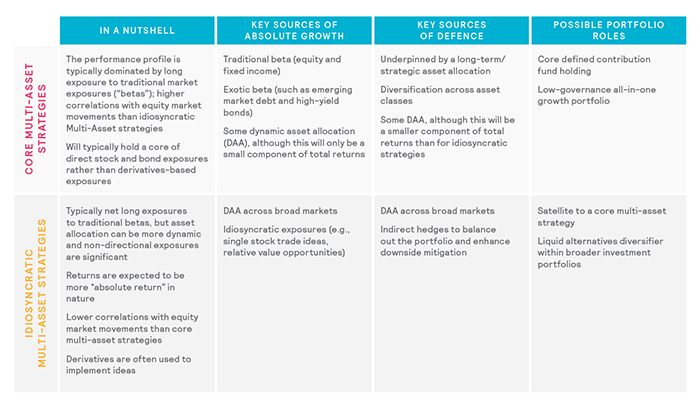
Mercer separates multi-asset strategies into four main universes: core multi-asset, idiosyncratic multi-asset, risk parity and diversified inflation. This article focuses on the first two categories (which in some regions have been labelled as diversified growth funds), as we discuss the range of options available, the different sources of risk and return, and the potential role that these products could play in an investor’s portfolio.

In 2014, Mercer created these two subcategories. We summarise their key points of difference in Table 1.

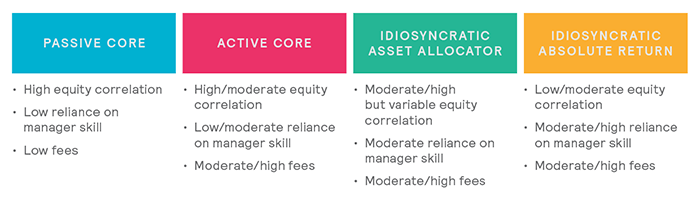
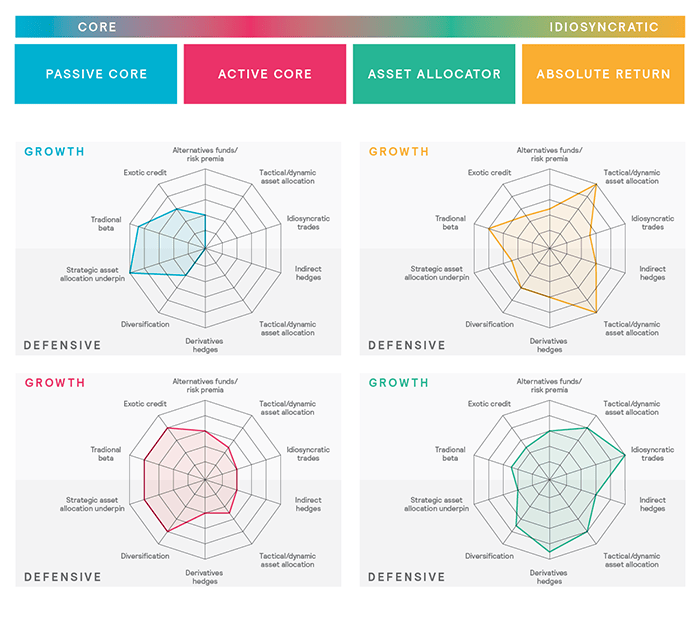
As the market has evolved, providers have continued to innovate and push the boundaries of these two categories, and we believe that the multi-asset space should be seen as a spectrum of strategies. The extent to which a strategy uses underlying active management, exploits dynamic asset allocation, and/or relies on market directional and non-directional return drivers all affect this breadth of options. To help understand the key characteristics of this diverse range of strategies, we informally separate them into the four further subcategories shown below. The radar charts show the biases (which Mercer has qualitatively assessed) for a typical strategy within each category.

As with all investments, we believe it is important to understand the associated costs of each option when allocating to multi-asset strategies. To help assess value for money, we have looked at the relationship between the sources of return within a strategy and the total cost of investing in that strategy. Overall, we believe a higher fee can be justified more easily for strategies that rely heavily on manager skill than for those driven by traditional market beta (primarily equity markets).

Core multi-asset: a ‘smooth ride’

In our view, the most common objective of investing in a core multi-asset strategy is to achieve a ‘smoother ride’, relative to a pure equity portfolio, by introducing exposure to a range of other traditional market betas.

Traditionally, these strategies have been popular with two types of investors: those searching for a low-governance, all-in-one portfolio solution and those with a long-term investment horizon that want equities to remain the main driver of returns. For governance-constrained investors looking for equities to remain the main driver of returns, we recommend passive corestrategies to gain core beta exposures in the most cost-efficient way possible. For those looking for an all-in-one portfolio solution, we believe our highly rated active corestrategies remain an appropriate option.

Idiosyncratic multi-asset: diversified growth

The key objective of an idiosyncratic multi-asset allocation is to introduce differentiated return drivers into a portfolio, thereby diversifying an investor’s growth assets away from traditional market exposures – in particular, equity market beta. To achieve this, investors generally have to rely heavily on strategies driven by manager skill and/or multiple alternative betas. Asset allocator strategies do this by using dynamic asset allocation to such a degree that it becomes a significant driver of returns, although they remain predominantly reliant on traditional asset classes. Meanwhile, absolute return strategies rely far more heavily on non-market directional trades to drive portfolio returns.

Although we see idiosyncratic strategies as a useful option for investors looking to represent their liquid alternatives allocation, we also believe they do not fully capture the available opportunity set. In our view, the purest and arguably best method of achieving this objective is to allocate to a diverse pool of hedge funds. This is particularly true for those investors that do not have any governance, fee or liquidity constraints.

The emergence of more liquid and fee-conscious alternatives strategies, such as alternative risk premia and Undertaking for Collective Investments in Transferable Securitieshedge funds, grants all investors – including those that have relied on multi-asset strategies because of constraints – a much wider range of strategies to choose from to ensure they can access the broadest range of return sources. Therefore, we see idiosyncratic multi-asset strategies as only one part of the range of options investors should consider when building their liquid-alternatives allocation.

Idiosyncratic strategies introduce a greater reliance on manager skill (relative to more beta-driven mandates), which introduces a degree of manager-specific risk – in particular, when large allocations are made to a single manager. It is not uncommon to see allocations of more than 25 per cent of a portfolio to a single idiosyncratic strategy. If a manager were to have a period of weak performance, it would have a significant and material impact on the investor’s returns. Therefore, we recommend investors diversify their allocation across more than one manager, and across styles, with no one strategy accounting for more than 10 per cent of a portfolio, to mitigate these risks,.

For more information see: Making Sense of Multi-Asset.

Kishen Ganatra is Mercer’s European strategic research director and Shailan Mistry (pictured) is a consultant in Mercer’s hedge fund research boutique.