We don’t believe the politics of Brexit are conducive to tactical asset allocation. Whenever Brexit happens, protracted uncertainty is likely. While we continue to believe that investors should modestly overweight global ex US stocks—including the United Kingdom’s globally oriented equity market—relative to US equivalents, our call is unrelated to Brexit and instead rests largely on our conviction that historically stretched relative valuations should partially mean revert over time.

UK equities in aggregate are fairly insulated from Brexit dynamics, but the market’s valuations and fundamentals are a mixed bag and do not support a tactical tilt vis-à-vis other non-US markets.

Regardless of near-term developments, the ultimate Brexit end-state may not be known for several years to come, given both (a) the Herculean task of unwinding years of economic and political convergence and developing a new relationship with the EU, and (b) the current lack of consensus within the UK government regarding what the future relationship should entail. To quote a member of UK Parliament, who recently likened Brexit to Welsh devolution, “Brexit is a process, not an event.”

This is particularly apt in light of the UK government’s current plan to make a mostly clean break from the EU’s customs union and single market and to attempt to negotiate a comprehensive free trade agreement, which could be years in the making. Investors should therefore maintain a long-term perspective and ignore the short-term Brexit noise.
Since the June 2016 referendum, the trade-weighted pound sterling appears to have moved to a structurally lower trading range in anticipation of greater trade friction between the UK and the EU. The pound’s valuation remains below its historical average, primarily driven by its exchange rate with the pricey US dollar. Sterling arguably has priced in much of the potential impact of the “hard, but orderly and prolonged” Brexit deal that’s been negotiated.

Though sterling could experience some moderate appreciation whenever “Brexit day” is confirmed,it’s difficult to see the GBP returning to pre-referendum levels on a sustained basis unless Brexit is ultimately cancelled.
Although exposed to Brexit developments through their sterling denomination, UK equities in aggregate have a globally oriented revenue stream that helps insulate them fundamentally.

The UK market derives less than one-third of revenues domestically and more than one-half of UK sales are generated outside Europe. Yet, the market’s sector exposure is less desirable. The UK market is heavily tilted to industries facing disruption—together financials, energy, and basic consumer goods compose roughly half of the market. Also, exposure to the companies doing the disrupting is limited, given the UK market’s miniscule exposure to technology, including internet software and services.

Sell-side analysts estimate that long-term earnings per share (EPS) growth will be roughly half the US market’s expected EPS growth rate.
UK equities appear somewhat undervalued on the surface, and the UK market’s dividend yield is among the highest on offer globally. Yet, while the overhang of Brexit uncertainty has been a factor, today’s below average valuations for the UK equity market as a whole also reflect the relatively unattractive industry mix and an above-average exposure to idiosyncratic company risks.

Additionally, the UK market also appears much cheaper than broader developed markets on a relative basis, but this is primarily due to the high valuations of US stocks and is not unique to UK equities.
The fundamental outlook for the largely internationally oriented UK equity market does not depend on the ultimate outcome of the Brexit process and its future implications for the domestic economy.

Still, undemanding UK equity valuations reflect more than just Brexit uncertainty and UK equities are not cheap enough in absolute terms to justify an overweight relative to other non-US markets. With UK stocks’ lower beta attributes, they could lag global peers in a scenario where external growth and bond yields surprised on the upside.

Similarly, any UK outperformance in anticipation of a softer Brexit scenario could be fleeting as the likely GBP rally associated with such an outcome would weigh on the market’s largely foreign-sourced revenues.


Michael Salerno is senior investment director on Cambridge Associates’ global investment research team.


Pensioenfonds Werk en(re)Inegratie (PWRI), the €9 billion ($10 billion) Dutch fund for disabled workers is already well renowned for its €100 million ($113 million) highly specialist inclusion portfolio. The fund invests in around 50 listed Dutch and international companies that promote employment for people with disabilities, backed up with intense engagement.

Now PWRI is going one step further, introducing a bespoke index for its entire 35 per cent equity allocation which will tilt investment towards companies with strong health and safety, labour and climate ESG scores across developed and emerging markets to better reflect its distinctive ESG priorities.

The €2 billion ($2.2 billion) developed market portfolio was transitioned last November, and the €1 billion ($1.1 billion) emerging market portfolio will transition this month or next.

“The idea came from the board after talking with our beneficiaries,” says pension expert Xander den Uyl, vice chair of Utretch-based PWRI, who is also a board member and supervisory board member at three other Dutch funds.

The genesis for the new strategy dates from 2017 when PWRI decided to revamp its equity allocation, divided at the time between two active portfolios invested in Europe and emerging market mandates, and two passive allocations to Asia and the US.

“We had the feeling that the portfolios weren’t aligned with our ESG policy and we were also worried about the cost of active management, especially in the emerging market portfolio which didn’t’ perform well,” says den Uyl.

Working with its fiduciary manager BMO Global Asset Management, PWRI decided to develop its own index, rather than track one of the growing numbers of off-the-shelf ESG benchmarks.

This way it could ensure that strategy mirrored its own, strong ESG beliefs around climate and disability, where it particularly prioritises helping disabled people in the workplace, rather than “someone else’s” values, says den Uyl.

“The biggest challenge in the process is defining what you want. We have a long history of ESG but there is a difference between an ESG policy and stepping towards a proprietary benchmark.”

Other issues also came to the fore. For example, PWRI’s equity allocation had been in funds, so creating a discretionary portfolio involved finding a new custodian.

In the allocation, PWRI targets improving its overall ESG score by 1.5 per cent compared to the MSCI ESG Universal index.

The fund also targets reducing its carbon footprint by 20 per cent compared to MSCI World and aims for investee companies in its portfolio to score 10 per cent better than MSCI World constituents in labour rights and health and safety. In more challenging emerging markets, where a deeper level of analysis makes integration difficult, the fund targets a 10 per cent increase in broader social scores.

“ESG scores in emerging markets aren’t accurate and it’s difficult to separate out between labour and health and safety so we created one overarching score.”

However, he is convinced that as more data becomes available and more investors prioritise social investment, this will change.

“We feel we are not at the end of the process, but at the beginning.”

MSCI provides all the data on the companies that make it into the passive universe, while the strategies are run by UBS and DWS in an equally split mandate. Manager selection was overseen by BMO in a process whereby PWRI “stood back” to let its fiduciary manager work with the asset managers, and deep dive into the technology and data behind the strategies.

“We set out our policy with our fiduciary manager and then asked them to deliver on it,” explains den Uyl.

The idea behind the split mandate is that it exposes the strengths and weaknesses in the managers’ slightly different investment approaches.

“We have done this because it is new, and we can see if one approach has slightly better results. We can see how they perform and decide if we continue with what we are doing, or we change it.”

The managers weight the different companies in the index accordingly, and BMO engages with investee companies. Splitting the mandate does cost “a little more” but the additional costs are only “a few basis points,” he says. “It is quite different from what you pay with an active portfolio and a little bit higher than MSCI World, but not very much higher.”

The results of the strategy have just started to emerge.

“We now have the first results and they show that the targets can be more than met. The first results show a performance over target on carbon reduction and on health and safety,” says den Uyl.

In one surprising revelation from back testing the strategy, the emerging market portfolio outperformed. Back testing the portfolio also confirmed the low tracking error in the strategies.

“Back testing has shown that the strategy has performed in terms of our ESG targets and in terms of our performance. It proved that there is room with a relatively small tracking error to make relatively large steps towards your ESG goals.”

Going forward, the goal is to introduce more challenging targets, particularly around investee companies carbon footprint, as the strategy beds down and the performance and low tracking error continues.

“The back testing shows this is possible, but we want to see what happens before we increase our targets.”

Full ESG integration across the entire portfolio is the other long-term objective. PWRI has a 60:40 split between return seeking and matching assets where, in the former, along with the equity allocation it invests in high yield and emerging market debt, convertible bonds, real estate and has a small private equity portfolio.

In an investment milestone, each private equity allocation for the five pension funds that comprise New York City Retirement Funds experienced net internal rates of return (IRR) of over 10 per cent since inception in the third quarter of last year.

“That is a strong number and it’s the first time we have been there,” said Alex Doñé CIO of the Bureau of Asset Management which manages the five funds, speaking at the Systems’ March Common Investment Meeting.

“We have seen sequential quarter over quarter improvement in the private equity portfolio for each system for well over two years.”

The allocation amounts to around $12 billion, equivalent to 6 per cent of the pension funds’ combined assets which have invested in private equity since the late 1990s. Unfunded capital commitments amount to around $8.2 billion, resulting in a total exposure of $20.2 billion across 221 funds and 116 managers.

Doñé cautioned, however, that the overall private equity portfolio continues to lag its public market equivalent (PME) benchmark (Russell 3000 + 300 basis points illiquid premium.)

Doñé attributed this to the impact of the legacy portfolio but said its anchoring impact on the broader allocation was waning.

“Importantly, your primary mangers continue to be a bigger share of your portfolios and we are encouraged by these trends,” he told gathered representatives from the five funds, New York City Employees’ Retirement System (NYCERS), Teachers’ Retirement System of the City of New York (TRS), New York City Police Pension Fund (POLICE), the New York City Fire Pension Fund (Fire), and the New York City Board of Education Retirement System (BERS) that make up the $187 billion System.

The Bureau overhauled the funds private equity allocations in 2011 when it hired a new consultant (Hamilton Lane is TRS’s consultant; Stepstone Group is NYCERS’, POLICE and Fire’s consultant) and changed strategy, reducing the number of relationships from 174 to 116.

The portfolio now has a 64 per cent allocation to buyouts, 9 per cent allocation to special situations, 8 per cent to growth equity, 8 per cent to secondaries, 5 per cent to co-investment, 1 per cent to energy, and 4 per cent to “other”, which includes venture capital, mezzanine, and funds-of-funds.

“Post 2011 the systems in aggregate have consistently outperformed in most vintages,” said Doñé noting, however, that the one year the portfolio didn’t fare as well was 2015.

“A couple of managers in that vintage in the portfolio are off to slow start and this led to underperformance versus the PME,” said Doñé, listing private equity firms EQT Partners and Warburg Pincus.

“It was a tough PME to beat given what public markets have done.”

Teachers’ was the one fund in the system that did outperform the 2015 vintage because it didn’t make private equity investments in that year.

“These funds have been slower out of the gate, but it is very early in the life of these funds and we have expectations they will return strong absolute and relative returns to the public market equivalent,” he said.

The City pension funds allocate around 28 per cent of their joint AUM to US equities, and Doñé attributed the rebound in equity markets in 2019 to the belief that US interest rates won’t rise through the year.

“The expectation is that interest rates will remain unchanged; there is dwindling expectation that there will be any interest rate increases this year.” He also said the more buoyant market is linked to abating fears of a trade war with China and noted that China has been “active in mitigating the slowdown” in its economy with fiscal stimulus.

At the end of December 2018 the five-system asset allocation was US equities (27.7 per cent), World ex-US (10.2 per cent), infrastructure (1 per cent), emerging markets (7.5 per cent), INTL FOF (0.7 per cent), fixed income (28 per cent), alternative credit (9.8 per cent), private equity (6.8 per cent), private real estate (4.8 per cent).


New Zealand’s largest investors are urging Facebook, Google and Twitter to take more responsibility for what is published on their platforms, following the live-streaming and sharing on social media of last week’s Christchurch terror attacks.

In a joint shareholder engagement the largest investors in New Zealand with combined assets under management of NZ$90 billion ($61.6 billion) – New Zealand Super Fund, the Accident Compensation Corporation, the Government Superannuation Fund Authority, the National Provident Fund and Kiwi Wealth – called on the tech giants to take more responsibility for the material they publish and fulfil their duty of care to prevent harm to their users and society.

“We have been profoundly shocked and outraged by the Christchurch terror attacks and their transmission on social media,” said Matt Whineray, chief executive of New Zealand Super Fund.

The New Zealand five, which all hold Alphabet, the parent of Google, and Facebook stocks, are calling on other global investors including sovereign wealth funds, asset owners and investment managers to join them in engaging with the tech companies, saying collective action will give the initiative the most impact.

The move follows increased engagement by institutional investors in investee companies around gun control and human rights.

Last year a coalition of 13 institutional investors whose assets total nearly $5 trillion, co-ordinated by the $229.2 billion California State Teachers’ Retirement System (CalSTRS), drew up a set of investor principles to improve the safety and responsibility of the firearms industry. New Zealand’s institutional investor community now want that ground swell to focus on big tech too.

“We are in the process of contacting other New Zealand and leading global investors, seeking their support for this initiative,” Whineray said.

In the Christchurch terror attack, the suspected killer posted a manifesto on Facebook and broadcast live footage of the attacks which have left 50 people dead in two Christchurch mosques. The video spread to other sites including Twitter and YouTube.

“These companies’ social licence to operate has been severely damaged. We will be calling on Facebook, Google and Twitter to take more responsibility for what is published on their platforms. They must take action to prevent this sort of material being uploaded and shared on social media. An urgent remedy to this problem is required,” Whineray said.

The group will focus their engagement on requesting more details from the tech companies on how they monitor and censor “objectionable and extremist content;” their policies on user accounts sharing such content and their investment in safety measures.

New Zealand’s investor cohort are also examining whether the companies have breached New Zealand laws and regulations.

“Our responsible investment decisions are guided by New Zealand law and major policy positions of the New Zealand Government. We are therefore also investigating whether there have been breaches of any New Zealand laws or regulations by these companies and monitoring potential changes to Government policy,” he said.

New Zealand’s lead will add to, and help group, existing pressure on the tech companies from a handful of individual investors. Lone investors with strong responsible investment beliefs have spoken out about Facebook in the past. For example, Nordic financial group Nordea banned investments in Facebook temporarily last year as it assesses the impact of multiple investigations into the social network’s handling of personal data.

In a broader coalition, US public pension funds including $175 billion New York City Pension Funds, as well as the state treasurers of Pennsylvania, Illinois and Rhode Island, have demanded that Facebook install an independent chairman rather than have CEO and founder Mark Zuckerberg in that post too.

“An independent board chair is essential to moving Facebook forward from this mess, and to re-establish trust with Americans and investors alike,” said New York City Comptroller Scott M. Stringer speaking last year during the Facebook data breach. New York City’s pension fund holds roughly $747 million of Facebook stock.

Other investors have also got big tech on their radar. Sweden’s SEK490 billion ($53.8 billion) AP7 has previously called for more regulation of internet companies.

The United Kingdom’s £2 billion Church of England Pension Board, where tech companies account for 7-8 of its top 10 equity holdings, is also invested in Facebook, said chief investment officer Pierre Jameson.

The investor’s ethical investment advisory group is about to begin an in-depth report into ‘big tech’ which will cover issues like regulation, privacy and taxation.

“It will be a substantial piece of work. Like our policy on the extractive industry,” Jameson said.

For most investors recognising whether geopolitical tensions are a short term blip, or a long-term systemic shift is key to understanding how those risks inform investment decisions. Amanda White spoke to investors about the impact of geopolitical risk on their portfolios.

Most long term investors agree that geopolitical risks are generally small short-term blips. But how do they know when those short-term blips – like US/China trade negotiations or Brexit – turn into larger systemic problems or trends that will impact markets and investment fundamentals?

CIO of the A$140 billion ($98 billion) NSW Treasury Corporation (TCorp), Stewart Brentnall, says his job is “to consider on a dynamic ongoing basis whether our risk is correct in quantum and complexion to meet objectives”. Geopolitical risks are assessed alongside other risks in the consideration of whether an issue is material in depth or longevity, and Brentnall and the investment team have constant interaction with Brian Redican – the chief economist at the fund –  who also meets with the investment committee on a regular basis. For them, the key challenge in assessing whether geopolitical risk will impact portfolio allocations is determining how sustained or long-lasting any particular risk is.

Similarly, Angela Rodell, chief executive of the $60 billion Alaska Permanent Fund says the challenge of geopolitical risk is determining how sustained or long-lasting any particular risk is and managing around it.

“We want to make sure we are not overreacting to short-term noise and taking advantage where we have conviction around any particular geography,” she says. “Geopolitical risk is one risk discussed with all the other risks an investment may have that are taken into account in making a decision,” she says.

“I think geopolitical issues have always been an important dimension to a global investment strategy and therefore you need to have views about what is happening in the world, where you want to be invested, where you do not want to be invested and how your risk profile changes as a result.”

In its geopolitical risk indicator Blackrock recently upgraded the risk around some specific threats namely global trade tensions, US-China relations, gulf tensions and European fragmentation risks.

Rodell says all of these risks will have an impact on the Alaska portfolio, and already have had an impact over the last couple of years.

“Since 2016 we have seen huge shifts in trade tensions, increasing tension with China, the Gulf continues to be a place of conflict and Brexit along with concerns about Italy impact the performance. The challenge for us as long-term investors is to find opportunity within these arenas and generate value for taking on certain geopolitical risks,” she says.

Brexit

Australia’s TCorp has listed equity index exposures in the UK and a number of unlisted investments including two airports, a gas distributor, water, and ports.

“We are actively engaged with most of the management teams of those investments, and we are very aware of those assets and their histories. They were all managed very diligently through GFC, and we have confidence in them. They are all long-term assets,” Brentnall says. For the most part he says it is business as usual with these long-term investments, despite the Brexit uncertainty. Although one threat is the impact of currency which he says could swamp the income generated from those investments.

For other funds, mostly those based in the UK or Europe, Brexit is less an opportunity, and more of a headache.

The giant Dutch fund, PGGM, for instance is still preparing for a no deal Brexit and is looking closely at how the regulations will hold. This throws up a whole bunch of operational issues including a close analysis of whether it can do business with UK asset managers, the impact on derivatives paper it has in the UK, counterparty risks, and whether it can pay pensions to people who live in the UK?

The French sovereign wealth fund, Fonds de réserve pour les retraites, is also preparing for a no-deal Brexit. Executive director, Olivier Rousseau, says to manage a mandate for FRR, an asset manager must have a European passport, and as a consequence of Brexit, soft or hard, the UK asset managers will lose their passport.

For several months, FRR has been preparing for a no deal Brexit, which would imply the loss of the passport with immediate effect, by working closely with its UK asset managers in order to have them assign the investment management agreements to an European Economic Area entity.

Alaska’s Rodell believes certain political risks do create buying opportunities.

Nationalisation of assets is one political risk to avoid so some emerging and frontier markets are challenging, she says.

But, in terms of a buying opportunity, she says Brexit is creating interesting opportunities in the United Kingdom and Europe. Opportunities she views as a more tactical move.

“When the initial referendum took place and there was a vote to leave the EU, we were in a good time zone and could see the Asia market over reacting and so could take advantage of the short-term noise,” she says.

“We have some tactical accounts where we can move money very quickly. We can also convene pretty quickly on investment committee level too, and are talking to our active managers and discussing opportunities with them.”

Alaska has an investment policy set by the board with percentage allocation bands around each asset class. The investment team can move within those bands. In addition its governance allows investment of up to 1 per cent of the fund in a single manager without board approval. That’s about $600 million.

“It allows us to be nimble,” she says.

This was also demonstrated during the euro crisis in 2012, where the fund took advantage of undervaluations in certain Eurozone countries, investing in real estate in Spain and Portugal.

“We try to look at these advantages and think the value outweighs the potential risks,” Rodell says.

At the end of the day perhaps geopolitical risk is something not to baulk at.

“The unexpected is what makes markets, creates spreads and allows us to generate alpha,” she says.

China/US trade relationship

The NZ$40 billion ($27 billion), New Zealand Super is one of few investors that is a true long-term investor in that it doesn’t have liabilities to pay right now.

So as chief economist of NZ Super, Mike Frith, says long term trends and valuations are the only relevant measures in how it allocates investments.

“When we think about our allocation or strategy we are not trying to predict or front run market movements,” he says.

So when assessing geopolitical risk it is very much about the impact on the long term. To this end, Frith believes the US/China conundrum is not just about trade.

“These are two largest economies finding their place in the world, and most importantly they are coming from completely different places,” he says. “There will be ongoing flare- ups. As a result whatever happens will effect long term thinking but it will be slow.”

Frith says the biggest issue for asset owners looking at geopolitical risks is working out when something is fundamental and what the implications will be.

New Zealand reviews its reference portfolio every five years, with the next review in 2020, and this is where any big trends are picked up.

“We might miss the timing point on certain things but that doesn’t matter to us, we distinguish between short term blips and a long term shift,” he says.

Frith says that over the past 30 years not many, if any, geopolitical events and the subsequent short-term volatility of markets have led to any significant shift in markets.

Firth is watching the China/US situation and says if the trade issues have not been sorted out by the end of the year it will attract more serious attention.

“The China/US relations are not affecting us right now, but if it went on for 12-18 months we would expect there’d be some enduring effects on global growth and that would impact our forward looking earnings expectations,” Frith says. “The longer it plays out the more likely it will effect expectations.”

TCorp’s Redican agrees that it is important to distinguish the noise – such as Trump tweeting about tariffs and markets going up or down by 1 per cent – and the underlying signal.

While he agrees that this short-term activity does not have a meaningful impact on growth he does warn that that analysis can lead to complacency about the long term implications.

For example, he says, a protectionist route can lead to weaker productivity growth over the medium term and those impacts should be monitored.

He says the current tension is impacting the “natural order” and potentially changing the slope of growth.

“The underlying problem [between the US and China] that we think is more pervasive is the issue around intellectual property rights, IP transfer, and technological issues. This is the basis of the dispute, and it is hard to see a compromise that satisfies both sides, it’s a simmering issue,” Redican says. “The worst case scenario is a bifurcation in the global economy and the western world trades among itself and the east and china trades among itself.”

This would result in a massive step down in productivity and efficiency, and potentially increase the risk of military tension.

Like other investors, NZ Super does scenario modelling including, for example, the various iterations of the China/US relationship including a full trade war, and the impact of that on global growth and the fund’s direct exposures in China as well as its New Zealand assets.

“This can help identify exposures we might not have been aware of and allows portfolio managers to think a bit deeper,” Frith says.

Similarly, NZ Super has some strategies it invests in that look at dislocation in markets and whether there is an opportunity big enough to take advantage of, sometimes the driver is geopolitics.

“We are always nervous when our models don’t explain something, like populism,” he says. “But this is not the ultimate driver of markets.”

To invest or not to invest

Some pension funds, such as the $14.2 billion South Dakota Retirement System see investing in China as too risky, while others including Sweden’s SEK345 billion ($39.1 billion) AP2 are increasing investments with really good results.

Alaska’s Rodell believes there is a fundamental change taking place in the US/China relationship and recognising that helps inform investment decision-making.

“Knowing what is long term systemic change and what is short term noise is important and while we don’t have any more knowledge than anyone else on that front we think there is definitely a need to watch trends and how the market responds.

“US and China relations are definitely significant, and there are trade tensions, but we think the US and China are too large to let it flounder. The global economy doesn’t allow countries to throw up borders and say they are not playing,” she says.

Having said that Rodell acknowledges that it is important to recognise the world is a different place.

“You could say you don’t want exposure, or you could say China is an important trade partner with the US and so want to invest in China. You have to distinguish between the long-term shifts happening in terms of trade and then the individual noise of certain behaviours, like Trump leaving China a day early,” she says.

Alaska has exposure to China through A-shares and is looking at private market opportunities in infrastructure and technology.

“We believe that China will continue to be a place we want to have exposure and so we need to work to find long term value in strategies that are exposed to China, and while maintaining awareness of how trade talks evolve and the relationship changes, not allow short term volatility dissuade us from that conviction.”

Rodell says there is some mild concern around the US and its attitude to foreign investment and whether there will be a response by some countries that results in barriers to US dollar investments.

“Does China still want to attract USD? This is something to watch,” she says.

But perhaps a Bloomberg interview with CEO of the $1 trillion Norges Bank, Yngve Slyngstad, puts geopolitical risk this  perspective for long term investors.

“We are invested in the UK with a long-term horizon. How much we will invest will not be changed depending on the results of this development [Brexit], if we look past this – 10, 20, 30 years – the UK will be an important economy in Europe, and it will remain in Europe. We expect business on that timeline to develop positively no matter the outcome.”

There is a fundamental shift occurring in the relationship between companies and society. Whereas previously, profit maximisation was seen as the dominant purpose of a business, increasingly it is now being regarded as an outcome of a company’s broader purpose.

The idea behind ‘creating shared value’ was discussed in Porter and Kramer’s 2011 work where it was argued that the competitiveness of a company and the health of the community around it are mutually dependent. This bridged the gap between the long held dichotomy of creating value for shareholders and creating value for stakeholders.

Robert Eccles also tackles this idea by noting that companies have two basic objectives: to survive and to thrive. He argues that shareholder value should not be the objective of a company but the outcome of the company’s activities. In other words, rather than profit being the purpose, profit comes from pursuing a purpose that benefits society.

These considerations are shockingly important when you consider the size and impact of some companies. In 2016, 69 of the world’s 100 top economic entities were corporations rather than countries and the world’s top 10 corporations had a combined revenue greater than the 180 poorest countries combined (a list which includes Ireland, Israel, South Africa and Greece). These 69 corporations clearly help shape the social foundation of our societies.  The investment industry has an immense opportunity to influence how these corporations are run.

Building a better social foundation for societies

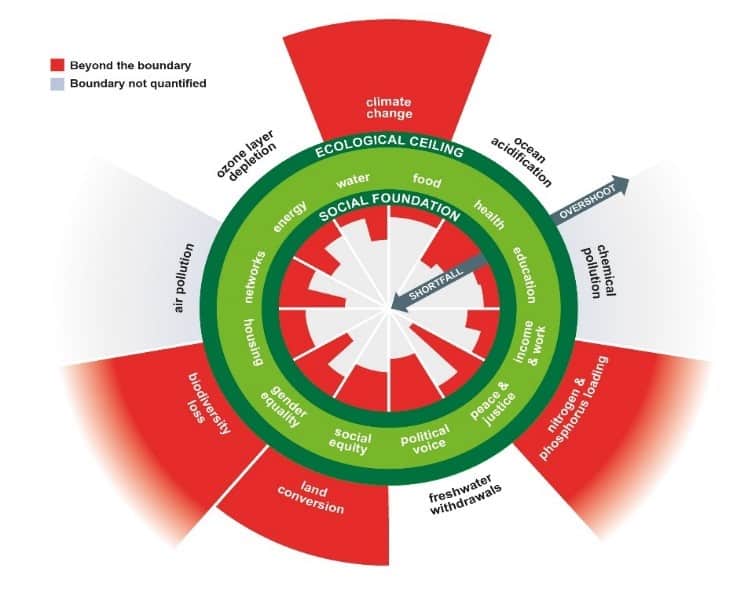
In 2009, Johan Rockstrӧm, executive director of the Stockholm Resilience centre, outlined nine planetary boundaries that are critical for keeping the earth in a stable state beneficial to life as we know it and attempted to quantify how much further we can go before there is a risk of “irreversible and abrupt environmental change”.

Human survival clearly requires the sustainable use of these planetary resources and complementing the planetary boundaries are social foundations below which there is unacceptable human deprivation.

Kate Raworth picks up this idea in her book, Doughnut Economics, and sets out a visual framework for sustainable development by combining the complementary concepts of planetary and social boundaries. The ‘doughnut’ (shaded green) represents the safe operating space for humanity: a social foundation of wellbeing that no one should fall below, and an ecological ceiling of planetary pressure that we should not go beyond.

Doughnut economics – balancing planetary and social boundaries 

Source: Doughnut Economics, Kate Raworth, 2017

For a clear statement of what societal wealth and well-being includes, a good place to look is at the UN’s sustainable development goals (SDGs).

This universal set of goals, targets and indicators has been agreed by 193 member states, and covers a broad range of social and economic development issues expected to frame government agendas and political policies at least until 2030.

The SDGs address the most pressing systemic social, economic and environmental challenges in our world today and are arguably the most objective reference point for determining what is good for society.

With goals such as ending poverty, and hunger, achieving gender equality and improving access to clean water and sanitation, the SDGs point to a common language which the great majority of economies (and hence industries and organisations) can rally around.

However, the UN estimates that meeting the SDGs will require $5 trillion to $7 trillion in investment each year from 2015 to 2030. The UN has put out a strong call to action for the private sector to play a fundamental role in achieving these SDGs.

While government spending and development assistance will contribute, they are expected to make up no more than $1 trillion per year and so “new flows of private sector capital will be key, either through new allocations or by re-routing existing cashflows”.

In their 2017 report, The SDG investment case, the UN PRI argues that investment organisations should consider the SDGs when making strategy, policy and active ownership decisions based on a fiduciary duty to consider the risks and opportunities generated by sustainability risks.

In short, the SDGs can be used as a framework through which investment decisions can be made, in keeping with an investor’s fiduciary duty, while offering opportunities for global economic growth that could lead to better investment outcomes for beneficiaries over the long term.

Creating system value

The idea of shared value has since been extended by the concept of creating ‘system value’, a term first introduced by the Future-Fit foundation. A system value perspective places a business within society – it is a subcomponent – and places society within the environment. The logic is unarguable. And the perspective shows that a business cannot be considered as independent from either society or the environment. It will affect both of them – for better or for worse.

To understand how an organisation creates system value, one has no look no further than how it designs its business strategy and executes its operations to benefit its stakeholders, using its various sources of capital (financial, human, social, manufactured, intellectual and natural).

Admittedly the bar for achieving true system value is high, however we believe that organisations can contribute to this target by pursuing activities which help create better societies and a more sustainable environment.

Marisa Hall is a director in the Thinking Ahead Group, an independent research team at Willis Towers Watson and executive to the Thinking Ahead Institute.