Axa divested from tobacco in 2016 making it one of the first global insurance companies to do so. It has taken that a step further and now doesn’t insure tobacco companies. Amanda White speaks to the chair of Axa, Denis Duverne, on why this is a natural part of the company’s strategy.

Amanda White: Why is it important for your portfolio to be tobacco free?

Denis Duverne: Tobacco kills 7.5 million people per annum and that is likely to grow with emerging markets getting more affluent. As investors we have a responsibility to invest responsibily and it makes no sense to be a health insurer and invest in tobacco

Has it had an impact on returns?

It is too early to say if it has impacted returns. At the time of the decision there was a big discussion at CalPERS and when they took the decision to divest I also made that decision. And then I started to make calls to other investors to introduce the idea of tobacco free portfolios. (CalPERS did well to snuff out tobacco)

We can only really have an impact if there are more sellers than buyers, so we need this intiative to grow

What is your opinion of divestment versus engagement as a way to influence companies?

This is very different from the energy debate. Our first big divestment was from coal, our initial stance was divestment from coal manufacturers and energy suppliers with more than 50 per cent revenue from coal. We could have an engagement with them because there is an alternative, but with tobacco there is no alternative. Engagement doesn’t make any sense. They are very smart people, and very decisive and we want to avoid them.

The decision has been very well received by employees and by investors. We went way beyond divesting, and have stopped insuring tobacco companies. Most decisions matter, the only way to have an impact

The decision to divest is consistent with your corporate responsibility strategy can you talk a bit more about that?

Our corporate responsibility strategy is part of our strategy, it is not something on the side. It is a three pronged approach.

First is climate – a 3 degrees world would be totally uninsurable so we are fully inline with our strategy so in line to invest with a climate sustainable strategy

The second is health, tobacco is one element of that. We also invest in medical research including prevention activities – health can improve a lot by prevention.

Inequality – the SDGs are good for society and we think we are can have an impact by providing insurance to those that don’t currently have it eg through micro finance

All companies, managers, owners and insurance companies should make sure the strategy is aligned with the SDGs and within that health, inequality and poverty are part of those objectives.

Tobacco kills and that will increase if we do nothing.

If you want to be consistent with your own objectives you should look carefully at tobacco free as part of the solution.


In this year’s International Forum of Sovereign Wealth Funds (IFSWF) annual review we highlighted four trends in sovereign wealth fund direct investments in 2018: private markets bouncing back, the acceleration of early-stage investments, the age of new urban mobility, novel partnerships and co-investment structures.

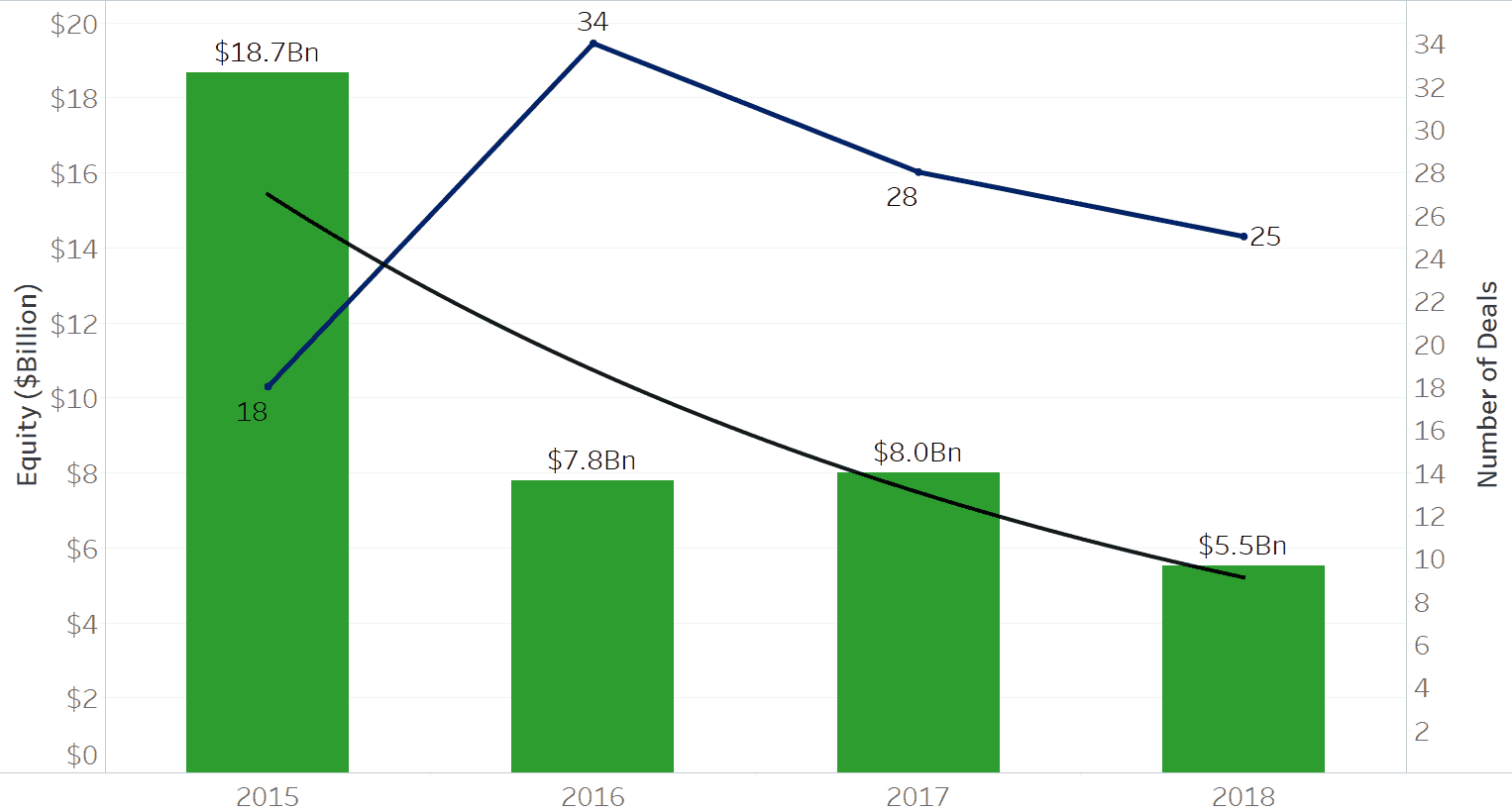
Some of these trends apply to infrastructure, with SWFs sourcing fewer transactions in hard assets. In 2018, SWFs invested 30 per cent less in infrastructure than they did the previous year, $5.5 billion in 2018 down from a total of $8 billion in 2017. The number of investments also dropped by 10 per cent from 28 to 25. This is not a one-year aberration, but a downward trend from the peak of $18.7 billion committed in 2015.

Chart 1.1 SWF Direct Investments in infrastructure

Source: IFSWF Database

Renewables: a gateway to climate change opportunities.

Global investment in renewable energy hit $288.9 billion in 2018, with the amount spent on new capacity almost triple the amount invested in new fossil fuel power, according to a report published this month by BloombergNEF, as a part of UN environment thinktank REN21’s Renewables 2019 Global Status Report.

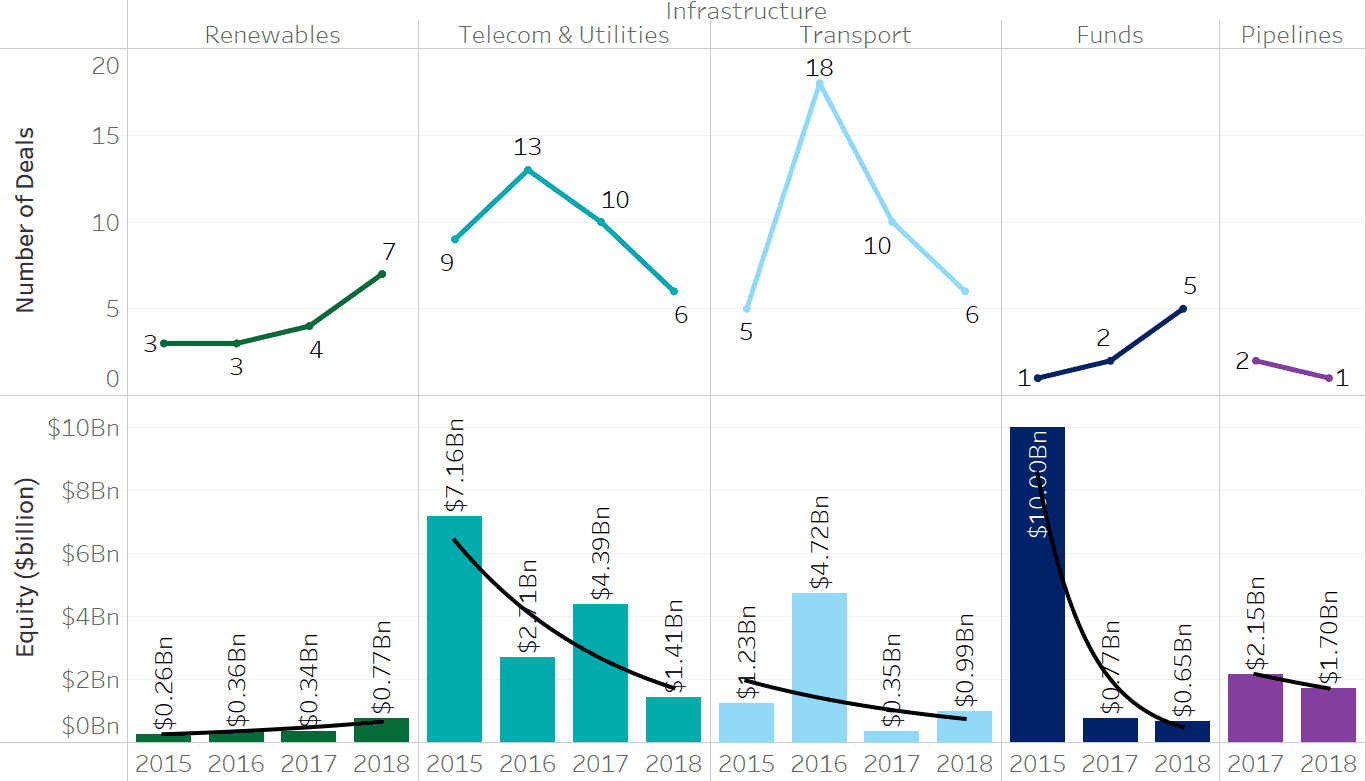
SWFs took advantage of the growing number of opportunities to finance renewable-energy projects in 2018, primarily co-investing with both asset owners and asset managers. According to IFSWF data, SWFs provided the most equity financing for renewable energy companies since 2015: $800 million over seven deals. It appears that renewable energy is the only infrastructure sector gaining momentum. Most investors are tapping into opportunities created as a result of the Paris Climate Change Agreement, signed by 175 parties in 2015 to slow climate change.

“SWFs and other institutional investors have embraced new investment opportunities arising from the transition to a lower-carbon economy,” said Majed Al Romaithi, Executive Director of the Strategy and Planning Department of the Abu Dhabi Investment Authority (ADIA), and Chair of the International Forum of Sovereign Wealth Funds.

“These range from infrastructure investments in solar and wind energy provision in both developed and emerging markets, through to early-stage venture-capital investments in new technologies in the battery and transport sectors,” added Al Romaithi when discussing the One Planet SWF Framework and the latest developments in measuring and reporting on climate change, in an interview with the IFSWF team.

It is not a surprise, therefore, that in 2018, two sovereign wealth funds – the China Investment Corporation (CIC) and Alaska Permanent Fund Corporation (APFC) – were part of a consortium that closed the largest renewable energy generation transaction in history. Global Infrastructure Partners, an infrastructure investment manager, and Canadian public pension fund, PSP Investments, led the $5 billion acquisition of renewable energy developer Equis Energy. The partners settled in cash, including assumed liabilities of $1.3 billion. It was an unusually large transaction for the sector, fully reflecting Equis Energy’s value as Asia-Pacific’s largest renewable energy producer.

Chart 1.2 SWF Direct Investments in infrastructure by sector

Source: IFSWF Database

Competition more than regulatory pressures slow down investors in infrastructure.
Headlines suggest that sovereign wealth funds and institutional investors are facing greater resistance from regulators preventing them from investing in major infrastructure assets abroad. Regulatory regimes in the US and Europe appear to have more stringent screening processes for foreign direct investments in strategic infrastructure assets. In the US, the Committee on Foreign Investment in the United States (CFIUS) chaired by the Secretary of the Treasury, which reviews any transaction that could threaten national security now has sweeping powers to stop deals in strategic sectors, and particularly in infrastructure. However, few transactions have ever been rejected outright by CFIUS, although from time to time parties have withdrawn from review and terminated those deals with the likelihood of an unsuccessful outcome.
Investors are wary about the timing under which CFIUS operates, and the fact that it is difficult to obtain an “advance” read from the Committee on any given transaction.

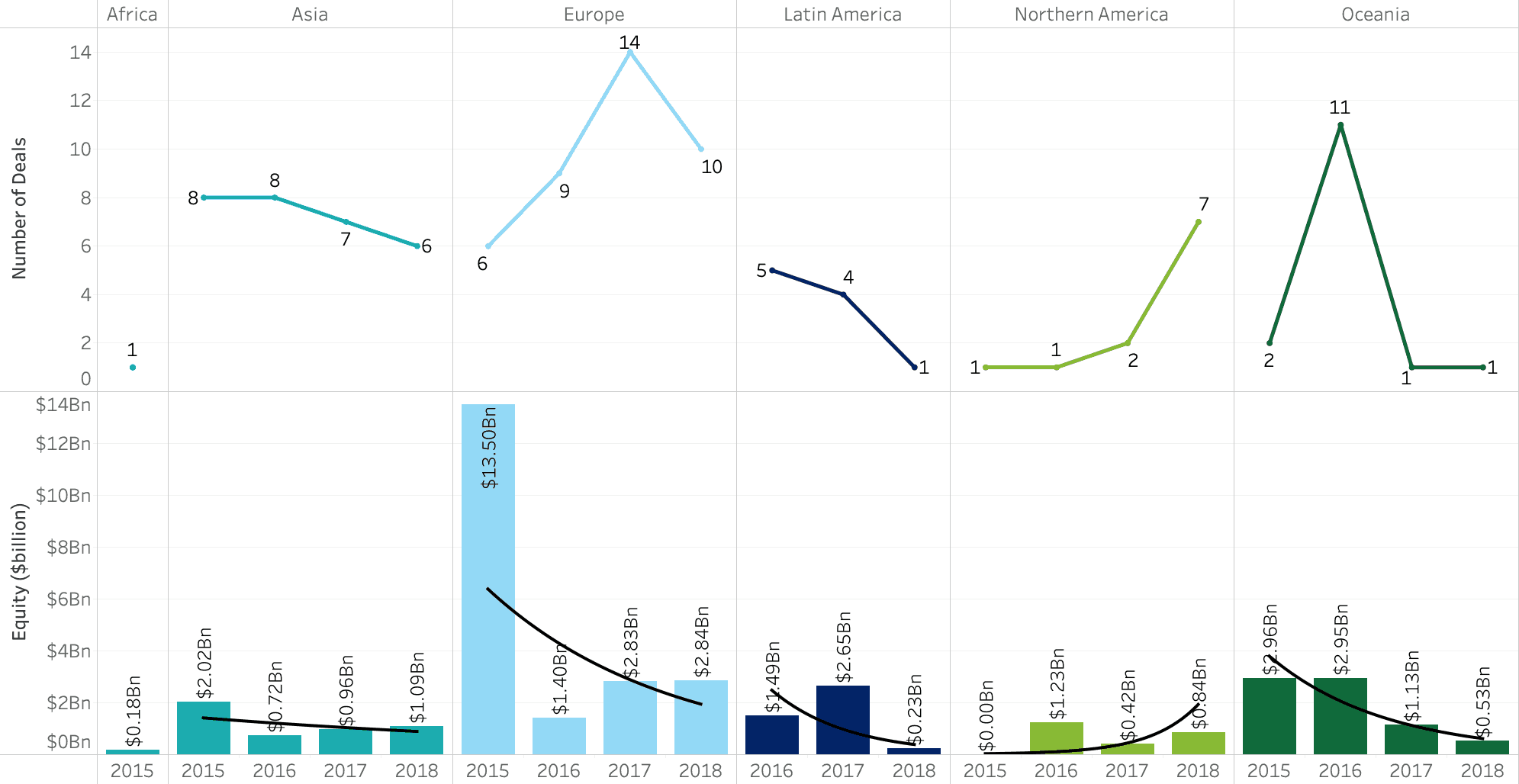
Chart 1.3 SWF Direct Investments in infrastructure by region

Source: IFSWF Database

According to our data, SWFs appear to be closing more deals in North America, despite the trade war rhetoric, more than tripling the number of deals from two in 2017 to seven in 2018. Europe, another difficult market, is still the largest region in the world for sovereign wealth fund direct infrastructure investments with 10 deals closed in 2018 for an equity commitment of approximately $3 billion.
Nonetheless, most of the infrastructure deals in Europe are facilitated as co-investments or joint-ventures with local sovereign development funds, such as the Russian Direct Investment Fund (RDIF) or the Ireland Strategic Investment Fund (ISIF). For example, in October 2018, RDIF and France’s water and sewage operator Veolia group, established a joint venture for investing in Russian utilities.

That said, when not operating as a magnet for co-investors in their domestic economies, government funds are facing increased competition and higher valuations for mature assets in developed markets. One developed market with a steady stream of privatising infrastructure assets like Australia, has been a case in point where major privatisation programmes have been hard fought. In 2018, the only sovereign wealth fund to invest in the country was ADIA, as part of a Transurban-led consortium (including Canada’s pension fund CPPIB and AustralianSuper) that purchased a 51% stake in Sydney’s new toll road development WestConnex for A$9.3 billion ($6.8 billion) from the New South Wales government.

Funds and co-investment partnerships promoting domestic development
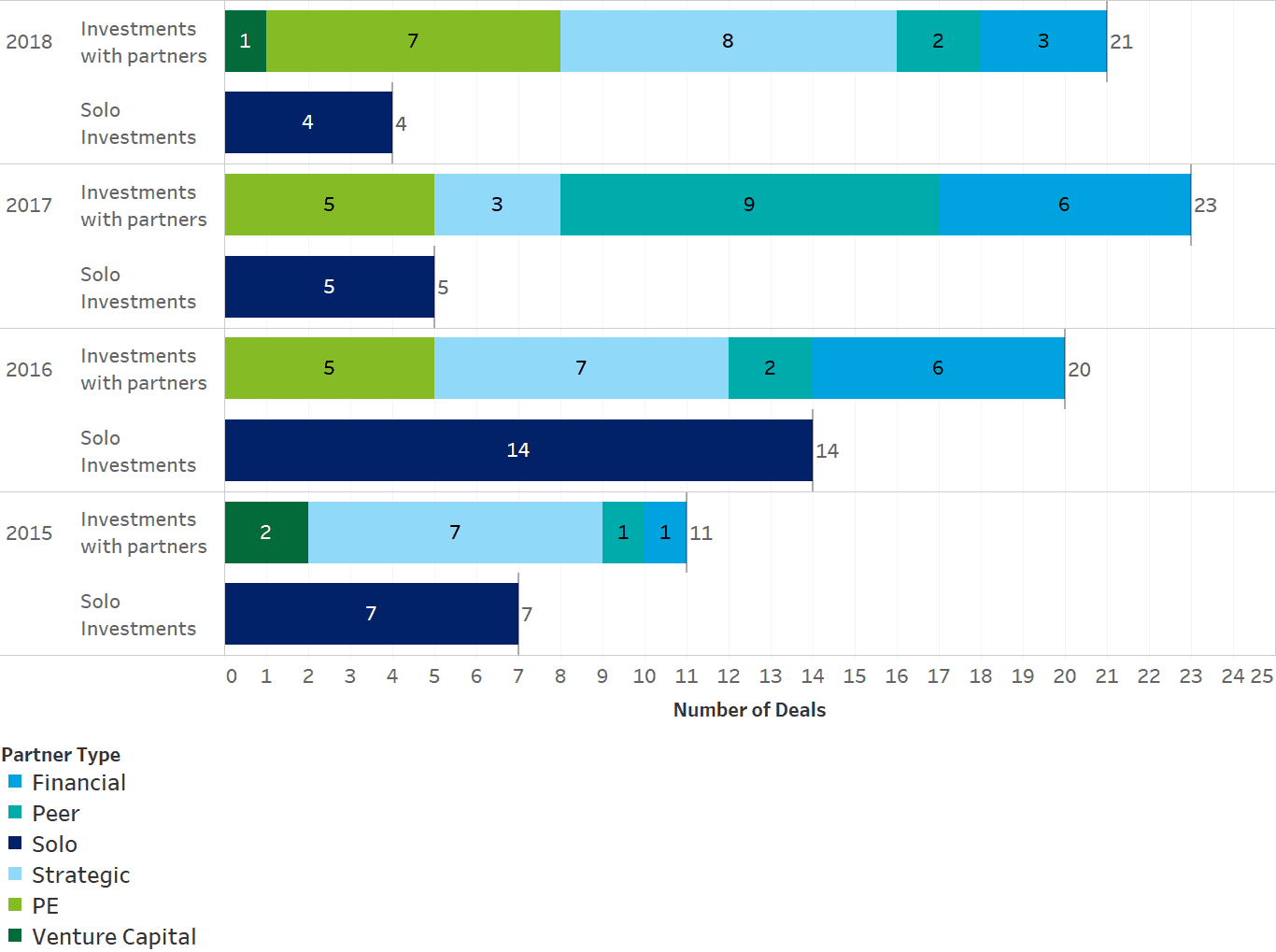
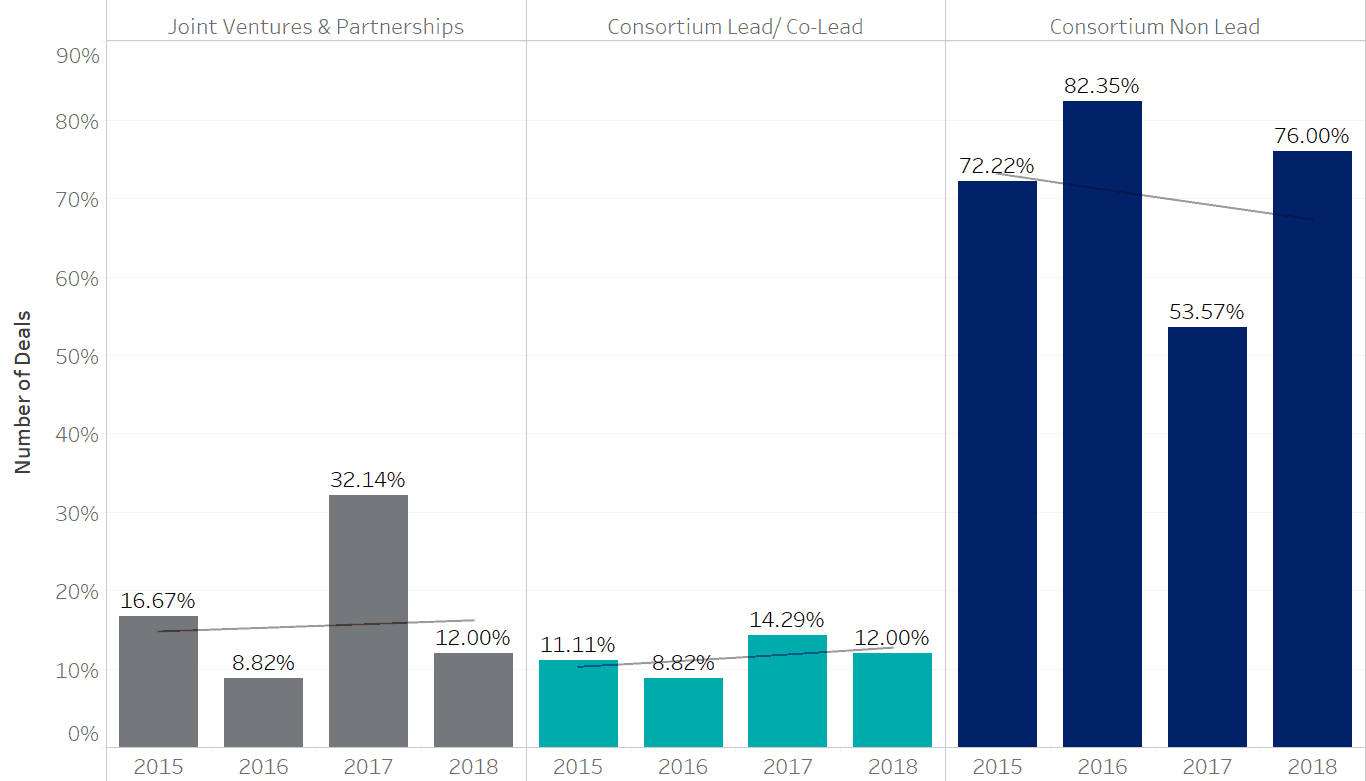
Over the last four years, SWFs have invested alongside a range of partners. In infrastructure, the trend accelerated in 2018, as SWFs completed 21 investments as part of consortia, over five times more than deals completed as solo investors in both public and private markets.

Chart 1.4 SWF Direct Investments in infrastructure by type of partner

Source: IFSWF Database
Although SWFs have been investing with peers and strategic investors for almost a decade, in 2018 they have found novel ways to collaborate with a range of partners. There is a consolidated trend towards SWFs partnering with other asset owners in both innovative new platforms and traditional private-equity-style transactions. In 2018, the Alaska Permanent Fund Corporation, for example, made an additional investment of $20 million in Generate Capital, a sustainable energy financing company, in which it originally invested $100 million in 2017. The objective of Generate Capital is to partner with leading technology vendors and project developers to build, own, and operate infrastructure projects.

Private-equity and venture-capital managers are also benefiting from SWFs becoming more collaborative and were co-investors in a third of SWF infrastructure investments in 2018. That SWFs are becoming more collaborative is partly driven by the fact that they are looking for exposure to innovative industries, such as energy storage and transport in the infrastructure sector. In January 2018, for example, Singapore’s state investor Temasek Holdings joined a group of venture capital investors, led by Activate Capital in the $80 million Series D round of storage startup Stem. The Californian company creates innovative technology services that transform the distribution of energy, using a proprietary artificial intelligence system for energy storage and virtual power plants.

Chart 1.5: SWF Direct Investment type of partnerships in Infrastructure by % of total deals

Source: IFSWF Database

While SWFs are increasingly taking the lead in consortia in other sectors, infrastructure seems to be an exception. SWFs still need the expertise of asset managers or other infrastructure specialists: they completed 76 per cent of transactions in 2018 as a non-lead. This is despite strategic and development funds, such as the Russian Direct Investment Fund, Italy’s CDP Equity and Ireland’s ISIF, that have a specific remit to attract foreign direct investment generally act as lead investors.

Developed and emerging markets alike still struggle with an infrastructure gap. It appears that government funds are often the best-suited investors to partner but, even they still face significant hurdles. SWFs are struggling to source deals in infrastructure as the demand is much stronger than the supply, therefore they are relying on new ways of investing in the asset class, mainly accelerating early-stage investments in renewable technologies, and with novel partnerships and co-investment structures.

Enrico Soddu is head of data and analytics at the International Forum of Sovereign Wealth Funds and Victoria Barbary is director of strategy and communications.

The launch of the damning report by the Royal Commission into Misconduct in the Banking, Superannuation and Financial Services Industry in Australia should serve as a kick-start for the industry to address its professional status. The Report has exposed significant problems in the financial industry in Australia, including advisers failing to act in the best interest of their clients, conflicted remuneration structures that lead to poor or inappropriate outcomes for clients, and an industry dominated by vertically integrated firms that puts the interests of the firms before the interests of their clients.

As we get closer to six months since the February release of the Report, we must move quickly to restore confidence in the industry and regain the trust of the public.

Reforming to regain trust

At the CFA Institute and CFA Societies Australia, we believe that reforms are needed in several areas, and that these areas must be addressed together to ensure better outcomes. The Hayne Royal Commission has shown that, despite the strong recommendations of the staggering number of inquiries that have preceded it, problems remain. It’s clear to us that the piecemeal approach to making improvements has not worked, and it is now time for a concerted effort across all areas.

In responding to the Hayne Royal Commission, we  have made recommendations, developed in close consultation with the CFA Societies Australia Advocacy Council and other investment management industry leaders in collaboration with the global CFA Institute advocacy team. Specifically, we have made ten recommendations which fall into four areas: strengthening best interest duty and ensuring appropriate consequences; addressing fees and conflicted remuneration; ensuring independence of advice; and the professionalisation of the financial advice industry.

Best interest duty

Recommendation 1: Strengthen the enforcement of best interest duty.

As currently defined, advisers’ duty to act in clients’ best interest often does not necessarily translate into best outcomes for the clients. Instead, the ‘safe harbour’ provision gets reduced to a “box-ticking” exercise, leaving room for circumventing the spirit of the regulation. We recommend a principles-based approach, and consideration of adopting a fiduciary duty standard.

Recommendation 2: Deter bad behaviour by establishing appropriate consequences for those who act against the interest of clients.

Deterrents should include the ability to suspend or ban people from the industry. Penalties should be in proportion to the damage done to clients and be significant enough that firms do not just view them as a cost of doing business.

Addressing fees and conflicted remuneration

Recommendation 3: Remove the grandfathering of commissions.

We strongly believe that the grandfathering of commissions allowed under the Future of Financial Advice (FOFA) legislation should be outlawed either immediately or with a short sunset period to allow firms to adjust.

Recommendation 4: Compel advisers to disclose and explain the fees that clients are paying.

Clients often pay for products and services without being aware of all the charges.  Advisers must disclose and explain in plain language to clients all fees and costs in relation to a financial product.

Recommendation 5: Ban conflicted remuneration arising from platform fees.

We want to eliminate the practice that rewards advisers for pushing particular products, rather than looking after the client’s best interests.

Recommendation 6: Reward the right behaviour by aligning the remuneration of both advisers and senior executives to the long-term interest of customers.

Remuneration and incentives at all levels should be focused on broader outcomes, which include non-financial  performance, client outcomes and compliance, while fostering ethical decision-making and removing bias toward sales.

Ensuring independent advice

Recommendation 7: Require all financial advisory firms to disclose institutional ownership or exclusive product relationships.

This recommendation is one of the most obvious steps. To ensure conflicts are known upfront, firms must disclose institutional ownership or exclusive product relationships with other organisations.

Recommendation 8: A ban on vertical integration should remain under active consideration.

We acknowledge the Royal Commission’s conclusion that an outright ban on vertical integration might not be warranted at present.  However, we believe that the banning of vertical integration for firms offering financial advice should remain under active consideration.

Professionalising the industry

Recommendation 9: Establish an independent professional body to register financial advisers.

The financial advice industry needs to become a true profession through the establishment of an independent professional body overseeing its members.

Recommendation 10: Require individual licensing of financial advisers.

Currently, individual advisers act as representatives of their firms, who often struggle to monitor the behaviour of their advisers. Individual licencing would impose an additional, individual level of accountability for professional conduct.

Changing a culture

We recognise, as does Commissioner Hayne, that the culture of the industry is a major factor behind much of the misconduct. In addition to the strengthening of regulations, significant cultural changes are required, driven not by government or regulators, but by the industry itself.

As the professional body for the investment management industry, CFA Institute and CFA Societies Australia have the tools and the ability to support the industry and its regulators in successfully achieving the reforms the Royal Commission has proposed. The CFA Institute Code of Ethics and Standards of Professional Conduct are an established ethical benchmark for the industry and, as such, can serve as a guideline in this effort.

We believe the time is NOW for the industry to act to ensure that the structures and behaviours underlying these issues are corrected. We look forward to playing a practical role in shaping the industry culture and improving outcomes on an individual and corporate level by lending our experience, expertise and resources.

Lisa Carroll is chief executive of CFA Societies Australia


Ensuring that investment consultants incorporate environmental, social and governance (ESG) factors into their core service provision is crucial for the next wave of responsible investment. Investment consultants are crucial – particularly for small and medium-sized asset owners – to understand the investment implications of ESG issues. As gatekeepers and a trusted source of knowledge, investment consultants’ advice is often accepted with little hesitation.

In December 2017, the PRI released the Investment consultant services review, examining the industry and its role in supporting asset owners with their growing need to manage ESG issues. Following several interviews with industry representatives and analysis of information reported to the PRI, we concluded that most consultants and their asset owner clients are failing to consider ESG issues in investment practice – despite a growing evidence base that demonstrates the financial materiality of ESG issues to portfolio value.

Investment consultants advise on trillions of dollars of assets globally. In the US, 84.1 per cent of defined contribution plan sponsors use investment consultants. The US DC pension market represents $7.7 trillion in assets (as of 2018); in the UK, investment consultants advise on pension scheme assets worth £1.6 trillion. Investment consultants also play an important role in Australia, Canada and Japan, as well as other markets around the world. Their service delivery on ESG issues has a multiplier effect throughout financial markets.

But there are myriad reasons why investment consultants need to up their game when it comes to ESG factors. The financial evidence base is strong, client demand for ESG products and advice is rising, and, perhaps most importantly, the industry is in the throes of dynamic and rapid transformation in policy and regulation.

In the EU, the spheres of financial and sustainability policy are coalescing at an accelerating pace, with sustainable finance groups elsewhere watching closely. Meanwhile, in the US, policy is less directional as each new administration sends slightly different signals. Despite this ambiguity, the Department of Labor has reaffirmed that, where material, fiduciaries should consider ESG factors.

Even as certain countries continue to drag their feet on sustainable finance policy, it has by and large only intensified in recent years – a trajectory we expect to continue. The cumulative and disruptive nature of the ever-growing catalogue of sustainability challenges we face mandates it.

Given the patchwork of international policy, investment consultants, particularly global firms, must adapt their service models to meet changing regulatory and client demands. The industry leaders will do best by being forward looking and incorporating ESG factors across services and geographies – and for their whole client base; the laggards will wait until they are forced to act, but this may be too late, and clients may be lost along the way.

What the PRI is doing

The PRI’s new Investment consultants and ESG: An asset owner guide prepares asset owners for what to expect from investment consultants, offering technical insights on what should be delivered at each step of the investment process. In every section there are questions that asset owners can ask existing or prospective investment consultants, to check that they have appropriate policies, processes, competencies and experience on ESG issues. The guide adds to a growing body of PRI asset owner resources.

Investment consultant signatories are required to report to the PRI about their responsible investment policies and implementation practices, but to foster industry-wide adoption we will be updating the Reporting Framework to reflect the new guide. Through the PRI’s Data Portal, asset owners can access reported information to compare how investment consultants fare on ESG practices.

Investment consultants should be proactive to meet this demand and indeed, the industry is a competitive one, where recognition of ESG factors is increasingly seen as table stakes.

We welcome the whole industry to get behind this message – we need to move from a world with pockets of ESG excellence, to one where ESG excellence is the norm.

Nicolaj Pedersen is senior manager, responsible investment programmes at PRI.


President of Robert F Kennedy Human Rights, Kerry Kennedy, welcomed delegates to its 2019 investor conference by outlining some of the milestones achieved by the organization in the past year. These include criminal legal system reform; suing Colombia on behalf of a journalist’s family; and major advancements in farm workers’ rights. This is an excerpt from her speech.

At RFK Human Rights we carry forward my father’s unfinished work on social justice.

On June 6th 1966, Daddy spoke to a crowd in Cape Town, South Africa and said: “Few will have the greatness to bend history itself. But each of us can work to change a small portion of events and in the total of all those acts will be written the history of this generation.”

Today we are sharing that message with students across the globe through our Speak Truth to Power education program. We teach students kindergarten through law school about their rights, about social emotional learning, and we show them how they can make a difference.

This year, thanks to our partnership with the Discovery Channel and board member Henry Schleiff, Speak Truth will be accessible to 30 million students. And thanks to board member Donato Tramuto, we are now expanding to corporate offices, beyond diversity and inclusion with our workplace Dignity program.

Earlier today, you heard the session on mass incarceration. At RFK Human Rights, we believe those closest to the problem are closest to the solution. So we joined with our partners — many who are formerly incarcerated — and asked them what their priorities were. We worked shoulder to shoulder for the next two years. And in March, the New York legislature passed, and the governor signed Bail Reform, Discovery reform and Speedy Trial Reform, the  largest package of criminal legal system reform in over fifty years-rendering New York state the safest, most humane and most fair in the union.

Across the globe, journalists are under attack. Washington Post columnist Jamal Khashoggi was killed with total impunity by the government of Saudi Arabia. Last week the president of the United States accused the New York Times of treason. 94 journalists and media workers died in targeted killings in 2018. 1340 journalists have been killed on the job since 1992. Journalism is one of the most dangerous professions on earth.

Five months ago, we won the first case in the history of Latin America holding a government responsible for the killing of a journalist. Nelson Carvajal was a local journalist and community organizer who wrote a series of stories about  corruption and collusion. The police never investigated his murder, his family started to investigate and one by one they were threatened with death and forced into exile. Over the years, 20 members of the Carvajal family were forced by those threats to go overseas. RFK Human Rights sued Colombia on behalf of the Carvajal family and against all odds we won.

The inter-American court for human rights held that the government of Colombia had to take protective measures for journalists, make a public apology and make reparations. Last February, we went to the convention of the inter-American press association in Cartagena Colombia.

Journalists arrived from across the continent. The president of Colombia lauded Nelson Carvajal. The ministry of justice officially apologized, and the twenty members of the Carvajal family reunited for the first time in two decades.

At RFK Human Rights, we hold governments accountable for abuses through advocacy and litigation, at any given time we have 35 open cases. And we have never lost a case.

In 1966, Daddy traveled to Delano California to hold hearings on conditions facing farm workers for the Senate Hunger Committee.

Half a century later, the conditions faced by the women and men who give us our daily bread—have changed very little.

In New York, the legacy of Jim Crow lives on,  resulting in near-slave conditions for children, women, and men across our state. People are stuffed into overcrowded shacks, they cannot afford adequate food despite laboring to feed our people, and many have little access to running water, blackened by pesticides and filth in the fields, after 14-hour days of back-breaking labor. Drudgery, subjugation, and humiliation characterize life for people who plant vegetables, pick fruit, and milk cows.

I went to a small community, ironically, just outside the town of Liberty, New York, to visit workers at Hudson Valley Foie Gras. Next time you see Foie Gras on the menu, ask where it is from. If they say Hudson Valley, that’s this farm.

Each day gruesomely exploited farm workers must force feed approximately 350 ducks in a row by holding each duck between the worker’s knees, elongating its neck, yanking open its beak, and shoving a long electric funnel down its throat. This process is sustained torture for worker and duck alike.  I asked one farm worker what  his hours are.  He said, “I work three, four hour shifts — from midnight till 4am, from 8am till 12 noon, from 4pm until 8pm.” The workday starts again at midnight.

During that entire period the worker never sees more than four hours off in a row.  He is paid minimum wage.  And though he earns it, he is denied the overtime pay due him — overtime paid to every deli worker in New York City.  If he dares to attempt to form a union, he can be fired.

I asked one farm worker when he gets a day off. The  answer? “We don’t get a day off.”  Not after a week, not after the 22 days it takes to cram a duck’s liver so full that it is ready for slaughter, not even on Christmas.

He said, “I worked at Hudson Valley Foie Gras for 10 years and never got a day off.”

I asked if he received any benefits. “None”, came the response, except, for “housing”.  And what is housing?  He lived in a 10 x 14 foot room with two married couples and three single men — for 10 years.

I asked about worker’s compensation. He said his wife worked at Hudson Valley Foie Gras for 10 years. One day she was permanently injured on the job. That’s the day she was fired. She received not a cent in worker’s comp.

Terrifying conditions such as these are the reality for thousands of workers on chicken farms, dairy farms, vegetable fields and fruit orchards. Workers who complain can be fired.

All this is legal in the State of New York because of left over Jim Crow Laws.

In the 1930s, when Congress passed the New Deal labor laws, it provided protection for practically every member of America’s work force, except farm laborers.

The farm owners and Dixiecrats in Congress simply didn’t want to kill the golden goose by giving their African American workers benefits that would cost the growers money, cause them inconvenience, or put the sons of slaves on par with white factory workers.

Consequently, farm laborers never received the rights most workers take for granted. Farm laborers were regarded almost as chattel-barely human. They were excluded from federal labor protections, so all that progress Cesar Chavez made in California had no impact on New York State.

For the past decade our lawyers at RFK Human Rights have been joining our partners in the farmworker community shuttling back and forth to Albany, demanding the legislature take action.  Last Wednesday, the legislature passed comprehensive reforms, and the Governor has promised to sign the package. Farmworkers in New York will now have the right to a day off per week, the right to collective bargaining , the right to overtime pay and the right to workers comp.

The proceeds from this Compass Conference make our work , both at home and around the world, possible.  And I want to thank all of you here tonight for your help and participation.

I love the work we do at home and abroad holding governments accountable and training the next generation of defenders.

But for me, some of our most important work happens at this conference.  Look around this room.  Tonight we have gathered a couple of hundred people who collectively control about 7 trillion dollars in assets managed.  That is about ten percent of the worlds economy. In this room, we have enormous power to make gentle the life of the world, and we will spend much of the next few days talking about how to harness that power for good while maximizing returns.

When people talk about sustainable investing, they almost immediately refer to ESG. At the Compass conference, we focus on the S in esg— the S is NOT about corporate philanthropy.

The S is about assuring that the company is respecting human rights throughout its business-  up and down the supply chain. It’s about  women and minority owned firms, not only in the C suites and on the boards of corporations, but also about hiring these firms to invest assets.

Today, women and minority-owned firms invest less than 2 per cent of assets under management world wide.

As my father used to say, we can do better than that.

The S in ESG  is  about the tech industry  protecting  free expression, access to information, privacy, and protecting from false information parading as truth.  And it’s about climate justice — not for the polar bears and the ice caps, but for the people most effected by climate change who are too often least able to  stop the polluters.

As my cousin Ted will discuss, it’s about disability inclusion, and, as my sister Kathleen will  remind you, its about retirement safety. And it’s about social, racial and economic justice.

I grew up in a political family, and I’ve been surrounded by politicians my entire life.  The easiest way to win a race is by appealing to people’s fear, anger and hatred. That’s an easy way to get elected, but it’s an impossible way to govern.

Daddy ran for president at a time when our country was more divided then at any time since the present.  And he spent his campaign trying to heal divisions in our country.

He was able to do that, because he appealed to the best in us, the better angels of our nature, that part of us that says, we can be better as a nation, by harnessing the most enduring American values, of liberty, justice and self- sacrifice for the common good.

His message is perhaps more important now than any time in the last 50 years.

When Daddy announced for president, he said “peace and justice and compassion towards those who suffer, that’s what the United States should stand for.”

Fifty years later, that’s the message Americans are yearning to hear. That’s what we want. Black, and white, young and old, rich and poor, red and blue, we want a leader who will not be about division, But will be about understanding the suffering in our society and appealing to the better angels of our nature, and calling on us to say “work together, we can do this, we can go forward with peace and justice and compassion.”

I think that is a message for the United States and I think it’s a message for the world.

That’s why your work with us at RFK Human Rights is so important.

Thank you.

The way the business community is approaching AI is fundamentally incompatible with civil rights, according to Vivienne Ming, co-founder and executive chair of Socos Labs, an independent think-tank that explores the future of human potential.

Ming, who has worked in machine learning for 20 years “long before the hey day of AI in business came about”, said the fact the infrastructure is controlled by so few people distorts the system.

“Such a small number of companies control the infrastructure behind these systems. They are working in the self-interest of a very small number of people,” she told delegates at the RFK Human Rights Compass Investor Conference.

“If not accessible to all of us, then how do you have civil rights? If I don’t have the mechanism to exert civil rights then I don’t have civil rights,” she said, using the example of the inaccessibility of individuals to use their own AI to debate why they should get bail.

“This is not a technology problem, it is technologists dreaming of how good the world could be if everyone used their technology perfectly. I’m not looking at that, I’m looking at the behaviour of humans.”

Ming was part of a panel discussing the governance gap in “big tech” and the role of regulators and the private sector.

It was set in the context of the recent comments by the chief executive of Apple, Tim Cook at the Stanford graduation ceremony where he said: “Too many seem to think that good intentions excuse away harmful outcomes”.

Manny Medina, chief executive of Cyxtera, said the central question was whether big tech is regulated “because there’s no turning back”.

“It is incredible the good that it can do. But this fourth revolution is a bit like the wild west and there is a need for the government. The Achilles’ heel of this revolution is security, it is very difficult. If you can’t secure it and have it be reliable, then it’s substantially more dangerous.”

But Ming had a different view of the role of government regulation.

“Despite being very progressive, I don’t think regulation is a solid solution to this problem. The space is fundamentally dynamic. It’s like a tree has been planted and the river will figure out how to flow about it,” she said. “Static approaches won’t create the deeper change we need. We need to look at the balance of power – there are a very small number of groups that hold all the power in this relationship, if you can shift that around then we’ll see something very different.”

“We need to power consumers. From a civil rights perspective we need to ask what [data] are you willing to share and what you are not willing to share. I don’t think that regulation will solve it and I sure don’t think good intentions/ethics training of engineers will change things. For all the good ethics training has done in the business world! Ethics is different to making a decision in the moment when your path differs from what is good – that is different and you don’t want it from a book.”

Ming’s suggestion of how to understand the problem, and how to solve it, means looking beyond what technology can do.

“The fundamental issue is with the people building the technology,” she said. “A lot of my work in economic equality shows it’s not about opportunity alone, it’s choice itself. If we think people will always make the best choice then we are not talking about human beings anymore.”