It is human nature to celebrate success. People love trophy ceremonies and hugs, confetti and high fives. Everyone loves a winner. The specter of “winning” associated with highly achieving firms in the investment industry, however, can be dangerous. Sometimes the intoxication of an extended period of laudable returns can lead to cultural apathy, lack of humility and reduced desire to innovate. This collective mindset can ultimately result in future woes.

Underperforming firms, in contrast, constantly seek new ways to create value, leverage innovation and force their way into the winner’s circle. CIOs responsible for investing on behalf of asset owners should recognise that underperforming firms could offer tremendous opportunities — especially when currently successful firms have become too comfortable with, well, winning. Below are five reasons why CIO’s should not overlook underperforming firms when seeking new avenues to invest an asset owner’s assets.

  1. The continued success fallacy   

The investment industry is predisposed to viewing past success as an indicator of future success. Reasoning tells us that firms that have generated winning returns in the past have the talent, mindset and resources needed to generate high returns in the future. This bias, however, can be misleading. Continued success is never guaranteed in the investment industry, and could even be considered a liability. People are innately fallible, and investment firms are run by people — who are prone to the familiar trappings of success: apathy, entitlement, hubris and being lulled into complacency by the inertia of the past. The world is full of parables about the many perils of success, and human nature is always at the center of those failures.

The Chinese proverb “The spectators see more of the game than the players,” highlights the dangers of tunnel vision and why it is wise to consult outside opinions. Relying solely on proven resources can lead to an echo-chamber of the same strategies, attitudes and insights over time. The investment industry’s tendency to view past success as an indicator of future success is an understandable, but precarious, bias. Replicating effective strategies is a formula for obsolescence in an industry that is constantly evolving. In contrast, underperformers keenly aware of their shortcomings are always thinking about new opportunities on the horizon. Experienced CIOs who have witnessed the inherent dangers of presumed continued success are more inclined to value a focus on inventiveness and creating the future. Just look back at how much the investment industry has changed over the past 10 or 20 years. Change never stops.

  1. The complacency trap          

CIOs must exercise due diligence on behalf of their stakeholders when evaluating the perceived benefits of working with currently successful investment firms. Complacency is a very strong and common psychological pitfall. After all, if the clients are happy and value is being created, why change? But complacency is deceptively quiet; it creeps in unnoticed over time, almost imperceptibly, and becomes part of a firm’s culture and operational routines. Complacency, as the byproduct of success, can masquerade as success itself and take root as soon as a firm begins patting itself on the back — and showcasing its latest industry awards beneath the bright lights of their lobby display box (you’ve seen them!).

The antidote to complacency is vigilance, humility and action. Investment firms must seek out groundbreaking or contrary ideas and learn to leverage evolving technologies and new regulations. Successful firms may ignore the inevitability and sweeping power of change because they are blinded by the glow of their current fortunes. What worked yesterday will certainly work today and probably tomorrow, they think. All investment firms, regardless of their prevailing circumstances, need to focus on what comes next. Firms that experiment with strategies and mechanisms that might give them a competitive advantage are more likely to stay ahead of change instead of chasing it. Investment firms with something to prove to themselves and the market, embrace change as opportunity.

  1. The client conundrum                 

Contented clients resist change for obvious reasons. Who in their right mind would change a strategy that is currently providing healthy returns? The onus to implement new strategies and a bold vision, therefore, falls on the investment firm. Educating clients today about future opportunities is key to winning tomorrow. An investment committee needs to be sure of its convictions if it wants to deviate from a historically lucrative path. Changing course and going out on a limb will be more difficult if the historic performance of the incumbent has been strong. The client conundrum constrains investment firms with the disadvantage of being trapped in a relationship that is inherently opposed to change. Underperformers, particularly less-established firms that are still making a name for themselves, tend to not have long-term clients, and therefore do not face the same obstacles. Not having to fight the gravitational pull of long-term success frees them to explore new or less traditional approaches to creating value. For investment firms that can only move as fast as their slowest parts, sometimes happy clients create headwinds that, in the long run, work against their interests.

  1. Timing Is everything                 

The investment industry is filled with firms that are at some point in their ascendancy or decline. CIOs, to effectively serve the asset owners that employ them, should strive to be as informed and insightful as possible with regard to timing. They must have the ability to read the tea leaves, so to speak, to identify where the most innovative ideas are coming from and know how to capitalize on those ideas before anyone else. Outperformers could be deceptively close to decline because they have realized their potential, and in an effort to maintain that success, have focused their energy inwards instead of outwards—which is where change and opportunities are born.

When determining the best investment strategies for their clients, CIOs should conduct qualitative, forward-looking assessments. The competitive edge could be found in underperformers who offer strategies that provide fresh perspectives. If a CIO waits too long to replace declining outperformers with ascendant underperformers, it could be too late to capitalize on the opportunities ahead. In this competitive industry, news regarding the “newest best thing” travels fast. Timing is key. CIOs who lack conviction can miss game-changing opportunities presented by lesser-known firms. In the famous words of financier James Goldsmith, “If you can see the bandwagon, it’s too late.”

  1. Evolving technology and AI       

The investment industry is entering a new era of technological experimentation. There will be winners and losers; disruption from modern technologies like AI will be the norm. FinTech is revolutionizing the industry, and it is especially poised to catapult lean, tech-savvy underperformers into new spheres or relevance. CIOs will be increasingly tested on their understanding of how technologies, like blockchain, impact the future of the industry. AI and automation are progressively doing the work of actual people, which means outperforming firms with resource intensive products or services and aging operations are particularly vulnerable to change.

This charged atmosphere makes new, and maybe untested, investment firms more prone to seek out alternative sources of information and apply technology in new ways to derive value. Underperforming firms can also use new technologies to leapfrog into prominence, as the digital age has democratized access to information and resources. The history of investing teaches us that the future of the industry will come from unexpected places. Measures of past success such as assets under management and length of time running a particular strategy often counter-predict future success. To outperform through active management, CIOs need to consider underperformers who offer new, innovative strategies and mindsets. The digital transformation of the investment industry is underway and advancing rapidly.

Finally, it is human nature to seek the familiar and comfortable. The brand names and reputations of some outperforming firms may offer a reassuring and intangible sense of security. To compete, underperforming firms must offer forward-thinking strategies that differentiate their services from long-established rivals. That fight for survival is what drives innovation and change. And that survival instinct is what many of today’s successful firms can lose as a result of their good fortunes.
 

Every five years or so $27 billion Nebraska Investment Council, NIC, conducts a deep dive, or what state investment officer Michael Walden-Newman terms a blank sheet approach, into one of its three main portfolios.

The process, currently underway in the 30 per cent allocation to fixed income, involves inviting up to 25 current and potential external managers to Lincoln to pitch their best ideas, particularly seeking out contributions from researchers and analysts rather than portfolio managers who usually meet the asset owners.

“It’s fascinating, free advice. We are one of the few that do this,” says Walden-Newman who observes Lincolns’ location “not really on the way to anywhere” and requiring “a couple of stops” doesn’t deter.

“We’ve only had one firm in all the time we’ve been doing it say they didn’t want to come; the rest have all been glad to talk and we’ve been glad to listen.”

The process begins by wiping any preconceived notions around an allocation’s role in the overall portfolio and justifying its place as if from scratch. Portfolios are deconstructed and then reconstructed, ensuring they are aligned with current and future thinking rather than past ideas in a process that takes around two years from those initial thoughts to issuing mandates, nine months of which involves in-house analysis by NIC’s small investment team.

It also requires Nebraska’s existing managers put aside everything they’ve learned about the investor, often garnered over long relationships, ahead of working meetings that last a couple of hours with all materials sent ahead.

“Taking time on the front end of a decision makes for a better back end,” says Walden-Newman who joined Nebraska four years ago from Wyoming State Treasury where he developed the novel process as CIO.

The fixed income blank sheet, due to complete in Q1 of 2020, will review allocations added to the portfolio in anticipation of rising interest rates that haven’t materialised, like high yield and bank loans. Walden-Newman also hopes it will lead to an increased and permanent allocation to private credit, an asset class he has been looking to build out for a while.

“In its simplest sense, if we have money to lend and someone is willing to pay a premium to access that money for a short period of time, why not do that every day? Once our blank sheet analysis is finished, we’ll be able to see where private credit fits as a permanent allocation.”

The portfolio is currently divided 70:30 between equity/alternatives and fixed income, and the review could see a 5 per cent allocation to private credit within the fixed income portfolio. It equates to around $700-800 million and the idea is to have around $500 million of that in direct lending and $200 million or so in other types of more opportunistic credit, he says.

Whatever the outcome for fixed income, any decisions will be informed by the NIC’s cautious philosophy where asset preservation of the 32 programs it manages which span retirement pools, public endowments, savings plans and various trust and funds, is written into state law.

“This dictates a conservative portfolio that is less volatile than others,” says Walden-Newman.

The long-term strategy isn’t rattled by short-term market moves but structured to withstand volatility with ample liquidity on hand given the small allocation to illiquid assets. The approach is also reinforced by the fact the NIC isn’t governed by the state’s defined benefit retirement system whose assets it manages. It means NIC doesn’t manage the portfolio to the pension fund’s 7.5 per cent assumed rate of return, unlike peers at most state or local public pension funds. Instead the NIC sets volatility at 12.5 per cent and targets a 6.5 per cent return.

“That divergence is not troubling to us, the retirement system or for policy makers,” he says.

The NIC uses Aon as its consultant in a relationship that spans general consulting, performance analysis, manager research and help with private equity and real estate, the only alternatives in the portfolio.

The bulk of the money is run externally in around 70 manager relationships in 150 different investments, but the NIC does manage Nebraska’s check book or operating funds which account for around $3.5 billion in short term cash and bonds, internally.

Reflecting on the responsibility he feels that the funds under his management touch every corner of Nebraskan life, Walden-Newman recalls a conversation with Nebraska’s then governor at his appointment four years ago.

“He said for me to keep in mind that this is all of Nebraska’s money. It was a nice, chatty conversation that ended with that serious comment. I answered, ‘Yes Sir.’ He stuck out his hand and said, ‘Welcome to Nebraska’.”


The $210 billion New York State Common Retirement Fund is considering pushing its return target below 7 per cent as it embarks on a deep dive review of its asset allocation.

Thomas DiNapoli, New York State comptroller and sole trustee of New York Common, says any adjustment will be downward.

The fund has seen its return rate drop from 8, to 7.5 and then to 7 per cent over the past few years.

“We will make a decision to move below 7 per cent but haven’t said what or when. Everything we’ve seen is towards a downward adjustment and that has an asset allocation impact.”

The fund, which is the third largest in the US, has just started the process of a deep dive into its asset allocation, a practice that comes around every five years.

It has a March 31 fiscal year and recorded a 5.23 per cent return for the past year, the previous two years it generated more than 11 per cent per annum.

While DiNapoli says 7 per cent is not unreasonable, given the uncertainty of the future it will look to be more conservative.

“The good news is a lower return target would prepare us for a lower return environment. The bad news is that will impact the contribution rates of employers,” he says.

But one of the benefits of the sole trustee model, DiNapoli says, is that the comptroller is responsible for setting that contribution rate.

“A big strength of the model is I set the contribution rate, not in the legislature,” he says. “This is helpful for the health of the fund and there is less of a political struggle regarding budget relief and contribution rates. For New York the sole trustee model has been very protective for the fund.”

DiNapoli, who was first elected comptroller in 2007, also says the sole trustee creates a clear line of responsibility and being an elected fiduciary gives independence.

Under DiNapoli, the decision-making processes at the fund has become more streamlined and it has also strengthened transparency regarding transaction reporting. There is now an advisory council, an actuarial advisory committee, an audit advisory committee, an investment advisory committee and a real estate advisory committee all providing counsel.

The investment advisory committee, with an independent chair, reviews the investment policy statement and any amendments to it, and reviews and provides a recommendation to the comptroller on the proposed asset allocation plan developed by the chief investment officer after the completion of an asset liability study.

“There are lots of bells and whistles including the strategy sign off and advisory committees which vote on asset allocation,” he says. “I have final sign off, questioning staff on the merits of their recommendations.”

There are a handful of state pension funds governed under the sole trustee system in the United States and the structure has come under some scrutiny. In New York DiNapoli’s predecessor Alan Hevesi pleaded guilty to corruption charges surrounding a pay to play scheme connected with the pension fund.

“The ethics and integrity of a person applies the same to a board as to a sole trustee,” DiNapoli says. “If this state abandoned the model it would be a mistake.”

(Other funds with multiple board members, such as CalPERS, have also been embroiled in pay to play scandals in the past due to rogue individuals.)

Asset allocation changes

Within the current investment cycle the fund hasn’t made any big moves away from its strategic asset allocation.

“We have faith in our asset allocation. We have made some tactical moves but nothing big,” he says.

One of those tactical moves has been to lower the allocation to hedge funds from 4 to 2 per cent which DiNapoli says was due to concerns about performance, fees and transparency.

“How that shakes out in the next asset allocation is not yet determined,” he says.

The fund is also underweight fixed income with DiNapoli not concerned about liquidity due to its 90 per cent funded status.

“We have confidence in how we’ve been structured. We are going to ask a lot of hard questions,” he says of the asset allocation review, “but I can’t imagine we will do any hard shifts.”

The fund’s long term policy allocation is domestic equity (36 per cent), international equity (14 per cent), private equity (10 per cent), real estate (10 per cent), absolute return strategy (2 per cent), opportunistic funds (3 per cent), real assets (3 per cent), bonds and mortgages (17 per cent), cash (1 per cent), and inflation-indexed bonds (4 per cent).

DiNapoli says that real estate and private equity have been strong performers for the fund, but their allocations are capped via legislation.

The fund’s current allocations in those assets are a little under where they would ideally be due to resources.

“One problem we have when making an allocation is in our pacing and staff resources,” he says.

The fund is without a permanent CIO with Anastasia Titarchuk the interim CIO following Vicki Fuller stepping down last July. DiNapoli says an announcement on the CIO will be made “over the summer”. It manages fixed income and domestic public equities in-house.

Future focus

There are two main areas of focus for DiNapoli. The first is the continuing issues regarding transparency around hedge funds and other alternatives, although he says the fund has been able to “work with some class A partners who are responsible when we raise these issues”.

At the end of its 2018 fiscal year the fund had 303 private equity partnerships for about $57 billion in assets allocated. The total actively invested private equity allocation was $21.69 billion with an expense ratio of 2.38 per cent. The fund has 39 absolute return strategy partnerships, and a further 24 in opportunistic funds and 13 in real assets.

The other area of focus for the trustee is “getting results in a responsible, ethical way” which is where the fund’s incorporation of ESG comes in.

It has long seen climate change as a core risk and is a global leader in sustainability, establishing a low-carbon index for its US equities back in 2016. (New York’s actions louder than words.)

It now has $4 billion allocated to that low emissions index as well as $6 billion targeted to sustainable investments across asset classes and LEED Gold real estate investments, green bonds and private equity investments; as well as active ownership through engagement and public policy advocacy.

The fund recently doubled its commitment to sustainable investments to $20 billion over the next decade as part of the new and comprehensive climate action plan.(NY State Common’s climate plan)

“I embrace the goals of the advisory panel,” DiNapoli says. “How quickly we can do it is the question.”

The finance literature has firmly established a size factor exists – stocks with small market capitalisation outperform larger stocks over the long-term. The size factor has recently come under attack from smart beta providers, for a simple reason: its performance has lagged behind that of other factors. A common recommendation is to remove size from the factor menu, to give more weight to factors with better performance.

This recommendation is in stark contradiction with the academic evidence on factor models of equity returns. The academic literature sees the size factor as an important driver of return differences across equity portfolios. The commonly prescribed models thus include the size factor, as confirmed by the most recent research. In fact, removing the size factor deteriorates explanatory power more than removing any of the other standard factors.

Where does this difference in judgement on the size factor come from? Smart beta providers typically compare the performance of size to other factors. When testing asset-pricing models, academics ask whether a factor carries information not captured by the other factors in the model. In other words, they account for interaction across factors. Similarly, investors are interested in how a factor contributes to investment outcomes when used alongside other factors. Even if it does not have the highest returns, a factor is useful if it provides diversification benefits with respect to other factors.

The Size premium

Exhibit 1 shows factor premia in US equities over the past 55 years. The size factor only had a 0.24 per cent monthly return. While this is significantly different from zero, it falls short of the returns achieved by other standard factors. The momentum and low risk factors came with premia that were roughly three times larger.

However, for multi-factor investors the relevant question is whether the size factor delivers a premium after adjusting for implicit exposures to the other factors. Among the implicit exposures, we account for the market, value, momentum, low risk, high profitability and low investment factors. Similar to the adjusted size premium, we obtain adjusted premia for each of the standard factors.

The size factor still generates a significant premium after adjustment. In fact, its premium remains unchanged compared to its stand-alone return. For the other factor premia, we observe a reduction when we account for their implicit exposures. The reduction is strongest for the value, low risk and low investment factors. This suggests that returns of these factors are partly explained by their implicit exposures. After adjustment, the size premium is at least as high as the value, high profitability and low investment premia. Only momentum and low risk still show a higher premium than Size.

Exhibit 1: Equity Factor Premia (monthly average)

The table reports average monthly returns and average monthly alpha from a six-factor model that includes all the factors other than the dependent variable. Data is for US equities from July-1963 to December-2018. T-statistics are reported in the parenthesis. Coefficients, which are significant at the 5% level are highlighted in bold.

Size Value Momentum Low Risk High Profitability Low Investment
Average Return 0.24% 0.32% 0.66% 0.83% 0.26% 0.28%
(2.04) (2.99) (4.10) (6.53) (3.06) (3.64)
Returns adjusted for exposure to other factors 0.24% 0.04% 0.59% 0.30% 0.24% 0.16%
(2.09) (0.45) (3.68) (2.65) (3.14) (3.04)


We stress the finding that the implicit exposures of the size factor have no impact on its premium. That the size factor delivers returns that are unrelated to other factors, should make it a valuable component in multi-factor portfolios.

The role of size in multi-factor portfolios

We have assessed factor allocations that maximise the risk/return ratio over our long-term period of analysis. We find that size receives a weight of more than 9 per cent in the optimal portfolio, which is greater than that of value (3 per cent), and close to that of momentum (11 per cent) and low risk (12 per cent). This result is striking. Recall that the average returns of momentum and low risk were about three times higher than the returns of size. Yet, the optimal allocation to size is only slightly lower than the allocation to momentum and low risk.

Despite a lack of stellar returns, the size factor improves the risk/return properties of a multi-factor portfolio. Of course, an optimal portfolio will allocate to a factor not only based on returns, but also based on volatility and correlation with the other factors.

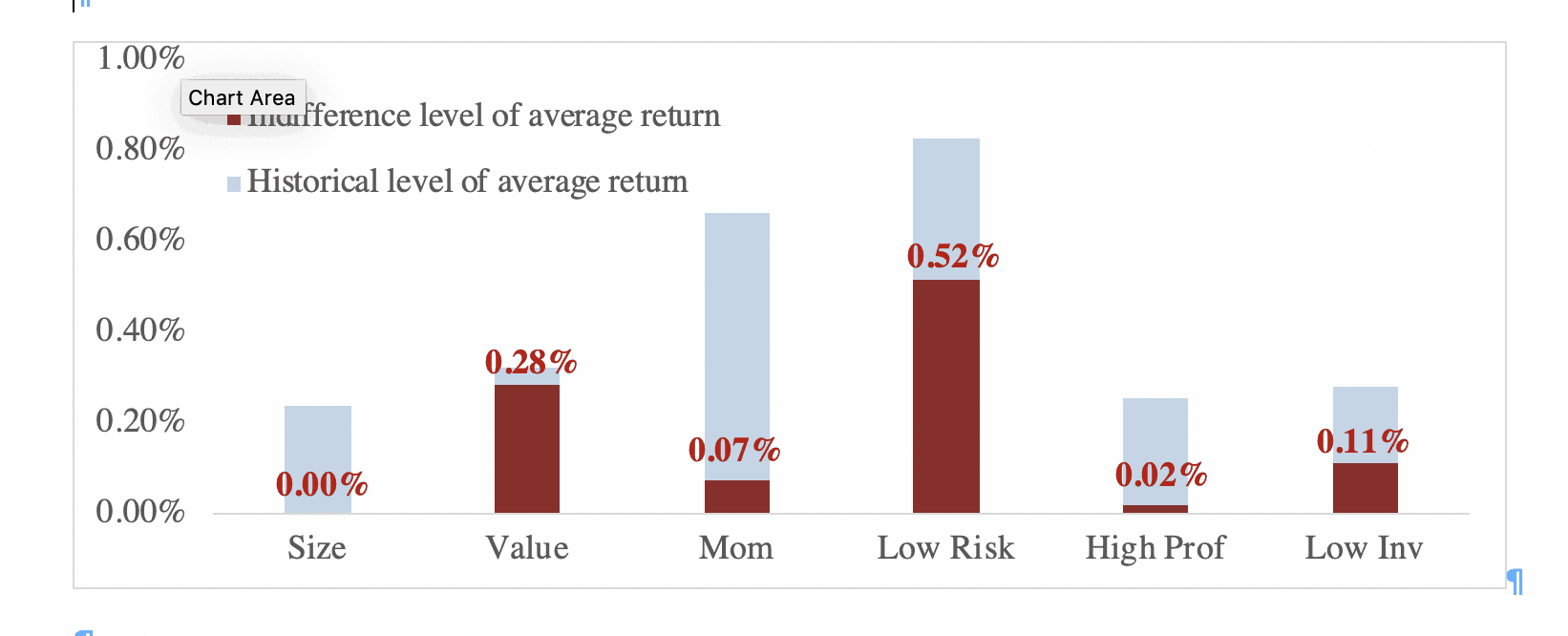
To assess the relevance of each factor for a diversified multi-factor portfolio, we can ask the following question: what is the hypothetical level of return at which the factor becomes unattractive to an investor? We can answer this question by gradually decreasing the return assumption for a given factor until the optimal portfolio assigns zero weight to it. If the premium of a factor were at this indifference level, investors would not get any benefits from including it in their portfolio.

Exhibit 2 shows the indifference level compared to historical average return. Even at a return of zero, the size factor deserves inclusion in a multi-factor portfolio. In contrast, the low risk factor would cease to add any value to a portfolio even with returns as high as 0.52 per cent per month. The value factor is no longer attractive if we reduce its expected return to 0.28 per cent per month, which is only four basis points below its historical average. Somewhat similar to the size factor, the momentum and high profitability factors would tolerate substantial reductions in premium before warranting exclusion.

Exhibit 2: Indifference level of return vs. historical level (monthly average)

Reported figures correspond to expected returns at which the weight for the given factor in the mean-variance efficient (MVE) portfolio becomes zero. Data for US Equities from July 1963 to December 2018.

Why do some factors remain attractive after a sizable reduction of their premium? This is because such factors provide diversification benefits in addition to contributing to returns. A factor that provides strong diversification benefits will receive a positive weight, even if we assume that its premium is low. A low indifference premium thus reflects strong diversification benefits.

Size is one of the factors with the most pronounced diversification benefits. Therefore, it would be included in the optimal portfolio, even if its average return were close to zero. The fact that value and low risk need to command a relatively high premium reflects that they have low diversification benefits relative to the other factors in the menu.

We find similar diversification benefits of the size factor when accounting for macroeconomic conditions. For example, size is less sensitive to interest rate shocks than other factors. Exposure to the size factor allows investors to counterbalance the high interest rate sensitivity of factors like value, low risk and low investment.

The size factor is alive and well

If your objective had been to pick the best performing factor, size would not have been a good choice historically. However, if you were looking to hold a diversified factor portfolio, size would have been a valuable addition. Due to its low correlation with other factors, size offers substantial diversification benefits. Investors need to look beyond stand-alone performance and consider such diversification benefits when selecting factors.


The Scientific Beta white paper from which this article was drawn can be accessed through the link below:

Does the Size Factor Still Have Its Place in Multi-Factor Portfolios? Scientific Beta White Paper, July 2019


Mikheil Esakia and Ben Luyten are quantitative research analysts and Marcel Sibbe is quantitative equity analyst at Scientific Beta. Felix Goltz is research director at Scientific Beta and head of applied research at the EDHEC-Risk Institute.


Last month at the Conexus Financial Fiduciary Investors Symposium, Amanda White, editor of Top1000Funds.com sat down for an hour-long fireside chat with David Veal, CIO of the $3 billion City of Austin Employees Retirement System. They discussed private equity, managing strategic relationships, internalisation and adopting Norwegian investment beliefs.

Amanda White: You moved to the City of Austin three years ago because you saw an opportunity to modernise the fund. What have you done since you’ve been there?

David Veal: We’ve moved from a consultant-driven model to a staff-driven model, we’ve dialled back active management from 86 per cent to 44 per cent and actually, generated more alpha. We focussed on where we can add value, where we think there’s actually value to be had in active management.

You have no private equity, isn’t it a little late in the game to get into that?

We looked at the strategic question of, okay, should we literally be the last fund in the room to buy private equity assets and decided the really smart money, the Oregons of the world that seeded private equity and gave KKR their first cheque, are dialling back their allocations. So, we won’t just stampede into this blindly. Anyway, the board, said no to the endowment model, it’s just not what we’re doing. We’re going to move more toward the Norway model. We’re going to focus on the asset allocation, focus on strategy, actually simplify the portfolio as opposed to ‘complexify’ it.

So, I think that’s something that makes us really different, a lot of my peers are moving towards more complex, more costly, and less liquid portfolios which I think may cause them challenges down the road. We’ve taken the different option; we’re actually moving to be more liquid, so that’s been a big trend for us.

The bad news is low growth, and a declining funding ratio. Are you taking more risk? And if it’s not in private equity, where is it?

Well, we’ve got two choices. We can take more risk and concentrate heavily in private equity, for example, which has been the traditional answer. Or, we lever up a more diversified portfolio, because you’re not sacrificing returns per unit of risk. One thing we’ve done is introduce the option of adding trust level leverage in the portfolio. It’ only about 10 per cent, so it’s not too exciting, but basically, the way we would use that leverage is to take those dollars and buy more of everything that we own. So, we would just take the same sharper issue and add a little bit of return to it, rather than just stuff it all into private equity with a 10, 12-year lock, and leverage what we can’t control. We think that’s a better way to do it.

Now we just need to get the mechanics and the governance in place for, okay, when do we put leverage on, when do we take it off, and how does that look? Again, we’re not market timing, but we’re asking, when is risk most likely to be rewarded?

Are you looking at tilts and tactical moves? Or, do you have more of a set and forget kind of style?

It’s an interesting discussion. I forget who it was that said ‘using indices as the basis for investing is absolute madness’, and I thought that was really well-said, and if we look at our passive portfolio, it’s all index based. I do think there’s a better way. I’ve got to figure out exactly what that way is, is that something quasi active, or is it country allocation. I do, want to take a step back and ask what’s the ROE on the S&P500? How does that stack up, and what are the drivers of that, and how does that compare to MSCI EM?

We’ve done some early work on this, and actually, the results are really compelling. We found out that MSCI EM actually has a pretty good ROE, but it’s being driven a lot by leverage, so that’s unsustainable. That’s important because the board doesn’t believe in market timing. So, how do you do a tactical asset allocation model in a world where the trustees don’t believe in market timing?

The way you square that circle is to say, look, we are fundamentally capital allocators, and so just blindly buying an index, that’s actually a decision. To not really know what are the ROE characteristics, what are the leverage characteristics, what are we actually buying in this basket of stocks, is at some level not consistent with our fiduciary duty. So, we’re going back to that and saying, what do we actually own, and can we improve upon it? Could you take EM and just exclude EM Latin America, and just have a better portfolio?

Let’s talk about Texas Teachers. You’ve previously worked there in a number of roles, but most recently managing the strategic relationships part of the portfolio. What’s your experience managing that that relationship?

The idea behind it is sound – taking a small portion of the portfolio and using it to inform what we do with the rest. This is what we call the tail that wags the dog. So, with Texas Teachers, it was 5 per cent of the fund, but it informed everything else that we did from manager research to best ideas forums so it really was sort of a forced multiplier for the rest of the trust.

That worked really, really well. The key question for me now is, does that idea scale down to a fund that’s an order of magnitude smaller than Texas Teachers? The answer is maybe, so far, in that we’ve struck a very similar relationship with Blackrock. We’ve given them a multi-asset mandate and we’ve said ‘your benchmark is our trust benchmark. So, you’re basically CIO for 5 per cent of the fund. We’ve given them a performance-based structure that has very low fees but significant upside if they do well. We’ve said we want to come to your conferences; we want to talk to Rick Rieder, we want to be in the bloodstream of Blackrock, and we want you to talk to our trustees once or twice a year.

We have not got the answer. Over the last year, the performance was basically flat. Still, we’re starting to integrate some of their macro signals into our asset allocation framework, and so I’m optimistic about where it’s going, but it’s a work in progress.

Lots of the larger funds in Australia are building internal teams. What’s your advice for them, having seen that in Texas?

We pay about $8 million a year in fees. I can hire a lot of staff for $8 million a year, especially in Austin, Texas. So, I can make a pretty easy case for that, but I’m also cognisant, having worked inside two pensions that ran internal investment management, that’s a big river to cross.

Once you cross that Rubicon, culturally it’s really hard to ever unscramble that egg, in the sense that once you start doing it, even if they start underperforming, you can’t … fire the whole department? Unlike a manager, where you can just say ‘well, hey, it’s not working out. It’s not you, it’s us’, and then move on.

So, I think that’s the big challenge that it becomes really, really sticky, and so I’m going to do a lot of things before I ever think about crossing that line, I think. Plus, for us as a small fund, how do you really do it well?

You mentioned that you want to be more like the Norwegian SWF. They have, as part of their investment beliefs, some thematics such as water and technology. How are you incorporating some of the big themes into your portfolio and the way you look at the world?

Well, I think it’s important to say we’re sort of disenchanted with traditional mean variance optimisation-oriented asset allocation. We’ve all seen it, here’s your expected returns, historical returns, covariance matrix, out pops your portfolio. I think that’s a little bit outdated, frankly.

So, part of that discussion is let’s think differently and break free of some of those traditional things, because really, when you think about the capital market assumption process, in a lot of cases, it’s only to feed that MVO, that’s the single point of failure for everything that we’re working on.

If we take a step and just ask, what do we own, what are the trends that are important? Is global trade headed into reverse? Is globalism … is liberalism in retreat? Is western civilisation in retreat? If so, what does that mean? Then the big challenge for all asset owners is they’ve got to have between 60 and 80 per cent in growth assets, so how do they reflect that?

One of the biggest things we’ve done is to take our fixed income portfolio and break it up into its component parts. We’ve broken a commingled fund up into three pieces, corporate bonds, treasuries and mortgages. We’ve shrunk the corporate bonds, because of the triple-B issue since it looks like equity risk.

The treasury piece is big, and it’s got long duration on it, and by the way, it’s held in a separate account so we have access to it in a crisis. I think that’d be one of my takeaways for folks in this room, is to think hard about how you hold things, because a commingled fund in the next crisis, there’s a risk, particularly with ETFs. Can you get to the underlying if you need it? Will you get liquidity? Because we know liquidity does tend to dry up.


A confluence of recent research and the evolution in perspective of the Delaware courts presents an opportunity for both companies and investors to systematically improve performance while reducing unwanted risk exposures.  However, investors must make the first move.

A growing body of research confirms that companies managed under a long-term strategic business plan substantially outperform their short-term peers over time.  In addition, the primary referees of corporate law in the United States, the Delaware judiciary, are signaling a readiness to confirm there is a fiduciary duty for corporate directors to consider strategic business planning focused on sustainable long-term success.[2]

Long-term investors are uniquely positioned to take advantage of these developments by bringing cases framed to give Delaware courts an opportunity to confirm what they have been hinting about in recent cases and commentary: that fiduciary duties of corporate directors (outside of sale of the company) run primarily to creation of sustainable value for the long-term providers of equity capital. Confirmation of this duty would incentivize corporate directors and their advisors to focus on long-term strategy, aligning them with the interests of investor beneficiaries as the ultimate holders of investment risk. It would also drive improved reporting to shareholders about strategic planning processes.

Investors could reap substantial rewards from imbedding a strategic planning fiduciary duty principle in corporate law, as it would force change across companies. The resulting enhanced risk management and company performance over time could easily generate more predictable additional investment returns than those associated with zero-sum trading strategies.

However, the Delaware courts can only address this strategic planning issue if investors bring carefully selected cases that frame the issue appropriately. Investors hold the key to fostering corporate behavior that boosts performance and lowers risk on a sustainable basis through robust adoption of long-term strategic planning practices.

Companies Managed for the Long Term Outperform

Research presented in the February 9, 2017 Harvard Business Review from the McKinsey Global Institute (“MGI”) and Focusing Capital for the Long Term (“FCLT”) found that companies managed with a long-term mindset consistently outperform their industry peers across almost every financial measure that matters. From 2001 to 2014, the average revenue and earnings growth of companies managed for the long term were respectively 47% and 36% higher than their peers. Average company economic profit was 81% higher and market capitalization increased during that time period by 58% on average over peers.

MGI further reported in the McKinsey Quarterly (April 2019) that revenue growth of long-term oriented companies is less volatile, with a standard deviation for growth of 5.6%, versus 7.6% for other companies. During the global financial crisis, long-term companies had smaller declines in revenue and earnings and continued to increase investments in research and development. From 2007 to 2014, research and development spending at those companies grew at an annualized rate of 8.5%, versus 3.7% for others.

Such results are no surprise, given that companies rarely engage in truly long-term strategic thinking.  A 2014 survey by McKinsey and the Canada Pension Plan Investment Board found that 85% of executive management teams primarily use a time horizon of four years or less in their strategic planning, shorter than a typical business cycle.  Furthermore, the potential advantages of long-term strategic planning are particularly relevant for companies in sectors like technology, media, software and pharmaceuticals, where (according to 2014 Organizational Capital Partners research published by the IRRC Institute) often half or more of current equity valuations are based on future value creation expectations.

Given this landscape, the expansion of corporate law obligations across companies through a long-term strategic planning fiduciary duty would “lift all boats” and substantially benefit long-term investors. It would also supplement current shareholder engagement initiatives aimed at promoting corporate governance improvements, which (in the aggregate) are less efficient and more costly drivers of systemic change than corporate law. For example, even a successful proxy contest that replaces board members cannot ensure adoption of internal company improvements in strategic planning processes as effectively as would a fiduciary duty under corporate law.

Delaware Courts Appear Primed to Address the Systemic Causes of Short-Termism

Investors have an unexpected and powerful ally for moving companies toward long-term management practices. The Delaware courts have shown increased willingness to confirm that director fiduciary duties include consideration of long-term risk assessment and strategic planning processes.

For instance, in a 2017 case, the Delaware Chancery Court stated, “the fiduciary relationship requires that the directors act prudently, loyally, and in good faith to maximize the value of the corporation over the long-term . . . . The fact that some holders of shares might be market participants who are eager to sell and would prefer a higher near-term market price likewise does not alter the presumptively long-term fiduciary focus.” [Frederick Hsu Living Tr. v. ODN Holding Corp., No. CV 12108-VCL, 2017 WL 1437308, at 18 (Del. Ch. Apr. 14, 2017), as corrected (Apr. 24, 2017).]

As early as 2005, now Chief Justice Strine of the Delaware Supreme Court, gave a speech to the European Policy Forum in which he said, “[M]ost of us think that the market’s fetishistic preoccupation with quarter-to-quarter profits is stupid. Anyone who is honest will admit that this obsessional behavior contributed to wrongdoing at corporations like Enron and Health South.”

More recently, writing in the 2016 Harvard Civil Rights & Civil Liberties Law Review, Chief Justice Strine chastised institutional investors for short-term actions that fail to promote corporate development of sustainable wealth.

“In sum, real investors want what we as a society want and we as end-user, individual investors, want, which is for corporations to create sustainable wealth. Until, however, the institutions who control and churn American stocks actually act and think like investors themselves, it is unrealistic to think that the corporations they influence will be well-positioned to advance that widely shared objective . . . [To] foster sustainable economic growth, stockholders must act like genuine investors, who are interested in the creation and preservation of long-term wealth, not short-term movements in stock price.”

These are just a few of the instances where the Delaware courts have stressed that Delaware corporate law already contemplates creation of value over the long term to benefit of the providers of equity capital.

Investor Action Would Bring Rewards

A roadmap for investors to focus corporate directors on the long term was laid out by Ken McNeil and Keith Johnson in The Elephant in the Room: Helping Delaware Courts Develop Law to End Systemic Short-Term Bias in Corporate Decision-Making, published in the Fall 2018 Michigan Business & Entrepreneurial Law Review. It presents investment research and outlines the legal foundation for selecting and framing cases that would provide an opportunity for Delaware courts to confirm that corporate directors have a fiduciary duty to consider strategic business planning.

The McNeil and Johnson article suggests engaging with underperforming companies that have a short-term corporate governance profile but a high future value expectation component of current stock price and no apparent or realistic strategic plan for delivery of sustainable long-term value. Indicators of this mismatch in governance and value drivers at those companies include things like executive incentive compensation that is primarily short-term; unaddressed industry risk exposures; limited expenditures on innovation or research and development; and persistent inability to generate return on invested capital that exceeds the company’s weighted average cost of capital.

Where shareholder engagement is unsuccessful in addressing these governance issues at Delaware companies, the roadmap for ensuing legal action to clarify corporate law obligations includes either prospective or retrospective litigation. The fiduciary duty questions could be framed appropriately through either: (a) a shareholder books and records inspection request and litigation focused on preventing future losses from the failure to consider a good faith strategic planning process or (b) where the board’s failure to strategically evaluate long-term risks and opportunities has resulted in shareholder losses, filing an action to recover those losses.

Mutually agreed settlements would create precedents to cite in future engagements at other companies, fostering systemic change over time.  Successful court outcomes would immediately refocus company directors and their advisors across all companies on implementation of long-term strategic planning fiduciary duties, steering companies toward improved risk management and long-term performance.

A Win-Win Opportunity for Both Investors and Companies

Given that the emphasis of this fiduciary duty would be on use of a good faith deliberative process rather than a specific result, corporate directors and their advisors should welcome the encouragement to focus on strategic planning.  Long-term investors would ultimately benefit from the improved company performance and risk management associated with long-term planning.

The first step is for investment and legal officers at institutional investors to talk. Integration of legal and investment perspectives into a well-planned strategy for better alignment of corporate law with the interests of long-term investors and their beneficiaries would help both companies and investors. The stars are aligned for success – but investor action is required.

[1] Keith Ambachtsheer is Director Emeritus of the International Centre for Pension Management affiliated with the Rotman School of Management at the University of Toronto. He is the author of four books on pension management, most recently The Future of Pension Management (Wiley, 2016).  Keith L. Johnson heads the Institutional Investor Services Group at Reinhart Boerner Van Deuren s.c. He previously served as Chief Legal Officer for the State of Wisconsin Investment Board, one of the top 10 public pension funds in the USA.  He is also co-editor of the Cambridge Handbook on Institutional Investment and Fiduciary Duty.

[2] A more detailed analysis of the research and legal principles highlighted in this article is available in McNeil & Johnson, The Elephant in the Room: Helping Delaware Courts Develop Law to End Systemic Short-Term Bias in Corporate Decision Making, Michigan Business & Entrepreneurial Law Review, Volume 8 (2018), at https://repository.law.umich.edu/mbelr/vol8/iss1/2/.