Life-cycle funds – also known as target date funds – de-risk the investor’s pension savings account as they progress toward retirement. Underlying this de-risking is the assumption of wage income that plays the role of a low-risk asset. This allows more risk to be taken in the pension account when this asset is of greater value early in the life-cycle. As the investor progresses through their working years, the value of the wage-related asset declines while the value of the pension account grows. Growth asset exposure in the pension account thus needs to be wound back to keep risk and return in balance.

A key issue in life-cycle fund design is how to set the ‘glide path’ for switching from growth to defensive assets over time. Recently, me and my colleagues considered the potential role for pension fund balance and investor risk aversion in determining the optimal glide path (How sub-optimal are age-based life-cycle investment products?). We found that accounting for both aspects can improve life-cycle fund design, but that risk aversion is the far more important of the two.

The set-up was basic, but sufficient to draw out the key concepts. We modelled an investor with known wage income of which a fixed percentage is contributed to their pension account over 40-years until retirement. The pension account could be invested in a risk-free asset or equities, with the latter generating a higher but random return. The distribution of balance at retirement was evaluated using a power utility function, which considers outcomes directly without assuming any particular target.

We analysed 13 investment strategies. The benchmark strategy was optimal under the set-up, and dynamically altered the asset mix in response to fluctuations in balance. Four strategies were proposed that pre-set the glide path with reference to projected balance levels. Five life-cycle strategies were selected to represent those seen in the market, including some actual funds from four countries. Three constant weight strategies were also examined.

With regard to balance, our main interest was investigating the importance of dynamically adjusting the asset mix in response to fluctuations in balance. We found that these dynamic adjustments did indeed add value, but the gains were relatively modest. Further, these gains could be mostly captured through any one of our proposed strategies. The results suggest that considering balance may be only of modest relevance for life-cycle fund design, but with a caveat.

Of far more importance was whether the risk aversion assumption on which the strategy is based happens to align with the risk aversion of the investor. If (say) a strategy designed for low risk aversion was taken up by an investor with high risk aversion, the utility loss could be similar to forfeiting one to two years of wage income. It turns out that the general level of exposure to equities over the accumulation phase is more important than the shape of the glide path. That is, an investor with high risk aversion will prefer to hold less equity exposure overall. A glide path designed around low risk aversion would be too elevated for such an investor, even if the broad trajectory was about right.

Our research raises a note of caution over offering a single, one-size-fits-all life-cycle fund. Such a fund may be suitable for some investors but not others, depending on whether their willingness to take on risk happens to match the strategy design. Nevertheless, a single life-cycle product is offered by most fund providers in three of the four countries from which we drew the representative life-cycle funds: US, UK and Australia. The exception was Denmark, where it is more typical to offer a range of life-cycle funds.

Providers have embraced the need to cater for differences in risk aversion for constant weight strategies under banners like conservative/balanced/growth/high growth. Doing the same for life-cycle funds is rarer. It is almost as if there is a presumption that glide path de-risking suffices to address risk. Our research questions any such presumption.

One caveat is in order. While our finding that risk aversion matters should be robust to changes in the set-up, the same need not be true for the findings regarding balance. Here our results will be driven in part by the use of power utility. If the investor had a target in mind – such as requiring a certain balance to support a desired level of retirement income – we suspect that dynamically responding to changes in balance may make a greater difference.

The research, which was written by Geoff Warren and Gaurav Khemka from ANU together with Mogens Steffensen of the University of Copenhagen.


The $700 billion Abu Dhabi Investment Authority, ADIA, is boosting its internal fixed income capabilities and scaling up capacity to run active strategies in-house, aiming to increase active management in the fixed income and treasury allocation from 40 per cent to all the portfolio actively managed in the coming years.

Active management in fixed income, where the long-term strategic allocation fluctuates out to 20 per cent in government bonds and 10 per cent in credit, is in line with growing active investment across the portfolio which stood at 55 per cent in 2018 compared with 50 per cent in 2017.

The decision to build out the strategy has been aided and abetted by portfolio simplification. Over the last year separate investment pools have been merged into one single fixed income pool allowing a more flexible allocation that reduces complexity without compromising strategic asset allocation or liquidity provisions, according to the giant fund’s recently published 2018 Review. The fund reported a lower 20-year annualised rate of return for the fund of 5.4 per cent in 2018 compared to 6.5 per cent the previous year.

The decline in rolling average returns, including the 30-year annualised rate of return dropping to 6.5 per cent in 2018 from 7 per cent in 2017, was the result of the exclusion of “strong gains in the mid-to-late 1980s and 1990s” says Sheikh Hamed bin Zayed Al Nahyan, managing director, in a letter attached to the Review. “ADIA’s real returns remained largely consistent with previous years and historical levels,” he says.

Portfolio simplification in fixed income follows on from strategy in the fund’s illiquid asset classes which already operate as single pools – as do outsourced equities.

It means that fixed income will be allocated money to invest as a whole, giving the team much greater discretion to invest across regions and strategies in contrast to the past when funds were allocated to specific mandates within the asset class determined on a top-down basis. The single pool increases the department’s flexibility to capture short and medium-term opportunities without having to request changes to their mandates in a new approach that works best with active management.

The transition to more active management in fixed income will see new hires within investment and research particularly, where the fund says its focus is on building technological and data gathering expertise.

ADIA, which manages 45 per cent of its assets internally, is also focused on filling internal positions with UAE nationals in line with its efforts to build home-grown talent, this is challenging given the size of the Gulf state’s local population.

In 2018, ADIA launched a “fundamentals” program for UAE nationals as part of an new early career development framework; of its 1700 employees most (29 per cent) are European, UAE nationals (28 per cent) or from Asia Pacific (21 per cent).

Equities

ADIA is also introducing changes in its equity allocation, considering complementing its current pool of external managers with new strategies that target “modestly” lower risk and lower returns over time.

The portfolio is split between developed and emerging markets where the strategic allocation fluctuates between 32 per cent and 42 per cent, and 10 per cent and 20 per cent respectively.

Other mooted changes include adding more single country portfolios like its Canada-focused allocation, launched last year. The idea is that this new, granular approach increases flexibility and the fund’s ability to capitalise on fleeting opportunities in a low-return environment.

It also reflects a central ambition, outlined in the Review, to enhance organisational agility so that the giant fund can respond quickly and purposefully when opportunities emerge, and which is also focused on “breaking down the barriers between asset classes” in the hunt for opportunities. In another example of this approach in action, the internal equities team is exploring creating sub mandates within some regional and country portfolios to capture specific opportunities.

Elsewhere, following a tough year for active equity management, the fund forecasts a return of a better stock-picking environment.

Hedge funds

In hedge funds (part of the fund’s 5-10 per cent allocation to alternatives comprising just hedge funds and managed futures) ADIA aims to tap industry-wide themes like the blurred boundaries between different hedge fund strategies which has seen successful single-strategy managers develop their offerings and business models across credit default swaps, interest rate swaps, and cash equities.

“This trend is being driven in part by an increased migration of investor capital toward established and well-regarded managers, which may also look to inhabit areas that were once the sole responsibility of banks, such as providing liquidity,” states the Review.

It predicts that as more money coalesces under fewer large funds, new funds will emerge with alternative offerings. Reflecting on last year, it noted that relative value was the “most consistently successful strategy” and equity-related strategies including equity hedge and event driven ended the year “slightly down”.

The fund plays down the impact of China’s slowdown on the portfolio, expecting most growth in coming years from emerging markets.

“Demographic trends continue to favour emerging over developed economies, with India and China in particular expected to remain important engines of growth. A slowdown in China received much attention, but to date the reality does not appear to have matched the degree of concern,” it says.

And rather than focus on the “late-cycle” where Sheikh Hamed notes the financial system is “more robust than it was 10 years ago” and “that the diversity and adaptability of the global economy means that the current cycle may well surprise with its resilience,” ADIA’s eye is on navigating, and uncovering, secular themes.

None more so than the retrenchment of globalisation and deteriorating trade relations that has led to tariff increases and greater resistance to cross border flows of both capital and labour.

“The myriad potential outcomes of a less hospitable international economic system will result in new challenges – but also ample opportunities – for global long-term investors,” says Sheikh Hamed.

Arguing that it “is clear that the gains from trade have not always been shared equally within and across countries, and that forces of nationalism have gained traction at the expense of economic liberalism,” he concludes that it is imperative capital market participants, who see the benefits of globalisation first-hand, communicate its benefits.

A recently released CFA Institute report entitled the Investment Professional of the Future provides answers to how investment professionals can stay relevant in the face of imminent changes to professional roles and the commensurate skills required. The first article in the series highlights those changes, while this article outlines a roadmap on how investment professionals can navigate the accelerating change and disruption affecting the investment industry.

The career flywheel

Although personal character and resilience have always been critical to advancing one’s career, 89 per cent of industry leaders surveyed as part of our research agreed that individuals’ roles will be transformed multiple times during their careers. This continual evolution of responsibilities will force investment professionals to be highly adaptable and to continually develop new skills over time. The first step in the roadmap is to keep learning and adapting and to embrace active career management by using the career flywheel.

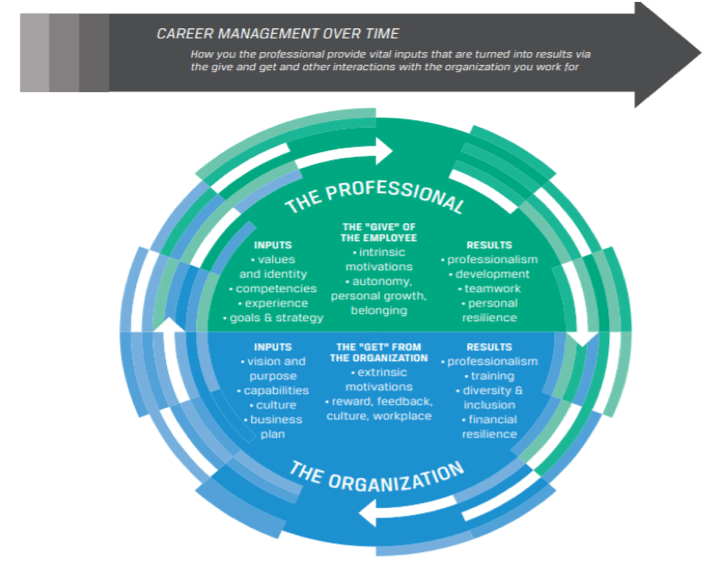
Just like the mechanical flywheel that provides continuous energy when the energy source is intermittent, an effective career flywheel sustains its momentum through a series of intentional and appropriately scheduled intercessions and adaptations during a professional’s career journey.


THE CAREER FLYWHEEL


There are various factors that keep the flywheel turning, which are dependent on the interactions and alliances built between motivated professionals and empowering employers. Employees need to provide a combination of solid work experience, competencies, knowledge, and the appropriate skills and motivations, as well as the desire to keep learning and developing. Critical success factors include a desire to keep learning and having a growth mindset. They also require building a “give and get” alliance with each employer, giving value to the employer, and getting explicit and indirect rewards such as personal empowerment, development opportunities, and feedback for further development.

This is all done while maintaining healthy work-life integration that will help support career resilience and new development opportunities. Our report’s interactive website provides users with a 15 question self-assessment to see how their past experiences and future ambitions compare with those of more than 3,800 investment professionals globally to help them determine how they can increase their career adaptability.

Adapting to changes in professional roles also means being open to the impending role changes. This necessitates being proactive by developing a career management framework that includes the career flywheel principles and by investing time into career management and the actions necessary to maintain career resilience and mobility.

The skills pathway

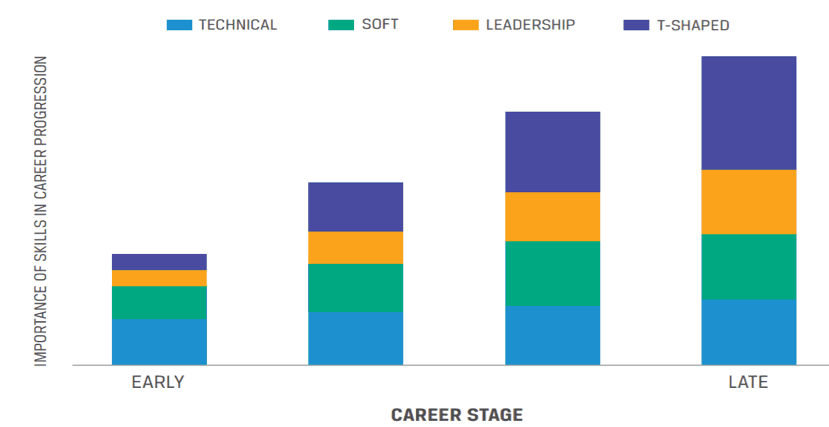
Another step recommended by our roadmap is applying the skills pathway. The pathway relates to progressively building four core skills – technical, sort, leadership, T-shaped — over time as one’s career advances. These particular skills are ones that are becoming more highly valued over time and are essential for investment professionals to take on greater responsibility and leadership positions. Another reality facing investment professionals is that escalating industry change is not just altering the importance of specific skills but also requiring professionals to build a portfolio of diverse skills and abilities.

At the start of a career, professionals should build an appropriate foundation by building a technical edge and then add increased soft skills aptitude for mid-career effectiveness. Greater upward career mobility requires improving leadership capabilities that produce value from managing and influencing others.

Over time, individuals also build T-shaped skills, meaning combining domain-specific specialist knowledge and wider professional connections, understanding, and perspective. Indeed, it is difficult to see how many senior roles in investing could exclude T-shaped skills.


SUGGESTED SKILLS PATHWAY


Although all four skills are highly valued, the investment industry leaders surveyed rank T-shaped skills as the most important future skill category (49 per cent rank these first), followed by leadership skills (21 per cent), soft skills (16 per cent), and then technical skills (14 per cent). Obtaining these skills along a career journey allows investment professionals to create a diverse skills portfolio and forward-thinking career plan.

Be tech savvy

The last step of our roadmap advocates that investment professionals become tech savvy and that they navigate and harness technology. Being tech savvy doesn’t mean simply having a facility for technology or being able to explain its use, but it is about being able to leverage technology to improve client outcomes and employer performance.

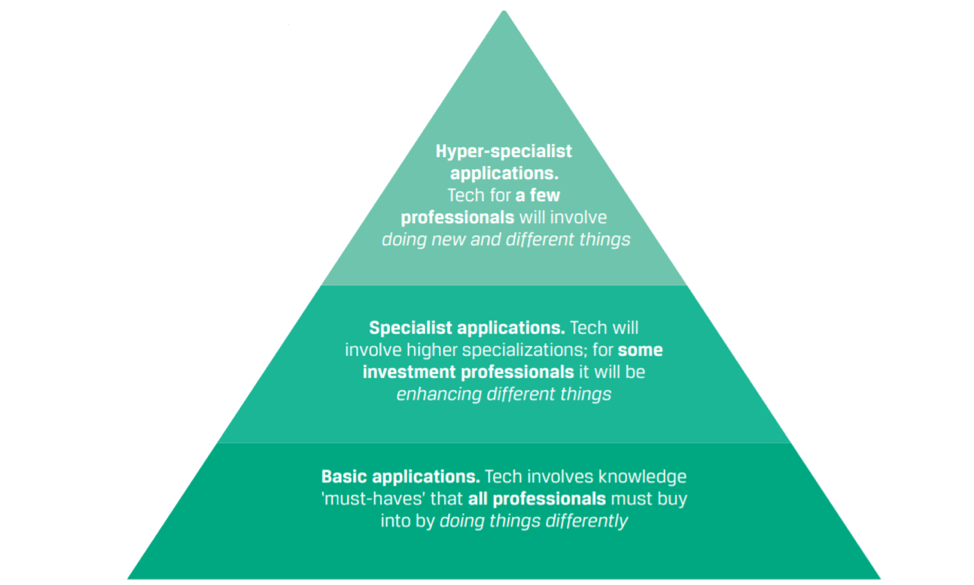
A large degree of the industry change and disruption expected in the next 5-10 years will be due to accelerating technological innovation, and the ability to work with technology is a clear necessity for all professionals. This dictates that investment professionals understand and embrace the three major effects of technology—basic, specialist, and hyper-specialist applications.


TECHNOLOGY HIERARCHY OF IMPACTS

At the bottom, the basic applications suggest that all investment professionals will have to do things differently, and they must be more comfortable using and understanding technology.

  • In the middle tier, specialist applications are where investment management and technology teams work together, and T-shaped skills are more important. Here, AI can deal more and more with unstructured data and is better at identifying patterns in information, but it’s dependent on the quality and quantity of information available and humans to determine the signal from the noise.
  • At the top, hyper-specialist roles will be less common but very valuable. This includes roles for data scientists, those at quant firms and AI labs.

The key point in being tech savvy is that professionals understand and use technology effectively and ensure that it serves them and their clients — and not the other way around.

Moving Forward

The investment professional of the future will need to take a more active and hands-on approach to their career management as the pace of change continues to accelerate. Professionals will need to pay attention to the changing value of skills and tech innovation to structure a development path that can fulfill the changing needs of employers and clients.


Bob Stammers, CFA, is the director of investor engagement at the CFA Institute and a member of the Future of Finance team at CFA Institute.

A decade of ultra-low rates and mediocre growth does not mean that every year will yield low returns for investors, according to Damian Graham, the CIO of First State Super one of Australia’s largest institutional investors.

Graham expects to achieve a mix of annual returns ranging from strongly positive to negative over the years ahead. Put simply, he is convinced there will be a cycle of returns through a much more muted economic cycle.

“That’s where I probably differ a bit from the consensus view since I don’t buy the idea that just because you have decade of more subdued growth, you will have no returns or that there won’t be times when returns are strong,” he argues.

Neither has Graham moved to minimise portfolio risk by adopting a more conservative asset allocation strategy, despite being stuck in a tough part of the cycle. Quite the opposite is true. The CIO of the A$98 billion Australian superannuation fund is intent on getting enough risk in the fund’s portfolios for the next 10, 20 to 30 years.

“Our members need to grow their portfolios in real terms and typically have time to recover from short-term volatility. So, we haven’t adjusted portfolios too much,” he adds.

“In fact, we are making sure we are holding enough risk even though equities are not attractively priced on a near-term view.”

Over the last few years, the super fund has modestly increased illiquid asset exposures and been reducing  equities and liquid alts to do so. It has also been curbing Australian equities in favour of global equities.

Like everyone else, Graham is on the hunt for more private market assets. But he says the search is more “at the margin” since, from where he sits, there aren’t any bargains.

With bond yields being so low, some of his peers claim shares, property and infrastructure prices will inflate further as central banks around the world continue their easing programs. They are suggesting high price-earnings multiples won’t look too bad in a zero-inflation environment.

Developing for value

Graham agrees that valuations will initially benefit but he rejects any idea that business fundamentals look better just because bond yields are at rock bottom.

“I’d suggest that people should be careful when aggressively adding into infrastructure assets, since the price paid is always an important ingredient to the long-term return,” he warns.

Given the high prices for completed projects, whether listed or unlisted, First State Super is convinced having an exposure to developing assets is the way to go. “Can you take on some risk, develop an asset and get some value for it? That’s a theme that we continue to see as an opportunity for the portfolio,” he continues.

“We have looked to create platform style investments over recent years and we see it as a continued opportunity, although admittedly, it is definitely easier in some areas than others.”

A great example of this is the super fund’s investment in Bankstown Airport, purchased a few years ago. It is a unique land holding close the middle of Sydney and Graham reckons it should offer development opportunities for years to come.

Last year, the superannuation fund teamed up with Lendlease to develop and hold multifamily (residential for rent) assets in major US cities. The sector is valued at more than US$3 trillion and has delivered positive outcomes so far, according to the CIO.

The fund has also been considering ways to extend its investments into emerging markets and has established some unlisted exposures in Brazil and some investments in China.

Despite the potential upside, Graham goes on to say, some sectors such as Chinese infrastructure projects are currently less efficient than in the developed world. For example, he suggests that some state-owned enterprises do not have the same profit motive that most global investors do.

Despite the trade wars, Graham is still broadly supportive of China for its above average longer-term growth prospects. Anyway, the resumption of talks between President Donald Trump and President Xi Jinping, potentially granting the world economy a stay, tells Graham that the parties want to deal.

“They both want positive outcomes and for this to be settled so we think that’s where its headed, but it may take more time than we would prefer,” he said.

“China is an important market for the US, so I think the trade tensions will settle eventually although the next twelve months could be very volatile.”

Buying disruption

Generally speaking, he sees interesting opportunities as new and disruptive Chinese companies emerge.

The CIO calls his exposure to China “modest in the scheme of things”, although “a sizeable dollar amount.” First State Super has more than $1 billion committed across A shares and private equity.

The super fund’s exposure to the private equity sector includes both fund investments but also a number of co-investments. First State Super has stakes in disruptive companies like eShang, a property and funds management business, and Jumao, a medical device manufacturer. Recently, the fund also established a venture capital investment  targeting South East Asia.

Disruption remains a key theme. Right now, Graham is also looking to leverage the disruption of the local banking sector.

Given the higher capital adequacy and liquidity requirements for Aussie banks, Graham is taking advantage of direct lending opportunities that arise as the banks are continually forced to adjust their business model.

“The interaction with banks has traditionally focused on providing capital and liquidity. This has now expanded to include providing credit alongside the banks. That’s something we have been doing the last year or so with most of the opportunities in the mid-market on a secured basis,” he says.

“We’ve had a really positive response from the country’s top lenders, local banks and the broader market and this is resulting in some really interesting opportunities for our portfolio and our members.”

Over the 12 months, First State Super has initiated a direct lending strategy and lent  about $700 million across 9-10 loans.

This week the fund signed a heads of agreement with another Australian super fund, VicSuper to merge. The new entity will manage A$120 billion and be Australia’s second largest superannuation fund after AustralianSuper.

To thrive in the future, the investment industry needs to overcome its fear of ‘making the world a better place’.  It needs to demonstrate – to its clients, its employees and the society around it – that it is an industry that cares. It needs to put morals and values at the heart of what it does. To do this, it needs leaders with authenticity. And to develop and support these leaders it needs to cultivate more opportunities for people to step back, look inside themselves and find the inspiration to do what they know is right. 


In its 2017 report on The Future State of the Investment Profession, the CFA Institute highlighted the importance of values in investment organisations if the industry is to regain the trust of society. Citing its own research showing that at that time only 11 per cent of investment leaders described the impact of the investment industry as very positive for society, it argued that ‘making a consistent … contribution to societal wealth and well-being is not just a nice goal for the investment management profession – it is quite possibly a matter of existential importance’.

So how far have we come since then?

A survey conducted for the CFA Institute’s recently published paper on The Investment Professional of the Future found that of seven job factors studied, ‘ability to help clients’ and ‘alignment to your organisation’s vision and values’ provide among the lowest levels of motivation for investment professionals.

It looks as though the industry still has a steep cultural slope to climb.  Even some of the institutions that have done the most to embrace the sustainability agenda can have blind spots. A millennial friend at an asset owner with a strong sustainability reputation told me recently that she was told very firmly by her new manager that she should not talk about ‘making the world a better place’ during working hours. That was something strictly personal that should not be brought into the office.

These challenges may be particularly deep-seated because they are strongly linked to values and ethics – the climate emergency, diversity and inclusion, fairness, and more. Addressing them is only partly about technical solutions – investment strategies, business models or product offerings. These ‘conventional’ issues may certainly sometimes be difficult. But they are well within the comfort zone bounded by the primarily financial training and skills that have enabled investment industry leaders to rise to the top.

The new agenda requires a new kind of leadership – a form of leadership that is intensely human. Authentic leadership that inspires trust from within and outside an organisation springs from the inner qualities and values of those in leadership roles. It flows not just from the head but from the heart; not just from spreadsheets and financial models but from personal values and emotions; and from a highly developed self-awareness and sensitivity to others.

Yet for the investment industry, the inner world of these values and emotions is all too often taboo; it is seen as unprofessional to think or talk explicitly about our personal values while we are at work. That’s not what my training says I should do. If I think and talk like that, my colleagues will think I’ve gone crazy. In fact, I know I’m a proper investor and I belong in this organisation precisely because I don’t think and talk like that.

But more is possible than we believe is allowed – or than we allow ourselves to believe.

What does the deepest part of us know is right and important? The part that looks into the eyes of a loved one and feels care, connection and compassion.  The part that delights when the seeds we have planted germinate and the first leaves appear through the earth. The part that just says ‘wow’ when we are hit by the beauty of a landscape, a flower or a work of art.

Who is in fact preventing us from acknowledging that part of ourselves and allowing it to stimulate more innovation and creativity in our work? We are.

So how can we allow ourselves to think and act differently? Here are some questions we can ask:

  • Who are the real people whose money I am managing – the end beneficiaries? Can I imagine them looking out at me from my Bloomberg screen? What are they thinking? Is there more I can do to serve their interests? Deep down, what shared interests do we have as human beings? What kind of world do they want to live in, now and in the future? What happens if I see the investment chain as a human chain of interconnected and interdependent people, not just as a chain of transactions and contracts?
  • Am I bringing the whole of myself into the picture – including all the things I care most deeply about when I’m not in the office? What can I contribute? How can I best use all the talents I have?
  • Who might be negatively affected by my decisions? Whose interests will be harmed? What can I do to counter that?
  • Have I listened enough – to people who can help me answer these questions; and to the part of myself that knows what is really right? What is that niggling voice at the edge of my awareness saying is the right thing to do? What is the cost of ignoring it – to myself and others?

Investment professionals are highly educated, talented, innovative and creative. These questions can help to harness their talents and abilities in new ways. Organisations can encourage and support people to ask such questions – in fact creating a culture that does this is not a bad definition of leadership.

This is the territory that was explored recently at the Authentic Leader retreat, organised by the Authentic Investor initiative. Thirteen CEOs, CIOs and board members from pension funds and asset managers in Canada, Denmark, the Netherlands, Sweden, the UK and the US gathered at Jesus College, Cambridge, UK, to reflect on the relationship between their personal values and their working lives; to share experience on the challenges of senior leadership; and to explore their personal and professional responses to sustainability issues, most notably the climate emergency.

A theme running through the whole retreat was the reality and importance of our ‘inner knowing’: our deep sense of what is right – for ourselves, for those around us, and for the world. Working life – indeed life in general – can cause us to forget or neglect this knowledge; we do not realise that we have forgotten, and are unaware of the implications of our forgetfulness. Taking a few days out, slowing down, and getting into a more reflective frame of mind is a way to tune back in to what we already know but have buried.

It’s a cliché – but life as a leader can be lonely. It can be difficult to find someone to talk to about challenges that engage the parts of us that cannot be expressed in numbers, or which are difficult to contain within the ‘rational’ frameworks of conventional investment thinking. Many of the retreat participants commented on the value of having an opportunity to share these dilemmas openly with peers experiencing similar situations; an opportunity to take off their corporate mask and reveal who they really were.

To thrive in the future, the investment industry needs to overcome its fear of ‘making the world a better place’.  It needs to demonstrate – to its clients, its employees and the society around it – that it is an industry that cares. It needs to put morals and values at the heart of what it does. To do this, it needs leaders with authenticity. And to develop and support these leaders it needs to cultivate more opportunities for people to step back, look inside themselves and find the inspiration to do what they know is right.

Rob Lake is founder of the  Authentic Investor and runs the Authentic Leader retreat.

The Caisse de prévoyance de l’Etat de Genève (CPEG), the CHF12.6 billion ($12.7 billion) pension fund for the Swiss Canton of Geneva runs a fundamental investment strategy shaped around harvesting the premia from its equally split allocations to bonds, equities and real estate, explains CPEG’s CIO Grégoire Haenni. Strategy eschews any tactical deviations, ‘riding out’ the market rather than trying to capture or call it, although Haenni has a keen eye on risk.

Recently this resulted in pro-active anticipation of the Brexit fallout, reducing the UK equity allocation ahead of the UK referendum on EU membership in 2016.

“The UK’s vote to leave the EU could have led to an implosion of the Eurozone and we sold part of our UK equities ahead of the vote to protect the portfolio. We bought them back after the market correction,” he says.

The UK’s Brexit saga is still playing out, but he believes the tremendous challenge the country has faced trying to leave the EU, has put other European countries off.

“We still think it’s a risk, but it’s just limited to the UK. Italy has stopped mentioning it. Other countries are less willing to leave the EU now.”

Now he is mindful of heightened risk in the equity allocation because of the late cycle.

“In equity we have to make sure we don’t alter the risk profile of the portfolio by overweighting the asset class,” he flags. “We are doing macro analysis to identify the potential risks that could derail the overall performance.” The portfolio is a mix of passive and active strategies and doesn’t include any thematic investment. “If there are sector rotations it could impacted thematic investment,” he says.

Haenni and his 12-people investment team is also navigating another enduringly challenging European issue: rock-bottom European bond yields. He believes that European bonds still play an important role in the portfolio for their protection against deflation.

“We could have an inflationary spike, but it would be short lived. We believe the deflationary cycle is here to stay and this is a good reason to keep the fixed income allocation in place,” he says. However, CPEG has started to look elsewhere for fixed income returns and is developing a high conviction strategy that focuses on capturing returns via increased risk focused on different bond maturities and qualities in investment grade Asian sovereigns and corporate bonds.

“We think Asia is the future; somewhere it’s still possible to find quality and where investors are rewarded for risk.  We have built a case for our investment committee.”

CPEG’s funded status has also just improved on the back of additional government funding, currently above 60 per cent. The government plans to inject between $4-5 billion into the fund that will bring the whole portfolio to around $17-18 billion, raising the funded ratio to 75 per cent in line with the average among other Swiss funds.

“It’s great news; we don’t believe our asset allocation will change because the bulk of the additional money is composed of a loan from government. Our one third, one third, one third structure won’t change dramatically.”

The fund targets a “predictable and stable” 2.8 per cent annual return reduced at the end of 2016 from 3 per cent. Around 30 per cent of CPEG’s assets are managed passively vs 70 per cent active. Around 50 per cent of assets are managed internally, including the fund’s active real estate allocation comprising mostly direct residential investments in Geneva, making CPEG the biggest investor in Geneva property.

“Residential is a good hedge against the economy and financial markets,” he says.

Haenni works with 34 external managers in relationships characterised by a very low turnover.

“We are more patient with active strategies and less patient with passive strategies. In the active allocations we’ll wait and monitor allocations during market cycles and make decisions after 3-4 years. Passive is just replication and we are much more rapid in our decision making here.” He works hard to ensure CPEG’s costlier active strategies, exacerbated by low yields, do add value and that higher fees are covered by outperformance.

“There is a big pressure to reduce costs going forward,” he says.

CEPG also asks its managers to integrate its ESG strategies as the fund pursues a bold ambition to lead ESG investment amongst Swiss peers.

“We want to be a pioneer in Switzerland,” he says.

He fund recently carried out a carbon footprint of its listed securities, analysing 7000 companies covering 95 per cent of its equity book and 85 per cent of its bond portfolio. It has now followed up that footprinting with “direct action” to reduce its carbon footprint, says Haenni.

It will exclude coal producers from its investment universe and is exploring a dedicated green bond strategy given their increasingly attractive yields and diversification benefits.

“The green bond market has evolved since its launch in 2007 and we think the market is deep enough; it is also easier now to check projects are properly green.”

He is finalizing analysis on any future portfolios size and says that once it is approved and signed off, CPEG will start a beauty contest, either investing in a fund or specific strategy. Elsewhere a new ALM study will also measure the carbon footprints of the different asset allocations.

“We are the first pension fund to perform a top down carbon footprint of our asset allocations” he enthuses.

The pension fund is also integrating ESG in the real estate allocation by improving energy efficiency in its properties and educating tenants on water and electricity usage. It is giving the portfolio an edge in an increasingly competitive market, particularly from insurance companies that have lower long-term returns, he says.

“It is becoming harder and harder to identify real estate projects that make sense in terms of expected return. Prices have gone up, the trend is going to continue and it has constrained our ability to build out this allocation. ESG integration is a way of putting effort into finding solutions in an asset that is richly priced across the board.”