Last month, the book Achieving Investment Excellence , authored by Kees Koedijk, Alfred Slager and Jaap van Dam was launched in the auditorium of Dutch pension investor APG. The book is a guide to empowering pension fund trustees to get a good grip on the difficulty of successful long-term investing for pension funds. Top1000funds.com spoke to one of the authors, principal director investment strategy of PGGM, Jaap van Dam.

Q: Congratulations on the launch Jaap, can you tell us why you set out to write this book?

A: We strongly believe that pension funds as institutional investors have a strong added value for participants. Whichever way you look at it, this means that there is a crucial role for boards and trustees: they set the policy, are in charge of designing and overseeing the investment organization. We set out to help and empower the board members. Almost all journals and books on investing are dedicated to technical stuff about portfolio management, alpha, factor investing, but to our surprise only a handful publications focus on the board member. We set out to “right this wrong”.

Q: Why is long-term investing important?

A: Many key assumptions in investing hinge on an important assumption: that you have the horizon and patience to sit through. Equity risk premiums and liquidity risk premiums are earned in the long term, furthermore the long term expands the investment opportunity set: new assets can be added. On the other side, often being impatient and acting on the short term will come at significant cost. The fruits come at a price: a board needs to understand where and how acting on the short term can and will come at a cost and has to act upon this knowledge. This is psychologically extremely difficult. The combination of having the relevant knowledge and the relevant behavior is crucial. Having the right horizon, focussing more on the forest and less on the individual trees are key for well functioning boards. We call this the right horizon, the right distance, the right altitude.

Q: Do you think there is a knowledge gap around the boards of asset owners when it comes to long-term investing?

A: Absolutely. And this is in a certain sense logical. All the time new board members will come in, and often they do not have a background in investment management. Yet they are expected to hit the ground running without a lot of formal training in this specialized field. Another thing is that the collective wisdom of a board is often lost when boards change. This is why we plead for learning boards, that pay a lot of attention to learn from their history. We ended up spending a good part of the book due to discussions with board members on how to avoid this dilemma and improve long term results.

Q: What do you see as the most difficult aspect of long-term investing, and how does the book help guide trustees in that endeavor?

A: Taking an integral approach, being detracted by short term developments, or even worse, not being prepared for short term fluctuations. Based on our discussions and case studies, the paradox is that, in order to be successful in the long term, you have to prepare for the short term, acknowledging all the short term pressures, biases and counter them or integrate them within your strategic policy to remain on course. With that in mind, onboarding new trustees is crucial, and if not done properly, it become a challenge for the board to remain long term focused.

Q: What are some of the practical insights that the book gives trustees?

A: The great thing of this book is that it is peppered with practical insights. We chose to collect as many as practical experiences as possible, and – true to our standing – filtered them through an evidence based lens – to derive at a set of self reflection questions for boards. So far we received great feedback on that, and that was our ultimate purpose – helping boards. At the launch, the first copies of the book were handed over to Geraldine Leegwater and Florent Vlak, chairs of the investment committees of ABP and PFZW respectively. In his comments, Vlak emphasized the relevance of the book for the boards of trustees of pension funds: “Because of the way this book is written, it is extremely accessible. And the self-reflection questions will help boards to discuss the tough questions that really matter. I wish I had this book when I became a member of the PFZW Investment Committee”. And Leegwater emphasized the strength of packaging academic insights into a practical handbook. Both stated that this is a much needed book for trustees, filling a gap between the high level oversight knowledge a board needs and the often extremely technical nature of the books which are available on the many specialized fields within the investment realm.

For further information on the book click here Achieving Investment Excellence
 

There is a prevailing view among LPs that once a PE firm has an underperforming fund, the best way forward is to stop committing to future funds. Even if that firm had multiple, top quartile funds in the past, LPs have a hard time letting go of that one bad fund. It’s a real life application of the old mantra, “Fool me once, shame on you. Fool me twice, shame on me.” Yet many private equity firms seem to experience the following life cycle:

  • First stage: $500 million – $5 billion fund sizes with a focus on a specific part of the market that leads to top quartile or top decile performance; professionals hungry to succeed and willing to do whatever it takes to win
  • Second stage: fund size grows by 2x-4x due to the success of previous funds; the firm can’t resist the almost insatiable LP demand for their fund; the larger pool of capital causes them to deviate from the strategy that made them successful; hunger for outperformance replaced by hunger to gather assets, build a large organization, and/or enjoy life
  • Third stage: the most recent, larger fund is underperforming and raising capital becomes very challenging; the fund decides to go back to what made them successful in the first place; fund size shrinks by 25%-80% and returns improve dramatically

Over the last decade, almost every LP has been confronted numerous times with the decision on whether to commit to a PE fund that was once top quartile, but then raised too much capital and invested it too quickly and now their most recent fund is mediocre. That firm has been humbled by a poor performing fund and now raising capital is challenging. Even though they’ve admitted their mistakes and they’re ready to return to the core competencies that made them successful in the first place, LPs seem disinterested. As institutional investors, how should we respond? Should we make a commitment, believing that the firm won’t repeat the mistakes of the past? But what if the firm underperforms again? Will my judgement be questioned for getting fooled twice?

Thus far, we’ve not given it much thought. To quote Nancy Reagan: “Just Say No.” Life is short and there are plenty of good PE funds. Why take a chance on a “restart” firm? In the past year though, a few data points made me wonder if the decision to decline these funds was correct. Is it possible that a historically strong performing PE firm who has one challenging fund might be highly incentivized to fix their mistakes and prove to others that the firm can be successful again? Is it possible that the firm’s source of differentiation never went away, but was simply neglected in favor of other priorities? Maybe they’re more compelling today because the low demand could allow LPs to better align terms?

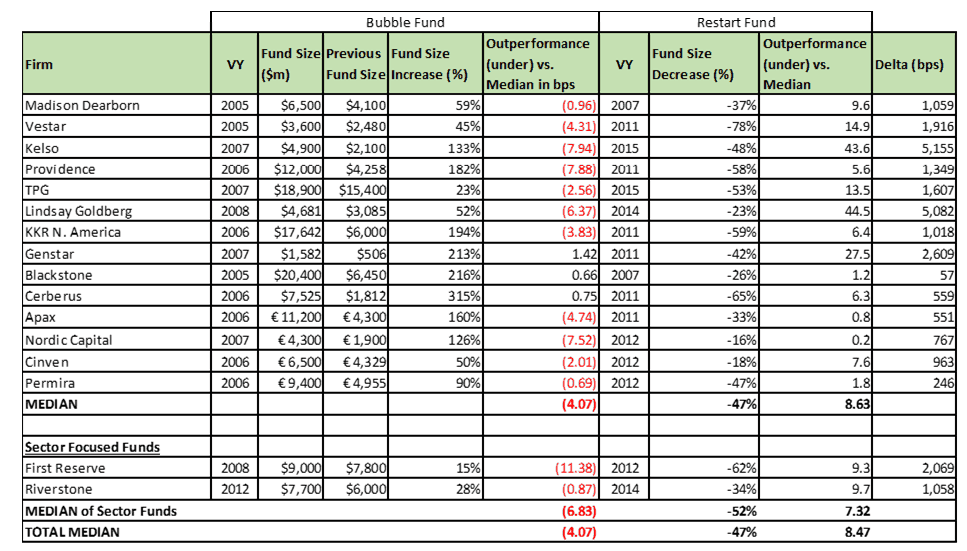
Below is the data set I used to test the hypothesis that outperforming firms who underperform should be avoided. In aggregate, I found 20 firms that fit the criteria of a fund size increase of 20% or more followed by a fund size decrease of 15% or more. At half of these firms, the fund size increase was 100%+ and in 65% of them, the subsequent fund size decrease was greater than 40%. The data only shows detailed information on 16 of the firms, as four had incomplete public information that had to be supplemented with private data. I selected the firms based on the 1,000+ funds I’ve seen in my career. The data set is anecdotal, but it’s a starting point for examining the entire universe. All of the performance data is based on information available on the websites’ of public pension funds. The analysis controls for vintage year bias by comparing the funds outperformance relative to the Cambridge Associates’ benchmark. The challenge in the analysis is the limited data set. First, a fund has to have 1-3 strong performing funds, then a much larger fund, and then a much smaller fund. That typically requires at least 12-15 years. In addition, some firms can’t raise capital after a poor performing fund or choose not to, so it’s impossible to include these firms in the data set. Finally, some funds are sector focused and if the sector experienced a prolonged downturn, that fund likely won’t outperform until sector conditions improve.

The data shows that of the 20 firms with a “restart” fund, 17 raised funds in 2005-2008 that were 35%-671% larger than the previous fund. 17 of the 20 funds, or 85%, underperformed the median benchmark by 69 bps – 2,400 bps. On a median basis, generalist firms underperformed by 407 bps and sector focused funds 683 bps. All 20 funds raised subsequent funds in 2007-2015 that were 16%-78% smaller than the previous fund. The median decrease across all funds was 47%. Of these 20 restart funds, 19 outperformed the median. On a median basis, generalist firms outperformed by 863 bps and sector focused funds by 732 bps. It would be one thing if a few firms outperformed, yet 95% of the restart funds outperformed their median benchmark and 90% did so by more than 500 bps!

Source: Fund data – WSIB, CalPERS, CalPERS, CalSTRS, State Board of Administration of Florida, Colorado PERA, Wikipedia, other public sources; as of 12/31/17 – 9/30/18
Benchmark: Cambridge, as of September 30, 2018; benchmark matched to strategy

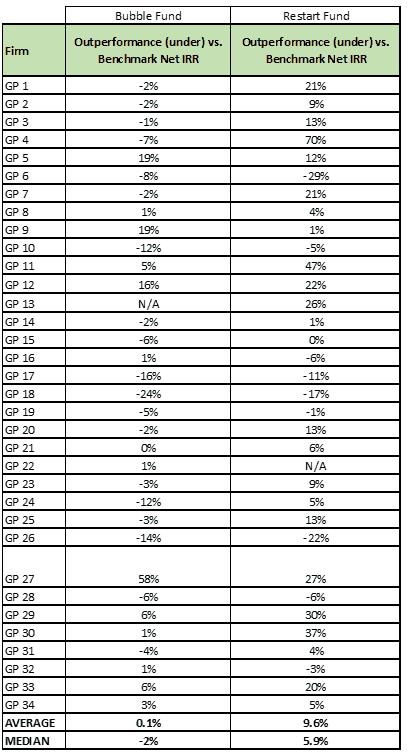
RCP Advisors, a fund-of-funds platform focused on U.S. lower middle market funds, ran a similar analysis among funds in their proprietary database with fund sizes of $2 billion or less. RCP found 34 funds that fit the “restart” fund parameters defined above. Each fund was at least 40% smaller than the previous larger fund. The chart below summarizes their findings. The spread between the median “restart” fund and the previous fund when compared to the median returns of the benchmark was 780 basis points in favor of the restart fund. The spread was even higher when comparing the average returns. While not shown in the chart below, the TVPI data also shows outperformance of restart funds over the previous funds when compared to a benchmark.

Median Fund Size Percent of funds above the CAM US Buyout Median Median Outperformance above CAM US Buyout Median Average Outperformance above CAM US Buyout Median
Previous Larger Fund $475 million 45% -1.9% 0.1%
Restart Fund $178 million 71% 5.9% 9.6%

Source: RCP, as September 30, 2018
Benchmark: Cambridge, as of September 30, 2018; benchmark matched to strategy

Source: RCP, as September 30, 2018
Benchmark: Cambridge, as of September 30, 2018; benchmark matched to strategy

The conclusion here should not be to commit to every “restart” fund and our findings should not be viewed as a recommendation to do so. Every situation is different. Some firms, despite raising a larger fund and underperforming, have no desire to change their behavior. Other firms continue to underperform for a host of reasons: the market has competed away their differentiation, the best investors have left the firm, and/or the market has changed and the firm refuses to adapt. Regardless, the data shows that outperforming funds that become underperformers deserve consideration. Hopefully this information will lead you to engage with a “restart” fund in your portfolio to determine whether making a new commitment makes sense, rather than dismissing it immediately.

Disclaimer: The views and opinions expressed in this article are those of the authors and do not necessarily reflect the official policy or position of Mr. Bradle’s employer, the State Board of Administration of Florida, or Mr. Abell’s employer, RCP Advisors.

Around 750 of the world’s largest listed companies are being encouraged by investors to disclose more workforce data. These companies have this week been sent the ‘Workforce Disclosure Initiative’ (WDI) survey. Supporting this call for data is a group of 127 investor signatories – including AustralianSuper, PGGM, OPTrust and USS – collectively managing $14 trillion.

Many responsible investors have long recognised the lack of standardised and comparable workforce information made available by listed companies across a wide range of metrics.

For example, a 2017 study found that of 6,441 large companies analysed, only 24 per cent of firms disclosed injury rates and just 15 per cent disclosed employee turnover. Investors are increasingly swinging behind the WDI as a platform for companies to disclose key information on how they manage and protect workers in their operations and supply chains.

 The WDI is run by responsible investment charity ShareAction, in partnership with the Responsible Investment Association Australasia (RIAA) and Canada’s SHARE. Funded by the UK’s Department for International Development (DFID), the initiative’s ultimate goal is to ensure better quality jobs in alignment with the UN’s Sustainable Development Goal 8, which calls for decent work for all. The first step is securing better data and there are promising signs in this regard.

Last year, 90 companies provided data in response to the WDI survey. Disclosers included 21 of the biggest 100 companies in the world and represented 16 different countries. These companies employ around 8.3 million people in their global operations and have business relationships with more than 1.5 million supply chain organisations.

The first ever WDI conference, held in early June in London, was a further sign of growing momentum in the drive for better workforce data. Over 100 representatives from companies, investors, governments and civil society came together to discuss why it is crucial for all parties that workforce data improves. To drive home that point, specific topics covered at the conference included gender equality and fair wages for the global workforce.

The message from investors at the conference was clear: they need better data to make sound investment decisions and be informed and engaged shareholders. Other themes provoked interesting and constructive debate. One speaker argued for a shift in mind-set from seeing workers as a cost, to seeing them as an asset which is crucial to the success of the business. Linked to this was the question of whether the interests of investors, companies and workers can ever fully align. Here the mood of the conference was one of hope and determination: yes they can align. But it is not enough to say they can align, instead they must align and delegates should do all in their power to ensure that happens. The benefits of a stable, well-motivated workforce have been clear to many asset owners for some time. After all, companies with high turnover rates, poor health and safety standards and unmotivated staff contain additional risks for the investor seeking to generate stable, long-term returns.

Encouragingly, there is an increasingly strong business case for treating the workforce as an asset and improving policies and practices on a wide range of issues. Research has found that 75 per cent of UK businesses who paid the real Living Wage reported increased motivation and retention from employees. Additionally, if companies work towards being more inclusive and diverse they then benefit from diverse talent.

Finally, there is also growing evidence of financial benefits of engaging on environmental, social and governance (ESG) issues for both companies and investors. The often neglected S of ESG is fundamental to this and – along with other initiatives – the WDI is helping to bring this to the fore.

Corporates nervous of discloure

Despite the growing business case for engaging with workforce issues, there is a sense that many companies still feel nervous about disclosure and are hesitant to be the first among their peers.  However, companies should recognise that, facing more scrutiny from investors, consumers and increasing legislative requirements, they would be better placed to get ahead of the curve.

Earlier this year the Australian Government introduced a Modern Slavery Act. The act requires Australian businesses with revenues over A$100 million to report annually on the risks of modern slavery in their operations and supply chains, as well as the action they have taken to address those risks. There have also being growing legislative requirements about disclosing diversity data globally. For example, since 2017 the UK has required all companies with 250 or more employees to produce a gender pay gap report. Australia has similar reporting requirements.

 As well as its core purpose of generating better workforce data, the WDI aims to continue growing its capacity to facilitate a forward-thinking and open dialogue about vital workforce issues between investors, companies and other stakeholders. It was apt, then, that the conference touched on the question: what would the world be like in 10 years’ time if the largest publicly traded companies undertake robust workforce disclosure?

 There are many things this world would be. It would be much easier to have honest discussions around workforce issues when more and more companies come forward, and current disclosers don’t feel like they’re alone in sharing data. It would be much easier for companies to learn from the best practice of others. It would be much easier for asset owners to have informed engagements with their managers, companies and, ultimately, allocate capital to firms providing better quality jobs.

 There is widespread support for creating a working world with less inequality: one where all workers enjoy decent work, are paid a living wage and work in good conditions. While there is a long way to go to achieve this – and many different organisations need to collaborate to get there – the WDI’s early momentum is promising.

 With that big picture in mind, focus moves to the shorter-term and, specifically October 21 – the deadline for companies to disclose to the 2019 WDI survey. By then it is hoped many more of the world’s flagship companies will have taken a vital step on the road to workforce transparency.

James Coldwell is investor engagement manager for the Workforce Disclosure Initiative at ShareAction in London.

In this third and final article on the EDHECinfra/G20 survey of infrastructure benchmarking practices the role of infrastructure investment benchmarks for the purpose of risk management is discussed. More than 300 respondents took part in the survey, including representatives of 130 asset owners accounting for $10 trillion in assets under management, or more than 10 per cent of global AUM. Most respondents declared needing to change their current benchmarks when it comes to the risk management of their infrastructure investments.

Infrastructure investment as a collection of risk factor exposures

In a portfolio context, risk management aims to control and optimise the amount of risk taken by investors per unit of expected reward (excess return or spread). As such, it focuses on the sources of remunerated risk found in various securities i.e. the factors that explain and predict the price and therefore the returns of these securities.

Priced risk factors are the result of fundamental economic and financial mechanisms but are usually proxied using the characteristics of investments that systematically explain or drive asset values.

For instance, most asset values are impacted by movements in interest rates. But not all assets are equally exposed to interest rate risk, depending on their expected life and payouts. An important aspect of risk management for infrastructure investors then is to understand the underlying risk exposure created by a given infrastructure investment strategy or mandate.

Moreover, as discussed in the second article in this series, the construction of an infrastructure portfolio can be a lengthy and uncertain process and investors’ risk exposures can be expected to evolve significantly overtime.

Infrastructure investors also face evolving risk exposure at the universe level: the underlying investible universe keeps changing as new countries embrace infrastructure privatisation, or others turn their back on certain types of concession contracts or revise existing regulation or subsidies.

This is reminiscent of the sub-optimality issues found in cap-weighted market indices: standard stock indices exhibit both sector and style biases (concentrations) that make them either relatively inefficient or relative unstable in terms of risk exposures.

Moreover, these biases tend to change over time, making standard cap-weighted indices unsuitable as benchmarks since their implicit risk exposures drift in the long-run in a manner that investors cannot control. The solution to this issue is to build benchmarks that have constant sector and geographic weights or, even better, target a constant exposure to certain risk factors.


The absence of infrastructure investment risk management

None of these issues are currently taken into consideration in the risk management process of infrastructure investors.

In the EDHECinfra survey, most investors declared using the same benchmarks for risk management as they do for strategic asset allocation and performance monitoring.

That is, nearly 70 per cent of investors in unlisted infrastructure continue to use absolute-return benchmarks for the purpose of risk management i.e. benchmarks that do not represent risks.

This suggests that the infrastructure portfolio risk management function is very limited amongst these investors.

Unsurprisingly, only 10 per cent of respondents said that their choice of benchmark is adequate for risk-management purposes.

Among the vast majority of respondents there is a consensus that current practices present a number of challenges.

More than 50 per cent of respondents are concerned that their choice of benchmark do not allow for measurement of diversification indicators such as effective number of factors/constituents.

Half worry that these benchmarks do not measure exposure to traditional risk factors such as size and momentum, which are likely to be found in multiple asset classes involving equity investment.

Likewise, around 40 per cent of equity investors said that current benchmarks do not allow for stress testing or default risk mapping, nor do they measure contributions to asset-liability-management (ALM) objectives.


Investors in infrastructure will benefit from understanding underlying risk factor exposures

As also discussed earlier, for infrastructure investors the choice of strategic benchmark effectively embodies two challenges: 1) the creation of the portfolio to which the benchmark refers, which is a lengthy and potentially costly endeavor, and 2) for this portfolio to also out-perform the benchmark.

Hence, from a risk management perspective, it is not enough for investors in infrastructure to simply know that they added another bridge or another airport to their portfolio. They need to know which risk factors they are becoming exposed to through each new investment.

A decomposition of risk exposures by individual factors would create more control in the way an infrastructure portfolio is built over time (since factor exposures are present in all investments) and also would also allow optimising the portfolio in order to achieve the desired risk exposure determined at the strategic level.

Moreover, to the extent that risk factors are found within multiple asset classes, investors’ total portfolio risk is also partly determined by the dependencies between assets classes created by common risk factor exposures.

For instance, interest rate or credit risk can be expected to be present in multiple asset classes like fixed income and also infrastructure, including infrastructure equity, since leverage is typically high in infrastructure companies and repayment period very long. As a result, the current value of any stream of future dividends to unlisted infrastructure equity investors is partly driven by the movement of interest rates (discount rates) and the possibility of being “wiped out” by a default.

Eventually, understanding how each asset-class component of the portfolio loads on various cross-asset-class risk factors is the key to a successful the risk-measurement and management process.

Because investments in infrastructure are illiquid, they are not easily or rapidly changed and optimizing the portfolio is more easily done though more liquid asset classes. Hence, if the infrastructure portfolio creates a certain exposure to interest rate risk, along with, say, bonds, because the former is the most illiquid, an investor owning both types of assets can optimize their total exposure to interest rate risk by buying or selling bonds, while taking the interest rate risk exposure of the infrastructure part of the portfolio into account.

While such approaches are not common in the unlisted asset space, recent evolutions and the need to better measure the sources of performance are becoming increasingly apparent amongst investors and regulators. This requires a robust statistical model of expected returns to be calibrated using observable and predictable inputs.

For instance, the technology developed by EDHECinfra to value unlisted infrastructure assets is based on a multifactor model of expected returns that allows measuring over time the impact of various priced risk factors such as interest rate risk, size (illiquidity), credit risk, investment (capex intensity), etc.

In due course, it will become possible to approach the risk management of unlisted infrastructure as a series of choice to gain exposure to a combination of risk factors. This evolution will occur as better benchmarks that represent the risks taken by investors gradually become used for strategic asset allocation and performance monitoring, as the respondents of the 2019 EDHEC/G20 Survey have strongly suggested in their responses.

The other two stories in this three part series are

Infra risks misunderstood

Infra performance benchmarks wanting


As the investment industry continues to experience accelerating change and disruption, what will the effect be on investment roles and required skills? What do investment professionals need to do to stay relevant, and how will organizational cultures need to adapt to attract the best talent?

These questions motivated the recently released CFA Institute report Investment Professional of the Future, which looks out over the next 5-10 years and incorporates input from more than 4,000 individuals globally—a combination of industry-leader survey respondents (more than 130), CFA Institute member and candidate survey respondents (3,800+), and 100-plus participants in a series of qualitative roundtables around the world.

This article is the first in a series and will provide an overview of our findings; articles will follow outlining roadmaps for investment professionals and organizations.

Size and growth of the market for investment professionals

In order to understand the availability of talent in different markets, now and in the future, CFA Institute commissioned Mercer to determine the market size and growth of core investment professionals, defined as those who are influential in managing investment strategy and portfolio construction, including portfolio managers, analysts, and private wealth managers, among others. This resulted in an estimate of 1.05 million core investment professionals, a number that is expected to grow to 1.2 million over the next 10 years, a compound annual growth rate (CAGR) of 1.5 per cent.

This anticipated growth rate was consistent with our industry-leader survey results. Market growth regionally is expected to vary from a CAGR of 2 per cent in Asia, to 1.4 per cent in EMEA, and 1 per cent in the Americas. India and China are expected to grow faster than the average, at 2.9 per cent and 2.3 per cent, respectively.

Changing roles and skills

Changes affecting the world of work in the next 5-10 years are expected to be significant, constant, and intensifying:

  • 48 per cent of CFA Institute members and candidates surveyed anticipate that their current role will change significantly or become non existent in the next 5-10 years. This is the case for 58 per cent of financial advisers and 57 per cent of risk analysts.
  • Meanwhile, 89 per cent of industry leaders believe that investment roles will transform multiple times during an investment professional’s career, making adaptability and life-long learning essential skills for future success.
  • 77 per cent of industry leaders expect greater change to the world of work, including roles, skills, work methods, workplace features, compensation, and incentives.

The amount and extent of role transformation will require individuals to actively manage their skill progression, and firms will need to partner with their employees on professional development to ensure they maintain an appropriately trained staff. Among industry leaders surveyed, 61 per cent expect that investment firms’ commitment to training and development will increase. Regionally, this is higher in Asia Pacific and EMEA (71 per cent) versus the Americas (46 per cent).

Most important skills

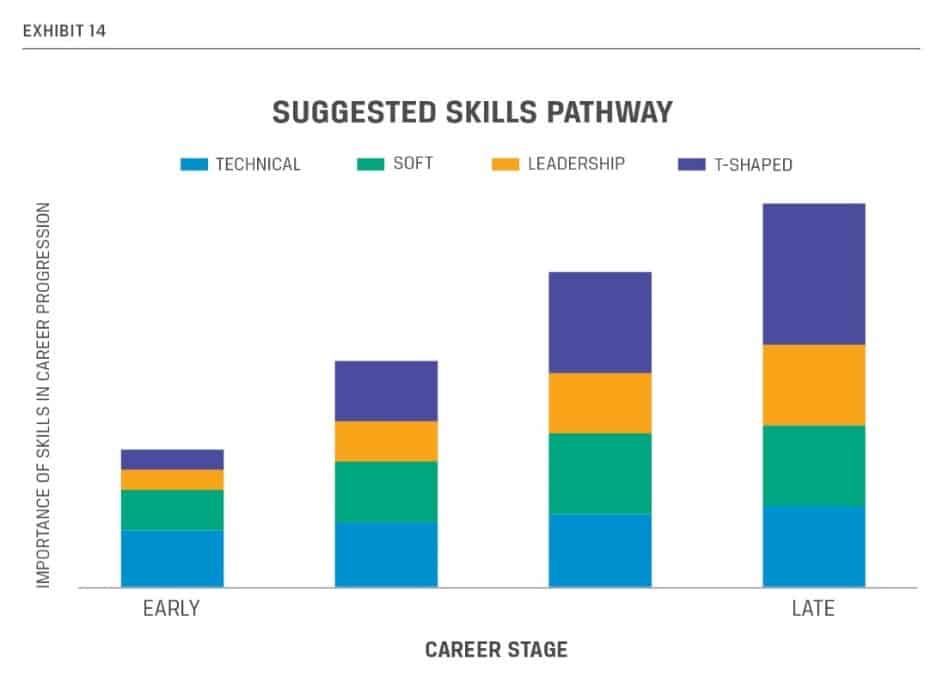
The Investment Professional of the Future describes four categories of skills that investment professionals need to develop over time to gain the experience and abilities needed for advancement.

  • Technical skills are those we most often focus on through structured programs. While clearly essential to build competence, it is the category the least number of industry leaders (14 per cent) rank first in future importance. Of these, solution skills are deemed the most important, namely the ability to understand client needs and develop appropriate investment portfolios.
  • Soft skills are most important to 16 per cent of industry leaders. Despite this relatively low number, soft skills are the most difficult skills to find in the industry, according to industry leaders. These include: communication, presentation, and relationship building skills, but also creativity and innovation skills, which topped the list of skills missing in the current landscape. Among the members and candidates surveyed, soft skills are the most common skills under development, which makes sense given their relevance across specialties.
  • Leadership skills are ranked slightly higher at 21 per cent, and among these the ability to articulate a mission and vision ranks as the most important. Others include instilling an ethical culture, governance, and crisis management.
  • T-shaped skills are considered the most important for the future by 49 per cent of industry leaders. These skills combine deep subject matter expertise (represented by the vertical bar of the letter T), and a wider knowledge of other disciplines or areas in the financial ecosystem (represented by the horizontal bar of the letter T). Examples include situational fluency and adaptability, understanding and leveraging diverse perspectives, and cultivating a valuable network of contacts. As fintech becomes more important, T-shaped teams can bring together economic intuition and technology expertise.

The mix of relevant skills changes over one’s career. In the skills pathway, technical skills are the most important on a relative basis at the beginning of one’s career, and the value of the other skills increases over time, with emphasis on leadership and T-shaped skills in the latter part of one’s career.

Next steps

For investment professionals, active professional development is needed for career adaptability. Individuals must develop a growth mindset and put energy into actively managing their careers and skill pathways. Life-long learning is crucial to stay relevant and valuable.

The good news is that investment professionals like to learn. On the job, they spend about 30 per cent of their time learning new things versus doing familiar work. In terms of aspects of an employer that are most important to them, the opportunity for personal growth exceeds all others by a large margin, and learning new things is one of the biggest motivators for investment professionals, even more than financial compensation.

Meanwhile, there is an important role for leaders of investment firms to play. Employers committed to training and professionalism will have an edge as firm culture becomes a differentiator to attract top talent. Leaders will need to guide their firms through substantial changes in how work gets done, and in particular, they will need to communicate how technology will change their business and impact individual roles—both disrupting and enhancing career paths.

We will outline the roadmap for investment professionals in our next article and then the roadmap for investment organizations.

Rebecca Fender is head of the future of finance initiative, and Bob Stammers is the director of investor engagement at the CFA Institute. They are both members of the future of finance team.